Introduction
Fashion brands today face mounting content demands that traditional photoshoots can't sustainably meet. E-commerce requires 5-8 images per SKU minimum, social channels demand constant fresh visuals, and ad platforms favour brands that test multiple creatives.
Meanwhile, photographer business costs rose 6-10% in 2024 alone. The traditional model — booking models, renting studios, coordinating crews — grows more expensive with every new SKU added.
SaaS photography platforms change that equation directly: production bottlenecks disappear, per-image costs drop dramatically, and time-to-publish shrinks from weeks to days. This article breaks down the concrete, measurable advantages these platforms deliver for fashion brands — what actually changes in practice, with numbers to back it up.
Key Takeaways
- SaaS photography platforms convert product packshots into on-model imagery — no studio, no models, no shoot required
- Brands cut image production costs from £60–120 per image to under £5, eliminating model fees, studio rental, and post-production
- Content scales across entire catalogs without scheduling constraints or quality inconsistencies
- Built-in diverse AI model libraries enable inclusive visuals without recurring casting costs
- Result: quicker launch timelines, lower overhead, and brand-consistent imagery ready for e-commerce, social, and ads
What Is a SaaS Photography Platform for Fashion Brands?
A SaaS photography platform is a subscription-based, cloud-hosted tool that generates professional product imagery — including on-model visuals — without running a physical photoshoot. It sits between product sourcing and content publishing, replacing the traditional pipeline of booking models, hiring studios, coordinating stylists, and waiting on post-production turnarounds.
Platforms like MetaModels.ai convert packshots into AI-model imagery with real-time fabric draping, producing ready-to-post content at up to 4K resolution. The technology analyzes garment characteristics — colour, shape, texture, print, proportions — and drapes the fabric onto AI-generated models, preserving authenticity rather than overlaying flat images.
For fashion brands, this is an operational infrastructure decision — a way to produce consistent, high-quality visual content at the speed and volume modern retail demands. Every output undergoes human fashion specialist review to verify colour accuracy, garment shape, proportions, and fit before delivery.
Key Advantages of SaaS Photography Platforms for Fashion Brands
The advantages below are anchored in operational and financial outcomes — the metrics fashion brands and e-commerce teams are directly accountable for: cost-per-image, time-to-publish, catalog coverage, and return rate. These advantages compound over time. The more consistently the platform is used across a product catalog, the greater the efficiency and quality gains.
Advantage 1: Dramatic Reduction in Image Production Costs
Traditional on-model fashion photography involves multiple cost layers that either disappear or substantially reduce with a SaaS photography platform.
The Traditional Photography Invoice:
A traditional photoshoot day runs £4,000 to £20,000 when everything is counted honestly. Agency models charge £650-1,200 per day plus 20% booking fees. Photographers charge £800-2,400 per day. Studio rentals add another £500-1,200. Retouching costs £16-65 per image, which for a 100-SKU shoot means £10,000 in post-production alone.
The hidden costs are where budgets truly bleed. Coordination time, reshoot contingencies, model cancellations, licensing disputes, and shipping logistics are rarely line items — they're budget overruns. A £33 per-image quote often becomes £70 when retouching, studio rental, shipping, and coordination are factored in.
SaaS Photography Economics:
SaaS platforms replace this fragmented cost structure with predictable subscription pricing. MetaModels.ai, for instance, offers plans from £16/month for 20 image credits (£0.80 per image) to £220/month for 300 image credits (£0.73 per image), with per-image pricing from £0.80. The marginal cost of each additional image approaches zero once subscribed.
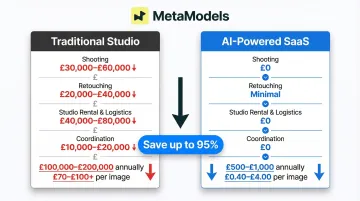
Cost Comparison: Traditional Studio vs. AI-Powered SaaS (500 SKUs Annually)
| Cost Category | Traditional Studio | AI-Powered SaaS |
|---|---|---|
| Shooting/Generation | £40,000 (25 shoot days) | Included in subscription |
| Retouching | £24,000-40,000 | £0 (built-in editor) |
| Studio Rental & Logistics | £23,000 | £0 |
| Coordination Time | £10,000 | Minimal |
| Realistic Annual Total | £100,000-200,000 | £500-1,000 |
| Effective Cost per Image | £70-100+ | £0.40-4.00 |
Cost Impact on Brand Operations:
For high-volume SKU catalogs — where each product needs multiple angles, model variations, and format sizes — the cost difference is substantial. Fixed SaaS pricing lets marketing and operations teams plan content budgets with greater confidence, eliminating surprise overruns from reshoots, model cancellations, or licensing disputes.
Reducing cost per SKU directly affects gross margin, allowing brands to reinvest savings into product development or improve profitability without cutting content output.
KPIs Impacted:
- Cost-per-image
- Total content production budget
- Gross margin
- Time-to-publish
- Volume of content produced per budget cycle
When This Advantage Matters Most:
This advantage delivers highest impact for brands with large seasonal catalogs, fast fashion turnaround cycles, or limited production budgets — particularly when scaling to new markets or launching multiple collections simultaneously.
Advantage 2: Scalable Content Production Without Quality Compromise
SaaS photography platforms allow brands to produce on-model imagery for entire product catalogs — dozens or hundreds of SKUs — without the scheduling constraints, physical logistics, or quality inconsistencies of traditional photoshoots.
How the Platform Creates This Advantage:
By using automated processing with manual editing options, standardised model setups, and consistent lighting parameters built into the system, every image produced maintains visual coherence across the catalog — regardless of volume or speed. MetaModels.ai combines fully automated processing with human fashion specialist review, ensuring garment details like shoulder fit, lapel detail, and trouser breaks are accurate before delivery.
Why Consistency Drives Revenue:
Brand consistency across product imagery is directly tied to customer trust and conversion rates. According to Baymard Institute, 56% of online shoppers' first action on a product page is to explore product images, before reading titles or descriptions. When product imagery is low-quality or inconsistent, the financial impact is immediate: one in three shoppers abandon a purchase due to low-quality or missing images.
High-quality images drive measurable revenue. When ASOS increased its product image count from six to twelve per SKU in 2024, the fashion retailer's mobile conversion rate jumped 18% within 90 days, generating an estimated £38 million in additional quarterly revenue.
The Speed Advantage:
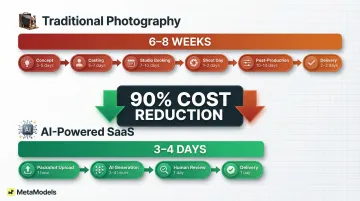
Traditional fashion photography requires six to eight weeks from concept to delivery. By adopting generative AI and digital twins, European fashion e-tailer Zalando cut this timeline to around three to four days, and reduced costs by 90%. This allowed Zalando to conceptualise, produce, and launch responsive campaign imagery in under 24 hours, capturing fleeting social media micro-trends that competitors with traditional workflows missed entirely.
Consistency also delivers internal operational benefits:
- Fewer revision rounds due to standardised outputs
- Faster approvals with predictable visual quality
- Reduced dependency on individual photographer or editor judgement
KPIs Impacted:
- Time-to-publish
- Catalog coverage rate
- Image consistency score
- Revision cycles
- Content output per week
When This Advantage Matters Most:
This advantage peaks during high-volume catalog launches, seasonal refreshes, or when a brand is expanding to new channels (e.g., adding a marketplace like Amazon or Zalando) that require consistent image formats at scale.
Advantage 3: Inclusive, Diverse Imagery Without Casting Complexity
SaaS photography platforms with curated AI model libraries allow brands to represent a wide range of body types, skin tones, ages, and demographics across their product imagery — without the logistical, financial, and scheduling overhead of running multiple casting rounds.
How the Platform Creates This Advantage:
By providing access to a diverse library of AI models (and in some cases, custom model creation), brands can assign different model profiles to the same product and generate a range of on-model shots in one workflow pass — something that would require separate shoot days with traditional photography. MetaModels.ai enables customisation for ethnicity, body type, age range, and styling to match brand identity requirements, all without booking fees for the second or third variation.
Why Representation Converts:
Shoppers are more likely to purchase when they see themselves represented in product imagery. A study by Dr. Ben Barry found that women increased purchase intentions by more than 200% when models matched their size — rising to 300% among women over size 6. Black consumers were 1.5 times more likely to purchase a product advertised by a black model.
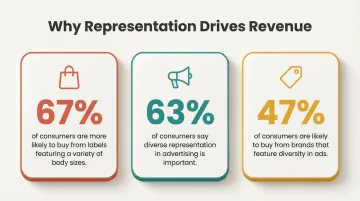
The commercial case for diversity is reinforced by broader consumer data:
- 67% of consumers are more likely to buy from labels featuring a variety of body sizes in marketing
- 63% say diverse representation in advertising is important to them
- 47% are likely to buy from brands that include diversity in their ads
The "Diversity Tax" of Traditional Casting:
While the ROI of diversity is clear, executing it via traditional photoshoots introduces severe logistical and financial hurdles. Running three or four different model options for a catalog — different body types, skin tones, heights — multiplies model fees, shoot time, and post-production. Brands that are serious about inclusive representation on their product pages are effectively running 3x the photography budget just to cover model diversity.
SaaS photography platforms eliminate this barrier. Brands can generate the same product on multiple AI models — different body types, skin tones, heights — for the same per-image cost, with no model booking fee for variations.
Risk Reduction Benefit:
Relying on a diverse AI model library removes the dependency on casting availability, reduces potential casting-related disputes, and ensures the brand can maintain representative imagery without campaign delays.
KPIs Impacted:
- Conversion rate by audience segment
- Customer satisfaction scores
- Brand equity indicators
- Reduction in casting-related delays or costs
When This Advantage Matters Most:
This is highest-impact for brands operating in international markets (where representation expectations vary by region), brands launching size-inclusive or adaptive clothing lines, and brands whose customer base is demographically diverse.
What Happens When Fashion Brands Skip SaaS Photography Solutions
Brands relying on traditional photoshoots face significant content production backlogs — particularly during seasonal catalog launches — because scheduling, logistics, and post-production cannot keep pace with the volume of SKUs that need imagery. A mid-size brand with 500 SKUs requires approximately 11,000 images annually to cover base needs, seasonal refreshes, colour variants, and platform-specific crops. At enterprise scale, brands with 2,000+ products need roughly 42,000 images per year.
Customer Experience Impact
Inconsistent imagery quality and model representation across a catalog directly affects conversion rates. Products that go live with low-quality or mismatched visuals underperform, often leading to higher return rates and lower average order values. When shoppers can't evaluate fit and quality from product images, they skip the purchase or buy and return. Online return rates reached 16.9% of total retail sales in 2024, with apparel return rates between 16–25% — more than double in-store levels.
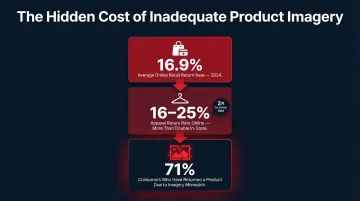
71% of consumers have returned products because the item didn't match what the images showed — a direct consequence of inadequate visual content.
Cost Escalation Over Time
Without a scalable content infrastructure, brands either increase headcount to manage production manually, pay premium rates for rushed photoshoots, or go to market with incomplete imagery — all of which erode margins and slow growth. Weak product content compounds the problem: 53% of shoppers abandon an online sale due to incomplete or poorly written product titles or descriptions.
Competitive Positioning Risk
Fashion marketing is shifting from a game of production quality to a game of cultural timing and relevance. Brands that can't produce diverse, high-quality imagery at scale fall behind. Competitors using AI and SaaS tools already publish faster and represent broader customer bases — and the gap is widening.
How to Get the Most Value from a SaaS Photography Platform
SaaS photography platforms work best when integrated early in the product launch timeline — not treated as a post-production fix. Brands that feed packshots into the platform as products are finalised (rather than waiting until launch week) gain the most turnaround benefit.
Value compounds when the platform is used consistently across all SKUs and channels. Mixing SaaS-generated imagery with ad hoc traditional photography introduces inconsistencies that undermine quality and brand cohesion. MetaModels.ai supports this through human-reviewed AI images and end-to-end production management — keeping visual standards consistent at scale.
Consistency alone isn't enough — measurement closes the loop. Track these KPIs to validate impact and identify where AI model imagery performs strongest:
- Cost-per-image across product categories
- Time-to-publish compared to traditional shoot timelines
- Conversion rate by content type to pinpoint what drives purchases
This tells you which SKUs benefit most from AI model imagery and gives you concrete numbers to justify the investment internally.
Conclusion
The core value of a SaaS photography platform for fashion brands lies in control, predictability, and scale. It replaces a fragmented, cost-heavy production process with a consistent, measurable workflow that can grow with the brand.
Cost reduction, scalable production, and inclusive imagery reinforce each other — and their impact grows as the platform is applied across more of the catalog. In practice, that looks like:
- Reducing cost-per-image from £70 to under £5, freeing budget for product development
- Cutting time-to-publish from six weeks to four days, capturing trend windows competitors miss
- Representing diverse body types without tripling production costs, building trust with broader customer segments
Adoption is a strategic infrastructure decision, not a one-off experiment. Brands that treat SaaS photography as an ongoing production standard (rather than a tactical fix) are the ones that compound these gains — lower costs, faster launches, and visual content that reflects the customers they're actually selling to.
Frequently Asked Questions
What are the benefits of fashion photography for e-commerce brands?
Strong fashion photography builds customer trust, reduces purchase hesitation, and directly impacts conversion rates. Shoppers rely on product imagery to assess fit, texture, and styling before buying online, making visuals the primary driver of first impressions and purchase decisions.
What are the benefits of AR in fashion?
AR in fashion enables virtual try-on experiences that help customers visualise how garments will look or fit on them, reducing return rates and boosting confidence in purchase decisions. According to Bold Metrics, AI and machine learning sizing technologies have helped apparel brands boost average conversion by 20% while reducing return rates by 32%.
What is a SaaS photography platform for fashion brands?
A SaaS photography platform is a cloud-based subscription tool that lets fashion brands generate professional product imagery — including on-model visuals — without physical photoshoots. These platforms typically use AI to convert packshots into styled model images, maintaining garment accuracy through automated processing and human quality review.
How do SaaS photography platforms reduce fashion content production costs?
By eliminating the need for model booking, studio rental, crew, and royalties, these platforms replace variable per-shoot costs with a predictable subscription fee. This lowers the cost-per-image, especially at high catalog volumes where the per-image cost drops close to zero as volume increases.
Can a SaaS photography platform replace traditional model photoshoots entirely?
For many e-commerce and catalog use cases, yes — particularly for high-volume SKU imagery where consistency and speed are priorities. Some brands may retain traditional shoots for flagship campaign imagery while using SaaS platforms for the bulk of their product catalog.
How does AI-generated model imagery support diversity and inclusivity in fashion?
AI model libraries can include a wide range of body types, skin tones, and demographics — allowing brands to produce inclusive, representative imagery without the casting constraints of traditional photoshoots. This means diverse representation no longer requires a larger budget or a more complex production process.