Introduction
D2C fashion brands face an escalating content crisis: Google Ads CPC for apparel averages $3.39 and climbs 10% annually, while Meta CPM surged to $14.19 in 2025—a 20% year-over-year jump. Meanwhile, apparel gross margins hover around 60-70%, leaving thin room for error when paid media costs consume larger budget shares each quarter. The pressure to publish high-quality model imagery across every channel—product pages, Instagram ads, marketplace listings, lookbooks—grows with every new SKU and seasonal drop, yet traditional photoshoot budgets can't keep pace.
The practical question for D2C operators isn't whether AI model photos look good — it's whether they move the needle on metrics that matter: conversion rates, return rates, cost per image, and time-to-market. What follows breaks down the measurable ROI advantages, the risks of ignoring this production shift, and how to deploy it systematically across your catalog.
Key Takeaways
- AI fashion model photos use real-time fabric draping to convert packshots into publication-ready imagery without physical shoots
- Brands cut per-image costs from $50-$200 to under $2, compress 2-4 week timelines to minutes, and eliminate model booking/studio rental entirely
- On-model imagery drives higher add-to-cart rates and lower return rates—76% of shoppers cite on-model photos as most useful for purchase decisions
- Competitors already using AI are publishing more creatives, testing faster, and converting better — the risk is waiting
- Human review checkpoints and diverse model libraries separate AI imagery that builds trust from AI imagery that undermines it
What Are AI Fashion Model Photos?
AI fashion model photos are studio-quality images generated by AI systems that show garments worn by virtual models—produced from packshots, flat-lays, or existing product photos without booking a single person or studio. The technology drapes actual garment fabric onto AI-generated models in real-time, preserving color accuracy, texture, print detail, and proportions, then delivers ready-to-publish imagery in up to 4K resolution.
D2C brands apply this technology across every channel that demands on-model content:
- Product detail pages and marketplace listings (Amazon, Flipkart)
- Instagram, Facebook, and paid ad creatives
- Email campaigns and seasonal lookbooks
- WhatsApp commerce catalogs
This is a production infrastructure decision, not a creative experiment. The result is faster content cycles, lower cost-per-image on paid ads, higher product page conversion rates, and full SKU catalog coverage without linear cost increases.
Key Advantages of AI Fashion Model Photos for D2C Brands
The three advantages below directly impact KPIs D2C operators track weekly: cost per asset, conversion rate, return rate, content velocity, and paid media ROAS. Each compounds faster when applied across your full catalog — not just a handful of hero SKUs.
Advantage 1: Eliminating the True Cost of Traditional Model Photography
Traditional photoshoots carry compounding costs far beyond the photographer's day rate. A single shoot day pulls from every direction:
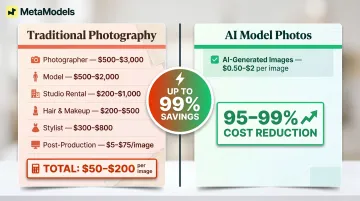
- Photographer: $500–$3,000/day
- Model booking: $500–$2,000
- Studio rental: $200–$1,000/day (up to $3,000 in NYC or LA)
- Hair and makeup: $200–$500
- Fashion stylist: $300–$800
- Post-production editing: $5–$75/image
The all-in per-outfit cost lands between $130–$830, with full-day sessions reaching $2,500–$8,000 once crew and coordination are factored in.
AI fashion model photo tools collapse this entire cost stack. Brands upload a packshot or flat-lay, select from a curated model library (or build a custom model matching brand identity), and receive ready-to-publish imagery—eliminating every third-party vendor cost. The per-image cost drops to $0.50–$2, representing a 95–99% reduction compared to traditional on-model photography at $50–$200 per image.
Why this is an advantage:
- A D2C brand running 4–6 seasonal collections annually can reinvest freed budget into paid media spend, faster SKU launches, or creative testing that improves ROAS
- AI removes unpredictable cost variables like model no-shows, reshoots (which affect 15–20% of traditional shoots and add $500–$2,000+ in costs), and rush editing fees
- Subscription-based pricing starting from $0.24/image delivers a predictable cost structure — essential for tight D2C budget planning
KPIs impacted:
- Cost per creative asset
- Annual photography budget as percentage of revenue
- Time-to-market for new SKU launches
- Internal team hours spent on shoot coordination
When this advantage matters most:
This advantage compounds for brands managing catalogs of 50+ SKUs, launching multiple collections yearly, or operating in high-SKU-turnover categories (fast fashion, seasonal apparel) where traditional photography can't match product volume velocity.
Advantage 2: Higher Conversion Rates and Lower Return Rates Through Better Visual Confidence
The gap between what shoppers imagine and what they actually receive drives both abandoned carts and post-purchase returns in fashion e-commerce. AI fashion model photos show garments on human-like figures with realistic fabric draping — not flat-lays or mannequins — giving shoppers immediate confidence in fit, proportions, and real-world context. Purchase decisions happen faster and with fewer regrets.
Why this is an advantage:
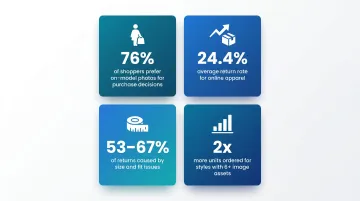
- 76% of shoppers state on-model photos are the most useful format for making buying decisions, according to a Stylitics survey of 411 shoppers
- Average return rates for online apparel hit 24.4% — 7.9 percentage points above the all-category average — with 53–67% of returns attributed to size and fit issues
- Processing a return costs approximately 66% of the original product price, and brands with zero returns estimate their bottom line would improve by at least 20%
- Styles featuring 6+ image assets result in 2x more units ordered compared to styles with fewer assets, demonstrating that richer product visualization directly drives revenue
When customers receive what they expected, they repurchase at higher rates, leave positive reviews, and don't initiate returns—all of which reduce operational drag and increase net margin per order.
KPIs impacted:
- Product page conversion rate
- Add-to-cart rate
- Return rate
- Post-purchase review sentiment
- Repeat purchase rate
When this advantage matters most:
Brands selling fit-sensitive categories (dresses, tailored pieces, fitted tops), brands with return rates above 20%, or brands running paid traffic to product pages where every percentage point of conversion rate swing has direct paid media ROI impact.
Advantage 3: Scaling Content Production with Inclusive, On-Brand Model Representation
Two problems compound quietly for most fashion brands: insufficient visual content to cover the full SKU catalog at launch speed, and the revenue left on the table by not representing the full range of your target customers.
MetaModels.ai addresses both through a curated library of AI models spanning diverse ethnicities, body types, ages, and demographics — plus custom model creation matched to brand identity. Brands produce inclusive, on-brand imagery for every SKU without any additional cost per model or shoot. Representation at this scale directly converts into revenue: shoppers who see themselves in product imagery buy with more confidence.
Why this is an advantage:
- Nielsen Norman Group usability research found shoppers report feeling "more confident in their purchasing decisions" when seeing models of different sizes, ages, and races wearing products
- Creative fatigue on Meta sets in every 2–4 weeks; brands testing fewer than 5 new creatives monthly see 15% month-over-month CPA increases
- The difference between your best and worst-performing creative can swing ROAS by 5–8x, making creative velocity and testing capacity essential to growth
- AI model photos scale on-demand with every new collection without traditional bottlenecks of scheduling and budget approval, giving brands a content production advantage that widens with every catalog expansion
KPIs impacted:
- Creative output volume per quarter
- Paid media ROAS
- CPA on prospecting campaigns
- Catalog coverage rate (percentage of SKUs with on-model imagery)
- Audience reach across underserved customer segments
When this advantage matters most:
Brands spending meaningfully on paid social (where creative fatigue is constant), brands expanding into new demographic markets, and brands whose catalogs have large coverage gaps—many SKUs with no on-model imagery due to shoot cost constraints.
What Happens When AI Fashion Model Photos Are Ignored
Brands relying exclusively on traditional photography face a widening content gap. AI-equipped competitors publish faster, test more ad creatives, and cover more catalog with on-model imagery. The slower brand quietly loses ground on organic search, paid media efficiency, and on-site conversion — no algorithm update required.
The compounding consequences:
- Photographer rates, model fees, and studio costs rise every year while AI-generated alternatives hold steady or decrease in per-image cost
- Paid media campaigns run on untested imagery, and you never discover which visual presentation actually converts
- Many SKUs ship without on-model photography, leaving product pages converting at flat-lay rates while on-model competitors outrank you in the same search results
- Customers keep guessing about fit and context — returns can represent 10–20% of total revenue, eroding net margin at scale
How to Get the Most ROI from AI Fashion Model Photos
AI fashion model photos deliver full ROI only when applied systematically and measured consistently—not deployed for a handful of hero SKUs while the rest of your catalog stays on flat-lay imagery. ROI compounds when three conditions are met:
Start with priority SKUs, but plan for full catalog coverage. High-traffic and high-margin products come first, but partial coverage means partial conversion gains. Brands that capture the full advantage treat AI model photography as standard production infrastructure—every SKU, every collection, every channel.
Build creative testing into the workflow from day one. The cost savings and faster content output create room for structured A/B tests on model type, pose, background, and product context. Treat the image as a performance variable, not just a branding asset. With creative fatigue setting in every 2–4 weeks on paid social, this cadence directly protects ad performance and lowers CPCs over time.
Keep human review in the process. AI-generated garment imagery should pass through quality checkpoints before publishing—verifying fabric draping, color accuracy, and garment details. MetaModels.ai's human-verified approach handles this by having fashion specialists review every image for garment accuracy before delivery, so brand trust doesn't erode at volume.
Conclusion
The ROI case for AI fashion model photos rests on three compounding advantages:
- Cost structure transformation — 95-99% cost reduction per image compared to traditional shoots
- Conversion and return rate improvement — driven by better visual confidence at the point of purchase
- Scalable inclusive content production — enabling the creative testing velocity that directly improves ROAS
Each advantage reinforces the others. Applied consistently across your full catalog, they compound rather than plateau.
Brands treating AI model photography as a one-time test — or limiting it to hero products — capture only a fraction of the available ROI. The brands that pull ahead build it into standard production workflows for every SKU, every collection, and every channel. That's when the math gets interesting: lower cost-per-image, higher conversion rates, and faster creative cycles all improving simultaneously.
Frequently Asked Questions
How much does AI fashion model photography cost compared to a traditional photoshoot?
Traditional photoshoots cost $50-$200 per on-model product image (with full-day sessions running $2,500-$8,000), while AI-generated model photos cost $0.50-$2 per image—a 95-99% reduction. D2C brands typically see annual photography budget savings of 80-90% when transitioning to AI-based production infrastructure.
Can AI fashion model photos accurately show how a garment actually fits and drapes?
Real-time fabric draping technology preserves garment color, shape, texture, and proportions, with human review checkpoints verifying accuracy before delivery. Structured pieces, knitwear, activewear, and casual apparel achieve highest accuracy; complex embellishments or highly reflective fabrics may benefit from supplemental traditional photography.
Do AI-generated model images actually improve conversion rates on product pages?
Yes—76% of shoppers cite on-model photos as most useful for purchase decisions, and styles with 6+ image assets generate 2x more units ordered. On-model imagery directly reduces cart abandonment and increases add-to-cart rates compared to flat-lay-only product pages.
How long does it take to convert product packshots into finished AI model photos?
AI platforms generate finished, publication-ready images in seconds to minutes after upload, compared to traditional photoshoot cycles of 2-4 weeks from scheduling to published imagery. This lets brands launch new SKUs faster and respond to trends as they emerge.
Are AI fashion model images accepted on major sales channels like Amazon, Shopify, and Instagram?
AI-generated images are generally accepted on major platforms when they accurately represent the actual product. Amazon requires main images to meet specific technical requirements (white background, 85% image frame fill), while Meta platforms label photorealistic AI content with "Imagined with AI" tags. Always verify current platform-specific policies before deploying at scale.
What types of garments or SKUs are best suited for AI fashion model photo generation?
Strongest use cases include solid apparel, structured pieces, knitwear, activewear, and fit-sensitive categories like dresses and tailored items. High-return categories—pants, shirts, blouses—benefit most, as on-model visualization sets accurate fit expectations and reduces post-purchase disappointment.