](https://file-host.link/website/metamodels-jdwky2/assets/blog-images/b0842760-cb79-4353-8b12-8276fb6baf3b/1777633397461283_4d52d3813c0b4a5f808ce58667114351/360.webp)
Introduction
Traditional fashion photoshoots are expensive, slow, and hard to scale. AI model generation platforms now handle what once required booking models, renting studios, and managing full production crews. But not every tool delivers the same quality, flexibility, or pricing transparency — and the gap between what's promised and what's produced can be significant: inconsistent rendering on complex garments, limited pose control, and opaque pricing that breaks down at scale.
Botika is a well-known entry point for AI fashion model generation, particularly for B2B catalog work. Growing brands are increasingly looking beyond it, though. Common friction points include:
- Credit-based pricing that becomes expensive as SKU counts grow
- Limited control over pose and model customization
- Inconsistent output on layered outfits and detailed prints
- No custom model creation to match brand identity
This guide compares the best Botika alternatives based on model quality, customization depth, garment fidelity, and pricing—helping fashion brands and e-commerce teams find the right fit for their workflow.
Key Takeaways
- Botika converts packshots to model images but lacks pose control, custom brand models, and transparent pricing
- Top alternatives: MetaModels.ai, WearView, Veeton, Uwear.ai, and Picjam
- Evaluate alternatives on model diversity, garment accuracy, output resolution, pricing clarity, and custom model support
- MetaModels.ai stands out with human-reviewed outputs, real-time fabric draping, and zero royalty fees
What Is Botika and Why Are Brands Looking for Alternatives?
Botika is an AI-powered fashion photography platform built primarily for B2B catalog use. It converts flat-lay, mannequin, and packshot images into on-model visuals using diverse AI-generated models and supports batch processing for product catalogs.
Key limitations driving brands to alternatives:
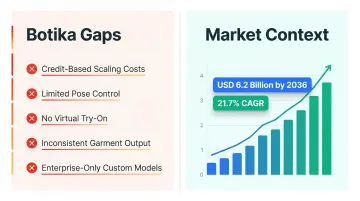
- Starting at £33/month (annual billing) for 600 credits/year, costs scale steeply as SKU counts grow or multiple generations are needed per garment
- Pose customization is locked out on standard plans; Pro/Advanced tiers allow only 2-3 retouching requests per photo
- No consumer-facing virtual try-on — the platform is built for catalog output only
- Layered outfits, detailed prints, and complex garment structures produce variable results
- Custom AI models matched to brand identity are available only at the Enterprise level
These gaps become more consequential as the category grows. According to Meticulous Research, the global AI fashion models market is projected to reach USD 6.2 billion by 2036 at a CAGR of 21.7%. Brands constrained by Botika's credit limits or lacking pose control will find that ceiling increasingly expensive.
Additionally, Botika holds a 2.8/5 Trustpilot rating based on 18 reviews, with 44% rated 1-star. Common complaints include login failures, unwanted subscription charges, and slow customer support—credible signals that push brands toward more reliable alternatives.
Best Botika Alternatives for AI Fashion Model Generation
These five platforms were chosen based on model customisation depth, garment rendering fidelity, output resolution, pricing transparency, and production scalability.
MetaModels.ai
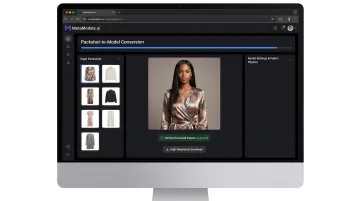
AI-powered fashion imagery platform that converts packshots and flat-lays into on-model content without physical models, royalties, or model booking costs—built specifically for fashion brands, e-commerce teams, and designers.
Key differentiators:
- Renders garment details accurately — colour, shape, texture, print, and proportions via real-time fabric draping
- Every output reviewed by fashion specialists before delivery to confirm garment accuracy
- Diverse model library covering varied ethnicities, demographics, and body types, customisable for brand identity
- Custom AI model creation matched to your specific visual identity
- Up to 4K resolution included across all plans
| Feature | Details |
|---|---|
| Key Features | Packshot-to-model conversion, real-time fabric draping, human-verified outputs, custom AI model creation, diverse model library, 4K output |
| Pricing | From £16/month (Starter: 20 credits); Growth £76/month (100 credits); Pro £217/month (300 credits); Enterprise custom pricing; per-image from £0.80 |
| Best For | Fashion brands and e-commerce teams needing brand-consistent, human-reviewed AI model imagery at scale with no royalty or model booking costs |
MetaModels.ai stands out for garment accuracy through human review—a critical quality gate missing from most competitors. The platform supports sportswear, menswear, luxury garments, and marketplace-compliant imagery for Amazon, Myntra, Flipkart, and other platforms.
WearView
All-in-one AI fashion photography platform offering eight tools in a single workspace: product-to-model, virtual try-on, AI model creation, consistent model identity, pose control, ghost mannequin, model swap, and AI video.
Eight tools in one workspace means brands managing multiple channels get visual coherence without stitching together separate subscriptions. Supports up to 4K output and team collaboration up to 15 seats.
| Feature | Details |
|---|---|
| Key Features | 8 AI tools, virtual try-on, consistent model identity, pose control, ghost mannequin, AI video, 4K output, team collaboration |
| Pricing | From £24/month (annual billing): Lite (50 credits); Pro £40/month (200 credits); Advanced £82/month (500 credits) |
| Best For | Fashion brands and agencies that need the broadest feature set in a single platform including virtual try-on and pose control |
WearView holds a 4.5/5 Trustpilot rating across 81 reviews—significantly higher than Botika's 2.8/5. Generation averages 30 seconds for still images and 1-2 minutes for video, optimised for Instagram Reels, TikTok, and YouTube Shorts.
Veeton
Virtual AI fashion studio focused on photorealistic garment rendering—accurately captures fabric drape, stretch, colour, and texture. Supports mix-and-match outfit styling on diverse AI models with camera angle and background control.
Differentiates through strong garment fidelity and outfit-level styling. Includes AI fashion video generation and collection management tools, with unlimited team members on the Pro plan.
| Feature | Details |
|---|---|
| Key Features | Outfit styling (tops + bottoms + accessories), fabric fidelity, camera/background control, AI video, custom model creation (Pro), collection management |
| Pricing | From £24/month (Starter: 30 credits); Pro £56/month (70 credits); Studio custom pricing |
| Best For | Fashion brands that regularly shoot complete outfits and need strong fabric texture accuracy |
Veeton offers a 10-photo free trial with no credit card required. With 3,000+ brands on the platform, it's a practical starting point for teams that need outfit-level control before committing to a plan.
Uwear.ai
AI fashion platform serving both brands and end consumers—generates on-model photos from flat-lay images in under 30 seconds. Supports batch processing of up to 10,000 products with multi-angle shots, 4K upscaling, and a shopper-facing virtual try-on widget.
Flexible pay-as-you-go pricing with credits that never expire, plus API access for programmatic integration—suited to high-volume retailers who need catalogue scale without subscription lock-in.
| Feature | Details |
|---|---|
| Key Features | Batch processing (up to 10,000 products), shopper-facing virtual try-on, AI video, multi-angle shots, 4K upscaling, API access |
| Pricing | Pay-as-you-go from £0.08/credit; Basic £46/month (150 credits); Plus £78/month (300 credits); Premium £238/month (1,000 credits) |
| Best For | Large retailers needing mass batch processing and brands wanting to embed consumer-facing virtual try-on |
Uwear.ai is the only platform here offering non-expiring credits and true pay-as-you-go pricing—practical for brands with variable monthly volume. Front, side, and back views generate from a single upload, with CSV export for catalogue management.
Picjam
AI visual content platform built for fashion e-commerce with a native Shopify app—generates on-model photos from flat-lays, ghost mannequin, or hanger images in approximately 60 seconds. AI model swap across 9+ ethnicities and 2,000+ poses, with repeatable presets for catalogue consistency.
Best suited to Shopify store owners who need a fast, integrated workflow. Offers the lowest entry price among these alternatives and includes video generation for social content.
| Feature | Details |
|---|---|
| Key Features | Native Shopify app, 2,000+ poses, AI model swap, repeatable presets, background generation, video creation, upscaling |
| Pricing | From £23/month (Pro with 200 credits); Studio £79–99/month (2,000 credits); Concierge £479/month (managed service) |
| Best For | Shopify sellers and small-to-mid-size fashion brands needing standardised, affordable product photography |
Picjam holds a 4.7/5 rating on the Shopify App Store with 12 reviews. The platform covers 9+ ethnicities (Asian, Black, Caucasian, Indian, Latino, Mediterranean, Middle Eastern, Multiracial, South East Asian) and offers 20+ background scenes across indoor, outdoor, and studio settings.
How We Chose the Best Botika Alternatives
Not every AI fashion platform suits every workflow. To cut through the noise, platforms were evaluated on five criteria that directly affect output quality, cost efficiency, and day-to-day usability for e-commerce brands:
- Garment rendering fidelity: How accurately does the platform preserve fabric drape, texture, print, and construction details? MetaModels.ai and Veeton address this explicitly; other tools vary in consistency.
- Model diversity and customization depth: Can you select diverse ethnicities, body types, and age ranges? Can you build custom brand-specific models, or are you locked into a pre-built library? MetaModels.ai, WearView, and Veeton (Pro) support custom creation; Picjam and Uwear.ai use curated libraries.
- Output resolution: All platforms reviewed support 4K or upscaling, but availability varies by plan. MetaModels.ai includes 4K across all tiers; Botika restricts it to Advanced plans.
- Pricing transparency: Flat-rate subscriptions, credit-based systems, and pay-as-you-go each carry different risks. Uwear.ai leads with non-expiring credits and PAYG flexibility. Botika's annual billing with credit rollover creates lock-in.
- Custom model identity: Can the platform generate models that match your brand's visual identity consistently across your full catalog — across product pages, social, and ads alike?
Common buyer mistakes:
- Choosing based on price alone without testing against actual garment types — complex prints, layered outfits, and embellishments reveal quality gaps fast
- Overlooking total cost of ownership: credit consumption per image, re-generation costs for errors, and integration overhead add up quickly
- Ignoring workflow fit: a Shopify-native tool like Picjam is seamless for DTC brands, but high-volume retailers need batch processing and API access that only platforms like Uwear.ai provide
Avoiding these mistakes starts with matching the platform to your specific workflow. Here's where each alternative fits best:
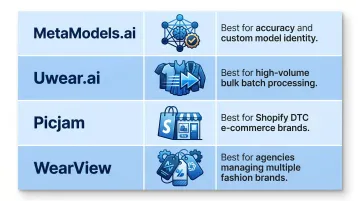
- Brands prioritizing accuracy and custom model identity: MetaModels.ai (human-reviewed outputs, custom brand models)
- High-volume retailers: Uwear.ai (batch processing, API access)
- Shopify-first DTC brands: Picjam (native integration, minimal setup)
- Agencies managing multiple client brands: WearView (broadest toolset across accounts)
Conclusion
Botika remains a functional option for basic product-to-model conversion, but brands with growing catalogs, higher creative standards, or tighter budgets will benefit from switching to a platform that better matches their specific workflow.
Test alternatives using your actual product images—not sample content—to assess garment accuracy, output quality, and real credit consumption before committing to a subscription. Complex prints, layered outfits, and detailed embellishments reveal platform limitations fast.
MetaModels.ai is built specifically for fashion brands and e-commerce teams that need human-verified, brand-consistent model imagery without model booking fees or royalties. Upload your packshots and see results firsthand at MetaModels.ai.
Frequently Asked Questions
What is the Botika app?
Botika is an AI-powered fashion photography platform that converts flat-lay, ghost mannequin, and packshot images into professional on-model imagery using AI-generated models of diverse ethnicities and body types, built for B2B e-commerce catalog production.
Is Botika free to use?
Botika offers a limited free trial with approximately 8 credits at signup. Paid plans start at £33/month (annual billing) on a credit-based system — 1 photo = 1 credit, 1 video = 5 credits — and costs rise quickly when re-generations are needed.
What are the main limitations of Botika for fashion brands?
Botika's key gaps include limited pose control on standard plans, no consumer-facing virtual try-on, no deep custom model creation (Enterprise tier only), and credit-based pricing that becomes expensive as SKU counts grow or when re-generations are needed for complex garments.
Which Botika alternative is best for small e-commerce brands on Shopify?
Picjam offers native Shopify integration and affordable entry pricing (from £23/month), making it a natural fit for Shopify stores. MetaModels.ai is a strong option for brands prioritising human-reviewed garment accuracy and custom brand model creation.
Do Botika alternatives support custom AI model creation?
Yes — MetaModels.ai offers custom models matched to brand identity, WearView supports consistent composite model creation, and Veeton provides custom AI fashion models on the Pro plan. Picjam and Uwear.ai rely on pre-built model libraries with customization through selection rather than creation.
Can AI fashion model generators fully replace traditional photoshoots?
For e-commerce catalog imagery, AI model generators can effectively replace standard photoshoots — cutting costs by 80-90%. According to Stylitics research, 76% of shoppers cite on-model photos as most useful for buying decisions, and 71% cannot distinguish AI-generated from real images. Highly editorial campaigns may still benefit from human creative direction.