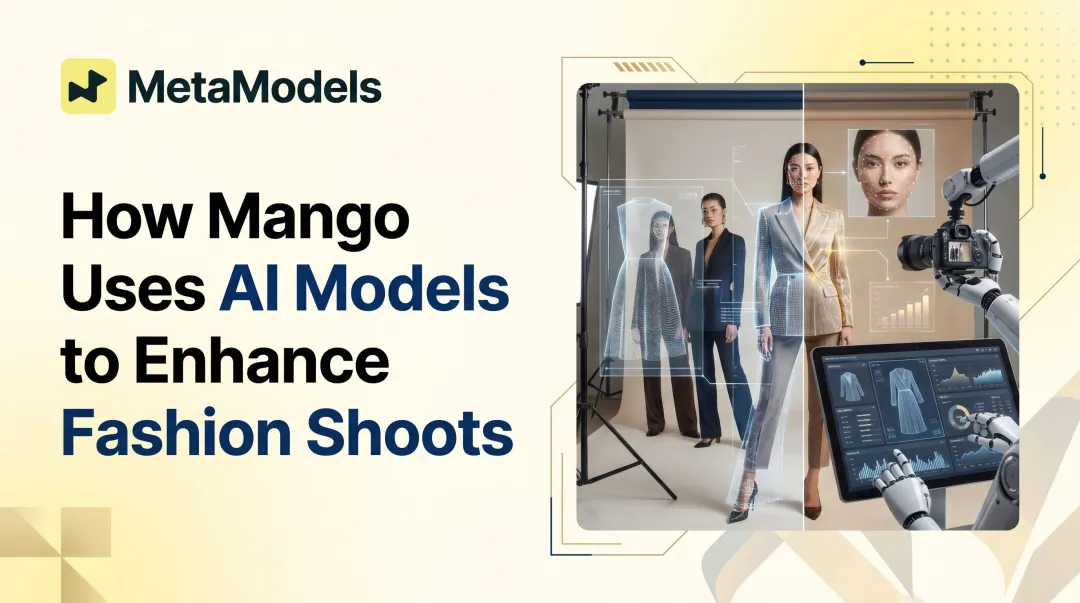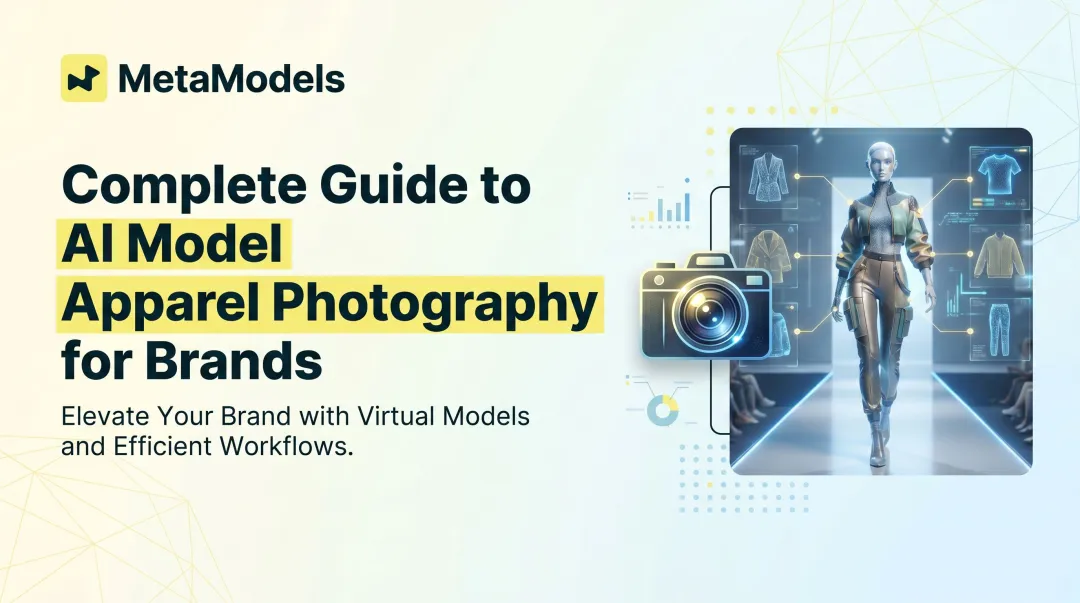
This isn't incremental improvement—it's structural change. Fashion brands launching 200 SKUs per season can now maintain complete visual coverage across every product, not just hero items. Regional markets get localized imagery without separate shoots. Pre-launch campaigns run before samples arrive. And the entire content supply chain—once a weeks-long bottleneck compressing full-price selling windows—collapses into same-day delivery.
This article explains what AI model photography actually is, how generative AI converts flat packshots into styled model photography, where it delivers measurable ROI, and where traditional shoots remain essential. We'll cover cost breakdowns, workflow mechanics, technical limitations, and the regulatory disclosure requirements taking effect across New York and the EU in summer 2026.
Key Takeaways
- AI model photography converts packshots into on-model visuals in hours — no studio, no model bookings, no crew
- Cost per image drops from $80-150 (traditional) to $1-5 (AI), with same-day turnaround replacing 4-8 week pipelines
- High-SKU brands, frequent-drop retailers, and brands localizing for regional markets see the strongest ROI
- AI cannot validate real-world fit, movement, or garment performance—physical reviews remain essential
- Only 24% of consumers view AI images as equivalent to human-created — and New York disclosure laws take effect June 2026
The Hidden Costs Holding Traditional Fashion Shoots Back
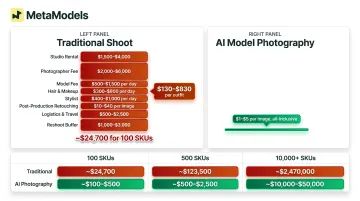
A mid-size commercial fashion shoot doesn't just cost photographer day rates—it carries a fully loaded expense structure most brands underestimate. Traditional e-commerce shoots covering 100 SKUs run approximately $24,700, with editorial-quality production pushing past $35,000. Here's where the money actually goes:
Full Cost Anatomy (Two-Day Shoot):
- Studio rental: $300–$2,500 per day
- Photographer: $1,000–$3,500 (e-commerce) or $2,500–$5,000+ (editorial)
- Model/talent fees: $200–$600 (in-house); $600–$1,500 (agency); $1,500–$4,000 (editorial)
- Hair and makeup: $400–$1,200 per day
- Wardrobe stylist: $400–$1,000 per day
- Post-production retouching: $20–$80 per image
- Sample logistics: $200–$800 per shoot (shipping, pressing, steaming)
- Miscellaneous crew, catering, equipment: $1,000–$4,000
- Reshoot contingency: $3,000–$8,000 for a partial day
Reshoots alone add 30–50% to initial budget estimates and consume 15–25% of quarterly content budgets. The per-garment cost for standard e-commerce on-model imagery lands between $130–$830 per outfit, with 40% appearing in vendor invoices and 60% buried in operational overhead.
The timeline problem compounds those costs. Traditional photography pipelines deliver approved final assets in 4–8 weeks from shoot completion, with on-model shoots producing only 20–40 looks per day at a pace of 6–12 garments per hour.
For brands running frequent drops or managing trend-sensitive inventory, that delay shrinks full-price selling windows and forces incomplete product launches.
Retailers lose up to 23% of potential revenue from bad product data, with missing or delayed imagery cited as a primary driver. The same research found that 22% of catalog variants are unsellable at any given time because visual assets are incomplete.
High-SKU brands face the worst squeeze. Mid-market and enterprise fashion retailers manage 10,000–100,000 active SKUs, each requiring visual assets across e-commerce PDPs, Amazon listings, paid social formats, email banners, and wholesale decks. Best-practice guidance recommends 5–8 images per product listing to show fit, detail, and styling context. For a 500-SKU seasonal launch, that's 2,500–4,000 images. At traditional shoot rates, producing that volume would take months and cost more than most brands allocate for an entire season.
How AI Model Photography Works: From Packshot to On-Model Visual
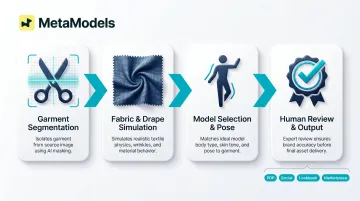
AI model photography ingests a flat product image—packshot, ghost mannequin, or flat-lay—and uses generative AI to simulate how that garment appears on a human model, including pose, body shape, lighting, and environmental context. No physical shoot required.
The process runs through four technical layers, each one determining whether the final image holds up to e-commerce scrutiny.
Garment Segmentation and Fabric Simulation
The AI first isolates the garment from the background, then interprets fabric weight, texture, drape behavior, and construction to render realistic on-body presentation. This fabric simulation layer is where most tools fail — designers immediately flag when AI fabric doesn't match the real material, and shoppers zoom in on stitching, weave, and finish.
MetaModels.ai's real-time fabric draping technology addresses this by preserving:
- Color, shape, texture, and print accuracy
- Garment proportions and construction details
- Finish quality across zoom levels
Every image is then reviewed by fashion specialists who catch color mismatches, proportion errors, and detail inconsistencies before delivery.
Model Selection and Customization
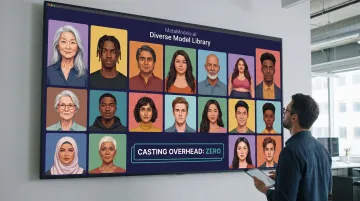
Brands draw from curated libraries of diverse AI models spanning varied ethnicities, body types, ages, and demographics. For brands that need visual consistency across every campaign, custom AI model creation locks in a signature look without royalty obligations or recurring booking fees.
MetaModels.ai supports both routes — a ready-made diverse library or a custom model built to match brand identity.
Input Quality Drives Output Accuracy
Single-angle packshots limit accuracy significantly. Providing front, back, side, and texture detail shots improves garment fidelity across all angles. Independent testing found that AI tools using only one reference photo exhibited garment hallucinations (inventing fictional design elements) and cross-angle inconsistency that made standard e-commerce image sets unusable.
Output Specifications
Resolution reaches up to 4K for print and high-resolution web use, with format readiness across all major channels:
- E-commerce PDPs (product detail pages)
- Paid social (Instagram, Facebook, Pinterest, TikTok ad specs)
- Lookbooks and wholesale decks
- Marketplace compliance (Amazon, Myntra, Flipkart)
That human review step at the end isn't just a safety check — it's what bridges the gap between what AI generates and what e-commerce standards actually require.
The Business Benefits Reshaping Fashion Photography
Cost Efficiency at Scale
The per-image economics shift dramatically. Traditional on-model photography costs $80-150 per image, while AI-assisted workflows drop to $1-5 per image—a 95-99% cost reduction for equivalent catalog coverage.
Volume Comparison (Annual Costs):
| Scenario | Traditional Cost | AI Cost | Savings |
|---|---|---|---|
| 100 SKUs, 3 images each, 2 seasons | $60,000 | $3,300 | $56,700 |
| 500 SKUs, 4 seasons | $169,000 | $18,000 | $151,000 |
Once a brand uploads packshots and selects model references, generating 10 variations versus 100 costs almost the same. That ratio doesn't exist in traditional photography.
Speed to Market
Traditional workflows produce 20-40 approved assets per day and deliver final images in 4-8 weeks. AI-assisted pipelines deliver same-day, compressing asset delivery cycles from weeks to hours. For fashion retailers, that compression directly protects full-price selling windows, when margins are highest and inventory is freshest.
For trend-sensitive categories where styles peak and fade in weeks rather than quarters, delayed imagery converts opportunity into markdown losses.
Diversity and Inclusivity Without Budget Overhead
AI model libraries allow brands to represent varied body types, skin tones, ages, and cultural contexts across their entire catalog without the casting, scheduling, and budget overhead of assembling a diverse human model roster.
This matters commercially: research from Harvard Business Review found that purchase intent among Black customers increased from 17% to 40% as perceptions of brand inclusion improved. While this research addresses inclusive branding broadly (not AI-generated imagery specifically), it demonstrates the conversion impact of authentic representation.
MetaModels.ai's curated model library spans diverse ethnicities, demographics, and body types, enabling brands to show garments on models who resemble their target customers—without separate casting for every size or demographic.
Localization Without Separate Shoots
Regional market imagery—different casting references, seasonal context, cultural styling cues—can be generated from the same base garment image. A single packshot becomes distinct visuals for European, Asian, and North American markets without additional location or model bookings.
Some vendor-reported data suggests localized e-commerce imagery can lift click-through rates by roughly 22%, though this figure hasn't been independently verified. The underlying logic holds: shoppers respond better to imagery that reflects their context.
Scalability Matching Modern Launch Cadence
High-SKU brands launching frequent drops can now maintain complete visual coverage across their entire catalog rather than cherry-picking only hero SKUs for photography. Mid-market retailers managing 10,000-100,000 active SKUs no longer face the structural bottleneck of traditional shoot scheduling.
That shift changes the economics of how brands plan launches—coverage decisions are no longer constrained by shoot budgets.
Where AI Model Photography Delivers the Most Value
E-Commerce PDP Imagery and Catalog Coverage
The highest-ROI application: brands launch with full visual coverage across all SKUs, generate alternate views and styled updates, and refresh seasonal imagery faster than traditional reshoot cycles allow.
Industry research recommends 5-8 images per product listing to show fit across body types, detail shots, and styling context. For a 200-SKU launch, that's 1,000–1,600 images — a volume where AI economics make complete coverage viable rather than aspirational.
Campaign Variations and Channel Adaptation
One approved campaign direction adapts into channel-specific formats — paid social sizes, email banners, wholesale decks, retail screen formats — without additional shoot days. What traditionally consumes weeks of production budget becomes a configuration task.
MetaModels.ai generates multiple variations of the same product with different models, styling, and backgrounds for A/B testing ad creatives, enabling rapid channel optimization without reshoots.
Pre-Launch and Teaser Content
Coming-soon pages, waitlist emails, paid acquisition campaigns, and buyer presentations often need polished visuals before inventory lands. Traditional shoots require physical samples; AI model photography generates pre-launch content from design-stage packshots or digital renders.
This means brands can test market response, build waitlists, and secure wholesale commitments — all before a single production run begins.
Pre-launch use cases include:
- Coming-soon landing pages and waitlist capture
- Paid acquisition campaigns running before inventory arrives
- Buyer deck visuals for wholesale commitments
- Early-stage social content to gauge audience response
Localized and Market-Specific Imagery
A single SKU generates distinct imagery tailored to different regional markets without separate casting or shoot logistics. European customers see garments on models reflecting European demographics in contextually relevant settings; Asian markets receive culturally appropriate styling, all from one packshot input.
What AI Model Photography Still Can't Do
Garment Truth and Fit Validation
AI simulates how a garment looks on a body, but it cannot validate real-world fit across movement, stretch, recovery, and diverse body proportions. Brands still need physical fit reviews before production sign-off.
Independent testing found that designers immediately spot when AI fabric doesn't match the real material—described as a "dealbreaker." The same review documented:
- Garment hallucinations (AI inventing fictional design elements)
- Resolution lower than modern cameras — unsuitable for print or high-resolution web zoom
- Inconsistent cross-angle views (front, side, back) required for standard e-commerce listings
AI is a visualization tool. Physical garment testing remains essential before any production sign-off.
High-Concept Editorial and Campaign Storytelling
The emotional resonance, creative spontaneity, and narrative depth of fashion editorial still requires human direction, live models, and on-set craft. AI handles catalog and commercial volume; it does not replace art direction.
That distinction showed up in practice when Mango created the first major AI-generated campaign for its Teen line's Sunset Dream collection in July 2024, deploying AI imagery across 95 markets. The campaign performed well for product-focused catalog content. High-concept editorial storytelling — the kind that builds brand identity — remained beyond its reach.
Consumer Perception and Disclosure Considerations
Consumer response to AI-generated fashion imagery is mixed. A Vogue survey of 251 respondents found:
- Only 24% say AI-generated fashion images are as valuable as human-created
- 51% would feel more negatively toward brands using AI in luxury fashion imagery
- Over 70% would never trust an AI influencer
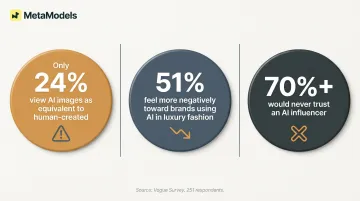
That skepticism creates real commercial pressure. Aerie reported a 23% Q4 2025 sales increase after expanding its "100% Aerie Real" pledge to never use AI-generated bodies — turning anti-AI into a competitive differentiator.
Another study of 411 shoppers found 71% could not distinguish AI-generated from real photos in side-by-side comparisons, though confidence collapsed when errors in fabric texture, buttons, and wrinkles appeared.
Disclosure Requirements Taking Effect Summer 2026:
New York's S.8420 requires "conspicuous disclosure" of synthetic performers in advertising, effective June 9, 2026. The EU AI Act Article 50 mandates machine-readable marking of synthetic images, effective August 2, 2026.
Fashion brands using AI-generated models must implement disclosure mechanisms before summer 2026 or risk compliance violations. The New York law applies when advertisers have "actual knowledge" of AI use—creating potential gaps in multi-vendor production chains.
Frequently Asked Questions
What is the 20-60-20 rule in photography?
The 20-60-20 rule is a compositional guideline dividing the frame into three zones (top 20%, middle 60%, bottom 20%) for visual balance. It's not a formal standard for fashion e-commerce. AI model photography makes maintaining high volumes of on-model imagery, the dominant category in most product catalogs, economically feasible at scale.
Can AI models fully replace human models in fashion photography?
AI models excel at high-volume catalog and e-commerce work, but human models remain essential for editorial storytelling, live campaigns, and content requiring genuine movement and emotion. Leading brands use both strategically: AI for high-volume catalog coverage, human models for editorial and campaign work.
How accurate are AI-generated garment images for e-commerce listings?
Accuracy depends on input quality (multi-angle product shots improve fidelity), the platform's fabric simulation capability, and human review before assets go live. MetaModels.ai uses fashion specialists to verify color, shape, and proportions prior to delivery.
What types of fashion brands benefit most from AI model photography?
High-SKU e-commerce brands, fast-fashion retailers, and brands targeting multiple regional markets gain the most. ROI scales with volume: brands launching 200+ SKUs per season see the clearest payback.
Is AI-generated fashion imagery legal and ethical to use commercially?
Legality varies by jurisdiction — New York mandates disclosure of AI-generated likenesses from June 9, 2026, with the EU following August 2, 2026. IP questions around AI training data remain active. Work with platforms that have clear ethical policies and appropriate licensing in place.
How does AI model photography handle diverse body types and representation?
Leading platforms offer curated libraries spanning varied ethnicities, body types, ages, and demographics, making inclusive representation scalable and affordable. MetaModels.ai provides both ready-made diverse model libraries and custom model creation, eliminating the need for separate casting for every size or demographic.