Introduction
Fashion brands face unrelenting pressure to photograph hundreds of SKUs across multiple channels—quickly, affordably, and without compromising quality. Traditional photoshoots require coordinating models, studios, stylists, and photographers while managing complex schedules and escalating budgets. A standard e-commerce shoot can cost £2,500–£8,000 per day, with per-image costs ranging from £80–£200 for on-model photography.
AI model photography changes that equation. It eliminates model bookings, studio rentals, and logistical overhead whilst enabling diverse representation and faster time-to-market. This article breaks down the specific, measurable benefits it delivers to fashion brand operations — from cost savings and speed to inclusivity and scalability.
Key Takeaways
- Traditional photoshoots cost £80–£200 per image; AI model photography reduces this to £0.05–£5 per image
- Brands produce on-brand imagery at scale without scheduling delays or post-production backlogs
- AI enables diverse representation across body types and ethnicities without additional shoots
- Images work across e-commerce, social media, ads, and lookbooks with no royalty limitations
- Every image is human-reviewed for garment accuracy, so scale doesn't come at the cost of quality
What Is AI Model Photography?
AI model photography uses machine learning to digitally place clothing onto AI-generated human models, eliminating the need for physical photoshoots. It converts packshots—flat-lay or ghost mannequin images—into photorealistic on-model imagery.
Advanced fabric draping technology handles the heavy lifting, preserving garment details including colour, shape, texture, and proportions throughout the process.
Fashion brands deploy this technology wherever on-model imagery is needed at scale:
- Product listings and e-commerce catalogues
- Social media content and digital advertising
- Lookbooks and seasonal campaign assets
For brands managing high-volume content needs, this is a production infrastructure decision with measurable output. Platforms like MetaModels.ai combine automated processing with manual editing options, maintaining brand-consistent quality at the speed AI generation enables. Major retailers including Zara have confirmed using AI to generate fashion imagery, a clear signal that the industry has moved beyond testing this approach.
Key Advantages of AI Model Photography for Fashion Brands
The advantages outlined below focus on measurable, operational impact—each tied to outcomes fashion brands actively track, including cost per image, time to publish, catalogue coverage, and representation goals. Brands managing large product catalogues, running seasonal launches, or expanding into new markets will see the strongest returns.
Advantage 1: Significant Reduction in Photography Production Costs
AI model photography removes the core cost components of traditional model shoots: model fees, agency commissions, studio rental, stylist and makeup costs, travel, and re-shoot expenses.
How this works in practice:
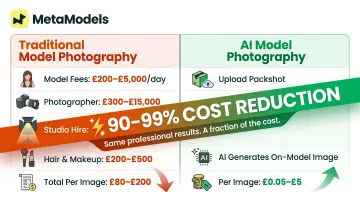
Brands upload flat-lay or packshot images and receive on-model imagery without coordinating a single shoot. The cost model shifts from per-shoot pricing to per-generation pricing. Traditional workflows stack up quickly:
- Models: £200–£500/day (emerging talent) to £1,500–£5,000 (top-tier)
- Photographers: £300–£15,000 depending on experience
- Studio space: £150–£3,000 per day
- Hair and makeup: £200–£500 per day
Industry research shows traditional on-model e-commerce photography costs £80–£200 per image, with full shoot days ranging from £2,500–£8,000 for standard e-commerce work. AI model photography platforms compress this to £0.05–£5 per image—a potential 90–99% reduction at the image level.
Eliminating royalties and usage licensing fees removes an ongoing financial liability that scales with content reach. Traditional model contracts typically add 50–200% of the day rate for extended usage rights, with renewal fees required beyond standard 6- or 12-month digital usage windows.
Why this advantage matters:
For high-SKU brands or fast-fashion labels refreshing inventory frequently, photography cost savings accumulate rapidly per catalogue cycle. D2C fashion brands typically spend 8–15% of annual revenue on product photography, making this a structurally significant cost centre. A growing brand managing 200 products might spend £25,000–£60,000 annually on photography using traditional methods; AI model photography reduces this substantially.
KPIs impacted:
- Cost per image
- Photography budget as percentage of revenue
- Content production ROI
- Re-shoot rate
Where impact is highest:
Particularly high-impact for brands with 100+ SKUs per season, brands entering new markets who need localised imagery, or startups and D2C labels with tight production budgets.
Advantage 2: Content Scalability and Faster Time to Market
AI model photography decouples content volume from production capacity. Brands no longer need to schedule shoots or wait in editing queues to publish product imagery.
How this works in practice:
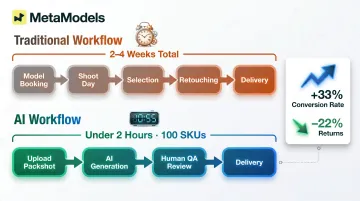
Once a garment image is uploaded, AI generates on-model visuals in under 30 seconds. Traditional workflows require 2–4 weeks from booking to final retouched assets—AI platforms compress this to same-day turnaround. A 100-SKU catalogue at three angles each (300 images total) can be ready in under two hours.
Platforms offering both automated processing and manual quality review—such as MetaModels.ai, which employs human fashion specialists to verify garment accuracy before delivery—maintain quality control without introducing bottlenecks.
Why speed translates to revenue:
Speed to market is a competitive differentiator in fashion. Brands that publish new arrivals with full model imagery faster capture more early traffic and purchase intent. Research from Baymard Institute found that 56% of online shoppers' first action on a product page is exploring product images—before reading titles or descriptions.
Professional on-model shots can increase conversion rates by up to 33% compared to lower-quality alternatives and reduce returns by as much as 22%. Faster publication doesn't just improve time-to-market metrics—it directly impacts revenue performance.
KPIs impacted:
- Time from product arrival to published listing
- Catalogue coverage rate
- Conversion rate on product pages
- Content output per month
Critical for seasonal launches, flash sales, and new collection drops where tight deadlines make traditional shoots impractical. Also high-value for brands managing ongoing product refreshes.
Advantage 3: Inclusive Representation Without Additional Cost or Complexity
AI model photography enables brands to present products on a diverse range of models—spanning body types, skin tones, ages, and ethnicities—without the logistics or cost of booking multiple models for each shoot.
How this works in practice:
Platforms with curated AI model libraries allow brands to select models matching their target customer demographics or brand identity. Custom model creation can reflect specific brand personas, covering variations in ethnicity, body type, and age range. Each variation is generated at the same base cost, with no incremental fees for diversity.
Why representation drives conversions:
McKinsey research found that 45% of Americans—approximately 120 million shoppers—believe retailers should actively support inclusive brands. At the same time, 48% of adults felt excluded from fashion advertising in the past year, representing significant missed conversion opportunities.
When ASOS showed products on different size models, total orders rose 30% compared to the prior year, average basket value increased by 3%, and conversions rose by 20 basis points. Customers who see themselves represented in product imagery are more likely to convert and return.
Achieving this through traditional shoots would require booking multiple models across body types and ethnicities—significantly multiplying cost and coordination complexity.
KPIs impacted:
- Conversion rate by customer segment
- Return rate
- Customer satisfaction scores
- Brand perception metrics
Where impact is highest:
High-value for brands targeting diverse demographics, expanding into new geographic markets, or building brand equity around inclusivity and accessibility.
What Happens When Brands Skip AI Model Photography
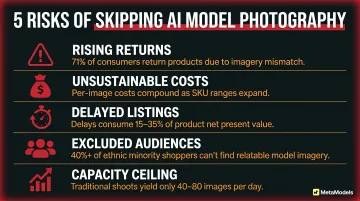
Traditional photoshoots don't just cost more as catalogues grow — they create compounding operational problems that affect revenue, returns, and customer trust. Here's what that looks like in practice:
- Return rates climb when imagery is inconsistent across shoots. 71% of consumers report returning products because the item didn't match online imagery, and 28% of apparel returns are driven specifically by appearance mismatch.
- Per-image costs scale poorly — model fees, studio rates, and post-production expenses compound as product ranges expand, making photography budgets unsustainable at volume.
- New arrivals sit unlisted when shoots are delayed or re-shoots are needed. Production delays can consume 15–35% of a product's net present value before it ever reaches the storefront.
- Diverse audiences go unrepresented — over 40% of ethnic minority shoppers in the UK struggle to find products shown on models who look like them, cutting conversion potential across entire customer segments.
- Peak season demand outpaces capacity — traditional on-model shoots yield 40–80 images per day, leaving brands that need hundreds of images per week with no realistic path to scale without a proportional budget spike.
How to Get the Most Value from AI Model Photography
AI model photography works best as a core production workflow, not a one-off fix. Brands that treat it as an ongoing system — with consistent model selection, styling standards, and quality checks — see stronger catalogue coherence and better on-site performance over time.
Brands should regularly review output quality and image-to-conversion data to identify which model presentations, garment categories, or visual styles perform best. Build those learnings back into production briefs, refining model selection and styling choices based on actual performance metrics.
Maintaining that quality at scale requires the right platform. MetaModels.ai combines automated processing with human review by fashion specialists, who verify garment accuracy across colour, shape, texture, and proportions. That built-in QA removes the need for manual checking on the brand side without sacrificing consistency.
A practical starting point is an 80/20 split:
- 80% AI model photography — standard product listing imagery across the full catalogue
- 20% traditional shoots — hero products, seasonal campaigns, and high-concept editorial
This keeps production costs low on volume work whilst protecting the creative investment where it matters most.
Conclusion
AI model photography's value for fashion brands lies not in replacing creativity but in restoring control—over cost, timeline, and representation—across the entire content production pipeline. By eliminating the structural constraints of traditional photoshoots, brands gain operational flexibility that compounds over time.
The returns scale with catalogue size. Brands embedding AI model photography into their standard workflow gain a cost and speed advantage that grows as operations expand — a brand processing 500 SKUs per season saves substantially more than one managing 50 SKUs, in both direct spend and production overhead.
That scale advantage only materialises when AI model photography is treated as infrastructure, not a one-time experiment. Brands that integrate it into standard workflows, refine output based on performance data, and maintain quality through human review see the most sustained return.
McKinsey projects that generative AI could add £150–£275 billion to apparel, fashion, and luxury operating profits within 3–5 years. Brands that build this capability now will be positioned to capture a meaningful share of that upside.
Frequently Asked Questions
What are the benefits of AI in photography?
AI in photography delivers time savings, cost reduction, scalability, and quality consistency. For fashion brands specifically, AI model photography adds flexible, diverse representation without logistical overhead, enabling brands to generate on-model imagery across body types and ethnicities at no incremental cost.
How much does traditional model photography cost compared to AI model photography?
Traditional on-model e-commerce photography costs £80–£200 per image, with full shoot days ranging from £2,500–£8,000. AI model photography platforms charge £0.05–£5 per image, representing a 90–99% cost reduction at the image level.
Can AI model photography replace real models entirely?
AI model photography covers the majority of e-commerce and catalogue use cases effectively. High-concept editorial and campaign work may still benefit from human talent, making it a complement rather than a replacement — AI handles scalable catalogue production while traditional shoots serve hero creative.
Is AI model photography suitable for all types of fashion products?
AI model photography works well for most garment categories, with particular strength in apparel where fabric draping and fit visualisation matter. Platforms with human fashion specialists reviewing garment accuracy handle tailored garments and complex styling effectively across standard product listings.
How does AI model photography support diversity and inclusivity?
AI model libraries with diverse demographics, body types, and ethnicities allow brands to represent their full customer base in product imagery without booking multiple models. This removes both cost and logistical barriers to inclusive content, enabling brands to show products on models that reflect actual customer diversity.
How long does it take to produce AI model photography compared to a traditional photoshoot?
Traditional photoshoots require 2–4 weeks from booking to final retouched assets, covering scheduling, shoot day, selection, and post-production. AI model photography generates images in under 30 seconds, with a full 100-SKU catalogue ready in under two hours.