Introduction
Fall season hits fashion brands with a compounding production problem: hundreds of SKUs across multiple sizes must launch across channels before peak buying season, with shoppers expecting immersive, motion-rich product visuals that show how layered fabrics actually move and drape. Traditional video production can't keep pace. Model bookings, studio availability, and post-production cycles compress timelines and inflate budgets at exactly the wrong moment.
Video drives conversion — that's settled. The harder question is how to produce it across an entire fall collection without missing September launch windows or blowing the creative budget. Brands managing 100+ fall SKUs typically end up covering only hero pieces with video and leaving the rest with static images. That's a scale problem, not a content strategy.
AI fashion models are changing that calculation. Faster time-to-market, more accurate fabric representation that reduces returns, and inclusive model diversity at scale — these are the measurable outcomes brands track in conversion rates, return costs, and seasonal revenue performance.
Key Takeaways
- AI fashion models eliminate physical model bookings, studio shoots, and post-production costs for fall video content
- Layered fall fabrics like wool and fleece show drape and movement far better in AI video than in static images
- Brands report measurable conversion lifts, lower return rates, and faster time-to-market for seasonal drops
- Diverse model representation scales instantly — no extra casting, no added shoot costs
What Are AI Fashion Models for Ecommerce Video?
AI fashion models are digitally created, photorealistic avatars dressed in product garments and animated to show movement, drape, and fit—without a physical model or video shoot. The technology converts existing product packshots or ghost mannequin images into on-model video content featuring realistic fabric behavior and motion.
AI fashion model video is already applied on product detail pages (PDPs), in social ads, email campaigns, and fall lookbooks—anywhere shoppers need to visualize how a garment behaves in motion before purchase. The process works from existing product imagery and delivers ready-to-post video content at scale.
By 2026, an estimated 40% of all ecommerce apparel listings will feature AI-generated product images, reflecting the technology's shift from experimental to operational standard.
Key Advantages of AI Fashion Models for Fall Apparel Videos
The three advantages below are grounded in measurable operational and commercial outcomes: cost reduction, production speed, conversion quality, and return mitigation. Fall is a particularly high-stakes season—new collections must go live quickly, SKU counts are high, and shoppers are emotionally invested in seeing how layered, textured pieces actually look in motion.
Advantage 1: Eliminate Production Bottlenecks and Scale Fall Video Across the Entire Catalog
AI fashion model video removes the primary bottleneck of traditional video production—booking models, studios, and post-production crews—enabling brands to produce video for every fall SKU, not just select hero pieces.
Existing product packshots or model images are processed through AI to generate animated, on-model video content. Brands using AI-generated lookbooks go to market 70% faster than those relying on traditional photography workflows. 30 campaign-ready images can be generated in under 4 hours using AI, compared to 3–5 weeks for traditional photography. Klarna reduced image production cycles from six weeks to seven days—an 83% time reduction—while saving approximately $6 million on image production in early 2024.
Fall collections have a narrow launch window. Retailers introduce fall collections in late July, with full rollout throughout August and September. Missing the peak consideration period means lost revenue that cannot be recovered that season. Winter holiday sales represent approximately 20% of the retail industry's annual sales, making timely fall launches critical to Q4 performance.
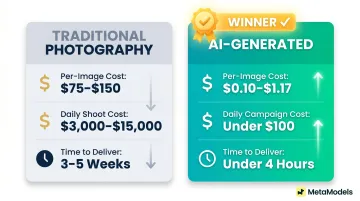
The cost difference is just as stark:
| Traditional Photography | AI-Generated | |
|---|---|---|
| Per-image cost | $75–$150 | $0.10–$1.17 |
| Daily shoot cost | $3,000–$15,000 | Under $100/campaign |
| Time to deliver | 3–5 weeks | Under 4 hours |
KPIs impacted: Time-to-market · Cost-per-asset · Catalog video coverage rate · Content production velocity
Brands with fall catalogs of 100+ SKUs, limited creative budgets, or lean marketing teams see the highest impact. MetaModels.ai converts packshots to AI model video using real-time fabric draping technology, with every output reviewed by human fashion specialists before delivery to ensure garment accuracy.
Advantage 2: Realistic Fabric Draping and Movement That Reduces Returns and Lifts Conversions
Fall apparel—knitwear, wool coats, layered outfits, corduroy—involves heavy, structured, or textured fabrics whose fit and movement are nearly impossible to communicate in flat static images. AI fashion model video renders fabric behavior realistically in motion.
Real-time fabric draping simulation shows how a coat falls on the shoulder, how a chunky knit stretches, or how a layered outfit moves as the model walks. MetaModels.ai uses real-time fabric draping technology with human-reviewed output to verify garment accuracy—including color, shape, texture, and proportions—before publishing.
Return rates tell the story. Online apparel return rates average 24.4% (Coresight Research, 2023) versus 16.9% for general ecommerce, costing the apparel industry an estimated $38 billion annually. Fit and size issues drive 53–56% of returns, with appearance-related reasons accounting for an additional 25–47%.
Video on product pages directly addresses both drivers:
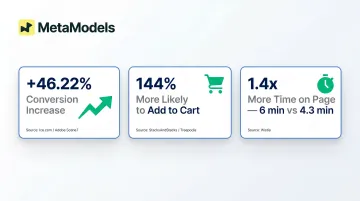
- Product pages with video saw a 46.22% increase in conversions versus control pages without video, even when the video wasn't watched (Ice.com/Adobe Scene7 case study)
- Shoppers who watch product video are 144% more likely to add to cart (StacksAndStacks/Treepodia)
- Pages with video see 1.4x more time on page—6 minutes versus 4.3 minutes—reducing bounce and improving engagement
KPIs impacted: Conversion rate · Return rate · Add-to-cart rate · Average order value · Customer satisfaction score
This advantage matters most for premium fall pieces—coats, knitwear, structured blazers—where purchase hesitation is driven by fabric uncertainty, and for brands with high return rates seeking to reduce logistics and margin costs.
Advantage 3: Diverse, On-Brand Model Representation Across All Fall Looks Without Additional Casting
AI fashion model platforms provide a curated library of diverse models—varying ethnicity, body types, age ranges, and demographics—that can be applied across the entire fall catalog without managing casting logistics, talent fees, or repeat shoots.
Brands select AI models that match their target audience and apply them consistently across every look. No separate booking, fitting, or scheduling is required per style or model type. For brands with specific identity needs, custom models can be built to match defined ethnicity, body type, age range, and styling from the ground up.
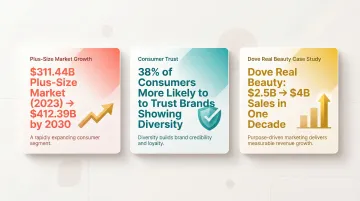
The commercial case for diversity is well-documented. Shoppers feel more confident and are more likely to purchase when models reflect their size, age, and race (Nielsen Norman Group, 2022). The plus-size clothing market reached $311.44 billion in 2023 and is projected to reach $412.39 billion by 2030. 38% of consumers are more likely to trust a brand that shows diversity in its advertising—and Dove's Real Beauty campaign demonstrated what that trust is worth commercially, growing sales from $2.5 billion to $4 billion in its first decade.
Brands that don't represent their customer base in product imagery face two costs: brand backlash and expensive retroactive reshoot campaigns. AI makes inclusive representation a default condition, not an afterthought—every SKU, every body type, no incremental production cost.
KPIs impacted: Conversion rate by customer segment · Return rate · Brand sentiment · Repeat purchase rate · Catalog representation score
Brands targeting wide or multicultural audiences, plus-size or extended-size categories, or operating across multiple geographic markets see the greatest ROI from AI model diversity at scale.
What Happens When Fall Apparel Videos Are Missing or Rely on Outdated Production Methods
Operational Consequences
Late-to-market launches as production cycles extend, low video coverage leaving most SKUs with only static images, and inconsistent visual quality across the catalog. Fashion brands manage hundreds of SKUs across multiple sizes that must be allocated across channels each season.
Commercial Consequences
Higher return rates driven by unmet expectations on textured fall fabrics, lower PDP conversion as shoppers seek more information before buying, and missed seasonal revenue windows that can't be recovered. 88% of people say they have been convinced to buy a product or service by watching a brand's video—brands without video leave conversion on the table.
Compounding Competitive Risk
Those revenue losses compound into a longer-term problem: brands that don't adopt AI-assisted production fall behind competitors launching full-catalog video faster, cheaper, and across more model representations. That gap widens with each season. Competitors accelerate their production cycles; traditional-only brands stay stuck with the same shoot logistics and budget ceilings.
How to Get the Most Value from AI Fashion Model Videos This Fall
Getting the most from AI fashion model video means applying it intentionally — across your full catalog, with consistent quality controls, and with ongoing measurement. These three practices make the difference between modest gains and meaningful seasonal lift.
Cover the full catalog, not just your top SKUs:
Reserving video for high-margin items leaves conversion potential on the table. Every PDP benefits from video — not just bestsellers. Product pages with video are 53 times more likely to rank on the first page of Google (Forrester Research), which means partial catalog coverage means partial results.
Produce content in multiple formats and verify before publishing:
Fall video should be delivered in the aspect ratios your channels require: 1:1 for PDPs, 9:16 for social and Reels. Beyond format, garment accuracy matters. Platforms that include a human review step — like MetaModels.ai's fashion-specialist verification process — catch draping errors and color inaccuracies before content goes live. Fashion specialists review each asset for color, shape, texture, and proportions before delivery.
Measure performance and refine as the season runs:
Track PDP conversion rate, return rate, and engagement by product category throughout the fall season. Use that data to identify which model types, video lengths, and presentation styles resonate with your specific audience — then prioritize those formats for spring planning. 85% of apparel brands already use or plan to implement visual tools (including video and virtual try-on) to drive sales and reduce returns, so the benchmarks for this kind of tracking already exist.
Conclusion
AI fashion model video delivers three compounding advantages for fall ecommerce:
- Faster production — catalog-ready video without shoot scheduling or location logistics
- Fewer returns — realistic fabric draping gives shoppers accurate expectations of texture and fit
- Broader inclusivity — diverse model options without casting constraints or additional cost
These advantages compound when applied consistently across the full fall catalog, not just select hero products. Brands that build AI model video into their standard production workflow — rather than testing it on a single SKU — get faster launches, lower return rates, and stronger seasonal conversion as each catalog cycle builds on the last.
Frequently Asked Questions
Are AI fashion models real people?
AI fashion models are digitally created avatars—not real people—generated using machine learning and generative AI technology to look photorealistic and represent diverse body types, skin tones, and demographics.
Is there an AI that puts outfits together?
Yes, several AI platforms can generate styled outfit combinations and place them on AI models for ecommerce imagery and video—including tools that process packshot images and apply garments to digital models automatically.
Which luxury fashion brand is using AI?
H&M announced plans to use "digital twins" of real models in AI-generated imagery (March 2025), and Gucci used AI-generated promotional images for Milan Fashion Week (February 2026). Both luxury houses and mass-market retailers are now incorporating AI models into their visual production workflows.
How to dress for a fall photoshoot?
With AI fashion model video, brands can simulate fall styling—layered earth tones, textured fabrics, seasonal accessories—across any garment without a physical shoot. Traditional photoshoots typically rely on these same cues, but AI removes the logistical constraints entirely.
What colors not to wear for a photo shoot?
Generally avoid very bright neons, pure white in overexposed settings, or colors that blend into the background. AI-generated video removes many of these constraints since lighting and backgrounds are digitally controlled.
Can AI fashion model videos replace all traditional apparel video shoots?
AI model video covers the majority of ecommerce use cases—PDPs, social ads, lookbooks—at scale. Some brands retain traditional shoots for hero campaigns or editorial storytelling, letting AI handle volume while traditional production handles flagship creative.