The pressure is operational and existential. Trend cycles that once lasted seasons now flip in weeks. Traditional photoshoots cost thousands per session and take weeks to coordinate. Global inventory complexity spirals as brands expand across regions. Consumers expect Netflix-level personalization from every retailer. According to McKinsey's The State of Fashion 2026, over 35% of fashion executives already use generative AI for customer service, image creation, and product discovery.
This isn't future-gazing. AI in fashion is projected to grow from $2.47 billion in 2026 to $9.45 billion by 2030—a 39.8% compound annual growth rate. The brands covered below aren't experimenting. They're executing.
Key Takeaways
- Fashion brands now run AI across design, supply chain, personalization, and marketing as core operations — not experimental pilots
- Zara, Nike, and H&M cut overstock by 25-35% using predictive analytics that feed sales data, weather, and social trends into demand models
- Stitch Fix and ASOS boost conversion with AI-powered virtual try-ons and personalized recommendations refined by human stylists
- Levi's and Balenciaga use AI-generated imagery to compress visual content production from weeks to days — with representation and diversity requiring active brand oversight
How AI Is Reshaping the Fashion Industry in 2026
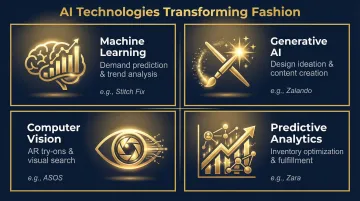
AI in fashion encompasses four distinct technologies, each addressing specific operational challenges:
- Machine learning — analyzes sales history, social signals, and external variables to predict demand with precision traditional forecasting can't match. Shein uses ML to trigger micro-production runs of 100–200 units, minimizing waste.
- Generative AI — accelerates design ideation by training on brand archives to produce novel concepts. Collina Strada fed past collections into Midjourney to build its Spring 2024 runway lineup.
- Computer vision — powers AR try-ons and visual search. Gucci's iOS app tracks foot movement in real time to overlay digital sneakers from multiple angles.
- Predictive analytics — optimizes inventory placement and fulfillment. Nike cut order cycle times by 50% in select distribution centers using RFID data combined with demand modeling.
The global AI in fashion market is growing fast regardless of which analyst you follow: Research and Markets puts it at $2.47 billion in 2026 with a path to $9.45 billion by 2030, while Fortune Business Insights forecasts a surge to $40.81 billion by 2034. Adoption is accelerating across luxury houses, mid-market retailers, and fast-fashion giants alike.
The 25 brands below represent documented, real-world implementations with measurable outcomes spanning design studios, warehouses, customer engagement platforms, and marketing departments.
25 Fashion Brands Using AI in 2026
These examples were selected based on publicly reported AI deployments with verifiable results—not aspirational press releases.
AI in Design & Product Development
Norma Kamali
Veteran designer Norma Kamali partnered with AI studio Maison Meta to train a proprietary generative AI model on her 57-year design archive. The collaboration treats AI "hallucinations"—typically considered errors—as creative inputs that generate avant-garde concepts impossible through traditional sketching. The result is a design process where unexpected outputs become deliberate starting points.
Collina Strada
Designer Hillary Taymour fed Collina Strada's design archive into Midjourney for the Spring/Summer 2024 collection. The team guided the AI with text prompts, iteratively refined outputs, and produced physical garments that debuted on the runway. The collection sparked industry debate about human-AI creative collaboration and where authorship truly resides.
Moncler
Moncler partnered with R/GA and Google to produce a 100% AI-generated brand film titled "From the Mountains to the City" using Google's Veo model. The brand also released the Verone AI Jacket—an AI-powered reinvention of its 1980s archive design featuring exaggerated proportions and reimagined quilted textures. Separately, Moncler worked with Maison Meta on AI-generated advertising campaigns for the Genius collection.
Tommy Hilfiger
During Metaverse Fashion Week 2023, Tommy Hilfiger hosted an AI design competition with DRESSX. Participants used prompt-based generative AI to co-design digital preppy-style garments. Beyond community engagement, the crowd-sourced design data informed future product development decisions.
Adidas
Adidas employs data-driven design through its Futurecraft STRUNG initiative. The system inputs athlete performance data into software that dictates the precision placement of each thread via robotic manufacturing. This AI-assisted material innovation delivers footwear optimized for individual biomechanics.
AI in Supply Chain & Inventory Management
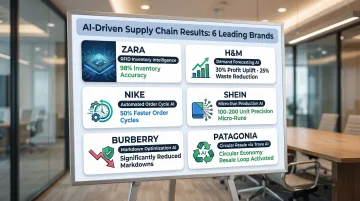
| Brand | AI Application | Key Result |
|---|---|---|
| Zara | RFID + SINT real-time sales & trend analysis | 98% inventory accuracy, restocking twice weekly |
| H&M Group | Demand models using sales, weather & social data | 30% profit uplift, 25% waste reduction, 14% fewer stockouts |
| Nike | Celect predictive analytics + RFID warehousing | 50% faster order cycles in key facilities |
| Shein | ML trend detection + small-batch production | 100–200 unit test runs reduce overstock |
| Burberry | Predictive AI with weather and social variables | Reduced markdowns and excess stock |
| Patagonia | Trove AI for resale grading, pricing & recs | Supports Worn Wear circular resale platform |
AI in Customer Engagement & Personalization
Stitch Fix
Stitch Fix combines proprietary AI algorithms with human stylist expertise. Its generative AI tool, Stitch Fix Vision, allows clients to visualize themselves in curated outfits. Engagement is remarkable: 75% of users return to the tool in subsequent months, generating a >100% increase in spending over 90 days.
The North Face
In partnership with IBM Watson, The North Face launched the Expert Personal Shopper (XPS)—a conversational AI offering product recommendations. Early testing showed a 60% click-through rate for recommendations and 75% sales conversions, proving AI can guide complex purchase decisions.
Gucci
Gucci integrated AR sneaker try-on into its iOS app using computer vision to track foot movements in real time. Shoppers view digital shoe overlays from different angles, improving purchase confidence and reducing return rates.
Steve Madden
Steve Madden deployed Fast Simon's AI-powered visual search and merchandising across 25 online stores globally. The results: 6x conversion rate increase and 120% growth in product purchases—demonstrating that AI search dramatically outperforms traditional category navigation.
White Fox Boutique
Australian brand White Fox Boutique uses AI-driven personalization through Fast Simon to deliver tailored product recommendations and optimize visual content for international markets including the US and UK, boosting global conversion rates.
ASOS
ASOS launched a hybrid virtual try-on tool on its iOS app in partnership with AIUTA, covering 10,000 products. The tool loads in 4-7 seconds and allows users to upload their own photo or select diverse virtual models, increasing repeat visits and confidence.

Dior
Dior partnered with Teads and Perfect Corp for an AR virtual try-on campaign for earrings. The VTO format delivered a 17% increase in brand recognition as premium, 36% lift in purchase intent, and 43% boost in ad recall.
AI in Marketing, Visual Content & Retail Innovation
Levi's
Levi's partnered with Lalaland.ai to deploy AI-generated fashion models representing diverse body types on e-commerce pages. The initiative faced "diversity washing" backlash, prompting Levi's to clarify AI supplements rather than replaces human models. Brands looking to scale AI-generated on-model imagery can use platforms like MetaModels.ai, which converts packshots into model photography without physical shoots.
L'ovedbaby
L'ovedbaby uses Birdseye's AI-driven email personalization to power targeted flash sales. The measurable gains: 340% increase in revenue per recipient and 55% email open rates—proof that behavior-based content dramatically outperforms generic campaigns.
Guess
Guess partnered with Alibaba's FashionAI to deploy smart mirrors and RFID-enabled interactive technology in a Hong Kong PolyU concept store. The installation drove measurable in-store engagement improvements in the Asia market.
Fashion Innovation Agency
FIA uses Stable Diffusion and AI image generation models to produce virtual fashion runway presentations through its Hyper-Realistic Meta Catwalk project. Virtual presentations eliminate the logistics and costs of physical runway shows while reaching global audiences.
Balenciaga
For its Fall/Winter 2024 show, Balenciaga created an immersive digital experience with walls and floors displaying AI-generated landscapes and distortions. The scale of the AI-generated environment was a first for a major luxury runway show.
Stella McCartney
Stella McCartney collaborated with Protein Evolution to use AI-designed enzymes for textile recycling. The Biopure technology breaks down plastic waste, used to create a recycled parka Stella McCartney debuted at COP28—one of the clearest examples of AI applied directly to fashion's environmental footprint.
Hat Club
Hat Club leverages Attentive AI for automated generative content creation and marketing campaigns. The platform reduced content production time significantly while improving campaign performance and revenue growth through localized visual merchandising.
Zalando
Zalando used generative AI to create 70% of Q4 2024 editorial content, cutting production time from 6-8 weeks to 3-4 days. At that speed, Zalando can publish trend-responsive content within days of a cultural moment rather than weeks after it passes.
What These 25 Brands Have in Common: Key AI Strategies
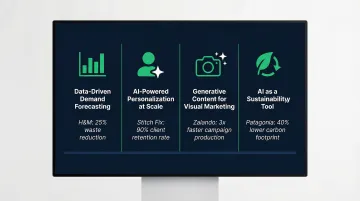
Four patterns emerge across successful implementations:
Data-Driven Demand Forecasting: Brands like Zara, H&M, and Shein integrate RFID, POS, social media, and weather data into unified demand models. H&M's 25% waste reduction and 30% profit uplift prove the ROI.
AI-Powered Personalization at Scale: Stitch Fix and ASOS combine algorithmic recommendations with human oversight. Pure automation consistently underperforms — brands that pair AI recommendations with human editorial judgment see stronger retention and repeat purchase rates.
Generative Content for Visual Marketing: Zalando's 70% AI-generated editorial content and L'ovedbaby's 340% revenue-per-recipient increase demonstrate that generative AI accelerates content velocity without sacrificing performance—when implemented thoughtfully.
AI as a Sustainability Tool: Patagonia's resale automation and Stella McCartney's AI-designed enzymes show AI can reduce waste and enable circular business models, not just drive efficiency.
The brands seeing measurable results avoid full automation. They integrate AI tools with human creative and operational oversight, treating AI as a collaborator rather than a replacement.
According to BCG's The AI-First Fashion Company, future designers will orchestrate teams of AI agents — one forecasting trends, another simulating fits, another optimizing assortment — but human judgment remains central to all of it.
AI adoption is accelerating across luxury, mid-market, and fast fashion. Brands not yet investing risk falling behind on content output, inventory efficiency, and customer experience expectations.
Conclusion
The 25 examples above share a common thread: AI solving specific, measurable problems—not replacing entire teams or overhauling operations overnight. Design workflows, supply chains, customer experiences, and marketing execution are all changing, but brand by brand, use case by use case.
For fashion brands and e-commerce teams evaluating where to begin, the most useful step is picking one area—design, inventory, personalization, or content—and identifying where the current process is slowest or most expensive. That friction point is where AI tends to deliver the clearest return.
For brands struggling with visual content production costs and speed, platforms like MetaModels.ai offer an accessible entry point. The service converts product packshots into AI-generated on-model imagery without the cost, coordination, or time requirements of traditional photo production, delivering ready-to-post content up to 4K resolution.
The brands featured here didn't overhaul everything at once. They found one problem AI could solve better than the existing approach, proved it out, then expanded. That's still the most reliable path in 2026.
Frequently Asked Questions
How is AI used in fashion retail?
AI is deployed across four main areas: design, supply chain optimization, customer experience, and marketing. Leading brands don't treat these as isolated tools — they integrate AI across the full value chain, from ideation and demand forecasting to personalization and content production.
Which fashion brands are leading in AI adoption in 2026?
Zara and Nike lead in supply chain optimization using predictive analytics and RFID technology. Stitch Fix dominates personalization with AI-human hybrid recommendations. Balenciaga and Gucci push boundaries in marketing and retail innovation with AR try-ons and immersive digital experiences.
How does AI help fashion brands reduce costs?
AI reduces costs through demand forecasting that cuts overstock by 25-35%, automating content production to lower creative spend from weeks to days, and reducing return rates by 20-30% via virtual try-on and better product matching. H&M reported 25% waste reduction and 30% profit uplift from AI-driven forecasting alone.
What is AI-generated model photography and how are brands using it?
AI model photography uses generative AI to place garments on digital models, eliminating traditional photoshoot costs. Brands like Levi's use it to improve diversity and scale content production — converting packshots into on-model images in days rather than weeks, with human review ensuring garment accuracy.
How do fashion brands use AI for demand forecasting?
Brands like Zara, H&M, and Shein feed sales data, social media trends, weather patterns, and external signals into machine learning models that predict what to produce, in what quantities, and where to position stock — delivering 98% inventory accuracy for Zara and 14% fewer stockouts for H&M.
Can small or emerging fashion brands benefit from AI tools?
Yes. Many AI tools now offer no-code platforms with entry-level pricing, making them accessible regardless of team size. Imagery platforms like MetaModels.ai, along with email personalization and forecasting tools, offer subscriptions starting under $100/month — no technical team required.