Introduction
Fashion brands managing thousands of SKUs face a stark economic reality: traditional photoshoot costs of $80 to $150 per image make comprehensive product visualization unsustainable. When a mid-size retailer needs on-model imagery for a seasonal catalog of 500 products, that single requirement translates to $40,000–$75,000 in photography costs alone—not counting studio time, model booking, and production delays. That constraint is pushing brands toward a concrete alternative: AI-generated fashion models.
The cost case is only part of the story. Major retailers including H&M, Levi's, and Guess have restructured their imagery workflows around AI models, while luxury houses like Valentino and Balenciaga deploy them for creative campaigns. The business benefits are real—but so are the ethical debates reshaping how the industry adopts this technology.
Key Takeaways
- AI fashion models are photorealistic digital avatars that display clothing without physical shoots or model bookings
- Global brands including H&M, Levi's, Guess, Valentino, and Balenciaga already deploy them across campaigns and e-commerce
- Key benefits: 95%+ cost reduction versus traditional shoots, faster time-to-market, and diverse representation at scale
- Ethical concerns — job displacement, consent, and transparency — are pushing brands toward clearer disclosure standards
- Platforms like MetaModels.ai convert product packshots into on-model imagery without a single shoot
What Are AI Models in Fashion and How Do They Work?
AI fashion models are digitally created avatars generated using machine learning and generative AI, designed to display garments on photorealistic human figures. Unlike early CGI characters that appeared obviously synthetic, modern AI models produce output nearly indistinguishable from traditional photography. They exist in two primary forms: fully synthetic personas created entirely from scratch, and digital clones built from real models' likenesses through scanning or training data.
Types of AI Models
Fully Synthetic AI-Generated Models
These personas have no real-world counterpart. Brands create them for e-commerce imagery and campaigns without booking talent, managing schedules, or negotiating rights.
The most prominent example is Lil Miquela (Miquela Sousa), a virtual influencer created by Los Angeles startup Brud in 2016. Her Instagram account maintains 2.3 million followers, with brand collaborations spanning Prada (2018 Milan Fashion Week), Calvin Klein (2019 ad with Bella Hadid), and Givenchy. Industry estimates put her annual revenue generation capacity above $10 million, with per-post rates ranging from $8,000 to $73,920.
Digital Clones
AI replicas built from real models' likenesses raise distinct questions. When H&M created digital twins of 30 real models in 2025, backlash centered on whether models were fairly compensated when their AI likeness books jobs independently. This category requires explicit consent frameworks, which organizations like SAG-AFTRA now mandate through standardized Digital Replica Riders in commercial contracts.
The Technology Behind the Visuals
The underlying systems rely on generative adversarial networks (GANs) and diffusion models trained on fashion photography datasets. GANs use two competing neural networks—a generator creating images and a discriminator evaluating realism—to synthesize photorealistic human forms. Diffusion models, now dominant for high-resolution output, progressively remove noise (starting from random static) to create detailed images with precise control over pose, lighting, and composition.
These technical foundations translate into a fast, repeatable production process. For brands, the workflow looks like this:
- Upload a product packshot or garment flat image
- Select an AI model from a curated library
- The system places the garment onto the model, simulating fabric drape, texture, and fit
- Adjust lighting, pose, and background settings
- Receive ready-to-publish imagery without physical samples or studio requirements
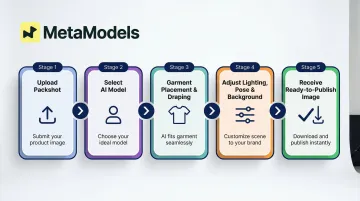
Real-time fabric draping technology preserves garment details including color accuracy, texture, print patterns, and proportions. Human fashion specialists review every image before delivery — a quality check that ensures garment accuracy holds up at the product page level, where detail drives conversion.
Fashion Brands Already Using AI Models
H&M's Digital Twin Program (2025)
The Swedish retailer deployed AI replicas of 30 real models—including Mathilda Gvarliani and Vilma Sjöberg—for social media and marketing campaigns developed with vendor Uncut. Models retained rights, granted permission, and received compensation at agency rates when twins were used. Images featured watermarks for transparency.
The protections didn't prevent blowback: production staff and the Model Alliance pushed back over job displacement concerns and questions about contract fairness.
Levi's Partnership with Lalaland.ai (2023)
Levi's partnered with Lalaland.ai to create diverse AI models representing varied skin tones and body types for online product pages. The brand stated the pilot would "supplement, not replace" human models. Public reaction was severe—critics questioned why the company didn't simply hire more diverse human models, viewing the approach as "cheapening diversity" rather than genuine DEI action.
Guess in Vogue (August 2025)
A fully AI-generated blonde model appeared in a two-page spread in Vogue US wearing Guess's summer collection. Produced by AI marketing agency Seraphinne Vallora, the campaign sparked intense consumer debate and criticism from models regarding unrealistic beauty standards. Small print disclosed "Produced by Seraphinne Vallora on AI," but the controversy highlighted reputational risks of deploying synthetic models in premium editorial contexts.
Luxury Brands: Valentino and Balenciaga
Valentino's September 2025 collaboration with Vans featured AI-generated video and images based on original AW25 runway footage. The brand explicitly stated AI use and confirmed "informed consent of the models and all talents involved," earning praise for transparency. Balenciaga's SS22 "Clones" runway show grafted artist Eliza Douglas's face onto stand-in models using deepfake technology, framing it as commentary on digital identity.
Industry Adoption Scale
These brand experiments aren't outliers — they reflect a fast-moving industry shift. 62% of fashion leaders say their companies already use generative AI, with 73% naming it a top priority, according to McKinsey. The numbers back the momentum: the AI-generated fashion photography market is projected to grow from $2.01 billion in 2025 to $8.07 billion by 2030, a 32% compound annual growth rate.
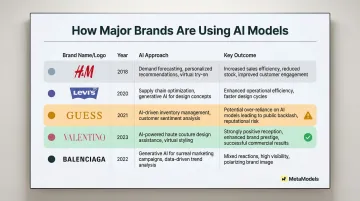
Here's how the five examples above compare at a glance:
| Brand | Year | AI Approach | Key Outcome |
|---|---|---|---|
| H&M | 2025 | Digital twins of real models | Backlash over job displacement |
| Levi's | 2023 | Diverse synthetic models for product pages | Criticism over DEI authenticity |
| Guess | 2025 | Fully AI model in Vogue editorial | Reputational risk, beauty standard debate |
| Valentino | 2025 | AI video based on runway footage | Praised for transparent consent process |
| Balenciaga | SS22 | Deepfake face-grafting as art | Positioned as digital identity commentary |
The Business Case: Benefits of AI Models for Brands and E-Commerce
Cost Elimination and Speed
Traditional e-commerce photoshoots cost between $5,000 and $25,000 per day, translating to $80–$150 per final retouched image when accounting for photographer fees, model booking, studio rental, styling, hair and makeup, and post-production. AI platforms report generating on-model imagery for $0.05 to $5.00 per image, representing a 95%+ cost reduction. Production speed scales proportionally, compressing multi-week shoot schedules into days.
Scale and Catalog Consistency
AI models allow brands with thousands of SKUs to produce on-model imagery for entire catalogs simultaneously with consistent lighting, styling, and brand aesthetic. At traditional shoot rates, that consistency simply isn't achievable. A brand launching 500 new products can generate complete on-model imagery in days rather than weeks, eliminating booking conflicts, weather delays, and sample shipping logistics.
Diversity and Shopper Confidence
AI models can represent a full spectrum of body types, skin tones, ages, and ethnicities without complex casting logistics. While direct A/B tests isolating AI model diversity are scarce, adjacent data demonstrates clear ROI: Fit Analytics reported conversion rate increases of 22%–29.9% when shoppers used personalized fit advisors, and Zalando reduced size-related returns by 10% using size advice technology. The National Retail Federation reports that 19.3% of online sales are returned, with poor fit driving 52% of apparel returns.
How MetaModels.ai Addresses These Challenges
That business case is exactly what MetaModels.ai is built around. The workflow is straightforward: upload a product packshot and receive human-verified, brand-consistent on-model imagery ready for commercial use. Key capabilities include:
- Diverse model library spanning ethnicities, body types, ages, and demographics
- Real-time fabric draping that preserves garment color, texture, and proportions
- 4K output formatted for e-commerce, social media, advertising, and lookbooks
- Custom model creation matched to specific brand identities
- Unlimited commercial usage rights with no royalties or ongoing licensing fees
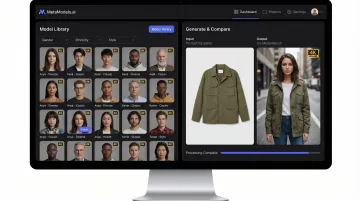
Subscriptions start with a Starter tier covering 20 image credits, scaling to enterprise plans with API access.
Challenges, Ethics, and Industry Concerns
Job Displacement and Worker Impact
The U.S. Bureau of Labor Statistics projects a 1% decline in modeling employment from 2024 to 2034, explicitly noting that "technology, including artificial intelligence that allows companies to reuse images of products and models, may also limit demand for these workers." An 87% majority of fashion workers polled by the Model Alliance expressed concern over AI's negative impacts, stating that generative AI is being used to exploit models' labor and heighten vulnerability to non-consensual image use.
Consent, Compensation, and Bias
When a model's AI likeness books jobs independently, are they fairly compensated? New York's Fashion Workers Act, effective June 2025, requires agencies and clients to obtain written approval before creating digital replicas, covering scope, purpose, pay rate, and duration.
Fully generated AI models — with no real person behind them — raise a separate set of concerns: whether training data was sourced ethically, and whether the output reinforces narrow beauty standards or actually broadens them.
Consumer Trust and Transparency
Consumer sentiment on AI imagery is split — and the data tells a nuanced story:
- Only 26% of Americans trust AI in retail settings, while 33% actively distrust it (YouGov, 2026)
- Nearly 90% of consumers globally want disclosure when an image was AI-generated
- MIT research found AI labels reduce belief in presented claims — yet had little effect on whether people engaged with the content
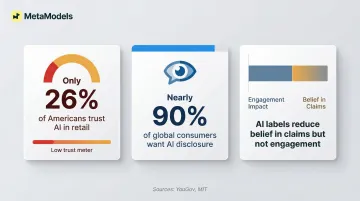
The implication for brands: disclosure alone won't rebuild trust. Output quality, consistent representation, and how AI is framed in brand communications all matter just as much.
The Future of AI Models in Fashion
Near-Term Developments
Zalando launched a feature allowing customers to receive size recommendations based on unique body measurements taken from two photos, paving the way for virtual fitting rooms with accurate 3D avatars. ASOS launched hybrid virtual try-on in 2026, partnering with AIUTA to let shoppers upload their own image or select from 20 AI-generated models reflecting their likeness, with results loading in four to seven seconds.
Agentic AI Discovery
McKinsey's State of Fashion 2026 report highlights the rise of the "AI Shopper." Shopping-related generative AI searches grew 4,700% between 2024 and 2025. Brands must now optimize for Generative Engine Optimization (GEO) — ensuring product imagery and data are readable by autonomous AI shopping agents that make purchase decisions on behalf of consumers.
The Co-Existence Model
That shift in how consumers discover products reshapes what brands need from their visuals — and who produces them. AI models are taking over high-volume e-commerce work: product listings, size variants, seasonal refreshes. Human models remain central to editorial campaigns, where emotional storytelling and cultural context drive the work.
The clearest path forward treats these as complementary functions, not competing ones.
Near-Term Developments
Zalando launched a feature allowing customers to receive size recommendations based on unique body measurements taken from two photos, paving the way for virtual fitting rooms with accurate 3D avatars. ASOS launched hybrid virtual try-on in 2026, partnering with AIUTA to let shoppers upload their own image or select from 20 AI-generated models reflecting their likeness, with results loading in four to seven seconds.
Agentic AI Discovery
McKinsey's State of Fashion 2026 report highlights the rise of the "AI Shopper." Shopping-related generative AI searches grew 4,700% between 2024 and 2025. Brands must now optimize for Generative Engine Optimization (GEO) — ensuring product imagery and data are readable by autonomous AI shopping agents that make purchase decisions on behalf of consumers.
The Co-Existence Model
That shift in how consumers discover products reshapes what brands need from their visuals — and who produces them. AI models are taking over high-volume e-commerce work: product listings, size variants, seasonal refreshes. Human models remain central to editorial campaigns, where emotional storytelling and cultural context drive the work.
The clearest path forward treats these as complementary functions, not competing ones.
Frequently Asked Questions
What are AI fashion models?
AI fashion models are digitally created, photorealistic avatars generated using machine learning and generative AI. They display clothing and accessories on virtual human figures without requiring physical models or photoshoots, converting product packshots into on-model imagery through automated fabric draping technology.
What fashion brands are using AI models?
Major adopters include H&M (digital twin program), Levi's (Lalaland.ai partnership for diversity representation), Guess (Vogue campaign), Valentino (AI-generated video campaigns), and Balenciaga (deepfake runway shows). Both luxury houses and mass-market retailers are now integrating AI models across e-commerce, campaigns, and runway presentations.
Which companies make AI models?
Several platforms offer AI model creation for fashion brands. MetaModels.ai converts packshots into on-model imagery using a curated model library with human-reviewed output and 4K resolution. Lalaland.ai focuses on diversity-driven representation for e-commerce, while Kartel.ai targets campaign-scale content production.
What are the top AI models now?
"AI models" covers two distinct categories: software platforms (MetaModels.ai, Lalaland.ai) that generate on-model product imagery, and virtual influencer personas like Lil Miquela used for brand campaigns. The best choice depends on whether your goal is product visualization at scale or social media marketing.
Who is the most popular AI fashion model?
Lil Miquela (Miquela Sousa) is the most widely recognized AI fashion model persona, with 2.3 million Instagram followers and brand partnerships with Prada, Givenchy, and Calvin Klein. Created by Brud in 2016, she was acquired by Dapper Labs in 2021.