Introduction
A traditional mid-range fashion photoshoot costs between $5,000 and $25,000 per day, with model fees alone ranging from $100 to $3,000+ depending on experience. Brands spend months planning seasonal campaigns — coordinating model castings, location scouts, stylists, photographers, and post-production retouchers. Generative AI is dismantling this workflow. Zalando recently compressed production timelines from six to eight weeks down to three to four days — a shift that signals where the industry is heading.
Generative AI isn't a single tool — it's a category of technologies reshaping fashion across design ideation, imagery production, personalisation, and supply chain optimisation. Brands now generate dozens of design concepts in seconds and produce marketplace-ready on-model images without a photoshoot.
The underlying systems learn patterns from vast datasets and create new content autonomously, enabling hyper-personalised shopping experiences at a scale that wasn't operationally viable before.
This playbook walks through every major application of generative AI across the fashion value chain. We'll clarify where the technology delivers measurable ROI today, where it's still evolving, and how fashion teams can build a structured AI strategy that builds lasting advantage — not just point-in-time efficiency gains.
TLDR:
- Gen AI reshapes the entire fashion value chain: design, imagery, personalisation, and supply chain
- AI model imagery eliminates photoshoot costs while increasing diversity representation
- AI recommendation engines now make personalisation a baseline expectation across e-commerce
- Ethical governance frameworks for IP, bias, and privacy are mandatory, not optional
- Brands that build AI strategies now will outpace those retrofitting the technology later
Generative AI in Fashion Design and Creative Ideation
Generative AI design tools allow designers to input text prompts, mood boards, or reference images and receive fully rendered design concepts, pattern variations, or silhouette sketches within seconds. Platforms like Midjourney, DALL-E, Stable Diffusion, and Runway ML compress the early concept development phase from weeks to hours, enabling designers to explore creative directions without committing production resources upfront.
Real-World Brand Adoption
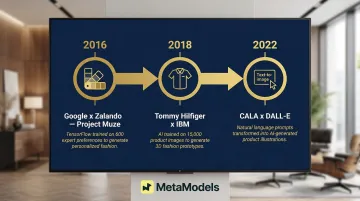
Tommy Hilfiger and IBM (Project Reimagine Retail): In 2018, Tommy Hilfiger partnered with IBM and FIT on "Reimagine Retail," where FIT students used IBM's AI trained on 15,000 Tommy Hilfiger product images to generate insights on colours, silhouettes, and prints. Outcomes included 3D digital designs and physical prototypes such as a plaid tech jacket with colour-changing fibre and a solar-active dress.
CALA's DALL-E Integration: Fashion supply chain platform CALA integrated OpenAI's DALL-E API in October 2022, allowing users to select product templates (like blouses) and generate new visual design ideas using natural language descriptions or reference images — transforming design briefs into product illustrations instantly.
Google and Zalando (Project Muze): In 2016, Google and Zalando launched Project Muze, using TensorFlow trained on colour, texture, and style preferences from over 600 fashion experts to generate virtual fashion designs based on user personality and interests.
These examples share a common thread: AI shortens the distance between an initial idea and a testable design concept, making experimentation faster and cheaper at every stage.
Rapid Iteration and De-Risked Experimentation
AI enables designers to explore dozens of variations — in colour, texture, silhouette, and pattern — in minutes rather than days. This dramatically reduces creative risk.
Instead of investing in physical samples before testing market response, designers can generate multiple concepts and share them with stakeholders or focus groups. Feedback gets incorporated before a single metre of fabric is cut — accelerating concept-to-prototype timelines and cutting material waste.
How Designers and AI Work Together
AI in design functions as a generative assistant — one that handles volume and variation while designers supply judgment. Manual editing, brand sensibility, cultural context, and emotional nuance still require human judgement. As Gonzague de Pirey, chief omnichannel and data officer at LVMH, stated: "Luxury in general is convinced that AI, however intelligent or generative it may be, cannot replace human creativity... However, it's a tool that can help us think and create." AI handles repetitive exploration tasks — generating the tenth colour variation or the fifteenth silhouette sketch — so designers can focus on the decisions that actually require taste and experience.
The Intellectual Property Challenge
Many generative models are trained on existing images scraped from the internet, creating unresolved legal questions around copyright ownership of AI-generated designs. In the US, the Copyright Office maintains strict human-authorship requirements: works produced by machines without human creative input cannot be copyrighted. The EU requires works to be the "author's own intellectual creation" to qualify for protection, while the UK offers specific protection for "computer-generated works" under Section 9(3) of the CDPA.
Practical advice: Engage legal teams before deploying AI-generated designs commercially. Document your AI tool usage, review platform terms of service, and establish internal IP governance policies.
AI-Generated Imagery for E-Commerce and Marketing Campaigns
Traditional fashion content production is a bottleneck. A mid-range photoshoot costs between $5,000 and $25,000 per day in the US, covering model fees, photographer rates, studio rentals, stylists, and post-production retouching. In the UK, per-image costs run £80–£150 for standard e-commerce photography and up to £1,500 for high-end campaign work. Brands managing seasonal catalogues with hundreds or thousands of SKUs face crippling time and budget constraints.
How AI Imagery Platforms Work
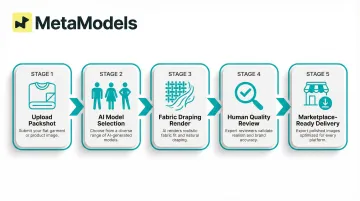
AI imagery platforms convert product packshots (flat lays or ghost mannequin shots) into on-model images without physical photoshoots. Brands upload garment images, and AI technology renders those garments onto realistic AI models across diverse poses, skin tones, body types, and settings. The workflow produces ready-to-use images at scale, eliminating model booking fees, studio costs, and post-production delays.
MetaModels.ai exemplifies this approach. Brands upload packshots, and the platform's real-time fabric draping technology renders garments onto a curated library of diverse AI models. Human fashion specialists review every output — checking colour, shape, proportions, and fabric texture — before delivering marketplace-compliant content in up to 4K resolution, with no models, royalties, or production overhead.
Diversity and Inclusivity at Scale
AI model libraries allow brands to represent diverse ethnicities, body types, and age groups consistently across product catalogues — something logistically difficult and prohibitively expensive in traditional photoshoots. Research on South Asian representation in UK advertising found that exposure to models matching consumers' ethnicities increased both inspiration and appearance satisfaction, demonstrating that representation directly impacts brand affinity and advertising effectiveness.
MetaModels.ai's library spans diverse ethnicities, demographics, and body types, enabling brands to maintain consistent representation across their entire catalogue — not just hero campaigns. For smaller brands, this removes the casting complexity that typically limits diversity to one or two seasonal shoots.
Campaign-Level Applications
Generative AI is used beyond product pages — for seasonal campaigns, lookbooks, and social content:
Casablanca Paris SS23 Campaign: For its "Futuro Optimisto" campaign, Casablanca Paris collaborated with AI artist Luke Nugent to create surreal, hyperrealistic images using Midjourney. The brand shot clothing on physical models first, then fed those images into Midjourney — producing a distinctive artistic vision at a fraction of traditional production cost.
Revolve's AI Billboard Campaign: Revolve's "Best Trip" campaign (April 2023) used Midjourney and Stable Diffusion to mark its 20th anniversary — including a limited-edition capsule collection based on AI-generated designs. Major retailers are now deploying AI for hero creative, not just product tiles.
Personalisation, Shopping Assistants and Customer Experience
AI-driven personalisation analyses browsing history, purchase data, style preferences, and contextual signals to surface product recommendations matched to each shopper's actual behaviour. Machine learning algorithms process this across millions of users simultaneously, turning standard e-commerce catalogues into individually curated selections.
Zalando's AI Infrastructure: Zalando deployed an AI assistant powered by its own models and OpenAI's GPT-4o mini across all 25 markets in local languages. The assistant drove a 23% increase in product clicks and a 40%+ increase in products added to wishlists. Zalando credited an 18% year-on-year profitability increase in Q2 2024 partly to generative AI features.
Stitch Fix's Human + Algorithm Model: Stitch Fix uses deep learning recommendation algorithms and GPT-4 embeddings to interpret freeform client feedback on fit and style preferences. The company generates 13 million new outfit combinations daily, with human stylists curating final selections based on algorithmic recommendations.
AI-Powered Chatbots and Virtual Shopping Assistants
Natural language processing enables chatbots to act as styling advisors, answering fit and sizing questions, guiding customers through collections, and processing returns. Kering's KNXT platform features an AI-powered luxury personal shopper named "/madeline," powered by ChatGPT, allowing users to ask conversational prompts and receive curated luxury product recommendations from Kering's brands — digital clienteling delivered across the full customer base.
Made-to-Order and Customisation Capabilities
AI enables on-demand, personalised product creation where customers configure fabric, colour, fit, and style, and AI coordinates production fulfilment. Nike and Adidas customisation programmes demonstrate accessible entry points. Compared to traditional batch manufacturing, on-demand production reduces overproduction waste — a practical sustainability benefit alongside the appeal to shoppers who want something distinct.
Data Requirements and Privacy Responsibility
Effective AI personalisation depends on high-quality first-party data. Brands without structured customer data infrastructure struggle to realise full value. Data collection must be paired with transparent privacy policies and clear consent frameworks to maintain consumer trust. Brands deploying personalisation AI must comply with GDPR, regional data protection laws, and industry best practices to avoid reputational and legal risk.
Supply Chain Efficiency, Trend Forecasting and Sustainability
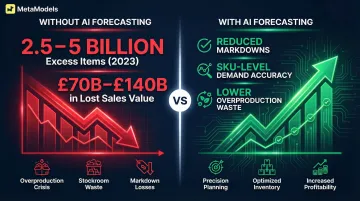
AI tools analyse sales data, browsing patterns, seasonal cycles, and external signals to predict demand at the SKU level. This helps brands produce closer to actual demand, reduce markdowns, and cut overproduction waste. According to McKinsey's State of Fashion 2025 report, the fashion industry produced between 2.5 billion and 5 billion items of excess stock in 2023, worth £70 billion to £140 billion in sales — an inefficiency AI forecasting directly addresses.
AI-Powered Trend Forecasting
Heuritech uses computer vision and machine learning to analyse millions of social media images daily, detecting over 2,000 fashion attributes — colours, prints, fabrics, and shapes. The platform predicts trend growth up to 24 months in advance with reported accuracy above 90%.
Reported results from case studies include:
- 9% increase in sales and a 2-point sell-through improvement for specific categories
- Up to 60% sell-through for a Middle Eastern luxury distributor
- Shortened collection planning cycles by reducing dependence on intuition-only forecasting
Sustainability Gains from AI Optimisation
AI contributes to more sustainable fashion operations through:
Smarter cutting and planning: AI-powered nesting at EverLighten cut fabric waste by 25% and boosted production efficiency by 40%. WFX's AI-driven planning also reduced remaining fabric rolls by 15% and sampling waste by 30%.
Digital product passports: EON's CircularID™ standardises product and material-level data via the Circular Product Data Protocol, enabling traceability, resale, and recycling. PANGAIA launched digital passports in 2021; The RealReal joined EON Exchange in 2024 for luxury resale.
Supplier traceability: Sourcemap maps supplier networks and verifies raw material origins for brands including Breitling (artisanal gold and lab-grown diamonds, 2022), Williams-Sonoma, Hoka, and Ugg.
Challenges, Ethics and Responsible AI in Fashion
Copyright and Intellectual Property
Generative models learn from vast datasets of existing creative work, creating contested legal status for AI-generated fashion assets. In the US, the Copyright Office and courts dictate that AI-generated outputs without human authorship cannot be copyrighted. The EU requires the "author's own intellectual creation" for protection.
Before commercial deployment, brands should address three areas:
- Document which AI tools were used and how outputs were created
- Review platform terms of service for IP ownership clauses
- Establish internal governance policies covering AI-generated assets
The EU AI Act, which entered force in August 2024, requires providers of general-purpose AI models to implement policies complying with Union copyright law and publish summaries of training content used. The Council of Fashion Designers of America (CFDA) partnered with AI startup Raive in 2024 to provide members with education and pilot programmes to navigate generative AI and protect intellectual property.
Bias and Representation Risks
AI systems trained on non-diverse datasets perpetuate narrow beauty standards, exclude underrepresented demographics, or produce outputs reflecting historical biases. A 2025 study on DALL-E 3 for fashion design prediction noted the AI struggled to incorporate trend elements like gender fluidity, and that trend keywords alone were insufficient without expert prompting.
Regular auditing of AI outputs — checking for demographic gaps, skewed body type representation, and culturally narrow defaults — is the practical safeguard here. Diverse training datasets reduce the problem at the source, but they don't eliminate the need for ongoing human review.
Energy and Environmental Cost of AI Infrastructure
Training and running large AI models consumes significant computational energy. The International Energy Agency reported that data centres consumed around 1.5% of total global electricity in 2024. That energy load directly offsets sustainability gains AI delivers elsewhere in the production chain — a trade-off brands cannot ignore in their ESG reporting. When evaluating AI vendors, prioritize those that publish energy consumption data and use renewable-powered infrastructure.
How to Build Your Generative AI Strategy in Fashion
Start with a Use-Case Audit, Not a Technology Audit
Identify your most painful production bottlenecks first — whether e-commerce content volume, design iteration speed, or personalisation gaps. Then select AI tools addressing those specific constraints, rather than adopting AI broadly because it's trending. McKinsey's State of Fashion 2025 advises prioritising use cases with the highest value using a test-and-learn approach.
Build for Integration and Workflow Fit
AI tools deliver maximum value when they fit into existing creative and production workflows rather than requiring complete process redesign. Start with one use case (such as AI model imagery for product pages), prove ROI, and then expand. Don't try to overhaul everything at once.
For example, MetaModels.ai integrates into existing workflows by accepting standard product packshots and delivering marketplace-ready images in formats compatible with Amazon, Myntra, Instagram, and TikTok. This minimises disruption while proving value through measurable time and cost savings.
Establish Governance Before Scaling
Define internal policies before scaling AI usage — covering areas like:
Define internal policies before scaling AI usage. Key areas to cover include:
- Data privacy: how training data and customer inputs are stored and used
- IP ownership: who holds rights to AI-generated outputs
- Bias review: processes for auditing model diversity and representation
- Disclosure standards: whether to label AI-generated imagery on product pages
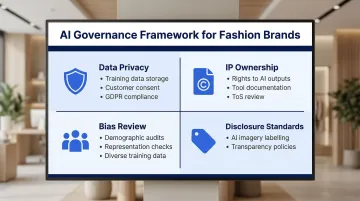
Early governance frameworks prevent reputational and legal risk as AI adoption deepens. More than 35% of fashion executives already use generative AI for customer service, image creation, copywriting, or product discovery — governance is no longer a nice-to-have.
Frequently Asked Questions
What is generative AI in fashion and how does it work?
Generative AI refers to systems that produce new content — images, text, designs, video — by learning patterns from large training datasets. In fashion, it's applied across design ideation, product imagery, copywriting, and customer experience tools such as chatbots and personalised recommendations.
How are fashion brands currently using AI-generated imagery for e-commerce?
Brands upload product flat lays or packshots into AI imagery platforms that render garments onto realistic AI models across diverse demographics and settings. This produces on-model product images without physical photoshoots, cutting costs and production timelines whilst increasing diversity representation.
Can generative AI replace human models in fashion photography?
AI model imagery is increasingly used for e-commerce and campaign content, but human creative direction, styling judgement, and cultural storytelling remain essential. AI supports rather than replaces human judgment — platforms like MetaModels.ai still employ human fashion specialists to review every output for garment accuracy before delivery.
What are the main ethical concerns with generative AI in fashion?
Three issues dominate the conversation: unresolved IP rights for AI-generated assets, bias risk when training data lacks diversity, and consumer privacy concerns tied to the behavioural data that personalisation systems rely on.
How does generative AI help with fashion trend forecasting?
AI trend forecasting platforms analyse social media signals, cultural content, and historical fashion cycles in real time to identify emerging trends. Platforms like Heuritech detect over 2,000 fashion attributes and predict trend growth up to 24 months in advance, giving brands data-driven lead time for collection and inventory planning.
What should a fashion brand do first when adopting generative AI?
Start with a specific, high-impact use case — e-commerce imagery is a strong entry point. Pilot one tool, measure time and cost savings, and put basic IP and data governance policies in place before scaling. This test-and-learn approach builds internal confidence whilst managing risk.