Introduction
Founded in 2013, Fabletics has evolved from a celebrity-backed activewear startup into the world's largest digitally native activewear brand—surpassing $1 billion in annual revenue by 2026 and serving over 3 million active customers. This success wasn't built on stylish leggings alone. What sets Fabletics apart is its relentless investment in AI and technology across every stage of the customer journey.
At the core of this strategy is a VIP membership model generating vast behavioral data from 2.7 million loyal subscribers. This data infrastructure fuels AI systems covering personalized product recommendations, CRM, ad creative production, and customer feedback analysis.
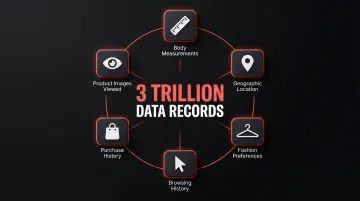
CEO Adam Goldenberg has publicly stated the company tracks three trillion data records on its customers—covering size, geography, fashion preferences, browsing history, and product interactions. Since inception, Fabletics has invested over $400 million in its proprietary tech platform to support this infrastructure.
The result is an AI-driven personalization system embedded across the entire customer lifecycle—from initial ad exposure through post-purchase engagement and product development feedback loops.
TLDR:
- Fabletics operates a VIP membership model generating three trillion customer data records that power AI personalization across all channels
- AI partnerships drive near-doubled Facebook CTR, a 7.7% digital sales uplift, and an 11-point conversion improvement
- Key AI tools include Jewel ML for product recommendations, Iterable for CRM automation, Smartly.io for ad creative, and Canvs for customer feedback analysis
- Customers with two or more marketing opt-ins are 2.5x more valuable, according to Fabletics' CRM data
Fabletics' AI Foundation: The Membership Data Advantage
Fabletics' AI capabilities rest on a data infrastructure most fashion brands simply don't possess. The company operates a VIP subscription model where members pay a monthly fee in exchange for exclusive credits and discounts. This seemingly simple business model creates an extraordinary data advantage: 95% of total revenue comes from VIP members, and approximately 60% of members have been with the brand for over two years.
That longevity produces deep, long-term behavioral data far richer than what transactional retailers can access. Every browse session, product interaction, purchase, skip, and survey response adds to a comprehensive member profile. CEO Adam Goldenberg revealed at the eTail Palm Springs 2025 conference that Fabletics tracks three trillion data records on its customers—encompassing everything from body measurements and geographic location to fashion preferences and every image viewed.
Unified Platform, Unified Intelligence
Prior to recent investments, Fabletics' customer data was fragmented across e-commerce, mobile, retail stores, and CRM systems. Effective AI required breaking down these silos. The company built what it calls "Fashion OS", a unified technology platform connecting every customer touchpoint, including:
- E-commerce and mobile apps
- 100+ retail stores
- CRM and warehouse management systems
That unified architecture enables real-time personalization that disconnected systems simply can't deliver. The company invests 5 to 10 times more in technology than industry peers, with the tech team representing the largest department in the organization.
Goldenberg credits this proprietary stack as the reason AI can operate simultaneously across every customer touchpoint, rather than in isolated pockets.
The data advantage deepens with membership longevity. Unlike fast-fashion retailers with largely anonymous, one-time purchasers, Fabletics maintains sustained relationships averaging 7–18 months with identified members. That window is long enough to train AI models with real predictive power over preferences, sizing accuracy, and purchase timing.
AI-Powered Personalization: Recommendations and 1:1 Marketing
Fabletics deployed Jewel ML, a no-code AI recommendation engine, across its home, product, and cart pages to deliver real-time personalized outfit suggestions based on each member's browsing and purchase signals. With a catalog too large to match manually at scale, the AI handles the heavy lifting — and the results show it:
- 7.7% uplift in digital sales
- 2x+ increase in customer interactions with recommended products
- 11-point improvement in conversion rate
- 1–5 million personalized recommendations delivered monthly
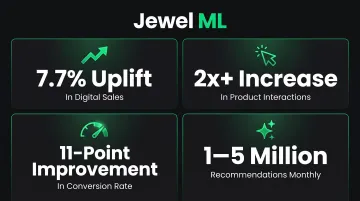
The platform now handles product discovery at scale while preserving Fabletics' signature "hyper-personal styling" experience.
CRM Personalization Beyond Mass Emails
Parallel to on-site recommendations, Fabletics uses AI from Iterable to move beyond mass email blasts toward 1:1 lifecycle messaging. The platform dynamically adjusts content, timing, and channel—email, SMS, push notifications, or in-app messages—based on individual member behavior.
Send-time optimization analyzes purchase history, browsing patterns, and engagement signals to pinpoint the ideal moment and channel for each customer. The AI delivers messages when that specific member is most likely to engage — lifting open and click rates without changing a word of the content.
This precision matters because Fabletics discovered that customers with two or more marketing opt-ins are 2.5 times more valuable than those with none. AI-driven channel optimization drives this multi-opt-in behavior by making every touchpoint feel relevant rather than intrusive.
AI in Digital Advertising: Creating Better Ads Faster
As a membership brand focused on constant acquisition, Fabletics needed to produce thousands of ad creatives rapidly across Facebook, Instagram, and Stories—each correctly formatted and on-brand. Manual production couldn't scale at the required speed.
Fabletics uses Smartly.io's AI platform to automatically pull images and videos from its product catalog and integrate them into ad templates, eliminating manual formatting work. Approximately 30% of Fabletics' ads are now created by the AI platform. The automation enables high-volume creative production—critical when testing which product combinations, video formats, and copy variations drive the best response.
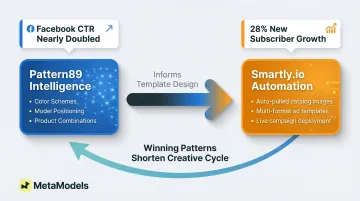
The business impact was immediate: Facebook clickthrough rate almost doubled in a very short timeframe. The platform also delivered a 28% increase in new subscribers quarterly, demonstrating that AI-driven creative isn't just faster—it's more effective.
Creative Intelligence Before Spend
Alongside creative automation, Fabletics partnered with Pattern89 (acquired by Shutterstock in 2021) for trend intelligence. This AI planner surfaces micro and macro creative trends driving conversions across Fabletics and broader industry competitors.
By analyzing over 2,900 creative dimensions of Facebook and Instagram ads, Pattern89 identifies which elements will perform before budget is committed:
- Color schemes that index above average for the current season
- Model positioning and framing styles trending in the category
- Product combinations with the strongest conversion signal
This forward-looking intelligence lets Fabletics align creative with what's working in the market rather than waiting on historical A/B results. The combination of Smartly.io (automation) and Pattern89 (intelligence) creates a feedback loop: winning patterns inform template design, shortening the time between creative concept and live campaign.
Extending AI Into Visual Merchandising
Beyond paid social ads, CEO Adam Goldenberg has cited AI as a tool within visual merchandising and store operations. For fashion brands looking to scale this specific capability—generating on-brand, catalog-ready imagery without traditional photoshoots—platforms like MetaModels.ai enable brands to convert product packshots into AI model imagery at scale. The approach cuts model booking fees and photoshoot logistics entirely, letting teams push consistent, production-ready visuals across thousands of SKUs without a studio.
AI-Driven CRM: Reducing Fatigue, Increasing Relevance
Subscriber fatigue is a persistent challenge for membership brands. Send too many messages, and customers unsubscribe or tune out. Send too few, and you miss revenue opportunities. Fabletics addressed this through Iterable's AI suppression tools, which automatically pause promotional messages for customers who have recently completed a purchase.
This intervention prevents the over-messaging that erodes trust and inflates unsubscribe rates. The AI recognizes the purchase event and adjusts messaging cadence — no manual rules required.
Multi-Channel Coordination at Scale
Beyond suppression, Fabletics uses AI to determine the right channel mix per customer. Instead of blasting every channel at once, the platform selects the best touchpoint for each member — SMS, push notification, email, or in-app — based on where they're most likely to engage.
The business outcome backs this up: customers with two or more marketing opt-ins are 2.5x more valuable than those with none. AI-driven channel optimization directly drives this multi-opt-in behavior by making every touchpoint feel relevant rather than intrusive.
Listening at Scale: Customer Feedback and Product Innovation
As Fabletics grew, its consumer insights team faced an overwhelming volume of open-ended survey responses and thousands of product reviews across styles, colors, and fabrications. Manual analysis couldn't keep pace, and critical customer signals risked being lost in the noise.
Fabletics deployed Canvs' emotion-driven AI to apply consistent code frames to unstructured feedback, automatically surface emerging themes, and deliver sentiment summaries to leadership. The platform pulls signal from:
- Brand health surveys
- Product reviews
- Open-ended feedback across product, marketing, retail, and customer experience teams
From Insight to Product Innovation
The product innovation outcome demonstrates AI's value beyond operational efficiency. AI-analyzed feedback revealed that curvier customers expected activewear-level stretch in Fabletics scrubs—medical apparel designed for healthcare professionals. This emotional and functional insight directly led to the development of the Flex Scrub Top, now one of their top-reviewed and best-selling products.
The scrubs line has grown into a $75 million product category, demonstrating how customer feedback — when properly analyzed — can directly drive product development and revenue growth. Customers said what they needed; AI made sure someone heard it.

What Fashion Brands Can Learn from Fabletics' AI Playbook
Fabletics' AI success comes from building an ecosystem where every tool draws from the same behavioral data pool, applied consistently across the full customer lifecycle. Brands that adopt AI in isolation — ads only, or CRM only — miss the compounding effect that unified intelligence creates.
The core transferable principle is integration over isolation. Fabletics uses AI everywhere, creating feedback loops where each system sharpens the next:
- Ad performance data influences product assortment decisions
- Customer feedback analysis shapes creative strategy
- CRM engagement signals continuously refine recommendation algorithms
Data as Prerequisite
Before any AI tool can work as intended, brands need unified, high-quality customer data. Fabletics' membership model is uniquely powerful — generating three trillion data records (per Fabletics' reported figures) through sustained member relationships — but any brand can start by consolidating purchase, browse, and engagement data into single customer profiles. Better data quality directly translates to more accurate predictions and more relevant personalization.
According to McKinsey research, personalization most often drives 10–15% revenue lift. Reaching that threshold requires moving well beyond basic segmentation — toward true 1:1 personalization built on comprehensive, unified data. That's the gap most fashion brands haven't closed yet.
Frequently Asked Questions
What is the business model of Fabletics?
Fabletics operates a VIP membership subscription where members pay a monthly fee for exclusive access to discounted activewear credits. Approximately 95% of revenue comes from VIP members, with average membership durations ranging from 7-18 months.
What AI tools does Fabletics use?
Fabletics uses Smartly.io and Pattern89 for ad automation and creative trend intelligence, Jewel ML for personalized product recommendations, Iterable for AI-driven CRM and multi-channel messaging, and Canvs for emotion-based customer feedback analysis.
How does Fabletics personalize the shopping experience?
Fabletics deploys Jewel ML recommendation engines on home, product, and cart pages to surface curated looks based on each member's browsing and purchase history. These signals also drive 1:1 marketing messages across email, SMS, push, and in-app channels.
How does Fabletics use AI to combat customer messaging fatigue?
Fabletics uses Iterable's AI suppression tool to automatically pause promotional messages after a recent purchase. Sending channel selection ensures customers only receive messages where they're most likely to engage, reducing over-messaging and unsubscribe rates.
What business results has Fabletics achieved through AI?
Fabletics achieved a near-doubling of Facebook ad CTR, a ~7.7% uplift in digital sales, over 2X growth in engagement with recommended products, and an 11-point conversion rate improvement across advertising, personalization, and CRM initiatives.
Can smaller fashion brands replicate Fabletics' AI strategy?
Fabletics' membership data scale is an advantage, but the core principles aren't exclusive to large brands. Unified customer data, AI personalization, automated CRM, and feedback analysis are all accessible through no-code and low-cost AI platforms.