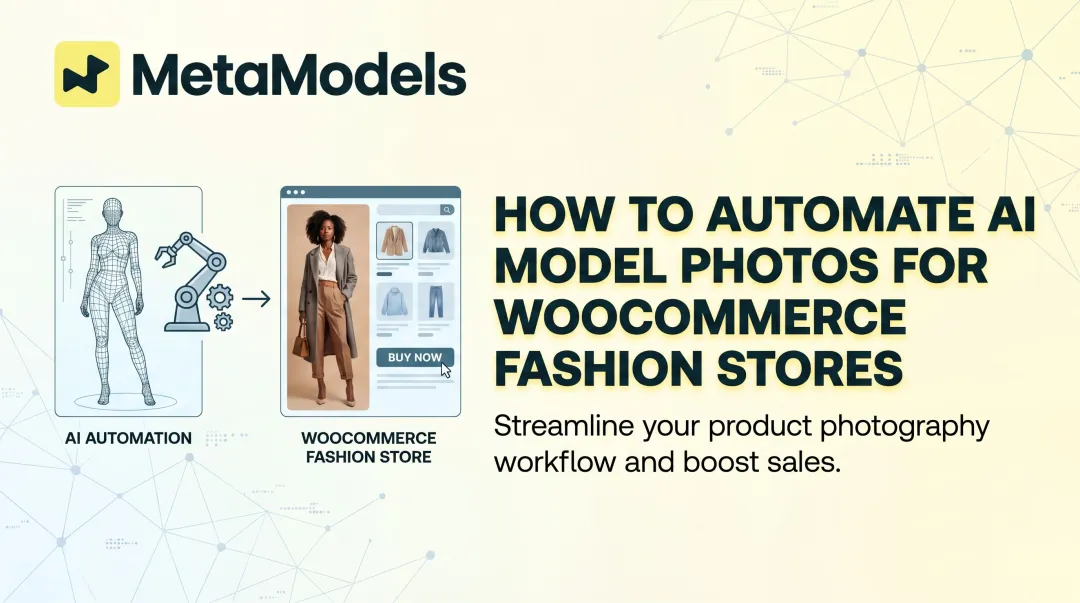
Introduction
Fashion brands today face a relentless triple challenge: design faster, produce leaner, and market louder—all simultaneously. The industry that once moved in seasonal cycles now operates in real-time, with consumers expecting fresh styles weekly and retailers demanding content volumes that traditional workflows simply cannot sustain. According to a Forbes industry analysis, the AI fashion market alone is projected to reach $60 billion by 2034, growing at nearly 40% annually.
Automation now runs through every stage of the apparel value chain. AI-assisted pattern making, robotic manufacturing, and automated product imagery are compressing timelines, cutting costs, and giving mid-size brands the production capacity once available only to industry giants.
Key Takeaways
- Automation spans the full fashion pipeline: design, production, and marketing content
- AI tools accelerate pattern making, virtual prototyping, and trend forecasting
- Robotic and adhesive systems are replacing traditional sewing in high-volume manufacturing
- E-commerce imagery automation converts packshots into ready-to-publish model visuals at scale
- Early adopters lock in cost and speed advantages that are difficult for competitors to replicate
What Is Automation in the Fashion Industry?
Fashion automation applies technology, software, robotics, and AI to replace or accelerate manual steps across the apparel value chain—spanning ideation, product development, manufacturing, and content creation.
Unlike automotive or electronics manufacturing, where automation has been standard for decades, fashion has historically lagged. The reason is the material itself: fabric flexes, stretches, and bunches unpredictably in ways rigid parts simply don't.
Why automation is surging now:
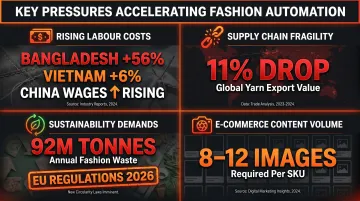
Apparel remains one of the least automated industries in the world. A convergence of cost, supply chain, and regulatory pressures is now forcing the industry to commit at scale:
- Rising labour costs: Bangladesh raised garment worker minimum wages 56.25% in November 2023, from $75 to $113 monthly. Vietnam implemented a 6% wage increase in 2024, while China's average enterprise wages reached 102,452 yuan annually.
- Supply chain fragility: McKinsey found that yarn export value across seven major textile-exporting countries dropped approximately 11% amid post-pandemic volatility—and demand signals still take months to reach upstream suppliers, compounding instability.
- Sustainability demands: The fashion industry produces 92 million tonnes of textile waste annually, with more than $500 billion in value lost to overproduction. The EU's Ecodesign for Sustainable Products Regulation will ban destruction of unsold apparel starting July 2026.
- E-commerce content volume: Brands now need 8–12 images per SKU across multiple channels—a volume that makes traditional photoshoots both cost-prohibitive and logistically impractical.
The AI in Fashion Market is valued at $2.47 billion in 2026, projected to reach $9.45 billion by 2030, growing at a 39.8% CAGR. Brands adopting automation now are compressing development cycles, cutting content costs, and reaching market faster than competitors still relying on manual workflows.
How Automation Is Reshaping Apparel Design and Development
AI-Assisted Design Generation
AI tools now allow designers to generate multiple concept variations based on brand direction, seasonal trend data, and consumer behaviour signals. This cuts concept development time dramatically and enables data-backed creative decisions before any sample is produced. Instead of sketching 20 concepts manually over two weeks, designers input parameters and receive dozens of variations in hours, each informed by real-time trend forecasting algorithms.
Digital Pattern Making and Virtual Prototyping
Automated pattern adjustments (grading, sizing, modification) replace time-consuming manual drafts. Virtual prototypes become a shared reference point for design, development, and production teams — reducing miscommunication and the need for physical samples.
Impact on sampling costs:
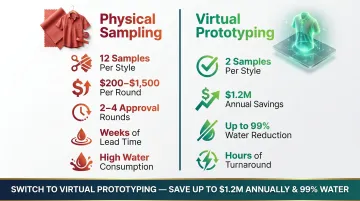
A major fast fashion brand using virtual prototyping reduced physical samples from 12 to 2 per style, saving $1.2 million annually in material and shipping. Academic research confirms virtual sampling can achieve up to 99% reduction in water consumption compared to physical sampling.
When each physical sample costs $200–$1,500 per round and most styles require 2–4 rounds before approval, virtual prototyping eliminates thousands in hidden development costs per style.
Automated Fabric Simulation and Material Visualisation
Advanced fabric rendering technology replicates how specific materials drape, stretch, and move in a digital environment—enabling brands to make confident production decisions without waiting for physical swatches. Digital fabrics can be used directly in online listings, giving buyers a more accurate sense of texture and quality.
Virtual Try-On and Fit Validation
3D body scanning and virtual fitting eliminate the need for physical fit sessions, catching fit issues early and accelerating sign-off. This matters commercially: nearly 40% of online apparel orders are returned, with 70% attributed to fit or sizing issues. Total returned goods in 2024 reached $890 billion across US retail, a 15% increase from 2023's $743 billion.
Virtual fitting gives brands a practical way to address this before production begins:
- Validates fit across multiple body types without physical samples
- Catches sizing inconsistencies early in the development cycle
- Reduces return rates and the customer friction that drives them
Tech Pack Automation
Automated tech pack generation pulls from virtual prototypes to produce bills of materials (BOMs), colorways, measurement sheets, and production-ready documentation — eliminating a key bottleneck between design and manufacturing. What once required days of manual compilation now happens in minutes, with fewer errors and complete version control.
Automation in Fashion Manufacturing and Production
Robotic and Adhesive-Based Garment Assembly
Traditional sewing automation stalled for decades due to fabric's unpredictability. But newer approaches are now ready for production use for high-volume basics:
Robotic sewing workstations handle specific operations—collars, cuffs, hems—with seam accuracy of 1.37-3.11mm (industry benchmark: <3.0mm), validated through collaborative research by Siemens, Sewbo, Levi Strauss, and Bluewater Defense. These systems use temporary fabric stiffening and closed-loop visual servoing to achieve precision stitching.
Adhesive-based assembly systems from providers like Bemis Sewfree are used by Nike, Patagonia, and streetwear brands. These systems replace thread-based sewing with advanced adhesive dispensing, providing smoother lines, lighter weight, and waterproof seams.
These solutions currently work best in standardised, high-volume contexts and are not yet capable of full end-to-end garment assembly. Complex fashion-grade construction still requires human operators.
Automated Fabric Cutting and Inventory Intelligence
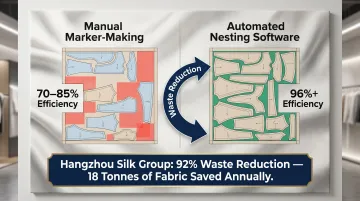
Laser and knife-based automated cutting systems cut material waste using nesting algorithms. Automated nesting software achieves 96% material efficiency or higher, compared to 70-85% for manual marker-making. Hangzhou Silk Group reported a 92% reduction in silk waste after switching to laser cutting, saving 18 tonnes annually.
AI-driven demand forecasting helps brands produce closer to actual need, reducing overproduction. Given that 92 million tonnes of textile waste is produced globally each year, more accurate production planning directly impacts environmental costs and inventory carrying expenses.
Labour and Reshoring Implications
Automation raises legitimate concerns about job displacement, particularly in manufacturing-dependent economies. Bangladesh's textile industry employs 4.5 million people and accounts for 84% of national exports. A survey of 20 factories in Dhaka found the largest facilities anticipate cutting 22% of their workforce due to automation, with each automated machine replacing 1-6 workers.
That displacement picture is real, but incomplete. Automation also generates demand for higher-skilled roles in machine operation, maintenance, and digital production management. Cost reductions from automation make nearshore and onshore production viable, letting brands respond to trends in real time rather than waiting on overseas shipments.
Automating Fashion Imagery and E-Commerce Content
The Visual Content Bottleneck
For fashion e-commerce brands, producing model imagery across hundreds or thousands of SKUs—in multiple colourways, for different markets and channels—is one of the most expensive bottlenecks in the business. Best practice calls for 8-12 images per SKU, with sportswear brands averaging 9 images per product.
Traditional photoshoots require model booking, studio time, styling, post-production, and significant lead time. Average e-commerce photoshoot costs range from $2,500 to $10,000 per day, with model fees of $250-$2,000 per hour, studio rental at $500-$3,000 per day, and hair/makeup at $300-$800 per session. Turnaround from booking to final processed images takes 2-4 weeks.
Mid-size fashion brands spend an average of $15,000 monthly just maintaining product imagery catalogues.
AI Model Imagery as Content Automation
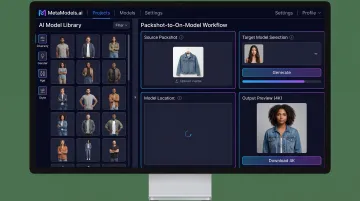
AI-powered platforms now allow brands to convert flat packshot images into fully styled, on-model visuals without a physical photoshoot. Upload a garment image, receive a finished on-model visual — with real-time fabric draping technology ensuring clothing fits, folds, and moves naturally on the digital model. The production economics shift entirely: no studio, no scheduling, no post-processing queue.
MetaModels.ai: Eliminating Photoshoot Bottlenecks
MetaModels.ai enables fashion brands, designers, and e-commerce teams to skip model booking and studio costs entirely, converting packshots into human-reviewed, brand-consistent visuals at up to 4K resolution—ready for use across e-commerce listings, social media, ads, and lookbooks.
Key capabilities:
- Curated AI model library spanning diverse ethnicities, body types, and demographics for inclusive representation at scale
- Custom model creation matched to specific brand identities
- Human review by fashion specialists verifying garment details, textures, and fit before any content goes live
- Flexible pricing from £20 per image, with subscription plans for high-volume catalogues
Scalability and Commercial Impact
Automated imagery platforms allow brands to scale content production across full catalogues without traditional bottlenecks—no model royalties, no studio scheduling, no post-production queues. This changes the economics of seasonal launches, allowing smaller brands to compete visually with larger retailers.
That visual parity has measurable consequences. Research from Coresight shows brands using on-model imagery see a 36% increase in purchase intent compared to flat-lay-only presentation — and when 75% of online shoppers rank product photos as the most important purchase factor, content quality directly drives conversion.
Quality and Brand Consistency
A common concern around AI-generated imagery is consistency — whether garments are rendered accurately enough to represent the product honestly and maintain brand standards. MetaModels.ai addresses this through a human review layer: fashion specialists check every output for garment accuracy, texture fidelity, and fit representation before images go live. The result is content that scales without sacrificing the quality control that brand teams depend on.
Benefits, Challenges, and What to Expect Next
Primary Benefits Across the Value Chain
Faster design cycles and shorter time to market: Virtual prototyping compresses development timelines by weeks, enabling brands to respond to trends before the moment passes.
Significant cost reductions: Fewer physical samples, reduced production waste, and automated content generation eliminate thousands in recurring costs per season.
Improved sustainability: Digital sampling reduces water consumption by up to 99%, automated cutting achieves 96% material efficiency, and better demand forecasting cuts overproduction.
Greater inclusivity: Virtual fitting validates sizing across diverse body types, and AI model libraries enable representation across ethnicities and demographics without the cost barriers of traditional casting.
Real Challenges
High capital costs: Fashion for Good and BCG identified a financing gap of approximately $20-$30 billion per year to develop and scale disruptive innovations in fashion manufacturing.
Integration complexity: Legacy PLM and ERP systems were not designed for automation, creating technical barriers for brands attempting to connect modular automation tools.
Technical limitations: Full robotic assembly of complex garments remains commercially unviable. Sewbots capable of fashion-grade garment assembly at scale do not yet exist.
Workforce transition: Job displacement is a serious concern requiring investment in reskilling alongside technology adoption, particularly in manufacturing-dependent economies.
The Near-Term Trajectory
Fully autonomous end-to-end garment production is still 5-10 years out. What's already compounding in impact: modular, targeted automation—cutting workstations, collar-setting equipment, tech pack generation tools, AI-powered design and content platforms—deployed in sequence across the value chain.
The brands gaining ground are those connecting these modules through shared digital infrastructure. Key indicators of where this heads:
- 91% of retail IT leaders are prioritizing AI implementation by 2026
- McKinsey estimates generative AI could add $150B–$275B to apparel operating profits within 3-5 years
- Brands integrating virtual prototypes, PLM, and automated imagery pipelines are already seeing structural cost and speed advantages
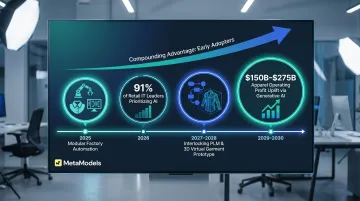
Brands acting now are compressing design-to-market timelines, cutting operational costs, and scaling content with smaller teams. Those advantages widen as the tools mature—making the gap between early adopters and laggards increasingly difficult to close.
Frequently Asked Questions
What is automation in fashion?
Automation in fashion uses technology, AI, robotics, and software to reduce manual effort across design, manufacturing, and marketing—covering everything from digital pattern making to robotic assembly to AI-generated product imagery.
How is AI used in apparel design?
AI generates design concepts, predicts trends, automates pattern adjustments, simulates fabric behaviour digitally, and enables virtual try-ons—all reducing reliance on physical samples and accelerating development timelines.
What are the benefits of automation for fashion brands?
Key advantages include:
- Faster speed to market with shorter development cycles
- Lower costs in sampling and content production
- Reduced material waste through digital prototyping
- Ability to scale operations without proportional headcount growth
- More consistent product quality across large catalogues
How does automation affect fashion photography and product imagery?
AI-powered platforms now convert flat product images into model imagery without physical photoshoots, eliminating model booking costs, cutting turnaround time, and enabling brands to produce consistent on-model visuals across entire catalogues at scale.
What are the challenges of implementing automation in fashion?
The main barriers are:
- High upfront investment costs
- Difficulty integrating new tools with existing systems
- Technical complexity of handling soft fabrics robotically
- Workforce transition challenges in garment-manufacturing-dependent regions
What is the future of automation in apparel manufacturing?
Targeted modular automation—robotic cutting, folding, and specific sewing operations—will scale faster than full garment automation. AI tools are already reshaping design, content production, and marketing, with deeper end-to-end integration expected within 5-10 years.