Introduction
Many businesses struggle with one-size-fits-all AI tools that produce generic results. While general-purpose models deliver acceptable performance for broad tasks, they fall short when workflows demand domain expertise, brand consistency, or regulatory precision. This gap becomes costly when outputs require heavy manual correction, eliminating the efficiency gains AI promises.
Bespoke AI models are AI systems built or fine-tuned on proprietary data, specialized vocabulary, and specific use cases. They're gaining traction across industries from film and healthcare to fashion and finance. According to recent benchmarking, smaller domain-fine-tuned models can outperform massive general-purpose models on specialized professional tasks—a result that's pushing organizations to rethink AI deployment from the ground up.
This article explores what bespoke AI is, why it's gaining momentum, where it's being applied, and how to evaluate whether it's the right investment for your business.
TLDR:
- Bespoke AI models are fine-tuned on domain-specific data, delivering higher accuracy than general models for specialized tasks
- Industries with strict compliance or brand consistency requirements are moving to self-hosted, custom-trained models
- Fine-tuning costs just 1-5% of building a model from scratch, making custom AI viable for mid-sized organizations
- On-premise bespoke deployments can be up to 4x more cost-effective than API services at high usage volumes
- Evaluate bespoke AI when outputs demand regulatory precision, domain accuracy, or heavy manual correction
What Is a Bespoke AI Model?
A bespoke AI model is a machine learning system built, fine-tuned, or customized on proprietary or domain-specific data to perform specialized tasks for a particular organization or industry context. Unlike general-purpose models trained on broad internet data and designed for average use cases, bespoke models learn the vocabulary, patterns, and constraints of a specific domain.
Consider the difference this way: a general AI is a multilingual translator who speaks dozens of languages adequately. A bespoke AI is a specialist who speaks only legal French, with the precision and terminology mastery a law firm actually requires.
Technical Pathways to Bespoke AI
Organizations typically take one of three approaches:
- Fine-tuning a pre-trained base model on curated domain data using the organization's specific examples and terminology
- Training on proprietary datasets built from internal records, transaction histories, or creative assets
- Deploying general models within constrained pipelines that enforce domain-specific rules, validation checks, or output formatting
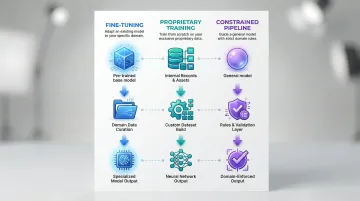
"Bespoke" does not mean "built from scratch." Most modern bespoke approaches start from open-source foundation models like Llama, Mistral, or Qwen, then specialize through fine-tuning. This significantly reduces cost and time compared to training a model from the ground up.
The Defining Output Characteristic
Because bespoke models learn domain-specific vocabulary and constraints, they deliver measurably higher accuracy and relevance within their specialty, even when significantly smaller in parameter size. A well-trained 7-billion parameter medical model can outperform a 175-billion parameter general model on clinical reasoning tasks, because every training token was medically relevant.
Why Businesses Are Moving Beyond One-Size-Fits-All AI
The Performance Gap in Specialized Tasks
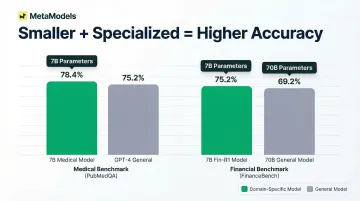
General-purpose AI models optimize for breadth, not depth. They perform reasonably well across many tasks but fall short when outputs must meet high domain-specific accuracy standards. A 7-billion parameter medical LLM outperformed GPT-4 on the PubMedQA benchmark (78.4% vs. 75.2%)—a striking example of how focused training beats raw scale.
The pattern holds in financial services: the 7-billion parameter Fin-R1 model scored 75.2 across financial reasoning benchmarks, outperforming a 70-billion parameter general model that achieved only 69.2. Smaller models trained on concentrated, domain-relevant data consistently outperform larger generalist ones on specialized tasks.
Data Control and Compliance Pressure
Industries operating under strict regulatory frameworks—healthcare (HIPAA), finance (Treasury AI Risk Management Framework), legal (client confidentiality)—face real risk when relying on third-party AI APIs. The European Data Protection Board stated in December 2024 that AI models must be "very unlikely to directly or indirectly identify individuals" to qualify as anonymous under GDPR.
Bespoke models deployed on-premise or in private cloud environments give organizations full control over data handling. That control reduces regulatory exposure and ensures audit-readiness—particularly when processing Protected Health Information or financial transaction data.
Brand and Output Consistency Requirements
For businesses where outputs represent the brand—product imagery, customer-facing content, legal documents—generic AI produces results requiring heavy manual correction. That erases the efficiency gains.
Bespoke models learn a company's specific style, terminology, or visual standards. A fashion brand's custom-trained visual AI will understand how its garments should drape, fit, and appear across diverse body types—capturing fabric behavior and fit nuances that a general image generator trained on random internet photos will consistently miss.
The Open-Source Fine-Tuning Revolution
Permissive open-source base models have lowered the barrier to bespoke AI considerably. Llama model downloads approached 350 million by August 2024, a tenfold year-over-year increase. Organizations no longer need to build foundation models from scratch—they can fine-tune on relatively small curated datasets.
Researchers fine-tuned a 7-billion Mistral model on 103.9 million medical tokens, achieving performance approaching a 70-billion model trained on 2,000 times more data. For fashion brands and e-commerce teams, that same principle applies: a model fine-tuned on your product catalog and brand standards can outperform a massive general model for your specific use case—at a fraction of the cost.
Bespoke AI in Action: Industry Applications
Creative and Visual Industries
Film and Entertainment
Major studios are building project-specific bespoke models trained on production dailies and original creative assets. Lionsgate partnered with Runway to create an AI model trained exclusively on its portfolio of over 20,000 film and television titles. The model generates cinematic video matching a director's specific visual vocabulary—adjusting lighting, editing backgrounds, manipulating scenes in post-production.
This approach sidesteps copyright concerns tied to models trained on third-party content. When Disney and Universal sued Midjourney for copyright infringement, alleging the company pirated their libraries to train its models, it underscored the legal risks of general-purpose AI for creative industries.
Fashion and E-Commerce
Fashion faces a specific pain point: producing high volumes of on-brand, diverse product imagery at scale without traditional photoshoot costs and logistics. Generic image generation tools fall short because they cannot reliably produce accurate fabric draping, fit representation, or style consistency across diverse garment types.
MetaModels.ai exemplifies this approach. The platform builds AI models trained on a brand's specific product catalogue, aesthetic requirements, and diversity needs. Key capabilities include:
- Drapes actual garment fabric onto AI-generated models in real-time, preserving color, shape, texture, and proportions
- Human fashion specialists review every output before delivery, ensuring accuracy that general-purpose tools cannot match
- Produces ready-to-post imagery in up to 4K resolution for e-commerce, social media, and advertising
- Eliminates costs for physical models, studio rentals, and photoshoot logistics entirely

Enterprise and Professional Services
Healthcare and Financial Services
Bespoke models trained on patient-specific records or institutional transaction histories achieve diagnostic and fraud-detection accuracy that generic AI cannot match. GatorTron, an 8.9-billion parameter model trained on over 90 billion words of clinical text, improved natural language inference accuracy by 9.6% and medical question answering by 9.5% compared to smaller clinical models like BioBERT.
In finance, BloombergGPT was trained on 363 billion tokens of financial data across a 50-billion parameter architecture. It outperformed general-purpose models across Bloomberg's financial benchmarks without sacrificing performance on standard NLP tasks.
Legal and Knowledge-Intensive Services
Law firms and professional services organizations use custom-trained AI for contract review, document classification, and compliance monitoring. The model learns firm-specific clause structures, regulatory terminology, and risk patterns that general AI would misclassify or miss entirely. This reduces manual review time while improving accuracy on high-stakes legal analysis.
Bespoke AI vs. Off-the-Shelf: The Key Trade-offs
Performance Advantage for Targeted Tasks
Bespoke models deliver higher accuracy within their domain. A well-trained smaller model can outperform a much larger general model on its target task because:
- Every training example reinforces domain-specific patterns, concentrating the learning signal
- Domain experts can filter training data for relevance and accuracy
- The model learns specialized terminology used in actual workflows
This matters for business ROI. If every output from a general AI requires 20 minutes of manual correction, but a bespoke model reduces that to 2 minutes, the productivity gain compounds across thousands of outputs.
Cost and Time Investment
Bespoke AI requires upfront investment in data curation, model training, and ongoing maintenance. Off-the-shelf tools deploy faster and require no training infrastructure.
Costs have dropped dramatically, though. Fine-tuning costs 1–5% of training from scratch. Here's what the numbers look like in practice:
| Approach | Cost Range |
|---|---|
| Fine-tuning a 7B model (LoRA) | $500 – $5,000 |
| Training a 70B model from scratch | $1.2M – $6M |
Weigh those figures against recurring costs: manual output corrections, traditional photoshoots, document review labor, and productivity losses from AI that doesn't fit your workflow. For high-volume use cases, a 36-month Total Cost of Ownership analysis shows local deployments of bespoke models beat proprietary cloud APIs on per-token cost.
Scalability and Adaptability Dynamics
Off-the-shelf AI scales across diverse use cases with minimal configuration. Bespoke models are optimized for a narrow domain and may need retraining as business requirements evolve.
This is a genuine limitation, particularly in fast-moving industries. If your product line changes quarterly or your regulatory environment shifts frequently, factor in the cost of periodic model updates.
The Hybrid Approach
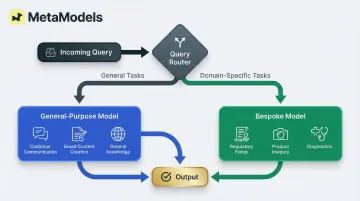
Most organizations don't choose one or the other outright. They use a general-purpose model for broad tasks — customer communication, general content — and a bespoke model for high-stakes specialized outputs like regulatory filings, product imagery, or diagnostic recommendations.
This setup works through query routing: simple requests go to the general model, while domain-specific ones trigger the bespoke layer. The practical result is that you get broad coverage without sacrificing accuracy where it matters most.
How to Know If a Bespoke AI Model Is Right for Your Business
Evaluate Output Specificity Requirements
If your business requires outputs with high domain accuracy—and generic AI requires consistent manual correction—that correction overhead signals bespoke AI would deliver positive ROI.
Signs bespoke AI is worth the investment:
- Errors carry regulatory, legal, or brand reputation consequences
- You produce hundreds or thousands of outputs monthly where small accuracy gains add up fast
- Outputs must match specific visual, tonal, or terminology standards that generic tools can't hold
- You operate in healthcare, finance, legal, or other regulated industries where generic outputs create risk
Assess Your Data Readiness
Bespoke AI depends on quality training data. Businesses with structured proprietary datasets—product catalogues, transaction histories, design assets, client document libraries—are well-positioned to build effective bespoke models.
If your data is unorganized, inconsistent, or scattered across systems, invest in data infrastructure first. A bespoke model trained on poor-quality data will deliver poor-quality outputs.
Once your data is in order, the next question is financial. The ROI calculation should include not just model development cost but the ongoing cost of the alternative:
Calculate Total Cost of Ownership Honestly
- Manual corrections: Time spent fixing outputs from general AI
- Outsourced labor: External consultants, traditional photoshoot logistics, manual document review
- Production costs: Model booking fees, photoshoot logistics, and equipment overhead
- Workflow friction: Time lost when AI tools don't fit your processes
Bespoke AI pays for itself through sustained operational savings. If eliminating 20 hours of manual correction per week saves $50,000 annually, a $25,000 bespoke model investment pays for itself in six months.
Frequently Asked Questions
What is a bespoke AI model?
A bespoke AI model is a machine learning system built or fine-tuned specifically for a particular organization's domain, data, or use case—as opposed to general-purpose AI trained on broad datasets. This results in higher accuracy and relevance for that specific application.
How is a bespoke AI model different from a general-purpose AI model?
General-purpose models are trained for broad applicability across many tasks, performing reasonably well on average. Bespoke models are trained or fine-tuned on domain-specific data, making them more accurate within their specialty but narrower in scope.
What industries benefit most from bespoke AI models?
Industries where domain accuracy, regulatory compliance, or brand consistency is critical benefit most—including healthcare, finance, legal, fashion/e-commerce, and creative production. These sectors deal with specialized terminology and sensitive data where generic AI outputs create real liability or quality gaps.
How much does it cost to build a bespoke AI model?
Costs vary based on scope, data availability, and approach. Fine-tuning an existing model typically runs $500–$5,000 for smaller implementations, while building from scratch can exceed $1 million. For most businesses, fine-tuning delivers the best return without the infrastructure overhead of a ground-up build.
Can small businesses use bespoke AI models?
Yes. Advances in open-source base models and fine-tuning tools have made bespoke AI increasingly accessible. Industry-specific platforms—particularly in fashion imagery—now offer bespoke model capabilities without requiring businesses to manage the technical setup themselves.
How are bespoke AI models used in fashion and e-commerce?
Fashion brands use bespoke visual AI models trained on their specific product catalogues and brand aesthetics to generate accurate, on-brand imagery across e-commerce, social media, and advertising channels. This eliminates traditional photoshoot costs and logistics without sacrificing quality or consistency.