Introduction
Fashion and e-commerce brands face a persistent production problem: generating high volumes of visually consistent creative content across seasonal campaigns, product variants, and localized markets. Traditional photoshoots answer this need—but at a steep cost. A single fashion photography day rate ranges from $1,000 to $3,500 in major markets, excluding post-production, licensing, and ongoing royalty obligations. For brands managing hundreds or thousands of active SKUs, these costs compound quickly while lead times stretch from 6 to 8 weeks.
Custom AI models address this directly. Trained on a brand's proprietary assets, style guides, and product data, they generate imagery that reflects your specific color palette, garment construction, photography conventions, and campaign tone from the first output—no generic stock aesthetic, no manual brand alignment required.
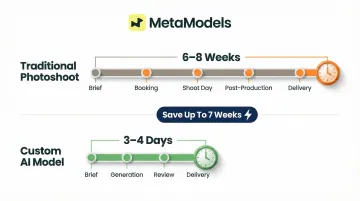
The business impact is measurable. Zalando cut image production from 6-8 weeks to 3-4 days using this approach, with 70% of its Q4 2024 editorial content AI-generated.
TLDR:
- Custom AI models train on brand-specific assets to generate visuals aligned with your identity, not generic stock aesthetics
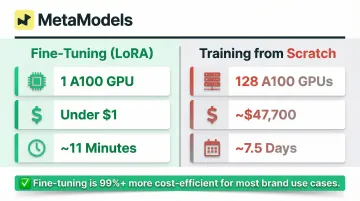
- Fine-tuning costs under $1 and takes ~11 minutes vs. $47,700 and 7.5 days to train from scratch
- Production accelerates from weeks to days while eliminating model royalties and licensing fees
- Platforms like MetaModels.ai use real-time fabric draping and human review to ensure garment accuracy
- ROI comes from speed, cost per image, and content volume scaled together, not from unit cost reduction alone
Custom AI Models vs. Generic AI Tools: Why the Difference Matters
What Generic AI Tools Deliver
Generic AI image generators—trained on broad internet datasets—produce aesthetically competent results that resemble polished stock photography. They excel at creating visually appealing imagery but lack brand specificity. These tools don't understand your color palette, garment construction standards, product photography style, or campaign tone. The output looks professional but feels interchangeable with any competitor's creative.
What Custom AI Models Deliver
A custom AI model is fine-tuned on your curated image library, style guides, and product data. DreamBooth fine-tuning requires just 3-5 high-quality images per concept to successfully embed specific product identity into the model. The AI internalizes your visual rules: lighting preferences, composition conventions, model aesthetics, and brand positioning—then generates outputs that reflect your identity, not a generic middle ground.
MetaModels.ai builds on this with real-time fabric draping technology that preserves:
- Color, shape, and texture fidelity across garment types
- Print placement and proportion accuracy
- Fit and drape characteristics specific to each product
Every AI-generated image also goes through human fashion specialist review for garment accuracy before delivery—something generic self-serve tools don't offer.
Why This Matters for Fashion Brands
For product-led categories, visual accuracy directly shapes purchase decisions and return rates. 71% of consumers have returned items because the product didn't match online imagery, contributing to the National Retail Federation's projected $890 billion in returns for 2024—16.9% of annual sales.
A generic tool produces a convincing image. A custom model produces an accurate one—representing fabric texture, fit, drape, and color faithfully enough to reduce returns and protect brand trust.
The Step-by-Step Process: Building a Custom AI Model for Brand Creative
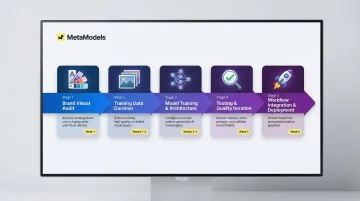
Step 1: Brand Visual Audit and Identity Mapping
Before training begins, your brand's visual DNA must be documented comprehensively. This includes:
- Color palettes and color accuracy standards
- Lighting preferences (studio vs. natural, hard vs. soft)
- Composition styles and product angles
- Model aesthetics (age range, body types, demographics)
- Market positioning cues (luxury vs. streetwear, minimalist vs. maximalist)
This foundational work directly determines the quality ceiling of your AI outputs. The more precise your identity mapping, the more consistently the AI will replicate your brand aesthetic.
Step 2: Training Data Collection and Curation
The model requires a high-quality, labeled dataset of existing brand imagery. Quality means:
- Resolution standards: Minimum 800x800px, ideally 2000px+ for e-commerce zoom capability
- Consistency of conditions: Similar lighting, backgrounds, and shooting angles across the dataset
- Removal of off-brand imagery: Outdated campaigns, inconsistent styling, or non-representative visuals
- Dataset volume: DreamBooth requires just 4-6 images per subject captured under different conditions and angles
Dataset quality is the single biggest determinant of output accuracy. Poorly labeled or inconsistent images produce unreliable results.
Step 3: Model Training and Architecture Selection
Two primary approaches exist:
| Approach | Compute Required | Cost | Time | Use Case |
|---|---|---|---|---|
| Fine-tuning (LoRA) | 1 A100 GPU | < $1 | ~11 minutes | Most brand use cases |
| Training from scratch | 128 A100 GPUs (23,835 hours) | ~$47,700 | ~7.5 days | Highly specialized needs |
Most brands use multiple specialized models working in a pipeline: a style model, a product model, and a character/model library. Parameter-efficient fine-tuning (PEFT) methods like LoRA tune only 0.1% of parameters, resulting in tuned models as small as 3.1MB—fast to train and deploy.
Step 4: Testing, Refinement, and Quality Iteration
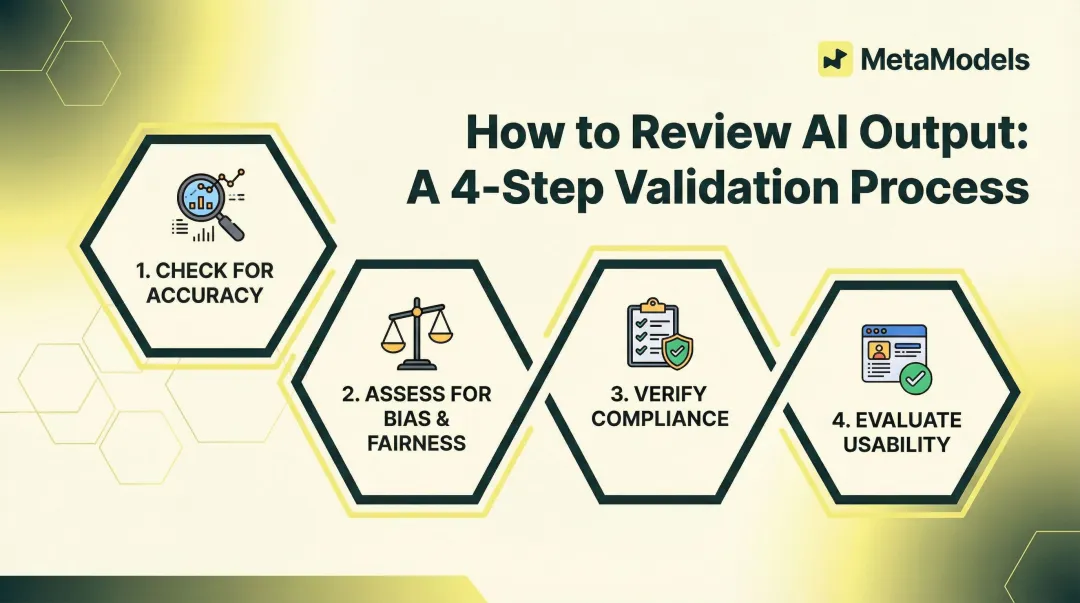
AI-generated outputs require structured human review before deployment. Reviewers check:
- Color accuracy against defined brand palette standards
- Fabric texture, fit, and drape realism across garment types
- Compositional adherence to brand framing guidelines
- Visual artifacts or unrealistic elements that signal AI generation
Metrics like DINO (subject fidelity) and CLIP-I (prompt fidelity) evaluate how well fine-tuned models preserve visual features that give a subject its identity. Plan for 2-4 rounds of iteration between brand teams and AI engineers before outputs meet deployment standards.
Step 5: Workflow Integration and Deployment
Once the model passes quality review, the deployment layer determines whether creative teams actually adopt and scale it. The most effective implementations pair a trained model with an interface built for non-technical users — no prompt engineering, no understanding of AI architecture required.
MetaModels.ai, for example, abstracts away that complexity entirely. Users select from curated AI model libraries, choose styling items and backgrounds, and receive ready-to-post content in up to 4K resolution. Look for platforms that connect with your existing digital asset management (DAM) systems or offer API access for broader enterprise workflows.
Top Use Cases for Fashion & E-Commerce Brands
E-commerce Product Imagery at Scale
Brands use custom AI models to generate consistent on-model imagery across entire catalogs without booking photoshoots for each SKU. On-model product photos outperform flat-lays by 20-30% in conversion rates, yet traditional photoshoots create bottlenecks for brands with hundreds or thousands of active listings.
MetaModels.ai converts flat packshots directly into fully styled model imagery using real-time fabric draping technology that ensures garments render accurately on the AI model. Color, texture, print, and proportions are preserved in the output — the kind of garment accuracy that generic AI tools don't reliably deliver.
Inclusive and Representative Visual Marketing
Custom AI model libraries can be built with intentional diversity across body types, skin tones, ages, and demographics. Inclusive advertising drives a 23-point lift in purchase intent, and 59% of consumers prefer brands that stand for diversity. Custom AI models enable brands to produce inclusive content at the same pace as standard content, rather than treating diversity as a separate, costly production effort.
Social Media and Campaign Content at Volume
Custom AI models allow marketing teams to generate dozens of on-brand variations for a single campaign concept—different backgrounds, lighting moods, or model aesthetics—in hours rather than weeks. Common applications include:
- A/B testing creative performance
- Localizing content for different markets
- Adapting campaigns across Instagram, Facebook, Pinterest, and TikTok
- Producing platform-specific formats (1:1, 4:5, 9:16 aspect ratios)

Lookbooks and Editorial Content
Brands use custom AI models to produce styled editorial imagery that communicates brand story and seasonal positioning without requiring full creative production teams, stylists, or locations. During seasonal transitions, the ability to publish new lookbook content within days — rather than waiting weeks for a shoot to be scheduled and delivered — directly affects sell-through rates.
Advertising and Paid Media Creative
Paid media requires high creative volume across formats, sizes, and audience variants. Custom AI models let brands produce these variants in hours while maintaining the visual consistency that drives recognition in crowded ad environments.
The scale requirements are real: Amazon recommends at least 6 images and 1 video per product, and Shopify supports up to 250 media items per product. Traditional shoots rarely deliver that volume cost-effectively.
The Business Case: ROI vs. Traditional Photoshoots
Cost Reduction and Speed
Traditional fashion photography charges $1,000-$3,500 per day in major markets, translating to $37-$87 per look when shooting 40 looks per day — before post-production, licensing, or royalties. Custom AI model generation cuts per-image costs by removing:
- Studio hire and equipment fees
- Stylist, hair, and makeup talent
- Traditional retouching workflows
- Usage licensing overhead
The stronger ROI case is volume. Brands can generate 10x the content within the same budget cycle, producing catalog-scale imagery that traditional photoshoots simply can't match in throughput.
Royalty and Licensing Risk Elimination
Traditional model photography creates ongoing royalty obligations, usage restrictions by geography or channel, and contract renewal overhead. Commercial model releases grant irrevocable, worldwide, perpetual rights. Even so, unauthorized use carries severe penalties — $30,000-$150,000 per image for willful infringement.
Custom AI model imagery generated through compliant platforms eliminates these variables entirely. Brands receive full usage rights with no expiry, no geographic restrictions, and no third-party royalty payments.
Speed to Market as Competitive Advantage
Fashion operates on seasonal windows where moving fast is commercially significant. Zalando reduced image production from 6-8 weeks to 3-4 days using generative AI. Brands using custom AI models can produce campaign-ready imagery within days of confirming a new product, rather than waiting weeks for photoshoot logistics to align. In an industry where ultra-fast-fashion players introduce 2,000-10,000 new items daily, that gap in production speed compounds quickly.
How to Evaluate Custom AI Model Platforms
Brand Fidelity and Customization Depth
Ask whether the platform trains on your brand's assets or applies a generic style filter. True customization means the model has internalized your specific product details, photography conventions, and aesthetic rules: not simply a style prompt layered on top of generic outputs. Request direct before/after examples with brands similar to yours in category and visual complexity.
Human Quality Review and Accuracy Validation
For fashion and apparel, garment accuracy is non-negotiable. Evaluate whether the platform has a human review layer that checks outputs for fabric accuracy, fit representation, and product detail before delivery. MetaModels.ai builds human verification directly into their workflow: every image is reviewed by fashion specialists for color, shape, and proportions before entering the production pipeline. Without this step, inaccurate garment renders can reach live listings and erode buyer confidence.
Output Format, Resolution, and Channel Readiness
Confirm the platform delivers production-ready content at appropriate resolution:
| Platform | Minimum Resolution | Recommended Resolution | Max Size | |----------|-------------------|------------------------|----------|\n| Amazon | 1000px (longest side for zoom) | 2000px+ | 10,000px | | Shopify | 800x800px | 2048x2048px | 5000x5000px | | Google Merchant | 250x250px (apparel) | 800x800px+ | 64MP | | Meta Ads | 1080x1080px | 1080x1080px (1:1) | Varies by placement |
Ideally, platforms deliver up to 4K resolution in formats suited for e-commerce, social media, lookbooks, and advertising—not raw AI outputs requiring additional post-production.
Scalability, Workflow Integration, and Support Model
Technical output quality only matters if the platform fits your team's actual workflow. Before committing, evaluate:
- Whether the tool supports team-level access or is built for individual users only
- How it connects with your DAM or online storefront
- What ongoing support looks like as your content volume grows
- Whether enterprise tiers include API access, dedicated account management, and volume pricing
Frequently Asked Questions
Who develops custom AI models for brand creative?
Custom AI models for brand creative are developed by specialized AI platforms that combine model training expertise with creative production knowledge. These providers fine-tune models on a brand's proprietary assets, style guides, and product imagery — ensuring outputs stay consistently on-brand rather than defaulting to generic results.
How long does it take to build a custom AI model for a brand?
Most custom brand model implementations take several weeks from initial asset collection to deployment-ready output. The fine-tuning phase is relatively fast, but quality iteration and workflow integration account for most of that time.
What training data does a brand need to build a custom AI model?
Brands typically need a curated library of high-resolution, consistently shot product and lifestyle imagery that reflects their current visual identity. The quality and consistency of the training dataset is the biggest factor in determining output accuracy—poorly labeled or inconsistent images produce unreliable results.
How do custom AI models maintain brand consistency across different outputs?
Brand consistency is maintained because the model is trained to internalize specific visual rules—color palette, lighting style, composition conventions—rather than generating from generic prompts. Combining this with structured prompt templates and human review layers further enforces consistency across campaigns.
Are images created with custom AI models commercially safe to use?
Brands should verify that the platform uses commercially licensed or proprietary training data and grants full usage rights to generated outputs, with no third-party royalty obligations or geographic restrictions. MetaModels.ai, for example, provides unlimited commercial usage rights with zero licensing fees and no model royalties.
How do custom AI models compare to traditional photoshoots for fashion brands?
Custom AI models offer significant advantages in speed, cost per image, and content volume—enabling brands to produce catalog-scale imagery without booking models, studios, or post-production teams. The trade-off is an upfront investment in model training and quality setup, after which ongoing production costs are far lower and turnaround times shrink from weeks to days.