Introduction
Traditional fashion photoshoots—once the unchallenged gold standard for brand campaigns—now face a direct challenge. The process is familiar: book models weeks in advance, secure studio time, coordinate stylists and photographers, shoot hundreds of images, then wait days for editing. AI tools can now generate campaign-ready fashion imagery in minutes, eliminating most of this workflow. The real question facing the industry is no longer whether AI will disrupt fashion photography, but what that disruption costs—and who bears it.
The numbers tell the story. The global Generative AI in Fashion Market grew from $96.5 million in 2023 and is projected to reach $2.23 billion by 2032, a 36.9% annual growth rate. At the same time, 58% of photographers have already lost commissioned work to generative AI, with average annual losses surging 142% year-over-year to $34,900 per photographer.
This article unpacks all of it — the new visual workflows brands are adopting, what AI means for diversity and creative control, the regulatory pressure building worldwide, and where the industry goes from here.
Key Takeaways
- AI compresses traditional multi-week photoshoot timelines into minutes while reducing production costs by up to 80%
- AI-generated models enable diverse, size-inclusive imagery at scale without casting constraints
- Photographers' roles are shifting: AI absorbs volume work, freeing human creativity for editorial and brand storytelling
- 84% of consumers want AI disclosure — and New York and EU regulations enforcing it take effect in 2026
- Winning brands will combine AI's production speed with human judgment to maintain consistent quality and brand voice
How AI Is Rewriting the Rules of Fashion Photography
The traditional fashion photography workflow is collapsing under its own weight. Brands once accepted that booking models, scheduling studio time, coordinating stylists and photographers, and editing hundreds of images would take weeks. That timeline is becoming commercially unviable when AI can deliver comparable results in hours.
This shift is already operational reality for many fashion companies. 73% of fashion executives acknowledge generative AI as a priority, and 43% of fashion companies reported using AI in at least one business function in 2023. The technology is already embedded in production workflows across the industry.
Core AI Capabilities Reshaping Production
Five specific AI capabilities now address distinct pain points in conventional workflows:
Product-to-model transformation converts flat-lay or packshot images into fully styled model photographs without physical shoots. The AI drapes actual garment fabric onto photorealistic models, preserving color, texture, print, pattern, and proportions. This directly eliminates the single most expensive workflow component: coordinating live talent and studio resources.
Virtual try-on technology allows customers to visualize garments on themselves or customizable avatars before purchase, reducing return rates while personalizing the shopping experience.
Background generation and scene creation replace location scouting and set design. Brands can swap backgrounds, lighting conditions, and environments post-generation, creating seasonal variations from a single original image without reshooting.
AI-powered post-production automates retouching, color correction, and image enhancement that once required specialized editors working frame-by-frame.
Static-to-video conversion transforms still images into motion assets for social media—a particularly valuable capability as short-form video dominates platforms like TikTok and Instagram Reels.
The Cost Economics Are Forcing Adoption
Traditional professional photoshoots carry substantial costs: photographer fees ($500–$3,000/day), studio rental ($200–$1,000/day), model booking ($500–$5,000/day), props and styling ($500–$2,000/session), and post-production editing ($10–$50/image). A 100-product catalog typically runs $10,000–$30,000.
AI platforms offer fundamentally different economics. One D2C brand case study documented an 80% cost reduction: annual photography spend dropped from $42,000 to $8,400, per-image costs fell from $175 to under $2.00, and production volume increased 10x—from 200 to 2,000 images annually.
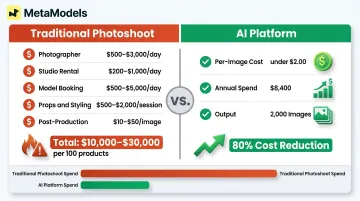
The cost advantage creates real structural pressure. Brands adopting AI can test more SKUs, move faster on trend cycles, and redirect saved budget toward distribution or paid media—while competitors are still waiting on shoot approvals.
How Client Expectations Are Changing
AI mock-ups and pre-visualization tools are fundamentally altering client-photographer relationships. Photography agents report that clients now arrive with AI-generated scamps showing near-finished references rather than directional mood boards.
Laura Dawes of Webber Represents notes that AI mock-ups often depict scenarios physically impossible to produce under actual shoot conditions. The agency updated contract terms to require AI-generated briefings be signed off by the agency first, protecting photographers from being held to unachievable standards.
Photographers increasingly hear they're "pitching against generative AI" for commercial assignments. The bar for winning work has shifted—human photographers must now demonstrate value beyond what AI can deliver at fraction of the cost.
The Quality Gap Is Closing but Still Visible
Early AI fashion imagery suffered from anatomical errors, fabric rendering inconsistencies, and uncanny-valley effects. Quality has improved dramatically, but problems persist.
J.Crew's 2025 AI campaign exhibited visible glitches including jawlines that realigned between shots, rugby polo stripes that fuzzed into "static," and implausibly torqued feet. Guess's August 2025 Vogue ad showed "plasticized" skin and faces that "subtly morphed" across different images.
Newer platforms address these limitations through real-time fabric draping, human review processes, and specialized rendering for complex materials. MetaModels.ai uses human fashion specialists to review every AI-generated image before delivery, verifying color accuracy, shape, proportions, and garment details. That review layer matters most in categories like tailoring and luxury knitwear, where a misrendered seam or inconsistent drape directly undermines buyer confidence—the exact scenarios where AI still falls short without specialist oversight.
From Packshots to Full Campaigns: The New AI Visual Workflow
Fashion brands now follow a dramatically compressed production process: upload a single product flat-lay, generate fully styled model imagery with varied backgrounds and poses, produce multiple colorways and styling variations—all without a single physical shoot.
The Product-to-Model Transformation Process
The workflow begins with a packshot—a flat-lay or ghost mannequin photograph of the garment. From there, the process moves quickly:
- Upload the packshot to an AI platform and select or customize models from diverse libraries covering different ethnicities, body types, ages, and demographics
- Choose a background from curated libraries or request a custom scene matching brand identity
- AI drapes the garment onto the selected model in real-time, preserving fabric texture, print accuracy, and drape
- Specialized rendering handles technical fabrics (activewear stretch, compression fits, moisture-wicking textures) and luxury details (color precision, embellishment accuracy)
MetaModels.ai's real-time fabric draping technology preserves color, shape, texture, print, and proportions throughout. Every generated image then goes through human review by fashion specialists before delivery—ensuring automated outputs meet professional standards.
Scalability Transforms Content Strategy
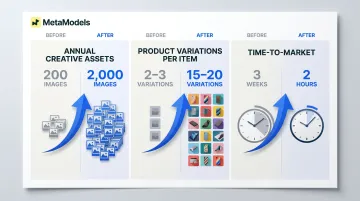
The biggest shift is raw production volume. A brand that previously created 50 images per season can now generate hundreds across multiple models, colorways, contexts, and poses within the same budget.
The D2C case study mentioned earlier shows what this looks like in practice:
| Metric | Before AI | After AI |
|---|---|---|
| Annual creative assets | 200 images | 2,000 images |
| Product variations per item | 2–3 | 15–20 |
| Time-to-market | 3 weeks | 2 hours |
This scalability enables entirely new content strategies. Brands can now create dedicated image sets for different platforms (Instagram, TikTok, Pinterest, Amazon), regional markets, and demographic segments simultaneously—at a cost structure that would have been impossible under traditional production constraints.
Post-Production and Content Repurposing
AI extends beyond still imagery into motion content and repurposing. Brands increasingly convert static fashion images into short-form video for social media, animate stills, and generate video content from single original photographs.
Charlotte Long of Academy Films reported instances where photographers shot still images, which brands then used AI to convert into "motion assets" for social media without the photographer's consent or input. This creates legal and creative conflicts, as photographers would have used different lighting techniques had they known the end product was video.
The International Advertising Bureau projects that generative-AI creative will reach 40% of all ads beginning in 2026, driven largely by platforms' prioritization of video content.
Commercial-Use Readiness Matters
As AI-generated content scales toward that 40% threshold, output quality becomes the deciding factor for commercial viability. Brands evaluating AI platforms should verify:
- Resolution: 4K minimum for professional e-commerce and advertising use
- File format compatibility: Check against platform and print spec requirements
- Licensing terms: Confirm unlimited commercial rights with no model royalties
MetaModels.ai provides unlimited commercial rights across e-commerce, social media, paid advertising, and lookbooks—eliminating the model release forms and usage restrictions that complicate traditional photography.
AI Models, Diversity, and the Inclusivity Opportunity
Traditional model casting has historically constrained representation. Geographic limitations, casting budgets, agency availability, and entrenched beauty standards made truly diverse campaign imagery difficult and expensive to produce consistently.
How AI Removes Casting Constraints
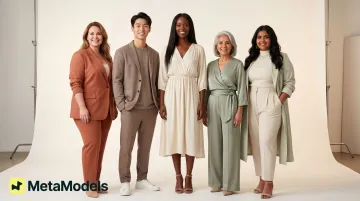
AI model libraries featuring diverse ethnicities, body types, ages, and demographics eliminate the structural barriers to inclusive representation. Brands can select from curated libraries or create custom models matching their specific customer base—without coordinating availability, negotiating rates, or managing geographic logistics.
MetaModels.ai's library offers customizable AI models across ethnicity, body type, and age range—with custom model creation options that match a brand's actual customer demographics rather than defaulting to whoever's available and affordable.
The scalability matters. A brand launching a plus-size line can generate hundreds of images featuring models of diverse body types within the same timeline and budget as a single traditional photoshoot—something that simply wasn't viable before AI.
The Levi's Controversy: A Cautionary Case
Scalability doesn't automatically translate to credibility. Levi's March 2023 partnership with Lalaland.ai to generate AI models showing diverse body types and skin tones triggered immediate backlash, with critics accusing the brand of "performative representation"—using AI as a cheap substitute for actually hiring diverse talent.
Professor Shawn Grain Carter of the Fashion Institute of Technology stated bluntly: "Let's make no mistake about it, Levi's is doing this because it saves money." The Model Alliance noted AI is "reshaping the modeling industry... by introducing synthetic models that threaten jobs."
Using AI to simulate diversity without hiring diverse talent elsewhere invites "diversity washing" accusations. Responsible AI inclusivity supplements human representation—it doesn't replace it.
Digital Model Clones: Consent and Compensation
One approach gaining traction involves real models licensing their likeness as AI avatars. H&M announced in March 2025 plans to create digital "twins" of 30 models, with models retaining rights over their digital replicas and receiving compensation. Images include watermarks distinguishing AI content.
Platforms like Kartel.ai enable models like Hannah James to license their likeness as AI avatars, retaining choice over which brands can use their digital representation. This consent-based model addresses some ethical concerns, though critics note it still reduces demand for physical modeling work.
New York has moved to formalize these practices through two laws now in effect:
- Fashion Workers Act (effective June 2025): Requires AI consent to specify scope, purpose, duration, and compensation
- Digital Replica Law (effective January 2025): Establishes legal protections for model likeness used in AI-generated content
The Human Creativity Question: What AI Can't Replace
A crucial distinction is emerging: AI dominates volume content (e-commerce product pages, catalog shots, social media grids) but struggles to replicate hero content (editorial, campaign storytelling, runway photography).
Volume vs. Hero Content
Photographer Jack Davison articulated this divide clearly. Speaking to Vogue, he emphasized "a sense of physicality" in his work, aiming to create imagery that feels "tactile and human"—qualities AI currently cannot reproduce convincingly for audiences attuned to visual authenticity.
Kalpesh Lathigra of London College of Communication echoed the point: "A machine can give you millions of possibilities, but it can't give you that elusive, intangible thing that draws us in and holds us."
Both photographers are pointing at the same gap: AI-generated imagery excels at functional product representation but lacks the emotional resonance and creative authorship that define premium brand storytelling. The result is clear market segmentation — AI for e-commerce efficiency, human photography for brand equity.
How Photographers Are Adapting
Photographers are responding in two distinct ways:
- Embracing AI as a tool — using it for storyboarding, background replacement, and animation while retaining human authorship over core creative decisions
- Doubling down on analog — leaning into in-camera techniques as a deliberate differentiator, positioning their work as an antidote to AI-generated "slop"
Neither approach signals replacement. Both reflect a maturing ecosystem still finding its shape.
The Talent Pipeline Crisis
The adaptation debate, however, sidesteps a harder problem: where does the next generation of photographers learn the craft?
Entry-level "bread-and-butter" work — e-commerce product photography, catalog shoots, "pack photography" — historically funded emerging photographers while they built portfolios and reputations.
AI is now replacing these assignments. The AOP survey found that each lost photography shoot affects up to 10 additional workers — assistants, stylists, retouchers, set designers — creating ripple effects across the broader creative workforce.
Jack Davison warned AI is removing "random early jobs" and "grunt work" that allow emerging photographers to learn the craft. The question facing the industry: where will the next generation of photographers develop their skills if the entry-level work no longer exists?
Consumer Perception, Ethics, and Emerging Regulations
Consumer reception of AI fashion imagery remains deeply mixed. Brands face growing scrutiny over transparency, authenticity, and the displacement of human talent.
Consumer Attitudes and Trust
A September 2025 Clutch.co survey uncovered sharp contradictions. 57% of consumers could not identify AI photos when tested, despite 66% claiming pre-test confidence they could spot AI. Yet 84% want brands to disclose AI use, and 95% express concerns about AI imagery.
Specific worries center on deception: 71% worry AI images may be misleading. Attitudes toward purchasing tell a different story: 42% are neutral about buying from sites using AI product photos, 33% are positive, and only 25% are negative.
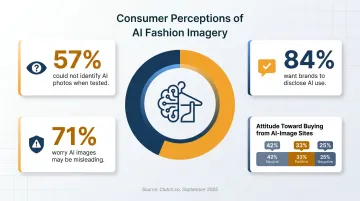
For fashion brands, the practical takeaway is clear: consumers don't reject AI — they reject being deceived. Disclosure is the variable that separates backlash from acceptance.
Brand Backlash Examples
Several brands faced criticism for AI imagery missteps:
- J.Crew (2025): AI campaign for Vans collaboration drew backlash after glitches were spotted; initially uncredited
- Guess (August 2025): AI-generated Vogue ad exhibited "plasticized" skin; disclosed as AI only in small print
- Mango: AI-generated models in marketing criticized for replacing human talent
- Levi's (2023): AI diverse models triggered "performative representation" accusations
- Gucci (2026): AI-generated images received mixed reviews and negative consumer feedback
Aerie took the opposite approach, publicly disavowing AI in marketing and positioning as an authenticity-first alternative. It worked — showing that a clear anti-AI stance can itself be a competitive differentiator.
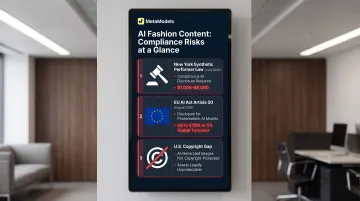
New York and EU Disclosure Laws
Regulatory requirements are converging rapidly. Two major laws take effect in mid-2026, with meaningful differences in scope and penalties:
| Regulation | Effective Date | Requirement | Penalty |
|---|---|---|---|
| New York Synthetic Performer Law | June 9, 2026 | Conspicuous disclosure of AI-generated "synthetic performers" in commercial ads | $1,000 first violation; $5,000 subsequent |
| EU AI Act Article 50 | August 2, 2026 | Disclosure when AI content could be mistaken for real/human-created; covers AI models and photorealistic e-commerce images | Up to €15M or 3% of global turnover |
Both deadlines are months away. Brands operating in New York or the EU need disclosure systems in place before summer 2026 — not after the first fine.
Copyright and IP Uncertainty
Beyond compliance, brands face a separate IP risk. The U.S. Copyright Office maintains that AI-generated works do not qualify for copyright protection unless human contributions are clearly identified and claimed — AI prompting is considered closer to "proposing an idea" than producing "protected expression."
This creates IP vulnerability: brands investing heavily in AI-generated visual assets may find those assets legally unprotectable. The absence of copyright means competitors can freely copy AI-generated imagery without recourse.
Key Trends Shaping the Future of AI Fashion Photography
Several emerging trends signal where the industry is heading.
3D Design and Digital Garment Prototyping Convergence
Browzwear's July 2025 acquisition of Lalaland demonstrates the convergence of 3D garment design with AI model generation. The integration allows brands to go from digital sketch to fully styled model image without producing a single physical sample.
CEO Greg Hanson stated the combination will "dramatically cut the time between concept and commerce." This eliminates not just photoshoots but also sample production, pattern-making, and fit testing—compressing the entire product development cycle.
For brands, this means:
- Faster time to market with fewer physical dependencies
- Reduced sample waste across the development pipeline
- Ability to test market response before committing to production runs
AI-Powered Trend Forecasting
Platforms like Heuritech analyze millions of social media images daily using computer vision to identify fashion attributes—colors, prints, patterns, silhouettes. The company reports over 90% accuracy in trend prediction detecting more than 2,000 fashion attributes.
This connects content strategy directly to predictive consumer data. Brands can forecast which styles will trend, photograph those products first (whether traditionally or via AI), and launch campaigns timed to peak consumer interest.
Human-in-the-Loop Quality Assurance
The more AI image generation scales, the harder it becomes to maintain consistent output quality. Human review has emerged as the industry's answer to this problem.
MetaModels.ai, for instance, has human fashion specialists review every AI-generated image for color accuracy, shape, proportions, and garment details before delivery. That combination of automated speed and specialist sign-off is increasingly the standard brands expect from production-grade AI imagery.
AI Video Content Growth
AI increasingly generates short-form fashion video from static images, driven by TikTok and Instagram Reels dominance. The IAB projects generative-AI creative will reach 40% of all ads beginning in 2026.
Brands can now produce high volumes of short-form video content without proportionally growing budgets or production teams—critical for maintaining presence on video-first platforms where static imagery underperforms.
Frequently Asked Questions
Will AI completely replace fashion photographers?
No, but displacement is uneven. AI is rapidly replacing volume and e-commerce photography where efficiency and cost matter most. Editorial, campaign, and creative work requiring human authorship, physicality, and narrative depth remain valuable. The industry is bifurcating: AI for functional imagery, humans for brand storytelling.
How do AI-generated fashion images stay true to the actual garment?
Platforms built specifically for fashion — using real-time fabric draping, texture preservation, and human review — reliably preserve print, pattern, and material details. General-purpose AI tools often fail at garment-specific accuracy. Platform selection is critical for commercial use.
How much can fashion brands realistically save using AI photography?
Cost reductions of 80–90% versus traditional photoshoots are well documented. One D2C brand reduced annual photography spend from $42,000 to $8,400 while increasing output 10x. MetaModels.ai offers per-image pricing starting at roughly $0.24 USD, compared to traditional per-image costs of $175+ in Western markets.
Can AI fashion photography support diverse and size-inclusive representation?
Yes—AI model libraries represent wide ranges of ethnicities, body types, and demographics at scale. However, responsible use means supplementing (not substituting for) genuine human diversity across the broader brand. The Levi's backlash demonstrated that AI diversity without human hiring draws "diversity washing" accusations.
Are AI-generated fashion images legal to use in commercial advertising?
Most reputable platforms grant commercial usage rights. However, New York (June 2026) and the EU (August 2026) now require disclosure of AI-generated human likenesses in commercial advertising. Review platform terms of service, verify commercial licensing, and implement disclosure systems before publishing AI content in paid ads.
What should brands look for when choosing an AI fashion photography platform?
Prioritize garment accuracy (real-time fabric draping, human review), output resolution (4K minimum), a diverse AI model library, unlimited commercial licensing with zero royalties, and end-to-end production management. MetaModels.ai includes fashion specialist review at each stage, which general-purpose tools skip entirely.