Introduction
A traditional fashion shoot—studio rental, model fees, stylist, photographer, post-production—can run $5,000 to $50,000 before a single image goes live. By 2026, AI-generated fashion imagery has made that equation optional. Brands now produce the same output in days, not weeks, at a fraction of the cost.
For fashion brands, e-commerce teams, and marketing professionals, the challenge is no longer whether to adopt AI imagery — it's how fast. Teams that struggle with content volume, inconsistent visual quality, or ballooning production budgets are finding AI models solve all three at once.
This article covers how AI fashion models work, what's driving adoption in 2026, and what brands need to know to integrate them effectively into their visual workflows.
Key Takeaways
- AI fashion models cut production costs by 80-95% and compress timelines from weeks to days
- The AI-generated fashion photography market grew from $1.51B in 2024 to $2.01B in 2025, with projections reaching $6.12B by 2029
- Five trends define fashion in 2026: packshot-to-model conversion, diversity libraries, AI campaigns, fabric rendering, and video
- Regulatory pressure and consumer acceptance are shaping deployment strategies as New York's June 2026 disclosure law takes effect
- Brands adopting AI workflows now are scaling content output faster than competitors still relying on traditional shoots
5 Key Trends in AI Fashion Photography in 2026
Trend 1: Packshot-to-Model AI Conversion Goes Mainstream
Packshot-to-model conversion transforms flat product photography—ghost mannequin shots, hanger images, or flat lays—into fully styled, on-model imagery using AI. This capability has become central to e-commerce content strategies in 2026 because it eliminates the single largest bottleneck in fashion photography: physical model availability.
Real-world adoption:
- Zara confirmed in December 2025 it uses AI to generate new images of real models in different outfits, drastically speeding production
- H&M announced plans to create 30 "digital twins" of real models in 2025, allowing models to work for any brand and receive payment per use
- Mango became the first major brand to replace core product page photos with AI-generated on-model visuals
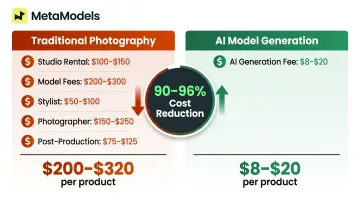
The cost impact is measurable. Traditional photography showing one product on four diverse models costs $200–$320 per product; AI model generation costs $8–$20—a 90–96% reduction.
Platforms like MetaModels.ai now offer packshot-to-model conversion with real-time fabric draping technology and human-reviewed outputs, delivering ready-to-post 4K content without a single photoshoot. Brands upload flat-lay or ghost mannequin images and receive garment-accurate, on-model content that preserves color, texture, and proportions.
Trend 2: AI Model Diversity Libraries Redefine Inclusive Representation
Curated AI model libraries now offer brands instant access to diverse body types, skin tones, ethnicities, ages, and demographics. For the first time, size-inclusive and representative imagery is logistically simple. Traditional casting required extensive coordination, extended timelines, and significantly higher budgets. AI libraries eliminate those barriers.
Business impact beyond ethics:
According to McKinsey's 2024 retail report, 67% of consumers actively consider brand inclusivity when making purchase decisions, and 42% have switched away from brands perceived as lacking diverse representation. Shoppers who feel represented show 59% stronger brand loyalty, according to Deloitte's 2024 survey.
Brands adding size-diverse models report a 10–20% decrease in fit-related returns. The representation gap remains stark: consumers over 40 control over 70% of disposable income but appear in less than 15% of fashion e-commerce imagery.
AI model libraries close this gap on demand. Brands generate imagery featuring diverse body types, ages, and abilities without extensive casting infrastructure. Better representation translates directly to improved shopper confidence and lower return rates.
Trend 3: End-to-End AI Campaign Creation at Scale
AI fashion models now power entire campaign pipelines, covering product catalog imagery, social media ads, lookbooks, and regional variants. Multi-day photoshoots for routine marketing content are increasingly optional. Brands generate multiple variations of the same product with different models, styling, and backgrounds for A/B testing across channels.
Confirmed brand deployments:
- Valentino posted an AI-generated video in December 2025 promoting its DeVain handbag, a surreal collage of models spliced between Valentino logos, labeled "created with AI"
- Gucci unveiled an AI-generated campaign for Fall/Winter 2025 using hyper-realistic virtual models ahead of Demna Gvasalia's Milan runway show
- Hugo Boss has used AI imagery across e-commerce platforms since 2023
- Jil Sander and MCM Worldwide deployed AI-assisted campaigns in early 2025
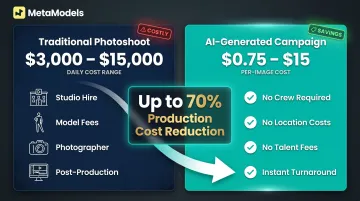
Traditional photoshoots cost $3,000–$15,000 per day for studio hire, models, photographers, and post-production. AI-generated per-image pricing drops from $150–$500 to approximately $0.75–$15, according to industry comparisons. Berlin-based AI studio Parallel Pictures reports AI-generated e-commerce imagery reduces production costs by up to 70% compared to traditional studio shoots.
Trend 4: Real-Time Fabric Rendering Closes the Authenticity Gap
Real-time fabric rendering means AI systems can simulate accurate garment drape, texture, weight, and movement on a digital model. Before 2025, this was the key technical barrier to broad adoption: early AI fashion imagery showed obvious distortions in fabric behavior that disqualified it for commercial use.
By 2026, the technology has matured. AI images now show subtle fabric behaviors, including wrinkle patterns, stretch, translucency, and garment weight, producing results that are largely indistinguishable from traditional photography.
A Stylitics/Aha Studio survey of 411 shoppers found 71% could not distinguish between a real photo and an AI-generated image. That perceptual parity extends across most standard garment types, and platforms have expanded to handle technically demanding materials:
- Stretch fabrics and athletic materials with accurate compression and moisture-wicking textures
- Structured garments preserving shoulder fit, lapel detail, and trouser break
- Luxury embellishments maintaining texture, proportion, and detail accuracy
Once this material-accuracy threshold was crossed, major fashion brands had little reason to delay public deployment.
Trend 5: AI Fashion Models Move Into Video and Dynamic Content
AI-generated fashion video content, including moving models, clothing in motion, and short-form social clips, emerged rapidly in 2026 as brands seek to extend AI's cost benefits from stills into video production. Multiple platforms now generate 5–10 second clips from product photos, with pricing from $6.99–$94.99/month.
An estimated 19,000+ fashion brands currently use AI model generation services, and video adoption is accelerating. Pic Copilot reported internal testing showing 150% conversion rate improvement over static images.
Current state and limitations:
AI video for fashion is in rapid development but still maturing. Most tools output at 720p–1080p with duration caps of 5–10 seconds. Complex movements still risk texture warping or proportion shifts. Industry sources note AI-generated video is "currently deemed unsuitable for high-end commercial use beyond short clips due to product distortion/warping during motion."
Despite those limitations, brands are deploying AI video for:
- E-commerce product pages to enhance conversion
- Social media reels for Instagram, TikTok, and Facebook
- Paid advertising campaigns
- Quick A/B testing of creative concepts
Still-image quality already meets commercial standards; video is catching up quickly, and most current limitations are expected to resolve within the next product generation cycle.
What's Driving These AI Fashion Photography Trends
Technology maturation, market demand, cost pressure, regulatory forces, and competitive dynamics are converging. Over $2.5B has been committed to fashion AI since 2022, accelerating development across the entire stack.
Technology Advances
The transition from early GANs to controllable diffusion models gave brands the ability to specify exact garment details, model attributes, lighting, and composition—making AI outputs brand-consistent rather than random. In 2022, AI fashion images were visibly distorted with obvious artifacts. By 2026, 71% of consumers cannot distinguish AI from traditional photography.
That quality leap unlocked commercial deployment: brands can now trust AI imagery to represent products accurately, meet marketplace compliance standards, and maintain luxury presentation quality.
Market Demand and Customer Expectations
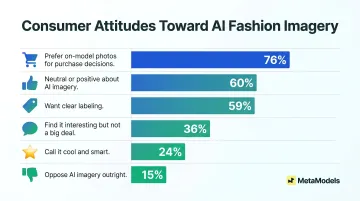
Consumer acceptance of AI-generated content has grown sharply. The Stylitics survey found:
- 60% of shoppers are neutral or positive when informed imagery is AI-generated
- 36% said it was "interesting but not a big deal"
- 24% called it "cool and smart"
- Only 15% opposed AI imagery outright
- 76% said on-model photos (real or AI) are the most useful format for purchase decisions
- 59% want clear labeling
Gen Z consumers show even higher acceptance rates, making AI-generated content commercially viable across most fashion segments.
Cost Pressures and Efficiency Needs
Traditional fashion photoshoots require location fees, photographer rates, model talent fees, stylist costs, assistants, equipment rental, and multi-week post-production. AI-generated campaigns eliminate model booking, royalties, and logistical overhead entirely.
The cost structure shift is dramatic. Berlin-based Parallel Pictures reports approximately 50% savings on campaign-related AI work compared to traditional production. Brands producing 10x the visual content at lower cost gain measurable advantages in catalog depth and social share.
Returns cost U.S. retailers nearly $890B in 2024. AI-generated diverse model imagery improves shopper confidence and reduces fit-related returns — directly attacking that cost center. McKinsey estimates this creative application alone could account for up to 25% of AI's total potential value in fashion.
Regulatory and Competitive Dynamics
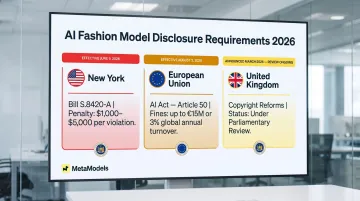
Three major regulatory frameworks are now shaping how brands deploy AI model imagery publicly:
- New York Bill S.8420-A/A.8887-B (effective June 9, 2026): Requires conspicuous disclosure of AI-generated synthetic performers in ads. Penalties: $1,000 first violation, $5,000 each subsequent.
- EU AI Act Article 50 (expected August 2, 2026): Requires watermarks and metadata for AI-generated content. Non-compliance fines reach €15M or 3% of global annual turnover.
- UK Copyright Reforms (announced March 2026): Regulatory review underway on AI content labeling requirements.
Transparency is no longer optional — it's a compliance baseline. Brands using AI as a competitive lever for content volume still need to build disclosure practices into their workflows from day one.
How These Trends Are Impacting the Fashion Industry
AI fashion model adoption is triggering measurable changes across operations, business strategy, and workforce composition. The impacts are already quantifiable in 2026.
Operational Impact
Production timelines that once required 4-8 weeks—casting, travel, shoot coordination, post-production—now compress to 3-7 days. Teams run simultaneous content iterations for multiple markets, seasons, and channels without scheduling conflicts.
Platforms offering end-to-end AI production management eliminate model booking, royalties, and logistical overhead entirely. Brands can generate multiple variations of the same product with different models, styling, and backgrounds for A/B testing across Instagram, Facebook, Pinterest, and TikTok — without incremental production costs.
Small teams can now produce content volumes that previously required dedicated production departments.
Business Impact
Brands are reallocating photography budgets away from logistics — crew, location, talent fees — and toward creative strategy and high-concept editorial work that AI cannot replicate. The shift is toward content abundance.
Brands that previously produced 50-100 hero images per season are now generating 500-1,000 images across diverse models, styling variations, and regional adaptations. That volume enables:
- Granular A/B testing of ad creatives
- Personalized marketing by audience segment
- Market-specific campaigns without additional shoots
Workforce Impact
Professional model employment declined significantly between 2024 and 2026. The Association of Photographers (AOP) report "Brave New World?" found 30% of photographers had lost assignments to generative AI as of September 2024; by February 2025, that increased to 58%. Average wage loss per photographer: £14,400. Each lost photography shoot affects approximately 10 additional workers—assistants, stylists, makeup artists.
Those losses are real — but displacement is also driving role creation. New positions emerging across the industry include:
- Synthetic media directors
- Prompt engineers specializing in fashion
- Digital wardrobe specialists
- AI model curators
- Storyboarding and mock-up specialists working within AI workflows
- Background replacement technicians
Entry-level catalog work is migrating to AI. High-concept editorial, luxury brand campaigns, and artistically driven work continue to rely on human models and photographers — for now.
Future Signals for AI Fashion Photography in 2026 and Beyond
The next 1-3 years will be defined by regulatory shifts, emerging technology milestones, and a structural split between AI-led and human-led photography. Here's what to track.
Early Indicators to Watch
Consumer and regulatory response to AI disclosure requirements will shape deployment strategies. New York's June 2026 law is the first major U.S. mandate, and the EU's Code of Practice on labeling is expected by the same month, with enforcement beginning August 2, 2026. Whether California and the UK follow with similar mandates will determine how brands label AI model content globally. So far, disclosed AI use has drawn neutral-to-positive consumer responses — but enforcement is just beginning.
Technologies to Watch
AI video quality approaching still-image standards: The gap between still-image quality and video quality is closing rapidly. When AI video reaches the 71% indistinguishability threshold that stills achieved in 2026, video deployment will explode across social media, e-commerce, and advertising.
Real-time personalization of AI model imagery: Showing a shopper a garment on a body matching their own measurements at the point of purchase. This technology is in pilot testing and will reshape how consumers evaluate fit and style online.
Multi-brand AI model consistency: Recognizable digital personas that appear across multiple campaigns and brands. H&M's digital twin program is an early example, where models own rights to their digital twin and license their likeness to any brand per use.
Scenarios for 2027-2028
The Business Research Company's January 2026 market report projects the AI-generated fashion photography market will reach $6.12B by 2029, up from $2.01B in 2025 (a 32.1% CAGR). Meticulous Research values the broader fashion AI market at $2.14B in 2024, projecting $75.9B by 2035 at 38.6% CAGR.
The projected industry structure by 2027-2028:
- AI dominates commercial catalog, e-commerce, and social content (80%+ of volume)
- Human photographers retain high-concept editorial, luxury brand campaigns, and artistically driven work (20% of volume, but higher per-project fees)
- Hybrid workflows become standard — real photoshoots extended with AI-generated variations for regional or channel adaptations
- Regulatory compliance becomes table stakes across all major markets
Conclusion
AI fashion models have moved from novelty to necessity in 2026. The five trends covered—packshot conversion, diversity libraries, campaign creation at scale, fabric rendering, and video content—collectively represent a structural shift in how fashion imagery is produced.
Brands moving early are building compounding advantages. Those establishing AI model workflows and brand guidelines for AI imagery are already seeing measurable leads across three fronts:
- Content output — faster turnaround from packshot to publish-ready image
- Cost efficiency — reduced spend on model bookings, studios, and reshoots
- Market responsiveness — ability to refresh visuals for new seasons, regions, or campaigns within days
Strategic adoption now builds the foundation for what's coming. As AI model quality, fabric simulation, and video generation capabilities continue improving through 2026 and into 2027, the gap between early adopters and late movers will widen. The workflows you establish today become the production infrastructure your team relies on tomorrow.
Frequently Asked Questions
Which clothing brands use AI models?
Major brands confirmed to have adopted AI model technology in 2025-2026 include Zara, H&M, Gucci, Valentino, Hugo Boss, Jil Sander, MCM Worldwide, and Mango. These brands use AI for product imagery, campaign content, and e-commerce visuals.
What is the AI shopping trend in 2026?
AI is reshaping fashion shopping through virtual try-on, personalized styling tools, and AI-generated product imagery that helps consumers visualize fit and style. This drives higher buyer confidence, stronger conversion rates, and lower return rates across e-commerce channels.
How much does an AI fashion model photoshoot cost compared to a traditional one?
Traditional shoots cost $3,000-$15,000 per day; AI-generated equivalents cost $8-$20 per product image. This represents an 80-95% cost reduction by eliminating crew, location, and talent fees while delivering comparable quality.
Are AI-generated fashion model images legally compliant?
Legal requirements vary by region. New York's June 2026 law requires disclosure of AI-generated human likenesses in commercial advertising. The EU AI Act's transparency obligations take effect August 2, 2026. Brands should work with legal counsel to stay compliant as regulations evolve globally.
Can AI fashion models replace human models entirely?
AI models are replacing the bulk of commercial and catalog photography, but high-concept editorial, luxury campaigns, and artistically driven work continue to rely on human models and photographers. Most brands are settling into a split approach: AI for volume content, humans for prestige campaigns.
How do AI fashion models improve diversity and representation?
AI model libraries let brands generate imagery featuring diverse body types, ages, ethnicities, and abilities on demand. This makes size-inclusive, representative visuals achievable at scale without complex casting logistics or extended production timelines.