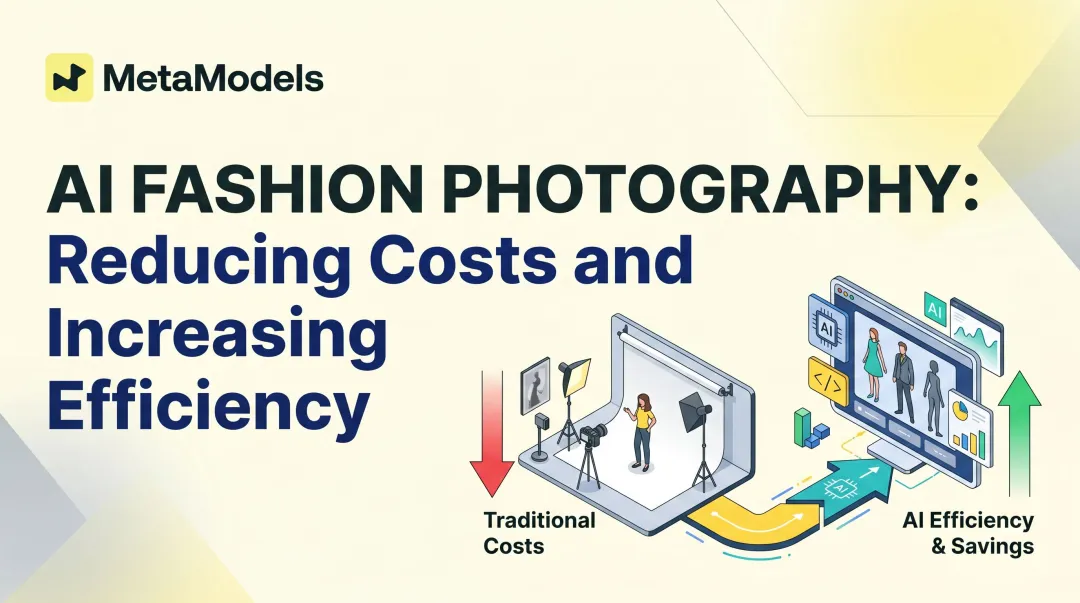
This article breaks down the specific, measurable advantages AI fashion photography delivers in practice—not as a futuristic concept, but as a production tool reshaping how brands compete on visual content today.
Key Takeaways
- AI fashion photography uses virtual models to generate professional on-model images from packshots, eliminating model fees, studio costs, and post-production bottlenecks
- Core advantages: 90–95% cost reduction per image, faster seasonal launches, and inclusive model representation at no extra cost
- Brands that skip it face higher content costs, slower launches, and thinner catalogs compared to AI-enabled competitors
- Best results come from consistent use, human quality review, and treating it as a core part of your content pipeline
What Is AI Fashion Photography?
AI fashion photography uses AI-generated virtual models to display garments in professional-quality images, produced from a product photo or packshot—without requiring a physical model, studio, or camera crew.
The technology is applied across e-commerce product pages, social media campaigns, digital lookbooks, paid advertising, and marketplace listings. Anywhere brands need scaled, consistent visual content, AI photography eliminates the need for model booking, studio scheduling, and crew coordination.
AI fashion photography removes the financial and operational bottlenecks of traditional shoots, freeing brand teams to focus on creative decisions rather than shoot logistics. A single packshot is all it takes. Platforms convert flat-lay or ghost mannequin images into photorealistic on-model imagery, preserving:
- Fabric texture and drape
- Colour accuracy
- Pattern placement
- Garment shape and fit
Key Advantages of AI Fashion Photography
The three advantages below are operational and measurable. They directly affect cost per image, content output volume, speed to market, and brand consistency across channels.
Advantage 1: Dramatic Reduction in Per-Image Production Cost
Traditional fashion photography bundles several cost centres into every shoot: model day rates (£500–£2,000 per day in the UK), photographer fees (£1,000–£3,500 per day), studio rental (£300–£1,500 per day), styling and makeup (£800–£2,200 per day), and post-production retouching (£20–£80 per image). These costs are fixed regardless of how many usable images are produced.
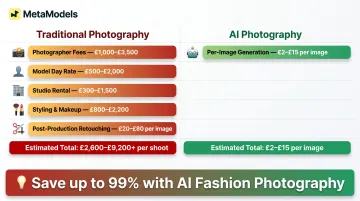
AI fashion photography eliminates most of these cost layers. A single packshot or flat-lay image is processed through an AI platform to generate on-model images in multiple poses, backgrounds, and variations—no booking, no travel, no crew coordination required. Platforms like MetaModels.ai remove model fees and usage royalties entirely, producing ready-to-post images at up to 4K resolution.
The numbers:
A case study published by PiktID documented a 93% cost reduction for Just Fashion, an independent retailer in Italy. Traditional production of 50 images cost €700 total (€14 per image); AI production cost €50 total (€1 per image). Similarly, LuisaViaRoma reported a 90% cost reduction processing over 10,000 SKUs, reducing per-image costs from €15–€50 to €0.50–€2.
For brands managing large SKU counts or frequent seasonal refreshes, the cumulative saving compounds across an annual content calendar. ASOS, for example, spends over £12 million annually on content production—a budget that could be reduced by 85–90% through systematic adoption of AI photography. This shifts photography from a capital-intensive project to a predictable, scalable operational cost.
KPIs impacted:
- Cost per image
- Total content production budget
- Gross margin on content operations
- Cost per SKU visualised
When this advantage matters most:
Highest impact for brands with large or frequently updated catalogues, businesses entering new markets who need localised imagery quickly, and small-to-mid-sized brands that previously could not afford consistent on-model photography across their full product range.
Advantage 2: Creative Scalability and Faster Speed to Market
Creative scalability means producing more image variations—different model types, poses, backgrounds, and styling contexts—from a single product input, without commissioning additional shoots.
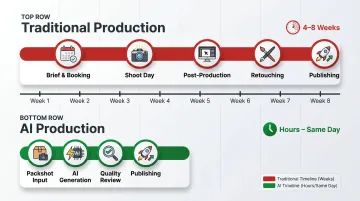
AI fashion photography makes this possible: one garment can be shown on multiple model profiles, in multiple settings (studio, lifestyle, editorial), at multiple crop ratios for different platforms—all generated on demand and iterable in hours rather than days or weeks. This removes the scheduling dependency that slows traditional content pipelines.
What the data shows:
According to industry data reported by Tellos, traditional production takes 4–8 weeks end-to-end; AI enables same-day turnaround. LuisaViaRoma reduced per-image time from hours to seconds using AI generation. Faster product launches mean brands can respond to trend cycles and seasonal shifts in real time, instead of working 6–8 weeks ahead of a shoot calendar.
For paid advertising and social media, the ability to test multiple creative variations at low cost improves performance data quality. Meta analytics show that conversion likelihood drops by 45% after just four repeated exposures to the same ad creative. High-performing brands need 15–30 new creatives per month to maintain stable ROAS at scale—a volume that traditional photography cannot support economically.
KPIs impacted:
- Time from product ready to image live
- Number of creative variations per SKU
- Campaign iteration speed
- Content refresh frequency
When this advantage matters most:
Most valuable during peak trading periods, new collection drops, flash sales requiring rapid visual turnarounds, or when entering a new sales channel that requires platform-specific image formats.
Advantage 3: Inclusive Representation Without Additional Casting or Cost
Inclusive representation—showing garments on models of diverse body types, skin tones, ages, and ethnicities—has historically required either multiple casting sessions or compromises on which audiences are visually addressed.
AI fashion photography addresses this directly through a curated library of AI models spanning diverse demographics. Any garment can be shown across a broad range of representations without separate shoots, casting fees, or additional post-production.
Custom model creation can also align closely with a brand's specific identity. Platforms eliminate model usage rights and royalties, which accumulate when managing large image libraries across multiple campaigns.
Evidence:
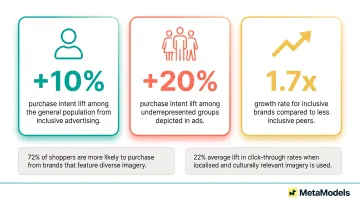
Research published in Harvard Business Review found that inclusive advertisements increase purchase intent by 10% among the general population and by 20% among the specific underrepresented group depicted. Inclusive brands also grow at 1.7 times the rate of less inclusive peers.
The commercial stakes are visible in market share data. Victoria's Secret's share fell from 33% to 24% between 2016 and 2020, a decline analysts linked partly to a lack of inclusive representation. Savage X Fenty, by contrast, reached a $1 billion valuation (USD) within three years by offering 50+ bra sizes and diverse model casting.
For global brands, this also enables market-specific imagery—adapting model presentation for regional audiences without commissioning localised shoots. Industry data cited by Style3D reported that 72% of shoppers are more likely to purchase apparel when images feature diversity in ethnicity, size, and skin tone, with brands using localised e-commerce imaging seeing an average 22% lift in click-through rates.
KPIs impacted:
- Breadth of customer representation in catalogue
- Royalty and usage rights costs
- Conversion rate differences across audience segments
- Return rates linked to fit perception
When this advantage matters most:
Critical for brands scaling internationally, repositioning for broader demographic appeal, or competing in markets where visual representation of the target customer is a key purchasing signal.
What Happens When AI Fashion Photography Is Missing or Ignored
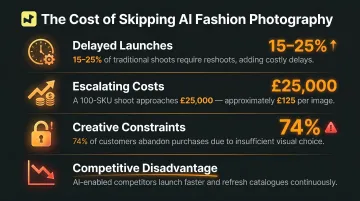
Skipping AI photography doesn't just mean slower production — it means ceding ground on speed, cost, and creative flexibility to competitors who haven't. Brands relying exclusively on traditional photography face compounding risks that compound as catalogue size grows:
Delayed launches: Shoot schedules create fixed production windows — missed deadlines push back product launches and shrink time-on-shelf visibility. Research shows that 15–25% of traditional shoots require reshoots, adding further delays and cost.
Cost that scales against you: Traditional photography costs grow linearly with catalogue depth — margins don't. A 100-SKU shoot at two images per SKU across a two-day production typically approaches £25,000, or roughly £125 per image.
Creative constraints: Limited image variations per shoot reduce A/B testing capability and platform adaptability. BoF and McKinsey report that 74% of customers walk away from online purchases due to the volume of choice—yet brands without diverse visual content cannot address segmented audiences effectively.
Competitive disadvantage: Brands using AI photography launch faster, test more creatives, and refresh catalogues continuously — while traditionally-shot competitors are still waiting on post-production turnarounds measured in weeks.
How to Get the Most Value from AI Fashion Photography
AI fashion photography works best when it's built into your production workflow from the start — not pulled in occasionally. The more consistently you apply it across your catalogue, the lower your per-image cost and the stronger the overall efficiency gains.
Three operating principles for maximum value:
Verify garment accuracy before publishing — review each output for fabric drape, colour fidelity, and fit. Platforms with human-in-the-loop QA (like MetaModels.ai's verified image process) reduce the inaccurate representation that drives returns.
Standardise model and background preferences — set clear guidelines for model selection, styling, and backgrounds. This prevents visual fragmentation at scale and keeps every image aligned with your brand identity.
Track performance by image type — compare conversion rates, return rates, and engagement between AI-generated and traditionally-shot images. Most brands find AI handles catalogue and e-commerce content effectively, while traditional photography stays relevant for hero campaign shoots.
Conclusion
AI fashion photography delivers three compounding advantages that traditional production simply can't match at the same cost or speed:
- Lower costs that directly improve margin per SKU
- Creative scalability that lets brands produce more content without proportional budget increases
- Inclusive representation that expands market reach by reflecting real customer diversity
The AI-generated fashion photography market was valued at $1.51 billion in 2024 and is projected to reach $6.12 billion by 2029 at a CAGR of 32.1%—adoption is accelerating rapidly.
Brands that treat AI photography as a core production workflow — not an occasional experiment — are the ones compounding these advantages into a durable competitive edge. Platforms like MetaModels.ai are built specifically for that kind of consistent, scalable deployment.
Frequently Asked Questions
How do fashion brands use AI in e-commerce?
Fashion brands use AI to generate on-model product images at scale, replacing or supplementing traditional shoots. This enables faster product page publishing, broader catalogue coverage, and more visual variations for A/B testing across e-commerce, social media, and paid advertising channels.
What are the cost savings of using AI in fashion e-commerce?
Published case studies document cost reductions in the 90–95% range per image versus traditional shoots. PiktID reported 93% savings (€14 to €1 per image), while LuisaViaRoma achieved 90% reductions (€15–€50 to €0.50–€2 per image). Savings compound significantly for brands managing large SKU counts or frequent seasonal updates.
Can AI fashion photography replace traditional photoshoots entirely?
For most catalogue and e-commerce use cases, AI photography can handle the full production need. Some brands retain traditional photography for hero campaigns, lifestyle content, or flagship launches. The most effective approach combines both: AI for high-volume product imagery, traditional for brand storytelling.
How does AI fashion photography maintain garment accuracy?
Quality platforms use real-time fabric draping technology and fashion specialists who review every image before publishing. This ensures colour fidelity, shape accuracy, and proportional correctness before any image goes live.
Is AI fashion photography suitable for small and mid-sized fashion brands?
AI photography is particularly well-suited to smaller brands because it removes the minimum-cost barriers of traditional shoots. A single packshot is sufficient input, and cost scales with usage rather than requiring upfront studio investment. Entry-level subscriptions make professional on-model imagery accessible regardless of brand size.
How quickly can AI fashion photography produce ready-to-publish images?
Production time compresses from 4–8 weeks (traditional shoots) to same-day or hours with AI. LuisaViaRoma reported per-image generation in seconds, while industry data shows same-day turnaround is achievable for most use cases. Actual timeframes vary by platform and plan tier, with faster processing available on premium subscriptions.