Introduction
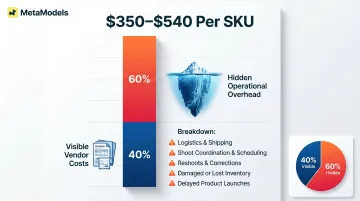
Traditional fashion photography carries a substantial price tag—typical production budgets range from $5,000 to $15,000 per day for mid-range shoots featuring professional models, stylists, and studio rental. When fully loaded costs are calculated, the true expense reaches $350–$540 per SKU, with 60% of that cost hidden in operational overhead. For high-SKU e-commerce brands, this creates intense budget pressure and operational bottlenecks—67% of e-commerce brands cite photography costs as their biggest scaling obstacle.
The revenue impact extends beyond direct costs. Retailers lose up to 23% of potential revenue due to bad product data, with missing or delayed imagery as a primary contributor. Every week a listing sits without imagery is revenue left on the table.
The cost problem is structural. Model bookings, location fees, per-SKU reshoots, and retouching labor each add incrementally, turning a single campaign into a five-figure commitment. AI fashion photography targets each of these layers directly — cutting production timelines from weeks to hours and per-SKU costs by up to 90%.
Key Takeaways
- Traditional photography costs stack across pre-production, shoot days, retouching, and seasonal reshoots
- Biggest cost drivers: model bookings, studio fees, per-SKU retouching, and variant reshoots
- AI-generated fashion imagery eliminates physical model and studio dependency entirely
- Front-end decisions—clear specs, packshots, and brand guidelines—are where the real savings happen
- Brands that pair AI generation with human quality review achieve the deepest, most consistent cost reductions
How Costs in Fashion Photography Typically Build Up
Fashion photography costs rarely appear as a single line item. They accumulate across multiple phases: pre-production planning, shoot execution, post-production retouching, and periodic reshoots for variants, colorways, and seasonal refreshes. Each phase introduces both visible and hidden expenses.
For a brand adding 50 new SKUs monthly, these costs aren't one-time — they recur every product cycle. Each missed shoot window pushes back listings and delays revenue. Annual photography costs for a mid-size brand (500 SKUs, approximately 11,000 images) reach $125,000–$250,000.
Many of these costs stay invisible until you're shooting at volume:
- Usage rights re-licensing for different territories or channels
- Model re-booking for new colorway variants
- Reformatting images for e-commerce vs. social media vs. lookbooks
- Internal coordination labor (10+ hours per shoot)
- Sample shipping ($50-$300 per shoot round trip)
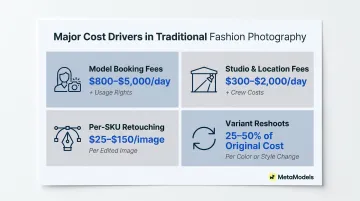
- Reshoot fees (25-50% of original session cost; 15-20% of shoots require partial reshoots)
The fully loaded per-SKU cost of $350–$540 tells the full story: only 40% shows up in vendor bills. The remaining 60% is operational overhead — logistics, coordination, reshoots, damaged inventory, and delayed launches.
Key Cost Drivers in Traditional Fashion Photography
Traditional fashion photography costs aren't random — they cluster around four predictable drivers. Knowing where the money goes makes it easier to spot where AI intervention has the most impact.
Model booking fees represent the single largest controllable cost. Agency-represented models for e-commerce typically command $800-$1,500 per day, with campaign-tier talent reaching $2,000-$5,000 daily. Add 20% agency commission on top of the model's rate, and a $1,000 model costs $1,200 total. This expense scales disproportionately for brands with large or frequently refreshed catalogs—booking three models to represent diverse body types triples the model cost component alone.
Usage rights amplify model costs significantly. E-commerce-only use may be included in the day rate or add 10-20%, but expanding to paid social ads adds 30-50%, digital advertising adds 50-100%, and print/out-of-home can add 300-500% of the day rate. Full buyouts for unlimited perpetual use cost $5,000-$15,000+ per shoot.
Studio and location fees create a high fixed-cost floor regardless of SKU count. Basic white cyclorama studios rent for $300-$800 per day; specialty spaces run $1,000-$2,000+. On-set crew compounds those costs fast:
- Stylist: $500-$2,000/day
- Hair and makeup artist: $400-$1,500/day
- Photographer: $3,000-$8,000+ in NYC/LA
Batching shoots reduces per-image cost by 40-60%, but half-day rates typically run 60-70% of full-day pricing — small batches pay proportionally more.
Per-SKU retouching and post-production is one of the most underestimated costs, and it scales hard with catalog size. Standard e-commerce retouching costs $25-$50 per image; high-end retouching reaches $75-$150 per image. Post-production accounts for 20-50% of total shoot cost. A mid-size brand processing 11,000 images annually can incur $330,000 in retouching alone—especially when reshoots generate new rounds of editing.
High-SKU fast-fashion brands feel volume compounding most acutely. Smaller brands typically hit the fixed-cost floor hardest — paying near-full-day rates for small batches. Either way, these four drivers are precisely where AI-generated imagery creates its most measurable financial case.
Cost-Reduction Strategies for AI Fashion Photography
Cost reduction in AI fashion photography depends on where spending originates—decisions made before generation, how imagery is managed during production, or the broader operational context around content creation.
Strategies That Reduce Costs by Changing Decisions
The most impactful cost lever is eliminating physical model bookings entirely by shifting to AI-generated model imagery. This removes day rates, agency fees, travel costs, and image usage royalties in a single structural decision.
Replace physical model shoots with packshot-to-model AI conversion. Brands that photograph garments on a mannequin or flat lay already have the source asset needed to generate on-model imagery through AI—eliminating the need to re-shoot on physical models. Platforms like MetaModels.ai enable this conversion using real-time fabric draping technology, producing human-verified results from existing product photography. AI tools cost $0.50–$3.00 per image compared to traditional photography's $150–$1,500 per image.
Define AI generation specifications upfront. Establishing a standardized brief—approved model types, pose range, background settings, crop dimensions—before generating any images prevents costly iteration cycles. Each rejected batch consumes credits and time without delivering publishable content.
Consolidate seasonal refreshes into AI batch workflows. Rather than scheduling new studio shoots for every seasonal update or new colorway, brands can generate variants from a single reference asset using AI—cutting the per-variant cost of keeping imagery current significantly. Zalando reduced imagery production time from 6–8 weeks to 3–4 days using AI generation for editorial campaign assets.
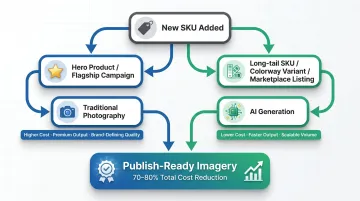
Audit which SKUs genuinely require traditional photography. Reserve physical shoots for hero products and flagship campaigns; use AI generation for long-tail SKUs, colorway variants, and marketplace listings. This hybrid approach typically reduces total costs by 70–80%.
Strategies That Reduce Costs by Changing How AI Fashion Photography Is Managed
Cost overruns in AI fashion photography often occur after generation—through excessive revision cycles, inconsistent outputs, or downstream return rate increases caused by inaccurate garment representation.
Build human quality review into the workflow. Automated AI generation without oversight can produce garment inaccuracies—misrepresented fit, fabric draping errors, or color shifts—that result in higher return rates. 22% of e-commerce returns occur because items appear different than pictured, with each return costing $10–$40 to process. A human review checkpoint before publication catches these issues before they create downstream costs.
Use batch processing for large catalogs. Uploading entire collections at once rather than processing SKUs individually reduces time-per-image and enables consistent output quality across the catalog. Volume batch processing at scale lowers cost per image materially compared to single-SKU processing.
Establish and enforce brand consistency guidelines for AI outputs. Defining approved models, background styles, and lighting presets as standing rules reduces the number of rejected images per batch and shortens the time between generation and publishing. Brands can create brand-specific AI models that ensure visuals always align with identity standards.
Strategies That Reduce Costs by Changing the Context Around AI Fashion Photography
Some of the highest cost pressures in fashion content production come not from the shoot itself but from the surrounding context: demand for inclusive representation, multi-channel formatting requirements, and royalty management overhead.
Eliminate usage rights and royalty costs by owning AI-generated content outright. Unlike imagery featuring real models, AI-generated content carries no re-licensing fees, no territory restrictions, and no expiration—removing a recurring budget line that grows with catalog scale across e-commerce, social media, paid ads, and print.
Scale inclusive representation without proportional cost increases. Producing imagery showing diverse body types, ethnicities, and demographics traditionally requires booking multiple models per SKU—multiplying shoot costs. Research from the University of Bath found that size-inclusive model photography does not negatively affect purchase decisions and helps customers assess fit—reducing return rates. AI model libraries cover diverse body types and demographics across an entire catalog without added per-SKU cost.
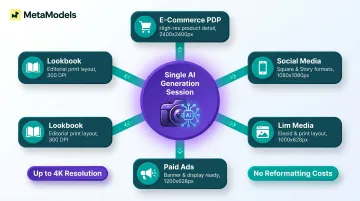
Plan AI-generated content for multi-channel output from a single generation session. By specifying output formats for e-commerce PDPs, social media, and lookbooks upfront, brands avoid reformatting costs and reduce separate content production cycles per product. MetaModels.ai delivers content up to 4K resolution formatted for e-commerce, social media, ads, and lookbooks simultaneously.
Remove scheduling dependencies that slow time-to-market. One of the indirect costs of traditional photography is the lag between product readiness and image availability—models, studios, and retouchers all require lead time. AI generation removes these dependencies, enabling images the same day a product is ready. Zalando produces trend-responsive content in under 24 hours using AI, compared to 6–8 weeks traditionally.
Conclusion
Reducing fashion photography costs through AI starts with identifying where spend actually accumulates — whether that's decision overhead, production management, or contextual reshoot volume — then targeting that layer specifically.
Brands seeing the most durable savings treat AI fashion photography as a repeatable production system, not a one-time budget fix. That means:
- Setting clear specs upfront to minimize revision cycles
- Maintaining quality oversight so outputs stay brand-consistent
- Refining the pipeline continuously based on conversion and return data
Frequently Asked Questions
What fashion companies are using AI for models?
Zalando uses AI for approximately 70% of editorial campaign assets, achieving 90% cost reduction. H&M created digital twins of 30 real models with AI provider Uncut. Other adopters include Levi's, Mango, Tommy Hilfiger, and ASOS, from enterprise retailers to small DTC brands.
How is AI being used in the fashion industry?
AI is used primarily for generating on-model e-commerce imagery from packshots, virtual try-on experiences, background generation, catalog retouching, and trend forecasting. Brands apply these tools to produce product photography, social media content, and marketplace listings at scale.
How much can AI fashion photography reduce costs compared to traditional shoots?
Zalando reported 90% cost reductions for AI-generated editorial content, with production crews reduced from 10-15 people to 2-3 specialists. Savings vary by catalog volume and workflow setup. Hybrid approaches combining AI and traditional photography typically land at 70-80% overall cost reduction.
What types of fashion content are best suited for AI-generated photography?
AI works best for long-tail SKUs, colorway variants, marketplace listings, and social media content. Traditional photography remains preferable for hero campaign imagery and flagship product launches where human creative direction matters most.
Does AI fashion photography affect product return rates?
AI photography with high garment accuracy can reduce return rates by giving shoppers realistic fit and drape information—important since 42% of apparel returns are sizing-related. However, AI imagery with inaccuracies can increase returns. Whether AI photography reduces or increases returns comes down to how rigorously garment accuracy is verified before images go live.
How do you ensure garment accuracy in AI-generated fashion images?
Start with high-quality, well-lit packshots that show full garment coverage, and define clear generation specs covering model type, pose, and background. Human review before publication is essential — MetaModels.ai reviews every generated image for color, shape, and proportion accuracy before delivery.