The tension is direct: fashion photography is one of the most expensive, time-intensive parts of running a clothing brand. A single e-commerce shoot can cost £5,000-£20,000 per day when factoring in models, studio rental, styling, and post-production. AI is now disrupting this workflow entirely—something Urban Outfitters and its parent company are actively navigating.
This article covers Urban Outfitters' actual AI adoption across the business, how AI is reshaping fashion photography industry-wide, what it costs to ignore this shift, and what brands of any size can replicate from this playbook.
Key Takeaways
- URBN embedded AI into merchandise planning via o9 Solutions' platform, optimising inventory allocation and demand forecasting
- AI is replacing expensive traditional shoots — packshot-to-model conversion and AI-generated imagery now power content production across full product catalogues
- Levi's uses AI models to increase diversity representation and reduce shoot costs simultaneously
- Brands ignoring AI risk falling behind on content volume, speed-to-market, and visual representation
Urban Outfitters' AI Strategy: The Foundation Beneath the Photography
On July 10, 2023, URBN selected o9 Solutions' AI-powered "Digital Brain" to transform merchandise planning across all portfolio brands. The partnership deployed five core capabilities:
- Merchandise financial planning
- Assortment planning
- Demand planning
- Allocation
- Replenishment
Rob Frieman, URBN's CIO, stated the goal clearly: "To position URBN for long-term sustainable and profitable growth, we embarked on an extensive review of the retail software market to digitally transform our end-to-end merchandising strategy."
The o9 platform uses predictive analytics to anticipate consumer demand, reduce overstock, and respond faster to trend cycles. This is a structural shift in how URBN makes decisions.
While URBN hasn't published specific outcome data, the implications are clear: AI now influences which products reach which stores, which SKUs warrant photography investment, and how quickly the brand responds to emerging trends.
Urban Outfitters extended this AI infrastructure into content strategy. In February 2026, the brand launched Me@UO, a creator program targeting micro-influencers with fewer than 10,000 followers. The brand built proprietary analytics tools to track creator engagement, participation, and content performance—moving away from traditional follower-count metrics toward structured, multi-factor evaluation.
A brand deploying AI across merchandising, demand forecasting, and creator analytics has already built the organizational muscle to adopt it in visual production too. Operational efficiency and content efficiency follow the same logic.
How AI Is Transforming Fashion Photography in Retail
Traditional fashion photography requires model booking, studio rental, stylist fees, photography and retouching labour, and lead times stretching weeks. Generative AI and AI model platforms are collapsing this entire pipeline.
What AI Fashion Photography Actually Means
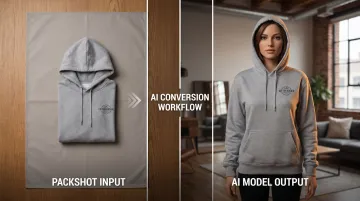
AI fashion photography converts flat product packshots into on-model imagery using AI. Brands can generate full editorial looks with AI models in varied settings and produce campaign-ready visuals at a fraction of traditional timelines.
Levi Strauss & Co. provides a concrete example. On March 22, 2023, Levi's partnered with Lalaland.ai to create AI-generated models across different body types, ages, and skin tones. The stated goal: enable customers to see products on models who "look like them." At the time, Levi's typically used one model per product due to cost constraints.
The partnership drew swift criticism. Critics accused Levi's of using AI as a cheap substitute for genuine diversity hiring. Within six days, Levi's issued a clarification stating the AI pilot was not "a means to advance diversity" or a "substitute for real action" toward DEI goals. The backlash illustrated a critical lesson: AI imagery must supplement — never replace — human creative talent and diversity commitments.
Generative AI Tools in Fashion
Generative AI tools like Midjourney and Stable Diffusion are already being used for campaign concepting, virtual runway shows, and visual prototyping. The Fashion Innovation Agency at London College of Fashion released a photorealistic virtual runway video in March 2023 using Midjourney, Stable Diffusion, and Runway AI. The result showed what editorial photography can achieve without a single physical set or model.
Luxury brands have followed:
- Louis Vuitton used AI-generated imagery for a 30-page editorial in Cultured Magazine, eliminating sets, models, and lighting
- Revolve completed its 20th-anniversary AI billboard campaign in three weeks via agency Maison Meta
- Moncler and Pangaia deployed AI-generated advertisements, with Pangaia citing sustainability over physical shoots
The Content Volume Imperative
Fashion brands need enormous volumes of visual content to feed platform algorithms. According to Sprout Social's 2025 benchmarks, brands published an average of 9.5 social posts per day across networks in 2024. For leisure, sports, and recreation brands (including apparel), that figure rises to 31 posts per day.
| Posting Rate | Monthly Content Needed |
|---|---|
| 9.5 posts/day (average brand) | ~285 pieces |
| 31 posts/day (apparel brands) | ~930 pieces |
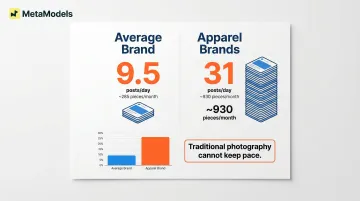
Traditional photography — with multi-week lead times — cannot physically keep pace with that volume. For brands operating at 31 posts per day, AI-assisted imagery isn't an experiment; it's the only model that makes the math work.
The Real Cost of Traditional Fashion Photography—and What AI Changes
Traditional fashion photography carries substantial cost drivers across multiple components:
Per-Day Cost Breakdown:
- Photographer: £800-£4,000 (emerging to senior tier)
- Model (agency standard): £500-£1,200 (editorial models: £1,200-£3,200)
- Studio rental: £250-£2,000
- Hair and makeup: £320-£1,900
- Wardrobe stylist: £320-£800 per day
- Set design and props: £400-£1,600 per shoot
- Creative/art director: £400-£1,200 per day
- Miscellaneous (catering, shipping, casting): £800-£3,200
Total per day (all-in): £5,000-£20,000
Post-production and retouching adds £16-£160 per image depending on complexity. The all-in per-image cost averages approximately £65-£120 when spreading the cost of a full production day across delivered images.
Time Cost vs. Financial Cost
Financial cost is only half the equation. Traditional production timelines stretch from model availability to shoot scheduling to retouching and approval cycles—often weeks or months. AI image generation compresses this to hours or days.
What AI Eliminates
Beyond cost savings, AI removes the operational bottlenecks that slow traditional production:
- No scheduling conflicts across models, photographers, and studios
- No reshoots for seasonal updates or trend-responsive campaigns
- No licensing expiry on model usage rights
- No post-production reformatting for different platforms
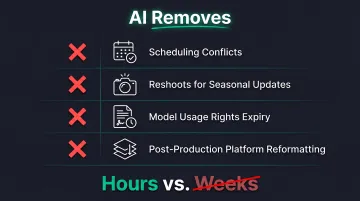
Removing those bottlenecks is only viable if the output quality holds up.
The Quality Question
Real-time fabric draping technology simulates how specific materials fall and move on a model's body, preserving garment weight, texture, and structure. Every AI image passes through human review for colour accuracy, shape, and proportions before delivery.
According to a blog analysis of Zalando's AI implementation, the retailer reported that 70% of its editorial images are now AI-generated, cutting campaign production costs by approximately 90% and compressing timelines from 6-8 weeks to 3-4 days.
Diversity, Representation, and Scalability Through AI Imagery
AI model libraries solve a genuine operational problem: traditional shoots make it expensive and logistically difficult to show the same product on models of different body types, skin tones, ages, and ethnicities. AI removes that constraint entirely.
The Business Case Alongside the Ethical Case
For a brand like Urban Outfitters, whose audience spans a wide demographic range, AI enables showing the same jacket on 10 different models without 10 different shoot days. Every customer segment can see themselves represented in product imagery.
The numbers back this up. Kantar's Brand Inclusion Index 2024, surveying 23,000+ people across 18 countries, found that 75% of consumers globally say diversity and inclusion influence their purchase decisions — and progressive inclusive advertising drives a sales uplift of over 16% compared to less inclusive content.
The Levi's Paradox
That commercial opportunity comes with a caveat. The Levi's backlash demonstrated that consumers and industry professionals distinguish between authentic representation (hiring diverse humans) and synthetic representation (generating diverse AI models). AI can generate models across body types and skin tones for a fraction of traditional costs — but it must still pass the same authenticity tests as any human diversity commitment.
What Fashion Brands Can Learn From Urban Outfitters' AI Playbook
Map Your Pipeline Before Picking a Tool
Urban Outfitters didn't pick one AI product. It layered AI across merchandise planning, demand forecasting, and content performance. Brands should map their own content production pipeline and identify where AI removes the most friction.
Start Where Volume Is Highest
For most fashion e-commerce brands, that's product photography — the category with the most images to produce, the tightest deadlines, and the most predictable brief. That predictability is exactly what makes it the right entry point for AI.
Design for Scale, Not Just Speed
Urban Outfitters' TikTok strategy required enormous content volume to feed the algorithm. The same pressure applies to product imagery — brands producing seasonal lookbooks need hundreds of on-model shots, often against tight timelines.
This is where tools like MetaModels.ai fit the workflow: converting packshots into on-model imagery without scheduling shoots, booking models, or managing royalties. Output is human-reviewed for garment accuracy and delivered ready for e-commerce, social, and advertising channels.
Use AI to Free Up Creative Capacity
The brands seeing the best results with AI use it to free up creative teams for more strategic work — trend research, campaign concepts, influencer strategy — not managing production logistics.
Frequently Asked Questions
Frequently Asked Questions
How is AI being used in fashion design?
AI touches multiple fashion design functions:
- Generative tools for concept ideation and collection planning
- AI-driven visual merchandising and demand-based assortment decisions
- AI model imagery for showing designs across diverse body types
It delivers the most value where it replaces repetitive, high-volume tasks.
Does Urban Outfitters use AI-generated models in its photography?
URBN has adopted AI broadly across merchandise planning and content strategy. No specific confirmation exists around AI model photography, but AI-generated imagery is becoming standard practice for large fashion retailers — Levi's being the most cited example.
How much does AI fashion photography cost compared to a traditional shoot?
Traditional fashion shoots can run £5,000–£20,000 per day when factoring in models, studio, photographer, styling, and post-production. AI image platforms produce equivalent on-model visuals at a fraction of that cost, in far less time, with pricing that scales by volume.
Can small fashion brands use AI for product photography?
AI fashion photography isn't reserved for enterprise brands. Packshot-to-model platforms give independent designers and small e-commerce businesses access to professional on-model imagery — no traditional shoot budget required.
Is AI replacing human models in fashion photography?
AI model platforms are being used primarily for high-volume e-commerce imagery and product catalogue photography, while human models remain central to campaign storytelling, editorial work, and brand identity. The two are increasingly complementary rather than directly competitive.
What is real-time fabric draping in AI fashion photography?
Real-time fabric draping is the AI's ability to simulate how a specific garment's material—its weight, texture, and structure—would realistically fall and move on a model's body, rather than simply applying a flat texture overlay. This is what makes AI-generated product images look accurate rather than artificially composited.