Introduction
Fashion brands lose sales every day—not because their products are inferior, but because shoppers can't picture how a garment actually looks when worn. Flat-lay packshots and ghost mannequin images dominate product pages, leaving customers guessing about fit, drape, and proportion. That hesitation directly translates to abandoned carts and lost revenue.
According to research by Splashlight and SHIFT Communications, 51.7% of U.S. online consumers say on-model photography increases their likelihood of purchasing compared to still-life images alone. Yet traditional model photoshoots carry weeks-long turnarounds and $150–$500 per-image costs, creating bottlenecks that keep products off pages longer than any brand can afford.
That gap is where AI model photography comes in. This article explains how it works, how it accelerates purchase decisions, and what to look for when adopting it in your content workflow.
Key Takeaways
- AI models convert flat-lay packshots into on-model imagery without booking a single photoshoot, cutting production time from weeks to hours
- On-model images outperform flat-lays and mannequin shots—51.7% of consumers say they increase purchase likelihood
- Representing more body types and ethnicities builds buyer confidence and lowers perceived fit risk—diverse AI model libraries make this achievable at no extra cost
- AI platforms preserve garment accuracy—textures, prints, fabric drape—at quality levels that now rival traditional studio photography
- One source photo generates ready-to-post imagery across every channel, multiplying output without multiplying budget
Why Traditional Product Photography Bottlenecks Fashion Sales
Traditional fashion photography moves slowly by design. Brands schedule models weeks ahead, book studio time, coordinate stylists and hair/makeup artists, then wait days for post-production retouching. From product sample arrival to published image, the typical turnaround spans 10-21 calendar days.
The Cost Structure That Doesn't Scale
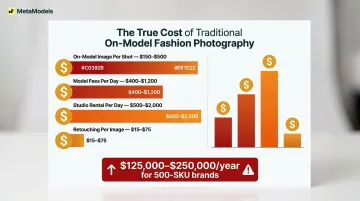
Professional on-model fashion photography costs $150-$500 per image when you factor in all components:
| Cost Component | Low End | Mid Range | High End |
|---|---|---|---|
| On-model image (per image) | $150 | $250 | $500+ |
| Model fees (per day) | $400 | $800 | $1,200+ |
| Studio rental (per day) | $500 | $1,250 | $2,000 |
| Retouching (per image) | $15 | $35 | $75 |
A mid-sized brand with 500 SKUs producing approximately 11,000 images annually faces $125,000-$250,000 per year in traditional photography costs alone.
The Scale Mismatch
A typical fashion collection generates 1,200 SKUs (50 styles × 4 colors × 6 sizes), and with 4 collections per year, brands manage approximately 4,800 SKUs annually. Fast-fashion brands operating on weekly drop schedules face 26-52 releases per year.
Traditional photography cannot keep pace. Products go live with flat-lays or no images at all, directly limiting visibility and sales velocity.
McKinsey research shows top-performing fashion companies deliver product to market in 6-8 weeks versus 40+ weeks for the industry average — and the top 20% capture all of the industry's economic profit. The photography pipeline is one of the few steps in that timeline that can be fundamentally restructured.
How AI Models Transform Product Photography
AI model platforms take a flat-lay, packshot, or ghost mannequin image as input and use generative AI combined with real-time fabric draping to render the garment accurately on a virtual human model. The technology simulates how fabric behaves on a three-dimensional body while preserving critical product details.
Why Fabric Draping Is Technically Challenging
Fabric draping matters because shoppers judge fit and quality based on how garments hang, fold, and move on a body. Different fabrics behave differently: silk drapes fluidly, denim holds structure, knits stretch and conform, and wovens create sharp creases. AI platforms must account for garment structure, weight, and flexibility to create believable on-model imagery that builds shopper trust rather than raising red flags.
The Garment Accuracy Layer
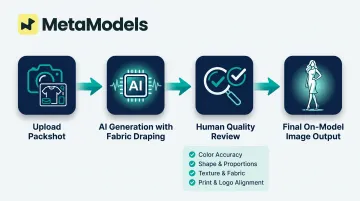
The most capable platforms include human review steps to verify that prints, textures, logos, and stitching are faithfully reproduced. This checkpoint separates credible fashion imagery from distorted outputs.
The review process checks:
- Color accuracy against the original product
- Shape and proportions on the model
- Texture and fabric characteristics
- Print alignment, logos, and decorative elements
This combination of AI generation and human verification ensures garment fidelity at a level that meets professional e-commerce standards.
The Diversity Advantage
AI model libraries now include models across ethnicities, body types, ages, and demographics. This lets brands show products on models that reflect their actual customer base—and the commercial impact is measurable.
Research published in the Journal of the Academy of Marketing Science (11 studies, 5,950 participants) found that seeing items on models of one's own size enhances purchase decisions by mitigating perceived fit risk. The effect is category-specific: stronger for dresses than for shoes, confirming the mechanism is driven by fit-related concerns.
Not one study showed that own-size model photography negatively affects purchase decisions compared to thin-size photos. Representation in product imagery directly impacts buyer identification and purchase confidence.
Custom Model Concepts
Some platforms allow brands to create proprietary AI models that match their specific brand identity and aesthetic. The result is visual consistency across campaigns without dependence on a generic model library. Custom models deliver:
- A distinct aesthetic tied to the brand's identity
- Consistent model appearance across all product categories
- Stronger brand recognition across e-commerce, ads, and lookbooks
MetaModels.ai puts this full workflow into practice. Brands upload a packshot, and the platform generates human-reviewed on-model imagery using a curated diverse model library or custom brand models. Real-time fabric draping and up to 4K resolution output means a single source image covers e-commerce listings, social media, ads, and lookbooks.
How AI Model Photography Directly Speeds Up Sales
Conversion Rate Impact
Shoppers buy faster when they can visualize fit, drape, and proportion on a human body. Baymard Institute's usability testing found that 56% of users' first actions on a product page are to immediately explore product images—before reading titles, descriptions, or scrolling down.
Images are the primary evaluation tool, and quality directly affects abandonment rates. When 51.7% of consumers explicitly state that on-model photography increases their purchase likelihood compared to still-life images, that's a conversion lever worth pulling.
Reduced Return Rates
Fashion e-commerce returns totaled $849.9 billion in 2025, with online sales facing a 19.3% return rate. Of fashion-specific returns, 23% are attributed to style/color dissatisfaction—the "looked different online" problem.
Accurate on-model AI photos showing real garment drape and fit set better expectations, directly targeting the second-largest return driver. When customers see how a garment actually looks on a body similar to theirs, perceived fit risk decreases and return likelihood drops.
Faster Time-to-Market
Traditional workflows require 10-21 calendar days from packshot to published on-model image. AI platforms deliver the same output in under one hour.
Brands can generate on-model imagery the same day a product is photographed in-house, meaning new drops go live faster and start generating sales revenue sooner. That speed applies equally to seasonal launches, trend-responsive drops, and mid-season restocks — any situation where getting to market first matters.
Multi-Channel Content from One Source Image
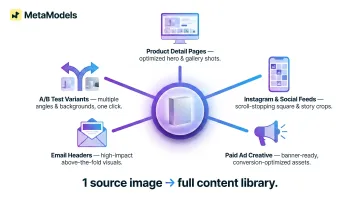
A single packshot can generate an entire content library. From one source image, AI platforms produce variations across:
- Product detail pages — clean, on-model imagery at multiple angles
- Instagram and social feeds — styled shots with context-appropriate backgrounds
- Paid ad creative — multiple model demographics for audience-specific targeting
- Email headers — cropped and formatted for campaign layouts
For A/B testing, brands can run different model demographics, styling contexts, and backgrounds simultaneously — optimizing conversion across audience segments without additional photography spend.
Seasonal and Campaign Agility
Refreshing campaign visuals for a seasonal promotion used to mean booking a studio weeks in advance. With AI model imagery, that same refresh happens in hours — giving smaller brands the visual agility that was previously reserved for retailers with in-house studios and dedicated creative teams.
When fashion operates on weekly or bi-weekly release cycles, generating fresh on-model content in hours rather than weeks is what separates brands that capture trend momentum from those that miss it.
Key Features to Look For in AI Model Photography Tools
Garment Fidelity and Human Review
The most important technical differentiator is how well a platform preserves garment details through the AI generation process. Look for platforms that explicitly mention:
- Fabric draping technology
- Print and texture preservation
- Human quality review before delivery
- Verification of colour accuracy, shape, and proportions
Platforms that skip human review often deliver images that look convincing at thumbnail size but fall apart on product pages — where buyers actually decide.
Model Diversity and Customisation Options
A platform's model library should cover the demographics of your customer base. Evaluate:
- Range of ethnicities, body types, and age ranges available
- Ability to create custom AI models aligned with brand identity
- Consistency of model personas across product categories
If the library doesn't reflect your customers, you'll end up defaulting to whichever models fit — not the ones that sell.
Output Resolution and Format Flexibility
For e-commerce product pages and high-quality lookbooks, output resolution matters. Look for:
- Up to 4K resolution output
- Files ready for multiple channels (e-commerce, social, ads) without additional formatting
- Platform-specific image specifications (Amazon white backgrounds, Instagram aspect ratios)
- Batch processing capabilities for large catalogs
How to Build AI Model Photography Into Your Content Workflow
Start with Your Existing Packshots
Most AI model platforms require only a clean flat-lay, packshot, or ghost mannequin photo as input. Brands don't need to invest in new photography equipment—the goal is to convert existing catalog assets into on-model imagery.
Best practices for input images:
- Clean, well-lit packshots on neutral backgrounds
- Minimal wrinkles or garment distortion
- Consistent lighting across product shots
- Sufficient resolution (check platform requirements)
Define Your Model Selection Strategy
Choose models—or create custom ones—that reflect your target customer demographic. Establish consistent model personas across product categories to build visual coherence across the catalogue.
Consider:
- Primary customer demographics (age, ethnicity, body type)
- Product category requirements (activewear vs. formalwear may warrant different model selections)
- Brand positioning and identity
- Geographic market considerations
Consistency builds brand recognition; strategic variation optimizes conversion across audience segments.
Integrate into Ongoing Workflows
MetaModels.ai handles the full production cycle — automated processing, manual editing, and quality review — so AI model photography fits into regular catalogue workflows rather than requiring a separate production track.
Evaluate integration points:
- Upload automation from existing product photography systems
- Quality review handoff points
- Multi-channel distribution to e-commerce platforms, social media schedulers, and ad platforms
- Analytics integration to measure conversion impact
Brands that connect output directly to their distribution channels — rather than treating image generation as a standalone step — see the fastest turnaround from shoot to live listing.
Frequently Asked Questions
Which is the best AI for image generation for e-commerce?
It depends on your product category. Fashion and apparel brands get better results from platforms purpose-built for garment accuracy, on-model generation, and diverse model libraries. General e-commerce categories can work well with broader tools that offer background generation and batch processing.
Can AI-generated product photos replace professional model photoshoots?
AI model photography now produces on-model imagery at a quality level sufficient for most e-commerce product pages, social content, and digital ads—especially when platforms include human review for garment accuracy. Some brands still use traditional shoots for hero campaign imagery requiring specific creative direction or brand storytelling.
How do AI models preserve garment details like textures and prints?
Specialised fashion AI platforms combine real-time fabric draping technology with human quality review, ensuring prints, textures, and stitching are accurately reproduced rather than distorted.
Are AI model images accepted on platforms like Amazon and Shopify?
Most platforms accept AI-generated product images provided they meet standard requirements: resolution, background specs, and accurate product representation. Amazon, Shopify, and Meta do not explicitly prohibit AI-generated imagery in their current guidelines. Always verify before publishing.
How much does AI model photography typically cost compared to traditional shoots?
AI model photography platforms charge on a subscription or per-image basis, with per-image costs typically ranging from £0.50–£0.65. Traditional on-model fashion shoots run £120–£400+ per image. That's a 99%+ cost reduction, with faster turnaround and greater scalability.
Do I need high-quality photos to start using AI model photography tools?
Clean, well-lit flat-lays or packshots on neutral backgrounds produce the best AI model outputs. Wrinkled garments, poor lighting, or cluttered backgrounds reduce quality. You don't need professional studio equipment, just consistent in-house photography basics: neutral backgrounds, even lighting, and garments presented without distortion.