Introduction
Most fashion brands understand that body-inclusive imagery matters. Research shows that 67% of shoppers are more likely to buy from brands featuring diverse body sizes—rising to 78% among plus-size consumers. Yet 97.6% of Fall/Winter 2026 runway looks featured straight-size models (US 0–4), with plus-size representation at just 0.3%.
The gap comes down to economics. A traditional studio shoot costs $500 to $2,000 per product, and scaling to additional body types multiplies those costs directly: more model bookings, extended studio time, styling fees, and post-production for each new size. For most brands, that math makes full-range body representation financially out of reach.
AI model photography changes that calculation. Brands upload a single garment photo—flatlay, ghost mannequin, or existing on-model shot—and generate realistic images across slim, average, plus-size, petite, and tall body types from a curated AI model library. No studio required.
This article covers why traditional photography falls short, how AI generates realistic images across body sizes, what quality factors matter most, and how brands can implement body-inclusive imagery today.
Key Takeaways
- Traditional shoots cover one or two model sizes due to cost constraints, leaving most shoppers unable to visualize fit
- AI model photography generates on-model images across slim, average, plus-size, petite, and tall bodies from one garment photo
- Representation converts: shoppers who see their body type on-site buy more often and return items less
- Quality is critical: fabric draping, garment fit, and print accuracy must be correct across all body types or trust erodes
- Implementation means choosing a platform with a diverse model library, uploading garment imagery, and maintaining consistent output quality across all SKUs
Why Most Fashion Photography Still Fails Diverse Body Types
The Economics Behind Narrow Representation
Traditional fashion photoshoots typically support one or two model sizes per session. Scaling to additional body types multiplies every cost component: separate model bookings, extended studio rental, additional styling sessions, and expanded retouching workflows. A traditional studio shoot costs $500 to $2,000 per product; for a 1,000-SKU catalog, this becomes a mid-six-figure production budget.
Adding body type coverage multiplies these expenses with each size added. Brands must:
- Book and pay for additional models (agency fees, day rates, travel)
- Extend studio time to accommodate multiple model fittings
- Multiply styling resources (each body type needs proper garment preparation)
- Expand post-production budgets for additional image processing
Most brands find full size-range coverage economically impractical — and shoppers bear the consequences.
The Representation Gap and Its Business Consequences
When shoppers with larger, petite, or non-standard builds only see clothing on one body type, they're forced to guess at fit—a primary driver of purchase hesitation and returns. Size and fit discrepancies account for over 50% of online apparel returns, with the apparel sector showing the highest return rate at 26%.
38% of consumers report frequently returning clothes due to poor fit, while 16% of fashion returns occur because products didn't match the digital imagery or description.
Rising Consumer Expectations for Body Diversity
The expectation gap is widening. The numbers tell a consistent story:
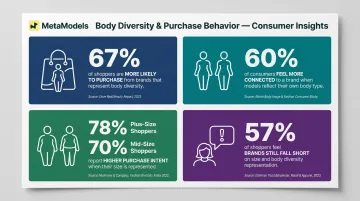
- 67% of shoppers are more likely to buy from brands showing diverse body sizes in marketing (Vogue Business)
- 60% feel more connected to brands featuring models who resemble their body type
- 78% of plus-size and 70% of mid-size shoppers report higher purchase intent when seeing similar body types represented
- 57% of consumers feel fashion brands still fall short on body diversity — rising to 68% for luxury brands
A peer-reviewed study in the Journal of the Academy of Marketing Science reinforces this: U.S. women shown average-sized models reported stronger purchase intentions than those shown thin models. The study also found that seeing thin-only imagery actively hinders fit assessment for differently sized customers — turning a representation gap into a direct revenue problem.
How AI Model Photography Represents All Body Types
The Core Workflow: From Packshot to Diverse Model Gallery
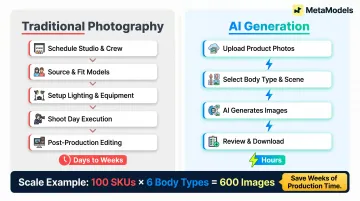
AI model photography platforms convert a single garment image into photorealistic on-model photos across multiple body types without requiring physical photoshoots. The workflow:
- Upload garment imagery — Brands submit flatlays, ghost mannequin shots, or existing on-model photos
- Select AI models — Choose from curated libraries featuring different body sizes, ethnicities, demographics, and age ranges
- Generate images — The platform produces photorealistic on-model imagery, preserving garment details like prints, seams, and fabric texture
- Review and deploy — Verify accuracy and publish across product pages, social media, ads, and lookbooks
No studio booking, model coordination, or photoshoot logistics required.
Body Type Spectrum Coverage
Comprehensive AI model libraries typically span:
- Slim/petite — Representing smaller frame proportions and shorter heights
- Athletic/medium — Mid-range builds with defined proportions
- Average/curvy — Standard size ranges reflecting typical consumer demographics
- Plus-size (XL/XXL+) — Larger body types that are consistently underrepresented in traditional fashion imagery
- Tall — Extended proportions for height-specific sizing
Covering this full spectrum matters for both male and female fashion lines. The right platform will let brands mix and match these variables—body type, ethnicity, age—to reflect who actually buys their products.
Multi-Dimensional Diversity Beyond Size
Body type is only one axis of representation. Advanced AI model libraries cover:
- Ethnicity and skin tone — Representing global customer demographics accurately
- Age range — From young adults to mature consumers across target segments
- Height variation — Petite, standard, and tall proportions affecting garment drape and fit perception
- Demographic diversity — Combinations of these factors reflecting real customer populations rather than idealized norms
Shoppers respond to imagery that looks like them. Covering multiple dimensions of diversity—not just size—is what makes that possible at scale.
Custom Model Creation for Brand Consistency
Some platforms allow brands to define or upload reference models matching their specific brand identity. The same AI model can then appear across every SKU in a collection—creating the visual coherence of a traditional brand campaign, without the coordination overhead.
MetaModels.ai supports both a ready-to-use diverse model library and custom model creation, so brands can build proprietary AI models that fit their aesthetic while still covering a full range of body types.
Scalability Advantage: Days to Hours
Traditional photoshoot logistics:
- Schedule model availability across multiple body types
- Book studio space for extended sessions
- Coordinate styling teams for each model
- Execute multiple rounds of shooting
- Process and retouch each set separately
- Timeline: Days to weeks per product collection
AI generation workflow:
- Upload garment imagery once
- Select body type range from library
- Generate images across five or six body types per SKU
- Review human-verified outputs
- Timeline: Hours for entire catalog
Consider a 100-SKU collection at six body type representations each: that's 600 individual shots. Traditional photography spreads those across multiple shoot days. AI generation delivers the same 600 images in hours—from a single set of product photos.
Fabric Draping and Fit Accuracy Across Different Sizes
The Critical Technical Challenge
Clothing physically behaves differently on different body types. Fabric folds, stretches, drapes, and sits differently on a size 6 versus a size 18 body. A loose-fit blouse hangs distinctly on a plus-size frame compared to a slim one. Stretch denim conforms differently across varying body proportions.
If AI doesn't simulate these variations accurately, the images mislead shoppers about actual fit—driving the same return rates that body-inclusive imagery should reduce.
Real-Time Fabric Draping Technology
Advanced platforms use physics-informed or trained models to simulate fabric interaction with different body shapes. This technology models:
- Fabric weight and drape — How materials fall under gravity on different body contours
- Stretch and conformity — How elastic fabrics adapt to body shape versus structured garments that maintain form
- Fold and wrinkle patterns — Natural fabric behavior at stress points, joints, and areas of compression
- Print alignment — How patterns stretch, compress, or distort across different body proportions
MetaModels.ai employs real-time fabric draping technology that preserves garment details including color, shape, texture, print, and proportions across body type variations.
The Human Review Layer
Garment accuracy in AI-generated images requires verification against the original product. Quality platforms incorporate human fashion specialists who check:
- Print and pattern fidelity — Ensuring graphics, logos, and designs appear correctly
- Seam and construction details — Verifying stitching, pockets, buttons, and structural elements are accurate
- Fit believability — Confirming the garment representation is realistic for each body type shown
- Color accuracy — Matching fabric color across all variations
MetaModels.ai reviews every generated image through human fashion specialists before delivery, correcting details including color, shape, and proportions to maintain accuracy.
Quality Red Flags to Watch
Platforms that skip robust draping simulation or human review introduce failures that directly erode shopper trust:
- Flat, wrinkle-free fabric — Clothing that lacks realistic fold patterns looks artificial and fails to communicate how a garment actually moves and behaves
- Proportion mismatches — Fit representations that don't reflect how a piece sits on a specific body type create false expectations and drive returns
- Hallucinated details — Extra buttons, misaligned prints, or fabricated design elements that don't exist on the real garment destroy credibility
A Stylitics and Aha Studio survey of 411 shoppers found 71% couldn't distinguish AI-generated apparel images from traditional photography. Yet upon learning images were AI-generated, 37% said they'd check return policies more carefully and 30% expected they might return the product.
Errors in garment fit, proportions, or fine details erode trust and increase returns—undermining the exact problem body-inclusive imagery is meant to solve.
The Business Case for Body-Inclusive AI Photography
Conversion and Discovery Impact
Shoppers who visualize how garments fit body types similar to their own make purchase decisions with greater confidence. The data is clear: 67% of consumers are more likely to buy from brands featuring diverse body sizes, with purchase intent reaching 78% among plus-size shoppers.
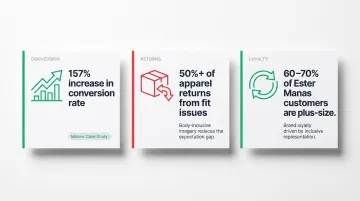
One case study shows tangible results: luxury retailer Milaner achieved a 157% increase in conversion rate and 40% boost in shopper engagement using AI-powered on-model imagery.
Size-inclusive photography doesn't negatively affect purchase decisions compared to thin-model photos — thin models actively hinder fit assessment for differently sized customers, costing brands sales they never see.
Return Reduction Through Accurate Expectations
Fashion e-commerce returns represent a massive cost burden. Retailers estimate 15.8% of annual sales will be returned, totaling $849.9 billion in 2025, with online return rates at 19.3%.
Fit-related issues drive the majority of these returns. Over 50% of online apparel returns stem from size and fit discrepancies, while 16% occur because products didn't match digital imagery.
Body-inclusive on-model imagery across sizes closes that expectation gap directly. When shoppers see how a garment fits a body type similar to theirs, return rates — and the operational costs behind them — drop.
Brand Differentiation and Long-Term Loyalty
In crowded e-commerce markets, body-inclusive imagery signals brand values and builds emotional connection with underrepresented customer segments. This creates competitive advantages:
- Underserved market access — Plus-size brand Ester Manas reports that 60-70% of its e-commerce customers are plus-size, demonstrating strong demand when brands offer inclusive sizing and representation
- Word-of-mouth amplification — Shoppers who feel seen by a brand share that experience, generating organic reach narrow-representation brands can't replicate
- Customer lifetime value — Feeling represented builds loyalty that outlasts any single promotion, driving higher repeat purchase rates over time
Together, these advantages reinforce each other: broader reach feeds word-of-mouth, which deepens loyalty, which makes size inclusivity a revenue driver rather than just a brand statement.
How to Get Started with AI Model Photography for All Body Types
Understand Your Customer Body Type Distribution
Before selecting AI model body types, analyze your actual customer size data:
- Which sizes generate the most sales volume?
- Which body types are currently underrepresented in your existing imagery?
- What demographic segments show highest engagement but lowest conversion?
This alignment ensures your investment in body-inclusive imagery maps directly to customer need rather than assumptions about your audience.
Prepare Your Garment Assets
AI platforms require specific input formats:
Accepted formats:
- Flatlays — product photographed flat on neutral background
- Ghost mannequin shots — invisible mannequin showing garment form
- Existing on-model photos — can be converted to different models
Quality requirements:
- Clean, well-lit images with centered framing
- Neutral backgrounds for easiest processing
- High resolution for best output quality
Packshot-to-model conversion (uploading product-only images and receiving on-model outputs) offers the most accessible workflow for brands without existing model photography.
Select and Configure Your AI Model Lineup
Choose models matching your customer demographics:
- Identify priority body types — Based on your customer size distribution analysis, select the 3-5 body type categories that cover your core audience
- Add ethnic and age diversity — Match skin tone, ethnicity, and age range to your actual customer base
- Create reusable configurations — Set up standard model selections that appear consistently across all SKUs in a collection
MetaModels.ai, for example, offers diverse model libraries with customizable body types, ethnicities, and age ranges — including custom model creation for brands that need consistent visual identity across campaigns.
Generate, Review, and Quality-Check Outputs
Review checklist before publishing:
- Garment details — Verify prints, seams, buttons, pockets, and logos match the original product
- Fit representation — Confirm the fit looks accurate and believable for each body type shown
- Fabric draping — Check that fabric behaves naturally with realistic folds and movement
- Color accuracy — Ensure garment color matches across all body type variations
- Resolution and format — Verify outputs meet requirements for intended use (PDP, social, ads, lookbooks)

Human review is non-negotiable. Every image needs verification by someone who understands garment construction — either in-house or through a platform that includes fashion specialist QA, as MetaModels.ai does.
Scale and Iterate
Build this into ongoing workflows:
- Seasonal refreshes — Update imagery for new collections without additional photoshoot investment
- A/B testing — Test different body type presentations on PDPs to measure conversion impact
- Expand coverage — Add new size ranges as your product line grows
Transparency considerations: Some brands disclose AI-generated imagery, and shoppers respond well to it when execution quality is high. The Stylitics survey found 60% of shoppers reacted neutrally or positively when informed images were AI-generated, interpreting transparency as honesty and brand integrity.
Beyond voluntary disclosure, regulatory requirements are also emerging. The EU AI Act (effective August 2, 2026) requires providers of AI systems generating synthetic images to mark outputs in machine-readable format. Deployers of realistic synthetic images must also disclose AI generation to end users.
Frequently Asked Questions
How to make AI models wear your clothes?
Upload a garment photo (flatlay, ghost mannequin, or product shot) to an AI model photography platform, select an AI model from the library matching your desired body type and demographics, and the platform generates photorealistic on-model images—no physical fitting or photoshoot required.
How do I figure out my body type for fashion?
The most practical approach is using size guides alongside on-model imagery featuring models with similar builds — slim, athletic, curvy, plus-size, petite, or tall — to visualize how garments will fit your specific proportions.
Does AI model photography accurately show how clothes fit on plus-size bodies?
Accuracy depends on the platform's fabric draping technology and quality review process. Advanced tools simulate how fabric behaves on different body shapes, but brands should verify outputs against actual garments to ensure fit is represented honestly and realistically across all body types.
Can I use my own garment photos with AI model generators?
Yes. Most AI model photography platforms accept uploaded garment images including flatlays, ghost mannequin shots, and existing on-model photos, converting them into on-model imagery across multiple body types without requiring new photoshoots or additional photography.
How does AI model photography compare to traditional photoshoots in cost for covering multiple body types?
Traditional shoots multiply costs with each additional body type: separate model bookings, studio time, and styling fees can run $500–$2,000 per product. AI model photography generates the same full size-range coverage from one set of garment assets at $1–$10 per image, letting brands cover six body types for roughly the price of one traditional shoot.