
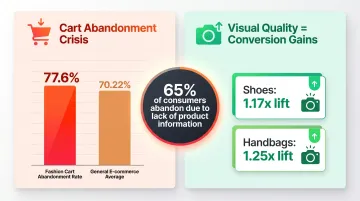
This visual uncertainty is expensive. Fashion cart abandonment rates hit 77.6%, nearly a full percentage point higher than the e-commerce average of 70.22%. The gap isn't random. Baymard Institute's large-scale usability research found that apparel products without human model images create lower confidence and lower purchase intent—because shoppers can't see how garments actually fit on a body.
AI model imagery directly addresses this problem. By converting packshots into realistic on-model visuals at scale, fashion brands can close the visual confidence gap that sends hesitant browsers away before checkout.
Key Takeaways
- Shoppers abandon fashion carts when they can't confidently visualize fit and drape on a real body
- AI model imagery solves this by showing garments on realistic virtual bodies, at a fraction of traditional photoshoot costs
- Quality is critical: low-fidelity AI images can increase returns and erode trust
- Diverse AI model libraries help shoppers see garments on bodies that reflect their own proportions
- Brands using accurate, diverse AI imagery at scale report higher conversion rates and fewer returns
Why Fashion Shoppers Abandon Carts in the First Place
Fashion cart abandonment is uniquely image-driven. Unlike electronics or books, apparel purchases depend on how an item looks worn. Uncertainty about fit, fabric movement, or styling is enough to halt a purchase decision entirely.
The top visual abandonment triggers:
- Flat-lay or packshot-only images give no sense of fit, drape, or movement on a body
- Mixed photography quality — polished studio shots alongside dim phone photos — signals an untrustworthy brand
- No diverse model representation forces shoppers to guess how a garment looks on their body type
- Products shot in isolation fail to show styling potential, leaving purchase intent nowhere to go
Akeneo's 2026 global research found that 65% of consumers would abandon a purchase entirely due to lack of product information—including imagery. 56% of shoppers' first action on a product page is to explore product images before reading a single word of description.
That visual-first behavior has a measurable cost for brands that underinvest in imagery. Cornell Tech research shows listings with higher-quality images are 1.17x more likely to sell in shoe categories and 1.25x more likely in handbags — conversion advantages handed directly to visually stronger competitors.
The Visual Confidence Gap: How Poor Imagery Drives Abandonment
The visual confidence gap is the space between what shoppers need to feel purchase-ready—seeing how garments fit, drape, and move on a body like theirs—and what most PDPs actually deliver. This gap is where cart abandonment lives.
Research from Stylitics and Aha Studio surveyed 411 shoppers and found that 76% rated on-model photos as the most useful format for purchase decisions—above flat lays, ghost mannequins, or packshots. When the most useful format is missing, confidence drops.
Catalog inconsistency compounds the problem. A shopper who sees a high-quality styled image for one SKU and a poorly-lit flat lay for the next experiences a trust rupture. The inconsistency signals brand unprofessionalism, making checkout feel risky. 70% of consumers would buy a different product than intended if the original item lacked sufficient information.
Size, Fit, and the Guessing Problem
Size and fit is where visual abandonment gets most expensive. Shoppers who can't see a garment on a body with their proportions or skin tone must guess — and guessing drives both abandonment and high-return purchases.
The numbers reflect that cost. Online apparel orders carry a 25% return rate, with returns driven by:
- 38% improper fit
- 15% item didn't match expectations
- Both tracing back to insufficient visual information at the decision point
The traditional fix — booking models, studios, and photographers for every SKU — is economically out of reach for most brands. Industry estimates suggest a 500-SKU catalog costs £125,000–£250,000 annually in photography, with most e-commerce work requiring 3-5 images per product. That cost barrier is exactly why AI-generated model imagery has moved from novelty to operational necessity for scaling fashion brands.
How AI Model Imagery Closes the Visual Gap
AI model platforms allow fashion brands to upload product images—even flat packshots—and generate realistic on-model visuals showing how garments fit, drape, and look on a human body. No models, no studios, no shoots.
AI model imagery removes visual uncertainty by:
- Turning catalog gaps into on-model visuals instantly — SKUs that would have gone live as flat lays now appear with full model photography
- Showing the same garment on multiple body types so shoppers can find a model that reflects their proportions
- Maintaining visual consistency across entire catalogs, so quality never drops between SKUs
MetaModels.ai delivers this through real-time fabric draping technology and a human-reviewed workflow. Every generated image is verified by fashion specialists for garment accuracy — color, shape, and proportions — before delivery.
That review step matters more than it might seem. Research from Stylitics found that shoppers grow more cautious about sizing when they know AI was involved. Execution quality is what determines whether AI imagery builds or erodes confidence.
Lower cost and faster turnaround mean brands can put on-model visuals on every SKU — not just hero products. That eliminates the flat lays and empty image slots that push mid-market shoppers toward abandonment.
A case study from luxury retailer Milaner tested AI-powered on-model imagery and reported a 157% increase in conversion rate and a 40% boost in engagement. While this is a single case study, it illustrates the potential impact when visual gaps are closed at scale.

Representation at Scale: Diverse AI Models and Shopper Connection
Traditional fashion photography operates within a limited model roster for budget reasons. This leaves large customer segments unable to visualize how products look on someone with their body type, skin tone, or age—a measurable abandonment driver.
Nielsen Norman Group's qualitative research found that shoppers felt more confident in purchasing decisions when they saw products on models with similar proportions or skin tones. Conversely, users were disappointed when "diverse" options were limited—such as finding all available models were 5'9" or taller.
Diverse AI model libraries resolve this at scale. When a shopper can see a garment on a model that reflects their own demographic or proportions, the "will this look good on me?" doubt is resolved before it triggers abandonment.
This matters particularly for younger consumers. BCG research projects that Gen Z and Gen Alpha will account for 40% of the US fashion market over the next decade, and 40% of this cohort already uses AI to shop. Their expectations for representation are higher and their brand loyalty lower—brands that don't reflect their customers visually lose them fast.
MetaModels.ai addresses this directly, without the cost or logistics of traditional casting:
- Curated AI model library spanning diverse ethnicities, body types, and demographics
- Custom model creation matched to a brand's actual customer profile
- No casting calls, no royalties — representation that scales on demand
The Quality Threshold: When AI Imagery Backfires
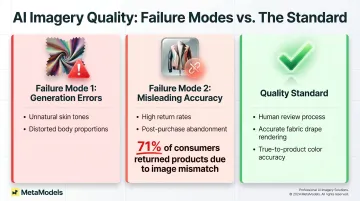
AI model imagery only reduces cart abandonment when it meets a quality threshold: accurate garment fit, realistic fabric drape, and true-to-product color and detail.
The Stylitics research revealed the risk of poor execution: 37% of shoppers said they would be more careful about sizing when they know AI was used, and 37% said they would check return policies more carefully. This behavioral caution quantifies the risk of low-quality AI imagery.
Two failure modes brands must avoid:
- Visible generation errors — Unnatural skin tones, incorrect fabric texture, or distorted proportions signal inauthenticity instantly and erode brand trust before a shopper even reads a product description
- Accurate-looking but misleading imagery — Images that appear polished yet misrepresent how a garment actually fits or drapes create a worse problem: high return rates that surface the abandonment cost after purchase
71% of consumers have returned products because the actual item didn't match the description or image. For brands investing in AI imagery, that statistic is a direct warning: inaccuracy doesn't eliminate abandonment — it defers it.
Accuracy has to be built into the workflow, not reviewed after the fact. Platforms that combine automated generation with human garment verification — checking fit, drape, and color fidelity before images go live — protect both conversion rates and reduce return-driven losses. That's what separates AI imagery that builds shopper confidence from AI imagery that just looks the part.
Frequently Asked Questions
Frequently Asked Questions
How is AI affecting the fashion industry?
AI is reshaping fashion e-commerce across imagery, personalization, and inventory planning — with visual content being one of the highest-impact areas. Platforms now produce millions of AI-assisted product images annually, while traditional photography workflows are being restructured around automation.
What percentage of online shoppers abandon their shopping carts?
The overall e-commerce cart abandonment rate is 70.22%, based on 50 studies. Fashion e-commerce runs higher at 77.6%, reflecting the fit and visualization challenges unique to apparel.
What impact has AI had on the authenticity of photos and videos?
71% of shoppers could not distinguish between real product photos and AI-generated ones, or noted only small differences. Execution quality and brand transparency about AI use determine whether shoppers respond with trust or skepticism.
Can AI model images actually replace traditional model photoshoots?
AI model imagery works best as a complement to traditional shoots, not a replacement. It covers the long tail of SKUs, catalog gaps, and diverse representation needs that production budgets can't reach — while brand-defining campaign photography remains the domain of traditional shoots.
How does diverse AI model imagery help reduce cart abandonment?
When shoppers can see garments on models that reflect their own body type or demographic, purchase uncertainty drops. AI makes diverse model representation economically feasible at catalog scale for the first time.
Do shoppers trust AI-generated fashion images?
60% of shoppers reacted with neutrality or positivity when told images were AI-generated, but 59% want clear labeling. Trust erodes when fit accuracy fails or AI use goes undisclosed — so quality execution and upfront transparency are non-negotiable.