
Introduction
Fashion e-commerce brands face relentless financial pressure from product returns. Apparel consistently posts the highest return rate of any retail category — in 2025, 26% of U.S. consumers returned clothing purchased online, nearly double the rate of the next closest category.
The financial damage compounds fast. Returns erode margins on every transaction, drain marketing spend, and carry a growing environmental cost. Total U.S. retail returns reached $849.9 billion in 2025, with fashion accounting for $218 billion of that total.
Most brands attempt to address returns through reactive measures—revising size charts, tightening return policies, or adjusting pricing strategies. Yet the actual root cause often goes unaddressed: expectation mismatch driven by inadequate product imagery. When shoppers can't accurately visualize how a garment fits, drapes, or behaves on a real body, disappointment becomes inevitable.
This article explains how on-model imagery functions as a practical, measurable tool to reduce fashion returns. The goal is closing the expectation gap before the first box ships — at the point where the shopper is still deciding, not after they've already been disappointed.
Key Takeaways
- On-model imagery answers the questions shoppers ask before buying — fit, drape, and proportion — before they click purchase
- 70% of fashion returns are caused by poor fit or style—on-model visuals directly address this dominant driver
- Fabric behavior and proportion mismatches drive "not as described" returns — accurate on-body imagery cuts both
- Catalog-wide on-model consistency reduces bracketing behavior and builds shopper confidence that compounds over time
What Is On-Model Imagery
On-model imagery refers to product photos where garments are shown worn by a human (or AI-generated) model, as opposed to flat lays, ghost mannequins, or packshots. This format matters most on product detail pages (PDPs) in fashion e-commerce—the exact moment customers make purchase decisions without physical access to the garment.
When executed properly, on-model imagery replaces the "try before you buy" experience that brick-and-mortar stores provide naturally. Shoppers get direct visual answers that flat lays and packshots simply can't offer:
- How fabric falls and drapes across the body
- Where hems and waistbands land relative to body proportions
- Whether the silhouette reads structured or relaxed
- How the garment scales against an actual human frame
Without this context, customers are left guessing — and guesswork typically ends in a return.
Key Advantages of On-Model Imagery
Each advantage below ties directly to measurable outcomes: return rate reduction, cost savings, and customer retention. These benefits are most visible at scale, when applied consistently across a full catalog rather than selectively on hero products.
Advantage 1: Closes the Fit and Size Expectation Gap
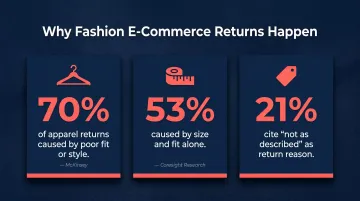
Size and fit issues drive the majority of fashion returns. McKinsey's Returns Management Survey found that 70% of apparel returns are caused by poor fit or style, while Coresight Research reports 53% are due to size and fit alone. For fashion e-commerce, fit is the single largest driver of return costs.
How on-model imagery creates this advantage:
When a shopper sees a garment worn by a model of disclosed height and size, they can map that information to their own body. That size comparison simply isn't possible with flat lays or packshots, which show garments with no body reference at all.
Why this matters financially:
- Customers who can judge fit before purchase are far less likely to bracket (ordering multiple sizes to return the wrong one)
- Each returned item costs retailers $10–30 in reverse logistics, depending on item value and handling complexity
KPIs impacted:
- Return rate (primary)
- Reverse logistics cost
- Customer acquisition cost efficiency (fewer one-time buyers who return and churn)
Where this matters most:
Form-fitting categories — dresses, swimwear, activewear, lingerie — where fit is nuanced and size charts fall short. MIT Sloan research found dresses were returned 72% of the time, the highest rate of any garment type studied. For these categories, on-model imagery does work that size charts and flat lays cannot.
Advantage 2: Eliminates "Not As Described" Returns Through Visual Accuracy
The second major return driver is products that don't match expectations — inadequate representation of fabric behavior, drape, opacity, and proportion. 21% of fashion returns cite "not as described" as the reason, while 23% are attributed to style and color dissatisfaction.
How on-model imagery creates this advantage:
When a garment is shown on a body in natural poses, shoppers can assess:
- How fabric falls and moves under real-world conditions
- Where hems and waistlines land relative to the body
- How structured or relaxed a silhouette appears
- The true opacity and weight of the material
None of this is visible in a flat lay, where fabric drape and body proportion disappear entirely.
Why this matters for brand trust:
Shoppers who receive a product that "looks different in person" don't just feel disappointed — they feel misled. This damages brand trust and makes future purchases less likely. 40% of consumers returned products due to incorrect information, including misleading images, according to Akeneo's 2025 survey.
Accurate on-model visuals close that gap before purchase — when the delivered product matches what was shown, expectation-mismatch returns drop.
KPIs impacted:
- Return rate (expectation mismatch category)
- Customer satisfaction scores
- Repeat purchase rate
- Product review quality
Where this matters most:
Textured, draped, or lightweight fabrics — chiffon, linen, jersey — where behavior under real conditions differs significantly from how they appear flat. Also critical for garments with structural features like peplums, pleats, and ruffles, where three-dimensional shape defines the product.
Advantage 3: Builds Catalog Consistency That Reduces Shopper Uncertainty
Inconsistent imagery across a catalog — some products on models, others as flat lays or packshots — creates an uneven experience where shoppers cannot reliably judge what they're buying.
How catalog-wide consistency reduces uncertainty:
When on-model imagery is applied consistently, shoppers develop a reliable read on how products will look and fit. They're not recalibrating their expectations from one product page to the next. That reliability translates directly into purchase confidence.
Why this matters for bracketing behavior:
Uncertainty drives bracketing — the practice of buying multiple sizes or colors intending to return the wrong ones. 56% of shoppers engage in bracketing, inflating reverse logistics costs across the board. Critically, 29% of consumers say they only bracket when sizing or other options aren't clear — meaning nearly a third would stop if product presentation provided enough clarity.
Consistent on-model imagery gives shoppers the visual confidence to commit to one choice. Platforms like MetaModels.ai make this feasible at full-catalog scale — with a curated library of diverse AI models across body types, ethnicities, and sizing, brands can cover every SKU without the cost or scheduling constraints of traditional photoshoots.
KPIs impacted:
- Return rate
- Conversion rate
- Average order value (less size fragmentation per order)
- Customer lifetime value
Where this matters most:
High-volume catalogs where photography coverage gaps are inevitable with traditional shoots. Also critical for brands launching new collections frequently, where imagery delays leave new SKUs without visual context — shoppers either skip those products or guess on fit, neither of which ends well.
What Happens When On-Model Imagery Is Missing or Ignored
When customers encounter flat lays or packshots on a PDP, they're left to imagine fit, proportion, and drape. That gap between expectation and reality is where returns begin.
The consequences compound:
- Return rates erode margins on every transaction, not just edge cases
- Shoppers trained by uncertainty start bracketing — ordering multiple sizes or colorways to compensate, inflating logistics costs across the board
- Conversion rates drop against competitors with stronger visual content, driving up customer acquisition costs per sale
The trust erosion pattern is especially damaging. When returned products match low-quality images, customers don't return to the brand — they leave. According to PwC's 2025 Customer Experience Survey, 52% of consumers stopped buying from a brand after a bad experience with its products or services. Every return carries that churn risk alongside the logistics cost.

How to Get the Most Value from On-Model Imagery
On-model imagery works best when applied consistently across the full catalog—not selectively on flagship products. Brands that reserve on-model imagery for hero SKUs while leaving the rest in flat lays get only a fraction of the return-reduction benefit.
Garment fit, fabric behavior, and color accuracy must reflect the real product — quality and accuracy aren't optional. Over-edited or poorly draped AI images can increase returns by creating a different kind of expectation mismatch. A Stylitics survey found that 31% of shoppers reacted negatively to AI model imagery, citing concerns that inaccurate fit representation would lead to higher returns. Execution quality determines whether on-model imagery reduces or inflates returns.
AI-powered platforms like MetaModels.ai now make catalog-wide on-model imagery operationally feasible — without traditional shoot costs or lead times. The platform delivers this through:
- Packshot-to-model conversion using real-time fabric draping technology
- Human review on every image by fashion specialists checking color, shape, proportions, and texture
- Ready-to-publish output up to 4K resolution, consistent across the full catalog
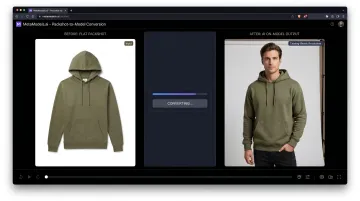
That combination of automation and human oversight is what maintains the accuracy standard required to actually reduce returns.
Conclusion
On-model imagery's primary value is expectation accuracy. When shoppers see exactly how a garment fits, falls, and behaves before purchase, the most common drivers of returns are neutralized before the box ever ships.
Brands that build consistent, accurate on-model imagery into their standard catalog workflow don't just reduce returns on individual products — they build shopper trust that carries forward into every future purchase.
The product detail page is where return decisions are made or avoided. Platforms like MetaModels.ai make it practical for brands of any size to produce on-model imagery at scale — without the cost or logistics of traditional shoots — so accurate visual representation becomes a standard part of the catalog workflow, not an exception to it.
Frequently Asked Questions
Why do flat lay images lead to more returns than on-model images?
Flat lays don't show how a garment sits, drapes, or proportions on a body—forcing shoppers to guess. When the product arrives and doesn't match their mental image, size and fit disappointment drives returns.
How much can on-model imagery realistically reduce fashion return rates?
MIT Sloan research found that product images improved return rate predictions by more than 13%. Size and fit returns—the largest return category at 60–70%—are the most directly impacted by better imagery.
Does on-model imagery help with size-related returns specifically?
Yes. When model height, size worn, and garment measurements are displayed alongside on-model images, shoppers can make size decisions with greater accuracy, reducing the need to bracket or guess.
Can AI-generated on-model imagery be as effective as traditional model photography for reducing returns?
Yes—when garment accuracy and fit representation meet the same quality standard as traditional photography. Human review is what determines effectiveness, not the production method itself.
What categories benefit most from on-model imagery for returns reduction?
Form-fitting and draped categories—dresses, lingerie, swimwear, and activewear—where sizing nuance and fabric behavior are hardest to communicate without a body. Dresses alone are returned 72% of the time online, making on-model imagery essential.
Is on-model imagery cost-effective for smaller or mid-sized fashion brands?
Traditional photoshoots can make full-catalog coverage cost-prohibitive, but AI-powered solutions change that equation. Brands can convert existing packshots into on-model content without booking models or studio time—making catalog-wide coverage practical at any scale.