Introduction
In ecommerce, customers cannot touch, try on, or physically interact with a product before buying. This "sensory gap" is what makes product visuals the single most important conversion lever available to online retailers. When 90% of apparel ecommerce sites fail to enable users to properly assess appearance, size, or fit, cart abandonment rates reflect that gap directly.
Most brands understand that product photography matters. What fewer realize is that the type of imagery used — specifically, whether products are shown on a human model versus a flat surface or mannequin — creates measurable differences in conversion and revenue. Choosing between on-model and off-model imagery is an operational decision, not a creative one.
This article examines why on-model photography drives higher conversions, fewer returns, and stronger brand trust — and what brands lose when they skip it.
Key Takeaways
- On-model photography shows products worn on a real body, giving shoppers the fit, drape, and scale context they need to buy with confidence
- Conversion rates rise 20-30% over flat-lay images, driven by reduced visualization uncertainty
- Returns drop 15-25% when shoppers see accurate fit expectations before purchasing (merchant data)
- Aspirational or relatable imagery builds emotional connection that drives repeat purchases
- MetaModels.ai lets brands generate diverse, on-model imagery across entire catalogs — no photoshoot required
What Is On-Model Photography
On-model photography is the practice of photographing or digitally rendering apparel, accessories, and wearable products on a human model—real or AI-generated—rather than on a flat surface, hanger, or mannequin.
It appears across the core touchpoints where shoppers evaluate products before buying:
- Product listing pages and marketplace storefronts (Amazon, Shopify)
- Social media ads and organic posts
- Lookbooks and email campaigns
The format exists to answer one question shoppers consistently ask before buying: "What will this look like on me?" How well a brand answers that question determines whether a shopper converts, returns the item, or comes back for more.
Key Advantages of On-Model Photography
The three advantages below map directly to buyer behavior and operational outcomes: conversion rate, return rate, and brand equity. Each one is measurable.
Higher Conversion Rates
On-model photography removes the single biggest barrier to online purchase decisions: visualization uncertainty. When a shopper cannot imagine how a product looks or fits on their own body, they leave without buying.
On-model imagery bridges this gap by showing real fabric drape, proportional fit across body types, movement, and styling context. It creates the same confidence a fitting room provides in physical retail, directly reducing "I'm not sure" abandonment.
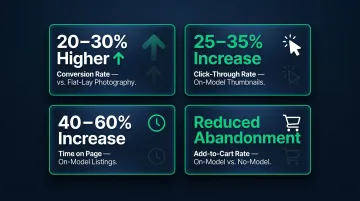
Aggregated Shopify merchant data shows on-model images convert 20-30% higher than flat-lay images across most apparel categories. This improvement compounds at scale: a brand with high traffic and even a marginal conversion rate improvement generates significant additional revenue without increasing ad spend.
On-model images also reduce the number of questions a shopper needs answered before clicking "Add to Cart," shortening the path to purchase. Click-through rates increase by 25-35% when on-model thumbnails appear in search results, and time on page increases by 40-60% for listings with on-model photos.
KPIs impacted:
- Conversion rate (CVR)
- Add-to-cart rate
- Time-on-page
- Revenue per visitor
This advantage peaks for apparel, footwear, and accessories — any wearable category where fit, proportion, and styling drive the decision. It's especially critical for brands launching new products without established review volume or size reputation.
Reduced Return Rates
Product returns are one of the highest variable costs in ecommerce, covering reverse logistics, restocking, and lost inventory value. In 2025, 26% of online clothing purchases were returned, representing $362.2 billion in the U.S. alone. A significant proportion of fashion returns are driven by unmet expectations around fit, size, or appearance.
On-model imagery mitigates this by showing the product on a real body. When model height, size, and measurements are disclosed, shoppers self-select into a purchase only when they have genuine confidence the product matches what they need. This reduces size-related and appearance-related returns before they happen.
Return rates drop 15-25% when on-model images are used as the primary photo. Even a 15% reduction translates to real savings: for a brand processing $5M in annual revenue with a 25% return rate, that reduction saves approximately $206,250 in direct return costs.
Buyers who receive what they expected are also more likely to leave positive reviews, repeat purchase, and recommend the brand — creating a compounding effect that on-model imagery initiates.
KPIs impacted:
- Return rate
- Net revenue
- Customer satisfaction score (CSAT)
- Repeat purchase rate
- Review ratings
This advantage matters most for brands scaling order volume, selling internationally where physical returns are expensive, or operating on thin margins where each returned unit cuts directly into margin.
Stronger Brand Trust and Emotional Connection
Fashion purchasing isn't purely rational. Customers buy clothing to project an identity, achieve a lifestyle, or feel a certain way. On-model photography engages this emotional dimension in a way flat lays and packshots structurally cannot.
How on-model images create emotional engagement:
- Aspirational imagery (models in desirable settings) triggers desire
- Lifestyle imagery (relatable models in everyday contexts) triggers connection
- Diverse model representation (varied body types, skin tones, ages) triggers inclusion
Each of these influences a customer's sense that this brand understands and speaks to them.
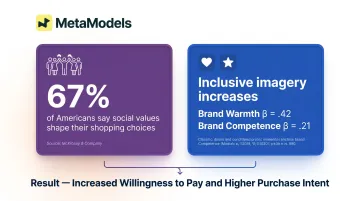
Research shows inclusive marketing increases brand warmth (beta = .42, p < .001) and perceived brand competence (beta = .21, p < .001). Customers who feel represented by a brand's imagery are more likely to trust it, engage with it, and return to it.
67% of Americans say their social values now shape their shopping choices. Brands offering extended sizing and diverse model representation see increased willingness to pay and purchase intent — even among shoppers who don't personally wear those sizes.
Consistent, high-quality on-model imagery builds a recognizable visual identity across all touchpoints — website, social media, ads, email — which builds consistent visual recognition that lowers customer acquisition costs over time.
KPIs impacted:
- Engagement rate (social)
- Email click-through rate
- Customer lifetime value (CLV)
- Brand recall
- Repeat purchase rate
This advantage is most pronounced for brands competing on identity rather than price — particularly mid-market and premium fashion, brands targeting specific lifestyle demographics, and brands using social media as a primary acquisition channel.
What Happens When On-Model Photography Is Missing or Ignored
Brands that rely exclusively on flat-lay, ghost-mannequin, or packshot imagery aren't at a neutral baseline. They're paying real costs in conversions, returns, and brand equity.
Here's what that costs in practice:
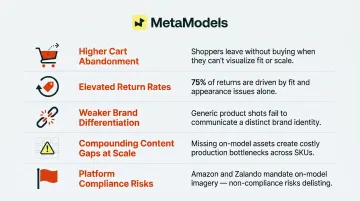
- Higher cart abandonment: Shoppers hit a visualization gap and leave rather than risk a bad purchase. Baymard Institute testing found that cut-out images on white backgrounds are insufficient for judging how a garment hangs, fits, or sits on the body.
- Elevated return rates: Fit and appearance mismatches that on-model imagery would have caught drive costly returns. 75% of consumers report returning items because they didn't fit, and product misrepresentation accounts for over 40% of apparel returns.
- Weaker brand differentiation: Without aspirational or relatable imagery, listings look interchangeable with competitors — eroding the emotional reasons a customer would choose one brand over another.
- Compounding content gaps at scale: As SKU count grows, brands without an on-model imagery system fall behind on catalog launches and lose visual consistency across the shopping experience.
- Platform compliance risks: Amazon prohibits visible mannequins and flat-lay for adult clothing main images. Zalando mandates on-model as the primary image for adult apparel. Non-compliance risks listing suppression or reduced visibility.
How to Get the Most Value from On-Model Photography
On-model photography delivers the strongest results when applied consistently across the product catalog, not selectively for hero products only. Inconsistent use creates uneven shopping experiences and weakens the measurable impact on conversion and returns.
Key practices that maximize value:
- Include multiple angles per listing — fashion ecommerce best practice is 4–8 images, covering at least one full front/back on-model shot, one close-up detail, and one styled lifestyle image
- Match model demographics — age, body type, skin tone — to your target buyer so shoppers can evaluate fit against a relatable reference, which directly reduces returns
- Build on-model photography into your content calendar as an ongoing system, not a one-time shoot; new SKUs, seasonal refreshes, and campaign rotations all require a steady flow of imagery
As catalogs grow, maintaining that consistency becomes the real challenge. Platforms like MetaModels.ai let fashion brands convert existing packshots into diverse, human-verified on-model imagery at scale — removing the cost and logistics barriers that make frequent shoots impractical.
Conclusion
On-model photography is a measurable sales driver with direct impact on the three metrics that determine ecommerce profitability: conversion rate, return rate, and customer lifetime value.
Its advantages build over time when applied consistently. Every additional SKU with on-model imagery reduces purchase risk for the buyer. High-quality images that reflect real customer diversity strengthen brand trust, and avoided returns improve margin directly. For brands that previously couldn't justify the cost of traditional shoots at scale, AI-generated on-model imagery — like what MetaModels.ai produces — makes this one of the most accessible high-ROI investments in ecommerce visual content.
Frequently Asked Questions
What type of photos sell best online?
On-model photos consistently outperform flat-lay and packshot images for wearable categories because they eliminate visualization uncertainty. Merchant data shows on-model images convert 20-30% higher, with lifestyle and multi-angle formats delivering the strongest results for apparel, accessories, and footwear.
Does on-model photography reduce return rates?
Yes, on-model imagery reduces returns by setting accurate expectations for fit, drape, and appearance. Shopify merchant data shows return rates drop 15-25% when on-model images are used as the primary photo, with brands that disclose model measurements seeing the strongest reduction.
What is the difference between on-model photography and flat-lay photography?
Flat-lay shows the product on a surface without a human body, communicating only basic design and color. On-model photography shows the garment worn, providing fit, drape, scale, and styling context.
When do you need a model for ecommerce photography?
On-model photography is essential for any wearable product category—apparel, footwear, accessories, jewelry—where fit, drape, or scale is a key purchase consideration. It's most critical for product page primary images and paid social ads, where shoppers make quick decisions based on visual confidence.
Is AI model photography as effective as real model photography for ecommerce?
High-quality AI on-model imagery, when human-reviewed for garment accuracy and rendered with realistic fabric detail, performs comparably to traditional photography for conversion and return rate outcomes. It also enables faster production, greater model diversity, and lower per-image costs — without sacrificing professional standards for any ecommerce channel.
How many on-model photos should a product listing have?
Best practice for fashion ecommerce is 4–8 images per listing, including at least one full front and back on-model shot, one detail or close-up shot, and one lifestyle or styled context image. More angles directly correlate with reduced return rates and higher conversion, as shoppers gain enough detail to commit to the purchase.