Introduction
Fashion e-commerce shoppers face a fundamental challenge: they can't touch or try on garments before purchasing. Model imagery becomes their sole proxy for fit, fabric, and feel. Conversion is won or lost within the first few seconds of viewing — and 83% of US smartphone users say product images are "very" or "extremely" influential in their purchase decisions, according to eMarketer.
Most fashion brands treat model images as an aesthetic decision. In practice, which angles you show — and in what order — is a measurable conversion variable. Product pages that convert well tend to answer buyer questions in a predictable sequence; those that don't lose shoppers before a decision is made.
What follows is a breakdown of the angles that do the most conversion work, the sequence that matches how buyers actually evaluate a garment, and a framework for auditing what your current pages may be missing.
Key Takeaways
- 76% of shoppers say on-model imagery is most useful for purchase decisions — it outperforms flat-lay across every conversion metric
- The six highest-converting angles are: full-front, back view, three-quarter/side, fabric detail close-up, fit-specific contextual view, and lifestyle shot
- Angle sequence matters — lead with clarity, build accuracy, close with aspiration to match how shoppers evaluate before buying
- Model diversity drives purchase intent — shoppers convert significantly higher when they see models who resemble them
- MetaModels.ai lets brands generate all six angles across diverse model types — no photoshoot scheduling, no per-model fees
Why Model Image Angles Are a Conversion Variable
Fashion shoppers move through a fast, instinctive checklist when landing on a product page: identify the item, assess fit and fabric, picture themselves in it. If images don't answer those questions in sequence, shoppers hesitate and bounce — even when the photography is technically sharp.
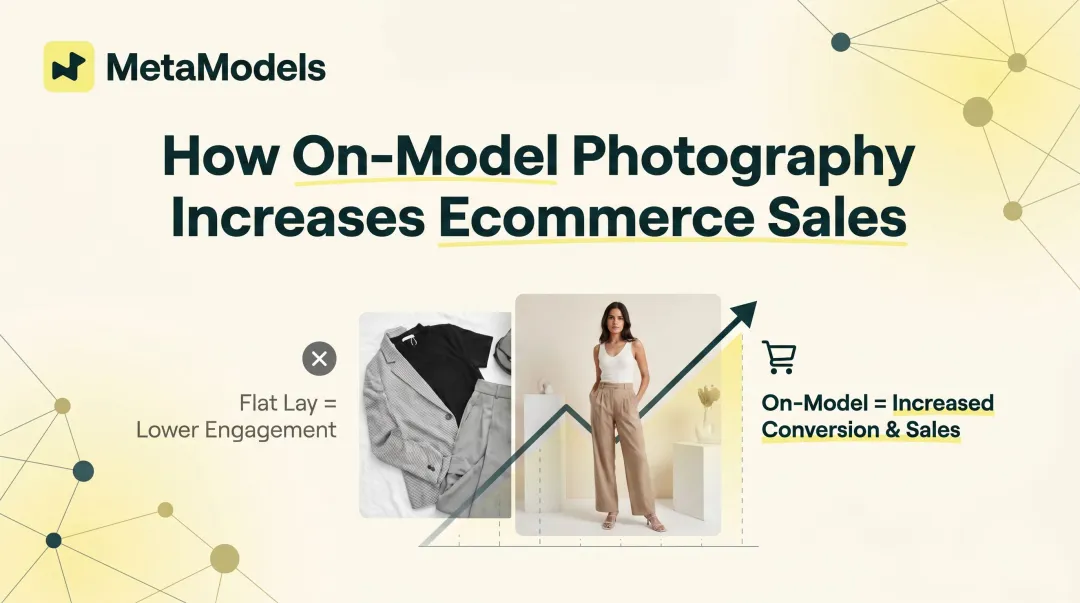
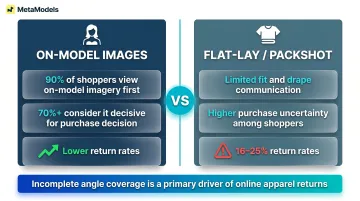
Model image angles fill a specific gap that flat-lay or packshot photography cannot. Unlike static product shots, on-model angles communicate drape, proportion, movement, and realistic fit — information that directly reduces purchase uncertainty. Research validates this: 90% of consumers look at images of garments worn on models first when browsing fashion e-commerce product pages, and more than 70% consider on-model coverage a "decisive element" to encourage a purchase.
That uncertainty has a measurable cost. Online apparel return rates run between 16% and 25% — more than double in-store levels — and incomplete angle coverage is a primary driver. When shoppers can't assess fit before buying, they either order multiple sizes or return items that don't match expectations.
Showing the right angles pre-purchase sets accurate expectations and cuts those return rates directly.
The Best Model Image Angles for Fashion E-Commerce
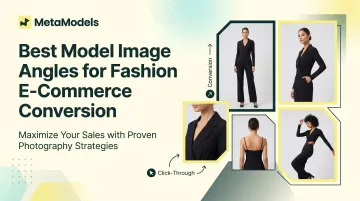
The following six angles, used together, create a complete visual answer to every question a shopper asks before purchasing. The goal isn't more images — it's the right images.
Full-Front View
The front view is the recognition shot. It must answer "what exactly is this product?" instantly and without ambiguity. Best practice requirements include:
- Front-facing or slight three-quarter turn
- Neutral background that doesn't compete with the garment
- Accurate color representation
- No dramatic cropping or props that obscure the silhouette
Several common mistakes undermine this shot. Lifestyle imagery in the primary position delays product identification. Heavy styling that hides garment structure creates confusion. Angles that make the product look smaller introduce purchase hesitation. The first image exists to eliminate doubt, not to be creative.
Back View
The back view is a trust and transparency image. It shows shoppers what is being hidden in the front shot:
- Closures, zippers, and buttons
- Seams and stitching quality
- Back structure and design details
- Length from behind
Skipping this angle creates doubt shoppers often can't name — they just hesitate. It's especially conversion-critical for dresses, jackets, back-detail tops, and trousers, where seat fit and hem length directly influence purchase confidence.
Three-Quarter or Side View
The three-quarter and side angles reveal silhouette depth, sleeve/waist/hip proportion, and how the garment sits in three dimensions on a real body — information the front view alone cannot provide. This angle is particularly valuable for:
- Structured garments (blazers, coats, tailored trousers)
- Products where shape and construction are key selling points
- Items where sleeve length and shoulder fit matter
Model pose within this angle matters significantly. A relaxed, natural stance communicates realistic wearability better than overly stiff or editorial poses, which can introduce uncertainty about how the garment will actually fit.
Fabric and Texture Detail Close-Up
E-commerce removes the ability to touch a product, and detail close-up shots are the primary tool for bridging this tactile gap. An effective detail shot shows:
- Fabric weave and knit structure
- Weight and sheen
- Stitch quality
- Embellishments and surface texture
Capture these at a natural scale without heavy filters or excessive sharpening that misrepresents the material. This angle has a direct impact on return rates. When fabric expectations are inaccurate — fabric looks softer, thicker, shinier, or more matte than it is — disappointment on delivery is almost guaranteed. According to returns data, "item different than described" ranks as the #2 reason for retail returns, behind only size and fit, with mismatched materials being a primary driver.
Fit-Specific or On-Body Contextual View
This angle directly handles late-stage purchase objections by showing how the garment fits at critical points — waist, shoulder, hem, and hip — especially during movement. Use cases include:
- Close-up of shoulder fit on a blazer
- Walking shot to show how a dress hem moves
- Seated pose to demonstrate how trousers sit
- Detail of waist fit and rise on bottoms
This is also the optimal position for diversity representation. Showing the same garment on a secondary model with a different body type significantly expands purchase intent across shopper segments.
Lifestyle or In-Context Shot
Lifestyle imagery belongs at the end of the image sequence, not the beginning. At this stage, shoppers have already understood the product and assessed fit. The lifestyle shot's job is to reinforce emotional desire and brand identity, not to explain the product.
When lifestyle images appear too early, shoppers get distracted before they've assessed the product. In the final position, the same image builds aspiration on top of an already-formed purchase intent. Effectiveness here hinges on relevance: generic editorial shots underperform compared to context-specific imagery that matches the brand's customer demographic and the garment's actual use occasion.
The Right Image Sequence for Maximum Conversion
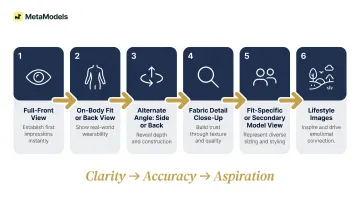
High-converting fashion product pages are built around how buyers reduce purchase risk. The sequence that works moves from clarity to accuracy to aspiration — matching the buyer's natural decision process: identify the product, assess the fit, verify the details, then commit emotionally.
Recommended image order:
- Full-front view
- On-body fit or back view
- Alternate angle (side or back, whichever wasn't used in position 2)
- Fabric detail close-up
- Fit-specific or secondary model view
- Lifestyle images
Deviating from this order — leading with lifestyle shots, or skipping to detail images before establishing fit — disrupts the decision process and increases bounce rates.
The gap between expectation and reality here is significant. Only 25% of e-commerce sites currently provide sufficient images for users to evaluate a product properly, despite 56% of shoppers exploring product images immediately on arrival.
Audit your existing product pages by asking:
- Does the first image eliminate all ambiguity about what the product is?
- Does the second image help shoppers imagine wearing it?
- Are detail shots placed before lifestyle imagery?
- Are there any visual questions left unanswered before the lifestyle shots appear?
The same logic extends beyond product pages. In ads and social media, front and on-body images consistently outperform lifestyle shots as primary creative — lifestyle content works better as secondary placements or retargeting material.
Model Diversity and Your Angle Strategy
Purchase intent is not uniform across a shopper base — it is shaped by how closely the model in the image resembles the shopper. Research by Dr. Ben Barry at Ryerson University, as cited by Veesual, documented significant purchase intent effects:
- A woman is 3 times more likely to buy a garment if she sees it worn by a model who is the same size as her or larger
- A woman is 2.75 times more likely to buy if the model reflects her own age
- A Black woman is 1.5 times more likely to buy if the model is also Black
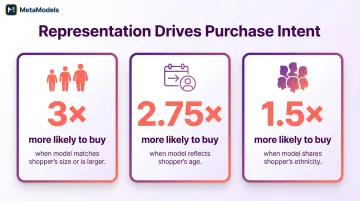
Each of these represents a meaningful lift in conversion, not a rounding error.
The operational challenge this creates for traditional photoshoots is significant. Showing each garment on multiple body types, ages, and ethnicities requires multiple models, multiple shoot days, and significantly higher production costs. This is why most brands default to a single model type and leave conversion on the table.
MetaModels.ai addresses this by maintaining a library of diverse AI models spanning ethnicity, age, and body type. From a single garment packshot, brands can generate all six recommended angles across multiple model types — without additional shoot days or model fees. Each image is reviewed by fashion specialists before delivery to confirm garment accuracy, so the diversity gain doesn't come at the expense of product fidelity.
Conclusion
Model image angles are a conversion decision as much as a creative one. Whether a product page closes a sale or loses a shopper to hesitation often comes down to whether the images answer questions in the right sequence — and leave nothing unanswered about fit, texture, or scale.
Brands don't have to trade visual quality for inclusive representation or speed. With MetaModels.ai, fashion brands can produce all six recommended angles across a diverse cast of AI models, ready for product pages, ads, and social, without booking a single photoshoot.
Explore how MetaModels.ai converts packshots into multi-angle model imagery — diverse, on-brand, and ready to publish — without the cost or timeline of traditional production.
Frequently Asked Questions
Frequently Asked Questions
How many product images should a fashion e-commerce listing include?
Industry benchmarks suggest 5-8 images per product, covering all critical angles (front, back, detail, fit, lifestyle) rather than repeating similar shots. Additional images only improve conversion when each one answers a distinct shopper question — 70% of shoppers bounce if visuals feel thin.
Which model image angle is the most important for conversion?
The front/primary view is most critical because it determines whether a shopper continues evaluating the product at all. However, the on-body fit view has the highest impact on actual purchase intent — both are essential, not interchangeable.
Does showing clothes on diverse models actually affect sales?
Yes. Purchase intent rises when shoppers see models who reflect their own body size, age, or ethnicity. Diverse model representation is now treated as a conversion strategy — brands that get this right see it show up in their numbers.
Should lifestyle images be used as the hero or primary product image?
No. Lifestyle images should appear after the product clarity shots (front, back, detail) because leading with lifestyle imagery delays product identification, increases cognitive friction, and typically reduces conversion — particularly for first-time visitors who don't yet know the brand.
Can AI-generated model images match the conversion performance of real model photography?
Yes. AI fashion imagery platforms now produce photorealistic on-model visuals that perform comparably to traditional photography for product pages. They also enable consistent model diversity at scale — MetaModels.ai, for example, adds a human-review step specifically to ensure garment accuracy across outputs.