Introduction
In e-commerce fashion, the image format you choose isn't just a creative decision — it's a conversion decision. Flat lay and on-model photos are the two most common product image formats, but they serve different shopper psychology and drive measurably different outcomes.
With online clothing sales continuing to grow, product photography is often the only "try-before-you-buy" experience a shopper gets. Research cited by Let's Enhance puts it plainly: 77% of shoppers say high-quality images and videos directly influence their purchase decisions.
The format question goes deeper than aesthetics. PowerReviews found that 96% of consumers actively seek out photos and videos from other shoppers when buying clothing online — meaning how a product is presented shapes trust before a single review is read. This guide breaks down exactly when flat lay outperforms on-model photography, when the reverse is true, and how to decide what's right for your catalog.
Key Takeaways
- On-model photos convert 20-30% higher than flat lay for most structured garments
- Flat lay excels for social content, accessories, and catalog consistency
- On-model reduces fit-related returns by setting accurate expectations
- AI on-model photography matches those conversion gains while cutting shoot costs by 80%+
- Use both: on-model for PDPs, flat lay for detail shots and social grids
Flat Lay vs On-Model: Quick Comparison
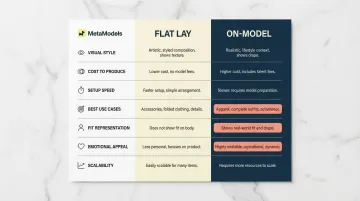
Here's how the two formats compare across the factors that matter most for e-commerce decisions.
| Criteria | Flat Lay | On-Model |
|---|---|---|
| Visual Style | Overhead, 2D product arrangement | Garment worn by person/AI model |
| Cost to Produce | £20–50 per image | £800–3,000+ per day (traditional); £15–20 per image (AI) |
| Setup Speed | Fast (minutes per shot) | Slow (2–4 weeks for traditional shoots) |
| Best Use Cases | Social grids, accessories, graphic tees, detail shots | PDPs, structured garments, hero images, paid ads |
| Fit Representation | Low (no body context) | High (shows drape, silhouette, proportions) |
| Emotional Appeal | Minimal (product-focused) | Strong (lifestyle context, aspirational) |
| Scalability | Excellent for large catalogs | Limited (traditional); excellent (AI) |
The right format depends on product type, sales channel, and where you are in your production workflow. The sections below break down exactly when each one earns its place.
What Are Flat Lay Photos?
Flat lay photography shows garments arranged on a flat surface and photographed from directly above. Also called "overhead" or "tabletop" photography, this format offers minimal setup, no model required, consistent framing, and fast production.
Where Flat Lay Excels
Flat lay performs best when showcasing:
- Print quality and logo placement (graphic tees, branded hoodies)
- Color accuracy and fabric texture
- Pattern details and design elements
- Items where fit context is less critical (joggers, casual tops, accessories)
Use Cases of Flat Lay
Flat lay shows up across several parts of a fashion brand's workflow:
- Social media grids — Instagram and Pinterest favor aesthetic, editorial-style flat lays
- Catalog listings — Fast-fashion brands managing large, frequently updated SKU catalogs
- Email campaigns — Multi-product showcases and bundle offers
- A/B testing thumbnails — Quick variations for testing
- Wholesale line sheets — Standardized product presentation
According to one analysis of Meta ad creative best practices, flat lay photography works best for multiple SKU showcases and aesthetic-focused Instagram placements. It's especially practical for fast-fashion brands that need to photograph hundreds of products monthly without the logistics of model shoots.
What Are On-Model Photos?
On-model photography shows clothing worn by a person (model or AI-generated model), showing how garments fit the body, drape with movement, and work as a complete look. This format answers the most critical shopper question: "What will this actually look like on me?"
The Conversion Psychology Behind On-Model Images
On-model photos reduce purchase hesitation by visualizing fit, silhouette, and proportions. When shoppers can see how fabric drapes on a body, where hemlines fall, and how garments move, they gain confidence in their purchase decision.
The data supports this psychology. In a 2025 survey by Stylitics and Aha Studio, 76% of shoppers said on-model photos are the most useful format for buying decisions. Shoppers prefer on-model over flat lays or collages because they better communicate drape, proportion, and styling context.
Where On-Model Photography Performs Best
That preference translates directly into placement decisions. On-model photography works best across:
- Structured garments (jackets, dresses, tailored pieces) where fit is the primary purchase driver
- Hero images on PDPs — the primary visual that carries the heaviest conversion weight
- Homepage banners and seasonal campaigns where brand storytelling matters
- Paid ad creative, where lifestyle context drives emotional engagement over specs
- Lookbooks showcasing complete outfit styling and brand aesthetic
- Social content requiring behind-the-scenes or campaign-style visuals
For mid-to-premium price point items, on-model isn't optional — it's essential. A £150 blazer needs to communicate fit and quality at a glance, and no amount of careful flat lay styling substitutes for seeing it on a body.
Which Format Converts Better — and When?
The conversion advantage depends on product type and placement context — not a single format winning universally.
Performance by Product Type
On-model wins for:
- Structured garments (blazers, dresses, tailored trousers)
- Fitted items where silhouette matters
- Premium products (£50+ price points)
- Items with complex draping or movement
Flat lay performs comparably for:
- Graphic tees and logo-forward casual wear
- Accessories (bags, jewelry, hats)
- Flat items (scarves, bandanas)
- Products where design detail matters more than fit
According to aggregated data from Shopify merchants reported by Photta, on-model images convert 20-30% higher than flat-lay images across most clothing categories, with time on page increasing 40-60% for listings that use on-model photos.

The Return Rate Connection
On-model images help set accurate fit expectations, which reduces size- and fit-related returns. The National Retail Federation reported that 16.9% of total annual retail sales were returned in 2024, with online return rates averaging 21% higher than in-store rates.
Narvar's consumer data shows that 42% of consumers cite size and fit issues as the reason for their last return. Flat lay images can distort perception of structure and fit, leading customers to receive products that don't match expectations. On-model imagery gives shoppers a realistic sense of how a garment sits on a body — before they buy.
Performance by Channel
Product Detail Pages (PDPs): On-model wins decisively. Shoppers on PDPs are in buying mode and need fit clarity to complete purchase.
Social Media: Both formats work, but for different purposes. Flat lay performs well for editorial-style posts and design-focused content. On-model excels for storytelling and lifestyle content.
Paid Ads: On-model tends to outperform due to lifestyle context and emotional engagement, particularly when imagery places the garment in a recognizable real-world context.
Marketplace Listings: On-model wins for trust signals and clarity. Amazon, Myntra, and similar platforms see higher click-through rates with on-model imagery.
The Trust and Consistency Factor
Channel performance data points to a broader principle: consistency matters. A standardized on-model presentation — consistent lighting, angles, and model aesthetic — signals a curated, reliable brand experience. Inconsistency between image formats across a catalog erodes trust, even if shoppers can't articulate why.
Situational Recommendation Summary
Choose flat lay for:
- Social content and editorial posts
- Accessories and flat items
- Graphic tees and logo-forward products
- Bulk catalog efficiency when budget is tight
Choose on-model for:
- Product detail pages (PDPs)
- Structured garments and fitted items
- Premium products (mid-to-high price points)
- Hero images and campaign content
- Any context where communicating fit is critical to reducing returns
The Smarter Move: AI On-Model Photography
The practical problem that limits most brands from using on-model across their full catalog is simple: traditional model shoots are expensive and slow.
The Traditional Model Shoot Barrier
Based on 2025 industry data, a single day of shooting typically costs £5,000 to £10,000. A day-long shoot with top-tier professionals can easily begin at around £10,000. This includes:
- Photographer fees: £1,000–5,000
- Studio rental: £600–1,500
- Model fees: £800–3,000+ (plus 20% agency fee)
- Hair and makeup: £200–1,000
- Wardrobe stylist: £500–3,000
- Post-production: £20–50 per image
Beyond cost, traditional shoots take 2–4 weeks from planning to final delivery. For brands with large catalogs or frequent product launches, this timeline is unsustainable.
How AI On-Model Photography Solves This Gap
Platforms like MetaModels.ai convert flat lay packshots into professional on-model imagery using AI, using real-time fabric draping technology and human-reviewed outputs to maintain garment accuracy. Brands get the conversion benefits of on-model imagery without scheduling a single shoot.
Key differentiators of MetaModels.ai:
- Diverse AI model library — Varied ethnicity, body types, and demographics for genuinely inclusive catalog coverage
- Custom model creation — Built to match your brand identity and core customer demographics
- Human-reviewed QA — Every image checked for color accuracy, garment shape, proportions, and drape
- 4K-ready, royalty-free output — No usage restrictions across PDPs, paid ads, social, or lookbooks
- Zero licensing fees — Unlimited commercial use from a single subscription
Shopper Acceptance of AI-Generated Imagery
Research suggests shoppers are largely comfortable with AI imagery when it's done well. According to the Stylitics survey, 71% of shoppers couldn't distinguish AI-generated apparel images from real photography, and 60% reacted neutrally or positively when told images were AI-generated.
That acceptance has a condition: accuracy and honesty. The same survey found 59% of shoppers want disclosure when AI is used — and they interpret that transparency as a mark of brand integrity, not a red flag. Where trust breaks down is in the details: wrong-colored buttons, unnatural drape, or distorted proportions are noticed quickly.
Strategic Use Case: The Hybrid Workflow
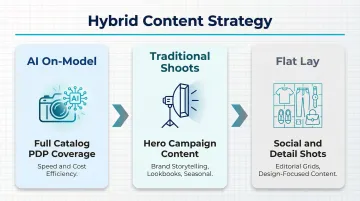
That evidence points to a practical workflow. Rather than choosing one format, brands that convert best tend to use all three deliberately:
- AI on-model for full catalog PDP coverage — Speed and cost efficiency across all products
- Traditional shoots for hero campaign content — Brand storytelling, lookbooks, seasonal campaigns
- Flat lay for social and detail shots — Design-focused content and editorial grids
A brand with 500 SKUs can now afford professional on-model imagery for every product — not just the top 20 sellers — without a corresponding increase in photography spend.
Conclusion
Flat lay and on-model aren't competing — they serve different roles in a well-built content strategy. The format that converts better is always the one that best answers the shopper's question in that specific context.
A simple rule of thumb:
- Structured garments on product pages: on-model nearly always wins
- Accessories and social grids: flat lay is often sufficient
The real opportunity for fashion brands isn't choosing one format over the other — it's getting on-model imagery across an entire catalog, not just the hero products that can justify a traditional shoot budget.
AI on-model tools make that scale achievable. With conversion uplifts of 20–30% and measurable reductions in fit-related returns, the economics point in one direction. The brands moving fastest are the ones treating on-model imagery as a catalog-wide standard — not a luxury reserved for hero products.
Frequently Asked Questions
Do 75% of online shoppers rely on product photography to make purchasing decisions?
Yes. According to Salsify's 2025 research, 77% of shoppers state that high-quality images and videos are important to their purchase decisions. Without the ability to touch or try on clothing, images serve as the primary trust signal — making format choice critical to conversion.
What percentage of clothing sales are online?
Industry modeling by AIMS360 for 2025 estimated a 38.1% online share of U.S. apparel spend, representing approximately $217 billion. That share is projected to grow, putting greater pressure on product imagery to do the work that in-store experiences once handled.
What is the ghost mannequin technique?
Ghost mannequin photography involves shooting clothing on a mannequin, which is then digitally removed in post-production to create a 3D, structured product image. It sits between flat lay and full on-model photography in terms of fit clarity and production cost, offering better structure visualization than flat lay at lower cost than model shoots.
Does on-model photography reduce return rates in fashion e-commerce?
Yes. On-model images set more accurate fit expectations, reducing size- and fit-related returns. Flat lay images can distort how structure and drape read, contributing to the 42% of fashion returns driven by size and fit issues.
Can AI on-model images match the conversion performance of traditional model photos?
When executed accurately, AI on-model images perform comparably to traditional photography for product listings. In research studies, 71% of shoppers could not distinguish between AI-generated and traditional photography — suggesting equivalent conversion potential when garment accuracy is prioritized.
Which photo format works best for social media vs. product detail pages?
Both standard and lifestyle flat lays tend to perform well on social platforms like Instagram and Pinterest for editorial appeal. On-model imagery consistently outperforms on product detail pages where shoppers need fit clarity before purchasing, with conversion rates 20–30% higher than flat lay for most clothing categories.