Introduction
Fashion e-commerce brands deal with a real tradeoff: ghost mannequin photography delivers affordable, consistent product visuals, while model photography drives aspiration and emotional connection. 56% of users immediately explore product images when they land on a product page, making the format of that image one of the most consequential decisions a brand makes.
This comparison matters specifically through a sales lens because product imagery is often the only touchpoint a customer has before purchase. The difference between ghost mannequin and on-model photography directly affects conversion rates, return rates, and brand perception. Together, those variables determine whether a fashion business grows or stagnates.
Key Takeaways
- Ghost mannequin shows garment shape in a clean, distraction-free format: best for catalog consistency and budget-conscious brands
- On-model imagery adds human context and lifestyle appeal, and it consistently drives higher conversions with fewer returns
- Model photography outperforms ghost mannequin on conversion metrics but costs significantly more
- The right choice depends on your product type, budget, brand positioning, and audience
- AI model platforms like MetaModels.ai offer a middle ground — conversion-quality visuals without traditional shoot costs
Ghost Mannequin vs Model Photography: Quick Comparison
Here's how ghost mannequin and model photography stack up across six key criteria for e-commerce teams:
| Criteria | Ghost Mannequin | Model Photography |
|---|---|---|
| Cost per image | $1.45–$5 (retouching only) | $80–150 (all-in at scale) |
| Production time | Next morning to 3 hours | 4–8 weeks (booking to delivery) |
| Conversion impact | Lower (creates cognitive gap) | Higher (proxy for fit visualization) |
| Return rate impact | Higher fit uncertainty | Lower when models reflect diverse body types |
| Scalability | 200+ images/day guaranteed | Constrained by talent and studio schedules |
| Diversity capability | None (no human representation) | High (reflects real customer demographics) |
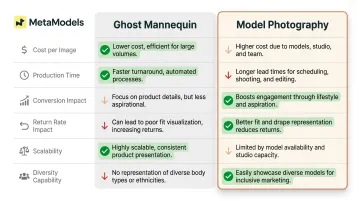
Cost figures reflect outsourced retouching only (ghost mannequin) versus full production — model fees, studio, photographer, styling, and retouching — for on-model shoots. Conversion and return impact are based on how well each format reduces purchase hesitation and fit uncertainty.
Understanding Both Approaches
Ghost Mannequin Photography: How It Works
Ghost mannequin photography — also called invisible mannequin or hollow man photography — is a post-production technique where a physical mannequin is removed from garment images to create a 3D, floating effect that shows structure and fit without a human wearer.
The production process:
- Photograph the garment on a modular mannequin
- A second shot captures inner collar or lining details
- Post-production editing stitches the images together and removes the mannequin
- The result is a hollow, three-dimensional garment image
Outsourced ghost mannequin retouching typically costs $1.45 per image at professional service levels, with volume discounts available. Turnaround is fast: next morning delivery is standard, with expedited 3-hour options for urgent jobs.
Core use cases where ghost mannequin excels:
- Catalog pages requiring visual uniformity across hundreds of SKUs
- Structured apparel (jackets, shirts, tailored trousers, blazers)
- Brands needing fast product launches without booking talent
- Budget-constrained operations prioritizing speed and consistency
Both approaches serve distinct commercial purposes — here's how model photography differs in production and application.
Model Photography: How It Works and When to Use It
On-model photography shows garments worn by real human models — either lifestyle/editorial shots that place the product in context, or clean studio shots that demonstrate fit and drape on an actual body.
Typical costs for a standard model shoot:
- Photographer day rate: $1,000–5,000
- Model fees: $200–4,000 (varies by agency and experience)
- Studio rental: $300–2,500/day
- Styling and makeup: $400–2,400/day
- Post-production retouching: $20–120 per image
At scale, the realistic per-image cost is $80–150 when producing 100+ images.
Production windows typically run 4–8 weeks from booking through delivery, constrained by studio schedules, talent availability, and crew coordination.
Core use cases where model photography excels:
- Fashion-forward apparel where fit on the body matters (dresses, activewear, swimwear)
- Lifestyle and social media content requiring aspirational or relatable context
- Lookbooks and seasonal campaigns
- Brands targeting audiences who respond to inclusive or representative imagery
How Each Approach Impacts Your Sales
Conversion Rate Impact
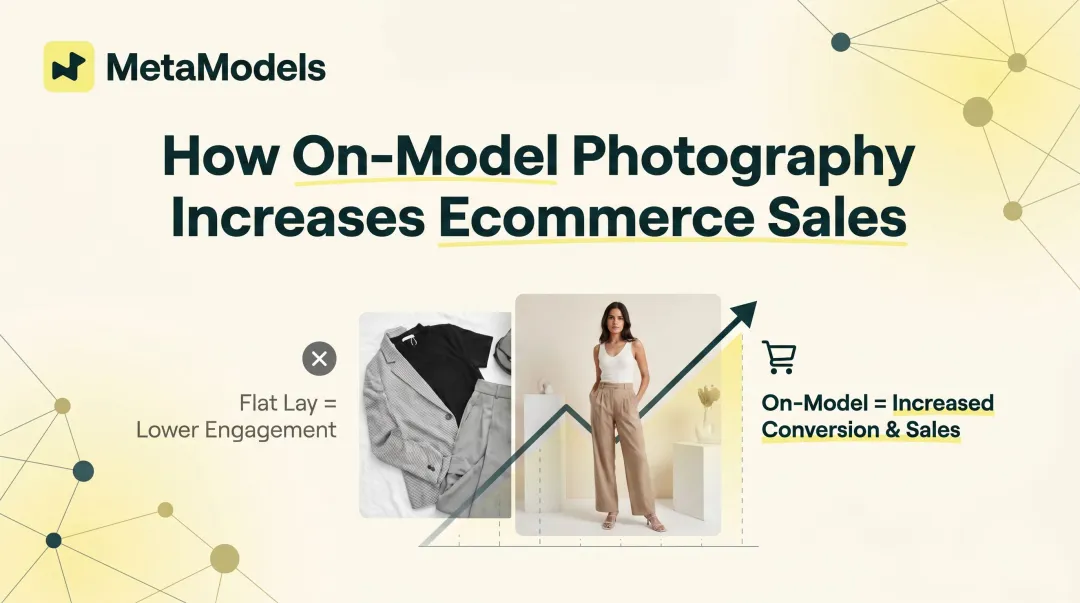
On-model imagery drives higher conversion because shoppers use models as proxies to visualize fit on their own bodies, reducing perceived purchase risk. When customers can see how fabric drapes, how a garment moves, and how proportions appear on a real person, they feel more confident clicking "add to cart."
Baymard Institute recommends providing human model images for products designed to be worn, yet 23% of sites still fail to do so. Aggregated merchant testing suggests on-model photos convert 20–30% higher than flat-lay imagery for many garment types, though direct A/B comparisons between ghost mannequin and on-model formats remain limited in published research.
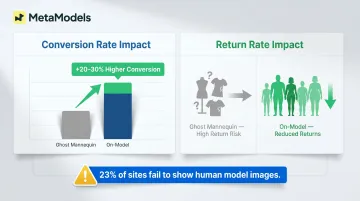
Ghost mannequin photography, while clear and professional, creates a cognitive gap where the shopper must imagine how the garment will look when worn. This gap introduces hesitation, particularly for higher-priced or fit-sensitive items like outerwear, tailored pieces, or activewear.
Return Rate Impact
Poor fit expectation is among the leading causes of apparel returns. 42% of consumer returns are due to fit and sizing issues, representing a massive cost burden for fashion brands. On-model imagery — particularly when models reflect diverse body types — helps customers self-select the right size more accurately before purchasing.
Peer-reviewed research published in the Journal of the Academy of Marketing Science demonstrates that size-inclusive model photography reduces perceived fit risk and lowers return likelihood among larger-size consumers. When customers see models that reflect their own body type, they can better assess fit and make more confident purchase decisions.
Ghost mannequin images, by contrast, offer no human reference point for fit assessment, leaving customers to guess how the garment will look on their body — a gap that increases return probability.
Brand Perception and Average Order Value
On-model lifestyle imagery positions products as aspirational and lived-in, supporting higher price anchoring and increasing add-to-cart rates on complementary items. When a jacket is shown styled with trousers and shoes on a model, shoppers are more likely to purchase the complete outfit, raising average order value.
Ghost mannequin images, while efficient, lack the styling context that drives cross-sell behavior. Without a model, there's no outfit framing, no aspirational cue, and no visual prompt for shoppers to consider what pairs with the product.
On-model content supports brand-building in ways ghost mannequin imagery structurally can't:
- Frames products in outfit context, prompting multi-item purchases
- Creates aspirational associations that support premium pricing
- Gives shoppers a visual anchor for how pieces fit together in a wardrobe
MetaModels.ai as a Middle-Ground Solution
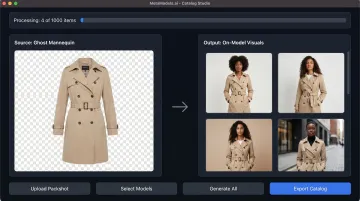
Brands seeking the conversion benefits of on-model imagery without the cost and logistics of traditional model shoots can use AI-powered platforms like MetaModels.ai. The platform converts packshots or ghost mannequin images into diverse, human-verified on-model visuals across an entire product catalog. Real-time fabric draping technology preserves garment accuracy, and all output is delivered at up to 4K resolution — no model fees, no royalties, no shoot scheduling required.
Which Approach is Right for Your Brand?
Product Type and Garment Complexity
Structured, layered garments (jackets, tailored trousers, blazers) communicate fit effectively via ghost mannequin, particularly when the goal is to show construction and silhouette. The 3D hollow effect highlights lapels, seams, and proportions clearly.
Fluid, body-conscious, or lifestyle-driven garments (activewear, dresses, swimwear) benefit more from on-model presentation. Drape, movement, and body conformity are the selling points — and ghost mannequin simply can't show those.
Brand Stage and Catalog Volume
Early-stage brands with large, fast-moving SKU catalogs may prioritize ghost mannequin for speed and consistency. When you're launching hundreds of products monthly and operating on tight budgets, the $1.45 per image cost and next-day turnaround make ghost mannequin the pragmatic choice.
Growth-stage brands investing in customer lifetime value and brand equity should weight the conversion uplift of on-model imagery more heavily. When acquisition costs are high and retention matters, the conversion lift from on-model imagery justifies the higher production cost.
Audience Expectations and Representation
Peer-reviewed research confirms that size-inclusive model imagery increases purchase intention and reduces fit anxiety among larger-size consumers — while thin-model-only photography actively deters them. Know your audience before defaulting to a single model type.
For brands serving diverse demographics, plus sizes, or niche communities where representation drives trust and purchase intent, on-model imagery with representative models is not optional — it's a commercial necessity.
Situational Guidance
Choose ghost mannequin for:
- High-volume catalog consistency and speed
- Structured basics where silhouette is the priority
- Budget-constrained product launches
- Category pages requiring uniform visual presentation
Choose model photography for:
- Conversion-critical hero products and seasonal campaigns
- Lifestyle content and social media storytelling
- Audience segments requiring aspirational or representative visuals
- Products where fit on the body is the primary purchase driver
- Brands building long-term equity in competitive markets
Consider AI model platforms when:
- Scale and cost make traditional model shoots impractical
- On-model imagery is still a commercial priority
- Diverse representation is essential but traditional casting is too slow or expensive
- You need to test multiple models, backgrounds, or styling variations quickly
Conclusion
Neither ghost mannequin nor model photography is universally superior. The right choice depends on where conversion, cost, and brand-building intersect for your specific business at your specific stage.
Product imagery format directly affects conversion rates, return rates, and brand perception. Understanding these tradeoffs — rather than defaulting to one approach because it's cheaper or "what everyone does" — is how you make imagery work as a growth tool, not just a cost line. Make your choice based on your product, your audience, and your business goals. And if traditional model photography costs are the barrier holding you back, AI-generated model imagery has closed that gap significantly for brands that need scale without the studio overhead.
Frequently Asked Questions
What is the difference between a mannequin and a model?
A mannequin is a physical or digitally-removed prop used to show garment shape without a person, while a model is a human wearer who adds body context, personality, and lifestyle appeal to product imagery.
Does on-model photography really increase conversion rates?
Yes, on-model imagery is consistently linked to higher conversion rates than ghost mannequin shots. Aggregated merchant data suggests on-model images can convert 20–30% higher for many garment types by reducing perceived purchase risk.
How much does ghost mannequin photography cost compared to model shoots?
Ghost mannequin photography primarily incurs post-production retouching costs of $1.45–$5 per image. Model shoots involve model fees, studio rental, photographer, and styling, putting the per-image cost at $80–$150 at scale — roughly 20 to 100 times more per image.
When is ghost mannequin photography the better choice?
Ghost mannequin is most effective for structured apparel, high-volume catalog production, brand-consistent category pages, and scenarios where speed and cost-efficiency outweigh the need for lifestyle context or emotional connection.
Can AI model photography replace traditional model shoots for fashion brands?
AI-powered platforms like MetaModels.ai can generate realistic on-model visuals from packshots or ghost mannequin inputs, making them viable for catalog-scale production. High-budget editorial campaigns may still benefit from traditional shoots where live direction and creative spontaneity are priorities.
Does product photography style affect e-commerce return rates?
Yes, imagery that better communicates fit, drape, and how a garment looks on a real body reduces return rates. Size-inclusive on-model photography lowers perceived fit risk, helping customers self-select the right size and reducing returns driven by poor fit expectations.