TL;DR
- The "Renaissance of Real" is the dominant design counter-trend to AI saturation, with A/W 26/27 and SS27 runways championing visible craftsmanship, raw finishes, and human imperfection
- AI-generated fashion imagery is becoming a production standard for e-commerce, though garment accuracy and resolution remain critical barriers to full adoption
- Consumer demand for emotional authenticity and individuality is driving both anti-AI aesthetics and fluid, era-blending silhouettes in SS27 forecasts
- Fashion brands that strategically blend AI efficiency with human-crafted authenticity in their visual storytelling will hold the strongest competitive position through 2027
The Renaissance of Real — Human Craft as the New Luxury
WGSN identified the "Renaissance of Real" as an emerging A/W 26/27 trend in March 2026, describing it as "a movement where designers emphasise visible craft, imperfection and material process to assert human authorship." This isn't just aesthetic preference — it's a direct commercial response to AI saturation in visual culture.
How the Trend Manifests on the Runway
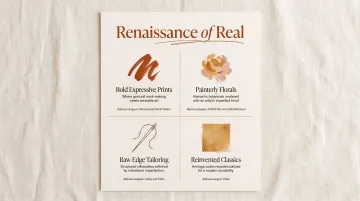
The Renaissance of Real expresses itself through four distinct design languages:
- Bold expressive prints with sketch-like marks — Altuzarra's ink blot prints and Henrik Vibskov's reworked houndstooth with sketch-like irregularity deliberately preserve the hand behind the work
- Painterly floral placements with unfinished brushwork — ROKSANDA and Emilia Wickstead showcase painterly florals with visible brush strokes and unfinished qualities that signal human authorship
- Raw-edge tailoring with exposed construction — Ashlyn and Erdem present raw-edge tailored blazers with contrasting topstitching and exposed construction lines
- Reinvented classics with deliberate irregularity — Prada features worn finishes, stained cuffs, and intentional abrasions that reject algorithmic perfection
The Consumer Psychology Behind Imperfection
Hannah Watkins, WGSN Head of Prints & Graphics, explains the emotional driver: "Design is increasingly signalling its human origin. As AI-generated visuals become widespread, creatives and brands lean into process, imperfection and materiality to prove that work is made by people, not machines." Research shows 72% of consumers believe AI makes it difficult to determine what content is truly authentic. With that context, Watkins notes, "designs that show the hand behind the work offer something algorithms can't replicate — meaning."
WGSN's consumer research reinforces this shift: "perfection is starting to feel impersonal and untrustworthy" to shoppers, who are "increasingly drawn to pieces that feel human" and view flaws as "proof of authenticity and value."
How This Reshapes Brand Storytelling
Luxury is being redefined through process visibility rather than polish. WGSN positions visible creativity as "fashion's most powerful currency" in a market flooded with AI sameness. In practice, that means:
- Behind-the-scenes studio and atelier footage showing the making, not just the made
- Campaign storytelling centered on the artisan's hand and design process
- Product descriptions that name materials, techniques, and makers explicitly
The commercial logic is straightforward: the more AI-generated imagery floods the market, the higher the premium consumers place on work that is unmistakably human. Brands that can demonstrate craft — not just claim it — will hold pricing power that algorithmic outputs cannot erode.
AI-Powered Fashion Imagery Becomes a Production Standard
Brands and e-commerce teams are integrating AI-generated imagery into production workflows — replacing or supplementing traditional photoshoots for catalogue content, social media, and lookbooks. Tools now place garments on AI models, swap backgrounds, and animate stills.
Real-World Adoption Patterns
According to the AOP's January 2026 member survey, 58% of photographers had lost commissioned work to generative AI services, with financial losses surging 142% year-on-year. Average photographer income losses reached approximately £14,400 per photographer.
Agencies are integrating AI across the production pipeline:
- Generates AI mock-ups and hyper-realistic storyboards during pre-production creative decks
- Replaces models and backgrounds within existing shoots at the production stage
- Converts stills to motion assets for social media in post-production
Named agencies including Webber, East Photographic, and Academy Films have all confirmed these workflows are now commercial practice.
The Critical Technical Challenge: Garment Accuracy
Widespread adoption, though, has exposed a hard constraint: garment accuracy. Fabric drape, cut, and detailing must match the actual product precisely or outputs are commercially unusable.
Multiple reference views — front, back, side, texture — are required for consistent AI output. Resolution must also meet the zoom-in demands of e-commerce shoppers who scrutinise fabric, stitching, and fit details before purchase.
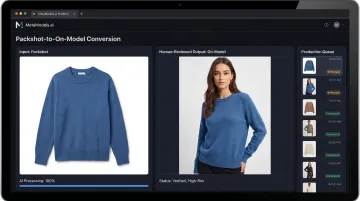
Purpose-built platforms address these limitations. MetaModels.ai, for example, uses real-time fabric draping technology and human-reviewed AI images to ensure garment accuracy. The platform converts packshots into on-model imagery at up to 4K resolution without a physical shoot, with every image reviewed by human fashion specialists before delivery to verify colour, shape, and proportions.
Why This Trend Is Accelerating
92% of fashion organisations plan to increase generative AI investment, according to the BoF-McKinsey State of Fashion 2026 report. Yet only 1% describe rollouts as "mature," which means most brands are still in early implementation — late movers risk falling significantly behind on content volume and cost efficiency.
Cost pressure and content volume demands are making AI imagery tools a practical necessity for brands managing hundreds of SKUs per season. Genera, working with 20+ enterprise brands, reports AI-generated images cost £0.50 to £1.50 per image versus approximately £4,000 per traditional session. For brands producing hundreds of SKUs per season, that gap is impossible to overlook at budget time.
Fluid Silhouettes, Emotional Minimalism, and Era-Blending
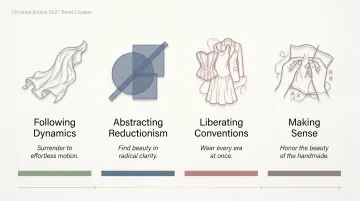
Trend forecaster Christine Boland's SS27 forecast identifies four connected movements — all reflecting consumer desire for ease, anonymity, or playful self-expression in uncertain times.
Following Dynamics brings weightless volume with deliberate pleating, knotted fabrics, and asymmetry. Jil Sander under Simone Bellotti, Burberry, and Tove exemplify this movement toward garments that feel fluid and unstructured.
Abstracting Reductionism offers pared-back geometric minimalism in confident colour — clear lines, razor-sharp seams, rounded shoulders. Louis Vuitton, Christian Dior, and Christopher Esber demonstrate this confident, reductive aesthetic.
Liberating Conventions embraces era-mixing, layering styles, prints, and decades for individualists. Chanel, Bottega Veneta, Balenciaga, and Isabel Marant express this through occasion-mixing — eveningwear with casual, formal with sport.
Making Sense responds directly to AI saturation. Boland states consumers seek items "that cannot be made by a machine," valuing "the human touch" and the "time and love invested in craftsmanship." This cluster features handiwork, beads, natural embellishments like shells, and minor imperfections as proof of human origin.
Why These Trends Resonate Emotionally
Boland describes consumers as feeling "overwhelmed" and "searching for purpose and meaning amidst chaos," and flooded with AI and machine-generated images that blur what is real. Across all four clusters, the throughline is the same: clothing as a source of calm, meaning, or joy when the external world offers neither.
For brands, this has direct implications for how SS27 collections are photographed and styled. Visuals that feel clinical or machine-perfect will work against the emotional grain of these trends. Instead, imagery needs to convey:
- Natural movement and fabric weight, not rigid poses
- Warmth and dimension over flat, high-key studio lighting
- Styling details — layering, texture, imperfection — that suggest a human hand
AI-generated imagery can meet this brief, but only when the output is directed toward these emotional registers rather than generic polish.
What's Driving These AI-Fashion Trends Toward 2027
The simultaneous rise of AI adoption and the human craft counter-movement are both responses to the same underlying forces, not contradictory ones. Three forces are reshaping how brands think about imagery: production economics, consumer sentiment, and a tightening regulatory environment.
Technology Advances and Cost Pressure
AI generative tools now deliver near-production quality for certain use cases. The economics make the shift hard to ignore: traditional photoshoots — model fees, studio time, crew, post-production — cost £4,000+ per session, compared to approximately £0.50–£1.50 per AI-generated image.
Consumer Expectations and Emotional Backlash
As AI-generated imagery floods digital feeds, consumers are developing a refined sensitivity to "AI gloss" — content that feels impersonal, generic, or untrustworthy.
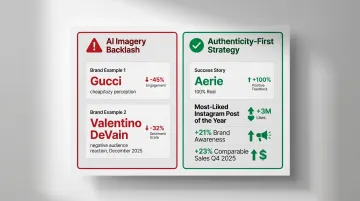
Gucci faced swift consumer backlash in early 2026 when it released AI-generated visuals to promote its Milan Fashion Week show. Comments described the imagery as "cheap," "lazy," and "out of step with a brand built on Italian craftsmanship." Valentino experienced the same negative reaction in December 2025 after posting a clearly labelled AI-generated video for its DeVain handbag.
Dr. Rebecca Swift, SVP of Creative at Getty Images, notes that consumers "hold brands to a higher standard than individuals" and full disclosure of AI use "isn't enough to win them over."
In contrast, Aerie's October 2025 pledge to never use AI-generated bodies or people in marketing — the "100% Aerie Real" campaign — became its most-liked Instagram post in a year. Brand awareness rose 21% exiting Q4 2025, and comparable sales climbed 23% in Q4 2025.
Regulatory and IP Pressures
New York Governor Kathy Hochul signed legislation S.8420-A in December 2025 requiring conspicuous disclosure of AI-generated human likenesses in commercial advertising, effective June 9, 2026. Violations carry civil penalties of $800–$4,000.
At the EU level, the EU AI Act's Article 50 requires AI-generated or substantially manipulated image, audio, and video content to be clearly identifiable as artificial, with penalties up to €15 million or 3% of global turnover.
Contract structures are evolving: model agencies now require express written approval before creating AI digital replicas, and photographers are negotiating IP protection clauses. This regulatory environment will shape how brands adopt AI imagery through 2027.
How These Trends Are Reshaping Fashion Photography and E-Commerce
Operational Impact on Photography Workflows
Photographers now receive AI-generated mock-ups as briefs, are asked to match references created with AI tools, and see stills converted to motion assets without their input. This changes pre-production assumptions, creative latitude, and post-production control.
Laura Dawes, director at Webber, confirmed the agency has updated contract terms. New terms require that any AI-generated scamps, pre-production briefings, or approvals must be signed off or approved by the agency to ensure the photographer can actually deliver the requested output.
Business Impact for E-Commerce Brands
Brands that adopt AI imagery workflows gain speed and cost efficiency but must invest in quality control processes. Key checks include:
Brands that adopt AI imagery workflows gain speed and cost efficiency but must invest in quality control processes. Key checks include:
- Garment verification against original packshots
- Resolution standards for multi-channel publishing
- Brand consistency across products, regions, and seasons
Platforms that offer human-reviewed outputs reduce this risk while scaling content volume. MetaModels.ai, for instance, handles the full production cycle — every AI image undergoes human fashion specialist review before delivery, verifying garment accuracy, colour fidelity, and fit details.
That combination of AI speed with human quality gates makes such platforms attractive to e-commerce teams under pressure to launch faster without compromising product representation.
Workforce and Talent Pipeline Impact
Entry-level photography assistant work is being displaced by AI, disrupting the talent pipeline for emerging photographers. Each lost shoot affects up to 10 workers including assistants.
The "Brave New World" report co-published by the AOP and other creative sector bodies in January 2026 found that generative AI is already displacing "bread-and-butter" creative work that sustains career pipelines. Based on evidence from over 10,000 creators, the report warns that AI is undermining the sustainable pathway for early-career creatives to build skills and income. Based on evidence from over 10,000 creators, the report warns that AI is undermining the sustainable pathway for early-career creatives to build skills and income. How the industry navigates this tension — embracing AI's efficiency while protecting the talent pipeline that feeds it — will define fashion photography's next chapter.
Future Signals: What Fashion Brands Should Prepare For
The AI-human tension in fashion will sharpen through 2027 as tools improve and regulation catches up. Brands that thrive will make a deliberate, communicated choice about where AI serves efficiency and where human craft serves brand value — and they'll say so publicly.
Technologies and Developments to Watch
Four developments are converging to reshape how fashion brands produce and present visual content:
- Real-time fabric simulation is improving AI garment accuracy for complex pieces — layered outerwear, detailed embellishments, and structured tailoring are now viable at production quality
- Motion and video generation from stills is entering standard social workflows, with platforms converting packshots into video assets for reels and product pages
- AI disclosure requirements are expanding beyond New York; the EU AI Act's Article 50 covers all providers and deployers of systems generating synthetic media — the widest regulatory scope to date
- Human-verified AI is emerging as a quality marker, with studios building human sign-off gates into AI pre-production workflows and positioning this review step as a differentiator for discerning brands
Scenario for 2026–2027
The most competitive fashion brands will operate a hybrid model: AI-generated imagery for high-volume e-commerce catalogue needs, and craft-forward human photography for brand campaigns and storytelling that signals authenticity.
Knowing when to use each approach will define content strategy through 2027. Brands producing hundreds of SKUs will use AI to scale catalogue content cost-effectively, while reserving human photography for hero campaigns, seasonal launches, and the kind of brand storytelling that demands emotional resonance — not interchangeable with a generated image.
The brands that communicate this strategy transparently — showing consumers where they invest in human craft and where they use AI for efficiency — will build trust in an era where 72% of consumers already find it difficult to determine what content is truly authentic.
Frequently Asked Questions
What fashion trends are expected for 2026–2027?
Key SS27 movements include fluid silhouettes and weightless volume, the "Renaissance of Real" counter-trend celebrating visible imperfection and handcraft, era-blending individualism, and the continued pull of geometric minimalism. Each reflects consumer demand for meaning and authenticity in uncertain times.
How is AI changing fashion photography in 2027?
AI now touches every production stage — from mock-ups and storyboards through model and background replacement to still-to-motion conversion. This displaces some traditional photoshoot work and raises demand for human review workflows that catch garment accuracy issues before images go live.
Will AI replace fashion photographers?
AI is displacing entry-level and catalogue work but not replacing the creative authorship and emotional intelligence of established photographers. The market is diverging between cost-driven AI adoption for volume content and premium human-crafted imagery for brand storytelling, with both coexisting through 2027.
What is the "Renaissance of Real" trend in fashion?
WGSN identifies this as a designer-led counter-movement on A/W 26/27 catwalks, emphasising visible imperfection, raw construction, painterly finishes, and handcraft. Brands like Altuzarra, ROKSANDA, and Erdem are pushing back against the uniform polish of AI-generated aesthetics with work that foregrounds human authorship.
How can fashion brands use AI for e-commerce photography without losing product accuracy?
Garment accuracy starts with multi-angle reference imagery — front, back, side, and texture shots — paired with human verification at the review stage. Purpose-built platforms with real-time fabric draping and structured human sign-off outperform general-purpose AI tools for e-commerce, where colour, fit, and detail fidelity are non-negotiable.