Introduction
Modest fashion brands face a product photography challenge that traditional agencies rarely understand. Finding models who authentically represent abayas, hijabs, and modest wear across diverse body types and cultural aesthetics isn't a quick studio booking.
It means navigating limited talent pools, cultural sensitivity requirements, and costs that multiply with every SKU in your catalog.
AI model platforms are shifting how brands solve this. Brands can now generate on-demand, brand-consistent visuals that respect modesty standards, accurately showcase garment drape, and reflect the diversity of their customer base—without booking a single model or studio.
The commercial stakes are substantial. Muslim consumer spending on modest fashion alone reached $327 billion in 2023 and is projected to hit $433 billion by 2028, according to DinarStandard's State of the Global Islamic Economy Report 2024/25. For brands competing in this fast-growing segment, producing high-quality, culturally appropriate content at scale is no longer optional.
This guide covers what to look for in AI model platforms, how they handle modest garment requirements, and which capabilities matter most when evaluating your options.
Key Takeaways
- AI model photography platforms generate professional product images without hiring models, booking studios, or managing photoshoot logistics
- Most platforms offer diverse model libraries — verify modest-specific coverage and hijab-friendly styling before committing
- Prioritize platforms with accurate rendering for layered fabrics, deep customization options, and clear image licensing terms
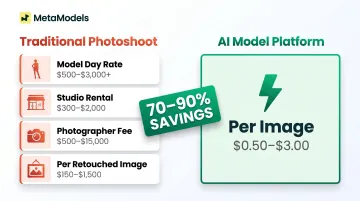
- Traditional photoshoots cost $150–$1,500 per final image; AI platforms reduce costs to $0.50–$3.00 per image—a 70–90% savings
- Top platforms covered: MetaModels.ai, Botika, Fashn.ai, and ZMO.ai
Why Modest Fashion Brands Have Unique Product Photography Needs
Modest fashion presents a unique visual challenge. Garments like abayas, kaftans, wide-leg trousers, and full-sleeve tops require models who won't inadvertently expose skin during movement. Finding models who authentically represent your brand's modest aesthetic—particularly with hijab styling—adds complexity and cost that traditional photoshoots struggle to accommodate.
That representation challenge runs deeper than styling. Modest fashion serves a broad global audience spanning Muslim, Orthodox Jewish, conservative Christian, and secular modest-dressing communities across vastly different ethnicities and body types. Traditional model agencies rarely maintain rosters with that range — achieving it through a single photoshoot budget is nearly impossible.
The cost pressure compounds when you're producing imagery at SKU scale. Modest fashion brands often carry dozens of styles per collection — each needing consistent, on-brand photography. Typical per-shoot expenses include:
- Model day rates: $500–$3,000+
- Studio rentals: $300–$2,000 per day
- Photographer fees: $500–$15,000
- Final retouched photos: $150–$1,500 per image
At that rate, total costs per SKU can easily exceed $500 before post-production begins.
For brands scaling into new markets or launching seasonal collections, those costs repeat every cycle. AI model platforms address this by removing the recurring fees entirely — no model bookings, no studio time, no per-image retouching costs — while making it practical to show the same garment on multiple model types without a second shoot.
Top AI Model Platforms for Modest Fashion Product Photography
These platforms were evaluated on garment rendering accuracy, model diversity, customization depth, ease of use, output resolution, and suitability for modest fashion's specific visual requirements—particularly how well they handle full-coverage, layered, and flowy silhouettes.
MetaModels.ai
MetaModels.ai is an AI-powered fashion imagery platform that converts flat packshots into on-model visuals without requiring any physical photoshoot. Purpose-built for fashion e-commerce brands, it delivers scalable, brand-consistent content through a combination of AI generation and human-verified quality assurance.
What makes it stand out for modest fashion:
MetaModels.ai uses real-time fabric draping technology to preserve garment behavior and coverage accuracy, which matters most for modest wear where fabric fall and coverage define the look. Every AI-generated image is reviewed by human fashion specialists before delivery, ensuring garment details meet professional standards.
The platform offers a curated library of AI models spanning diverse ethnicities, body types, and age ranges. Brands can customize selections or commission fully custom model creation to match their brand identity — removing model sourcing friction entirely for brands serving multiple regional markets.
Output is delivered ready-to-publish in up to 4K resolution with no model royalties or licensing concerns. The platform manages production end-to-end across e-commerce listings, social media, paid ads, and lookbooks.
| Feature Category | Details |
|---|---|
| Key Feature | Packshot-to-model conversion with real-time fabric draping; human-reviewed images for garment accuracy; custom model creation |
| Model Diversity | Curated library with varied ethnicity, body types, and demographics; supports custom model styling and scene creation |
| Output & Licensing | Up to 4K resolution; no model royalties; unlimited commercial usage rights for e-commerce, social media, ads, and lookbooks |
Botika
Botika is a generative AI platform designed for e-commerce brands that need to swap out flat-lay and mannequin photography for on-model visuals at scale. Upload a garment photo, select a model from the library, and generate professional imagery with contextual backgrounds.
Botika integrates directly with Shopify and WooCommerce, which makes it accessible for D2C brands on either platform. Models vary in skin tone, body type, and style, with full library access on higher-tier plans.
Documented results from Botika case studies include a 90% reduction in production costs for Jordache, a 40x speed increase for JUAN & ME (cutting timelines from 6 weeks to 24 hours), and a 150% click-through rate lift for Get Dressed Collective.
However, Botika notes that output realism can vary with complex garments. Modest fashion brands selling layered or floor-length pieces should test the platform with their specific products before committing to a subscription.
| Feature Category | Details |
|---|---|
| Key Feature | Flat-lay and mannequin-to-model conversion; AI fashion video generation; retouching workflows |
| Model Library | Diverse skin tones, body types, and styles; full library access on Pro and Advanced plans |
| Pricing & Access | Plans from approximately £22-33/month for 30 credits; HD to 4K resolution depending on tier; commercial rights on paid plans |
Fashn.ai
Fashn.ai is an AI fashion studio offering virtual try-on, product-to-model transformation, model swap, and model creation features. The platform supports three garment categories — tops, bottoms, and one-pieces — with automatic garment detection that identifies category without manual tagging.
The "one-pieces" category and full-body visualization focus suggest capability with longer garments like dresses and jumpsuits, which is promising for modest wear. Fashn.ai preserves garment details including logos, text, patterns, and fabric draping adapted to model proportions.
At £19/month for 200 credits, Fashn.ai has the lowest entry point among the reviewed platforms. The plan includes up to 4K upscaling, all core AI tools, and 720p AI video generation. A free tier with 10 credits is available for testing.
The platform provides a full API with endpoints for image generation, virtual try-on, model creation, and background manipulation. API access is also available via fal.ai marketplace at £0.075 per generation. Users can create custom AI model faces and reuse them across shoots for brand consistency, though hijab or modest-specific presets are not explicitly documented.
| Feature Category | Details |
|---|---|
| Key Feature | Virtual try-on and product-to-model transformation for tops, bottoms, and one-pieces; automatic garment detection; fabric detail preservation |
| Integration & Workflow | Full API available via docs.fashn.ai and fal.ai marketplace; supports custom model faces for brand consistency |
| Pricing & Output | £19/month for 200 credits (Basic); up to 4K upscaling; commercial use permitted; free start with 10 credits |
ZMO.ai
ZMO.ai is an AI-powered image generation platform trusted by over 1 million users, featuring a dedicated AI Fashion Model tool that places uploaded garments on AI-generated models. The workflow lets users mask or select the garment area, choose from the model library or describe models via text prompt, select backgrounds, and generate multiple results at once.
With 50+ body types and skin tones, ZMO.ai has the broadest documented model diversity among the platforms reviewed here. Text-based customization lets users describe model appearance and background in natural language, going beyond pre-set library options.
The platform generates 4 image variations per prompt in approximately 20 seconds. For teams with existing tooling, integrations include:
- API access for custom workflow integration
- Zapier and Make.com for automation
- Plugins for Figma, Sketch, and GIMP
Pricing starts with a free tier (10 credits), with paid plans from approximately £59/month to £799/month depending on credit volume and resolution. Subscribers own all generated content with full commercial rights, including resale and merchandise use.
ZMO.ai does not document specific results with floor-length or full-coverage garments. Brands should run tests with their own product types before scaling — particularly if layering or coverage accuracy is a priority.
| Feature Category | Details |
|---|---|
| Key Feature | AI model generation with text-based customization; mask/select workflow; batch generation with multiple simultaneous results |
| Model & Style Options | 50+ body types and skin tones; text prompt customization for model appearance and backgrounds; pose variety |
| Pricing & Licensing | Free tier (10 credits); paid plans from £59/month; up to 4096px resolution; full commercial rights including reprint and merchandise |
How We Chose the Best AI Model Platforms for Modest Fashion
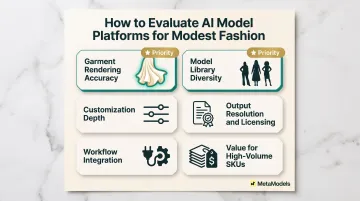
Each platform was evaluated across six criteria relevant to modest fashion production:
- Garment rendering accuracy for flowy, full-coverage, and layered silhouettes
- Model library diversity across ethnicity, body type, and styling preferences
- Customization depth for brand-specific model creation
- Output resolution and licensing clarity
- Ease of integration into existing workflows
- Overall value for high-volume SKU production
One mistake to avoid: selecting a platform based on general fashion demos rather than testing it on your actual garment types. AI platforms tend to handle structured pieces like blazers and jeans well, but may struggle with the drape and movement of floor-length abayas or layered kaftans. Request test outputs with your specific products before committing.
For modest fashion brands specifically, two criteria carry extra weight:
Coverage and drape accuracy — Does the platform preserve full-coverage silhouettes faithfully, including the way fabric moves and flows in floor-length or layered garments?
Model library representation — Does the platform reflect your actual customer base, with diverse ethnicity, body types, and styling preferences beyond Western fashion defaults?
No platform reviewed explicitly documents hijab-wearing model presets or modest fashion use cases in its marketing materials. That gap is real, and worth factoring into your evaluation. Brands that push providers to test modest wear rendering early are in the best position to shape how these tools develop.
Conclusion
Modest fashion brands no longer need to compromise between authentic representation and content production efficiency. The right AI model platform delivers both, at a fraction of traditional photoshoot costs—typically reducing per-image expenses by 70-90% while compressing timelines from weeks to hours.
Evaluate platforms not just on price or visual quality in demos, but on how well the tool handles your specific garment types, your required level of model diversity, and whether the output is scalable enough to support your full catalog. Request test outputs with your actual products—abayas, hijabs, layered kaftans—before committing to a subscription.
If those criteria matter to your brand, MetaModels.ai is built specifically to meet them—human-verified garment accuracy, a diverse AI model library spanning ethnicity and body type, and no royalty complications at any volume. Request a demo with your own packshots to see exactly what publish-ready output looks like for your catalog.
Frequently Asked Questions
Can AI-generated models accurately display modest garments like abayas, hijabs, and full-coverage clothing?
Leading platforms use fabric draping simulation to render covered, layered, and flowy silhouettes—though quality varies and none explicitly document modest-specific presets. Test with your own garment types, particularly floor-length and layered pieces, before committing.
Do AI model photography platforms offer diverse model options suitable for modest fashion brands?
Most platforms include diverse model libraries covering ethnicity, body type, and age range. MetaModels.ai and ZMO.ai support custom model creation for brand-specific representation, though hijab-wearing or modest-appropriate styling presets are not explicitly documented across platforms.
How much can modest fashion brands save by switching from traditional photoshoots to AI model photography?
Traditional fashion e-commerce photography costs £150-£1,500 per retouched image versus £0.50-£3.00 per AI-generated image, representing potential cost reductions of 70-90%. Botika case studies document a 90% production cost reduction for Jordache, while eliminating model fees (£500-£3,000+ per day), studio rentals (£300-£2,000), and photographer costs (£500-£15,000).
Are AI model images licensed for commercial use including social media, e-commerce, and advertisements?
MetaModels.ai, Fashn.ai, and ZMO.ai all include royalty-free commercial licensing covering e-commerce, social media, paid ads, and print. Terms vary by platform, so confirm usage rights for all intended channels before committing.
How long does it take to generate AI model product images compared to a traditional photoshoot?
AI model platforms generate images within minutes to hours per batch versus 2-6 weeks for traditional photoshoot cycles. ZMO.ai produces 4 variations in approximately 20 seconds, while Botika's JUAN & ME case study documented reducing timelines from 6 weeks to 24 hours, making AI platforms especially valuable for new collection launches and time-sensitive campaigns.
Can I create AI models that reflect my modest fashion brand's specific aesthetic and customer identity?
Yes. MetaModels.ai supports fully custom model creation across ethnicity, body type, age range, and styling, while ZMO.ai enables detailed text-based model descriptions. Both approaches deliver a consistent visual identity without relying on generic library options.