Introduction
Traditional summer lookbook shoots cost $10,000 to $30,000 per day for professional fashion photography — luxury editorial work easily exceeds $50,000. Add 6–10 weeks from model booking through post-production, and resort collections, swimwear lines, and lightweight fabric showcases routinely miss the window when consumers are actively shopping.
Leading fashion e-commerce teams are closing that gap with AI virtual models. These platforms convert packshot product photography into styled, on-model lookbook imagery, eliminating studio bookings, model fees, and location logistics while meeting the visual standards luxury consumers expect.
TLDR
- AI virtual models generate full summer lookbooks from packshots, cutting studio costs and 6–10 week timelines
- Seasonal environments (beach, poolside, resort) and lightweight fabric rendering are produced without location shoots
- Luxury-grade output requires fabric draping accuracy, human review, and brand-consistent styling
- Leading brands use AI for catalog volume (70–80% of SKUs), reserving traditional photography for hero imagery
What Are Luxury AI Virtual Models for Lookbooks?
AI virtual models for lookbooks are brand-side production tools that place AI-generated human figures wearing actual garments into professional-quality editorial environments. Unlike consumer-facing virtual try-on apps (which fit clothing to a shopper's uploaded photo), these platforms serve fashion brands producing e-commerce and marketing content at scale.
Two Primary Creation Methods:
CGI-Sculpted Avatars
The CGI approach offers maximum creative control at significant cost. Balmain's pre-fall 2018 "Virtual Army" campaign enlisted three CGI models created by digital artist Cameron-James Wilson: Shudu, Margot, and Zhi. Each required labor-intensive 3D modeling, with digital garments rendered by CLO, a studio specializing in garment simulations. The result is exacting visual precision — but the timeline and budget reflect that level of craft.
AI-Generated Model Platforms
Generative AI platforms offer a faster, scalable path. These systems are trained on fashion imagery to understand garment fit, draping, and styling — and most maintain curated model libraries spanning diverse body types, ethnicities, and skin tones. MetaModels.ai, for example, converts packshots into on-model imagery while preserving garment details through real-time fabric draping technology and human review by fashion specialists.
The Luxury Quality Bar:
"Luxury-grade" AI imagery meets a higher visual standard than standard e-commerce photography. Dr. Rebecca Swift, SVP of Creative at Getty Images, notes that consumers "hold brands to a higher standard, especially expensive brands" when it comes to AI-created content.
That skepticism is measurable. According to Vogue Business research, only 24% of consumers say AI-generated fashion images are as valuable as human-made content.
Luxury applications demand:
- Accurate fabric rendering with correct drape and texture
- Natural posture and proportions
- Garment detail preservation (seams, buttons, prints)
- Coherent aesthetic that integrates seamlessly with traditional campaign photography
Why Summer Is the Hardest Season to Shoot — and How AI Solves It
Summer's Unique Production Challenges
Summer collections compress multiple production complexities into tight seasonal windows:
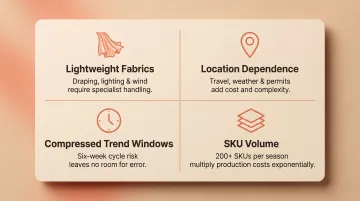
- Lightweight fabrics — Chiffon, silk, and linen demand precise draping, specific lighting, and wind machines. Translucent and flow-dependent materials are technically difficult to photograph consistently.
- Location dependence — Coastal, poolside, and resort settings add travel coordination, weather risk, permit requirements, and extended crew time.
- Compressed trend windows — A six-week production cycle often means launching after the trend has peaked.
- SKU volume — 30 styles can exceed 200 SKUs once sizes and colorways are factored in, multiplying every production cost.
The Timeline Problem
Traditional fashion photoshoot timelines span weeks:
- Model casting and booking: 1–2 weeks
- Location scouting and permits: 1–2 weeks
- Shoot day coordination: 1–3 days
- Post-production and retouching: 2–3 weeks
Total timeline: 6–10 weeks minimum
For Spring/Summer collections — shown in September, delivered in January, on sale by June — that's a timeline with almost no slack. A single delay anywhere collapses the launch window.
How AI Virtual Models Solve Each Challenge
AI-generated imagery addresses each friction point directly. Beach, terrace, and poolside environments are rendered digitally — no travel, no weather delays, no permits. McKinsey research shows generative AI can compress the initial design phase from weeks to days, which means brands can respond to trend windows instead of chasing them.
The cost math also changes at scale. AI-generated imagery cuts e-commerce production costs by up to 70% compared to traditional studio shoots — and generating 200 SKUs doesn't cost proportionally more than generating 20.
The adoption rate signals how quickly this has moved from experiment to standard practice. By February 2025, 58% of photographers had lost assignments to generative AI, up from 30% just five months earlier, according to the Association of Photographers. For brands managing tight seasonal windows, that shift isn't surprising — it's the logical response to a production model that no longer fits the pace of fashion.
The Luxury Quality Bar: What Real Brand-Ready AI Model Content Looks Like
Why Early AI Fashion Imagery Failed Luxury Brands
First-generation AI fashion imagery suffered from consistent quality issues that made it unsuitable for luxury applications:
- Stiff, unrealistic fabric rendering
- Uncanny facial expressions and unnatural poses
- Inconsistent proportions and anatomical errors
- Visual "flatness" that felt misaligned with editorial sensibility
Consumer backlash illustrated the gap between capability and luxury standards:
| Brand | Campaign | Consumer Response |
|---|---|---|
| Valentino | DeVain AI video (Dec 2025) | Called "cheap," "lazy," "disturbing" despite clear labeling |
| Prada | Wolfson AI campaign | Described as "unsettling" and "polarizing" |
| Gucci | AI campaign imagery | Mixed to negative reviews from consumers |
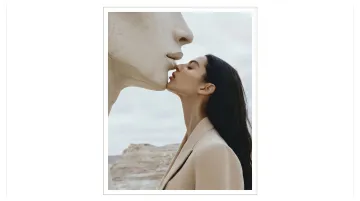
Academic research confirms the challenge. A study published in the Journal of Advertising found that AI models scored low on "social presence" — the degree to which people perceive an artificial figure as humanlike. "When you see AI models, you don't consider them as human, as warm or as relatable," explained Quan Xie, associate professor at SMU's Temerlin Advertising Institute.
Fabric Draping Accuracy: The Critical Differentiator for Summer
Lightweight summer materials — silk, chiffon, satin, linen — depend on flow, drape, and transparency for visual appeal. Generic AI image generation treats fabric as surface texture rather than understanding how material behaves on the body.
Real-time fabric draping simulates how actual garment fabric behaves on the body, preserving:
- Natural fold patterns
- Movement and flow
- Translucency and layering effects
- Weight-appropriate hang
Sheer overlays, flowing maxi dresses, and lightweight resort wear all render accurately — no stiff silhouettes or incorrectly weighted fabric that undercuts summer styling.
Human Review: The Non-Negotiable Quality Layer
Jill Asemota of Parallel Pictures notes a fundamental challenge: "When models start moving, the product can change or warp. For us, that's not acceptable."
Human-verified workflows catch generation errors before content reaches product pages. MetaModels.ai's process includes human review by fashion specialists for every AI image, checking:
- Color accuracy — Garment colors match original packshots and brand specifications
- Construction details — Buttons, seams, prints, and embellishments render correctly
- Proportions — Garment fit, silhouette, and drape maintain proper form
That human checkpoint is also what makes model diversity viable at scale — representation only works as a brand asset when the execution is right.
Model Diversity as a Brand Asset
A curated library of AI models across body types, skin tones, age ranges, and ethnicities enables brands to build inclusive summer lookbooks without casting logistics.
However, execution matters. When Levi's partnered with Lalaland.ai in 2023 to use AI-generated models to show diverse body types, the brand faced backlash for "cheapening diversity by failing to use real diverse models." Diversity through AI only lands when the intent is genuine inclusion — not a workaround for cutting casting budgets.
Resolution and Output Quality Requirements
Luxury e-commerce and lookbook content must hold up at full-bleed editorial sizes. 4K output is the baseline for professional deployment across:
- Product detail pages (PDP)
- Digital lookbooks and catalogs
- Paid social media campaigns
- Editorial email marketing
- Large-format digital advertising
When AI-generated imagery sits alongside traditionally photographed hero content, resolution parity is non-negotiable — anything below 4K shows immediately at editorial scale.
From Packshot to Lookbook: How to Produce Summer AI Model Content
Step 1 — Start with Quality Packshots or Flatlay Imagery
The quality of your input images directly affects the quality of generated output. AI platforms need clean product photography to accurately extract garment details.
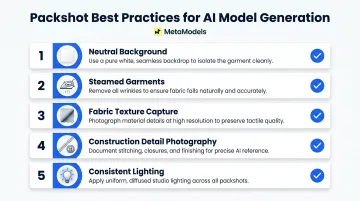
Input image best practices:
- Use white or neutral backgrounds for clean extraction
- Remove wrinkles and ensure garments are properly steamed
- Capture fabric texture clearly (especially important for lightweight summer materials)
- Photograph construction details (prints, embellishments, seams)
- Ensure consistent lighting across all packshots
For translucent summer fabrics, photograph layering clearly so the AI understands how sheer materials sit over base garments.
Step 2 — Select AI Model Specifications for Your Summer Collection
Define model parameters relevant to summer lookbooks:
Model selection criteria:
- Body type (athletic, curvy, petite, tall)
- Skin tone and ethnicity
- Age range (Gen Z, millennial, mature)
- Pose category (active, editorial, resort, lifestyle)
Build a consistent model library — Establish a core set of 4–6 recurring figures rather than selecting randomly per garment. Consistent model choices create visual cohesion across the full collection.
Step 3 — Define Summer-Specific Scene and Background Parameters
Brief the AI on seasonal environment settings appropriate for summer collections:
Environment options:
- Coastal/beach settings with natural light
- Resort terraces and poolside scenes
- Garden or outdoor lifestyle contexts
- Neutral studio with summer color palette (whites, pastels, brights)
Lighting considerations — Bright, natural light works best for summer aesthetics. For translucent fabrics specifically, lighting direction affects how sheerness and layering appear. Backlit scenes emphasize transparency; front-lit scenes showcase color and print detail.
Step 4 — Run Generation and Quality Review
The generation-to-review cycle:
- Generate initial variations
- Check garment accuracy against original packshots
- Flag images with incorrect details or poor draping
- Regenerate flagged items with adjusted parameters
- Human review verifies final output before delivery
MetaModels.ai includes human review by fashion specialists as part of the production workflow, ensuring every image meets garment accuracy standards before delivery. This built-in quality control step matters most when processing full summer catalogs at volume.
Step 5 — Organize Output for Lookbook Deployment
Structure final deliverables for different end uses:
- E-commerce pages: Studio shots with neutral backgrounds, consistent lighting, and multiple angles
- Lookbook PDFs: Lifestyle editorial images in summer environments, styled with accessories
- Social media: Aspect-ratio variants for Instagram (1:1, 4:5), TikTok (9:16), Facebook (1.91:1), and Pinterest (2:3)
- Paid advertising: Platform-specific formats meeting each channel's ad specifications
Organizing output by channel at this stage prevents last-minute reformatting and keeps deployment on schedule.
Keeping Your Brand Aesthetic Consistent Across Hundreds of Summer SKUs
The Consistency Challenge at Scale
A summer catalog may contain 80–200+ SKUs. Without locked generation parameters, AI-generated imagery risks looking disjointed — different models, varying lighting styles, inconsistent backgrounds.
Define "locked" generation parameters:
- Consistent model selection (your core 4–6 recurring figures)
- Unified lighting style (natural bright light for summer)
- Approved background types (beach, poolside, neutral studio)
- Consistent color grading
- Defined pose vocabulary (editorial standing, resort seated, lifestyle movement)
These parameters function like a traditional shoot creative brief, ensuring every generated image fits within the same visual world.
How Luxury Brands Are Splitting the Workload
Jill Asemota of Parallel Pictures explains the emerging model: "AI is rarely used for primary campaigns; instead, it is used for add-ons." Brands typically shoot one real campaign then use AI to create 10–20 additional assets for social and digital channels.
Typical hybrid split:
- 70–80% of SKUs — AI-generated model content for catalog volume
- 20–30% of SKUs — Traditional photography for hero pieces and campaign imagery
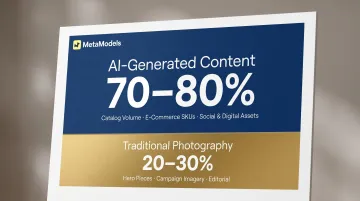
This approach balances operational efficiency with brand authenticity. Hugo Boss has used AI imagery across e-commerce platforms since 2023, showing that AI content can hold up alongside traditional photography when the visual parameters are locked from the start.
Turning Your AI Brief Into a Team-Wide Standard
Before generating a single summer image, document your AI brief. The parameters defined above aren't just for the AI tool — they need to live in a shared document your whole team can reference.
What that brief document should include:
- Named model selections with reference images (not just descriptions)
- Background environments listed with specific visual examples, not broad categories
- Lighting notes with direction and intensity (e.g., "soft front-fill, late afternoon angle")
- Color grading samples showing approved warm/cool range
- Pose category names tied to visual references your retouchers can match against
With this on file, anyone running a generation batch — or reviewing outputs — can make consistent decisions without escalating every judgment call.
Frequently Asked Questions
Frequently Asked Questions
Is virtual try-on clothing accurate?
Consumer-facing virtual try-on — which maps clothing onto a user's uploaded photo — is a different tool from brand-side AI model content. For lookbook production, accuracy depends on fabric draping technology and human quality review. Platforms that verify garment details against original packshots before delivery produce the most reliable results.
Is there an AI that puts outfits together?
AI platforms generate models wearing specific garments, but outfit curation is not their primary function. For luxury lookbook production, the use case is placing a particular garment on a chosen AI model accurately. Styling decisions remain a human creative call.
What brands use virtual try-on?
Major luxury houses including Gucci, Burberry, Prada, and Louis Vuitton have integrated virtual model or AR try-on technology. Hugo Boss has used AI imagery across e-commerce platforms since 2023.
Are AI fashion models real people?
AI fashion models are entirely computer-generated figures, not based on specific real individuals. However, some platforms train on licensed photos of real people. Brands and platforms should disclose when imagery is AI-generated, and no real model's likeness may be used without explicit consent.