This article explores how virtual AI models are transforming winter fashion discovery, enabling luxury brands to visualize entire collections on photorealistic models without a single studio booking. From fabric-rendering technology that accurately drapes cashmere and velvet to campaign-ready lookbooks produced in days instead of weeks, AI models are changing how premium brands present seasonal aesthetics—faster, more inclusively, and at a fraction of the cost.
Key Takeaways
- Visualize entire winter collections on photorealistic AI models — no photoshoots, no model bookings required
- Advanced fabric-draping technology renders luxury materials like cashmere, velvet, and bouclé wool accurately
- Winter aesthetics like quiet luxury, oversized silhouettes, and tonal dressing reach market faster and across more body types
- Per-image costs drop sharply while seasonal content scales to meet full collection demand
The Visual Challenge of Presenting Luxury Winter Fashion Online
Winter is the most demanding season for fashion imagery. Heavy layering, textured fabrics—faux fur, tweed, cashmere—and complex silhouettes require more editorial context than single-item product shots. Buyers need to see how pieces work together to grasp the luxury proposition. A belted cashmere coat shown alone on a mannequin doesn't communicate the same value as that coat styled over a merino turtleneck with wide-leg wool trousers.
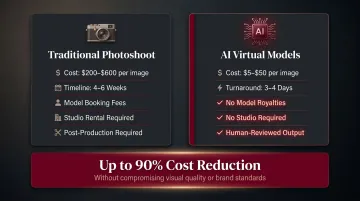
The production bottleneck intensifies during winter rollouts. According to industry benchmarks, shooting a 50-piece collection traditionally costs $15,000–$50,000+ and takes 4–6 weeks. Per-image costs run $200–$600 when factoring in model fees, photographer day rates, studio rental, hair and makeup, and post-production.
These costs hit hardest during winter launches, when the holiday and resort shopping window is short and brands are competing for the same consumer attention.
That cost pressure also creates a visualization problem. Brands often can't see how a new winter piece will actually look styled before committing to production or buying decisions. AI virtual models address this directly — teams can see a coat layered over separates, on a specific body type, in a styled scene, before a single shoot is booked or a manufacturing run confirmed.
Luxury Winter Aesthetics That AI Virtual Models Showcase Best
Quiet Luxury and Tonal Dressing
Quiet luxury for winter centers on minimalist layering of premium fabrics—merino turtlenecks, wide-leg wool trousers, belted cashmere coats—in neutral palettes of stone, taupe, ivory, and charcoal. No visible logos. The entire aesthetic relies on fabric quality and silhouette, making high-fidelity AI model rendering essential.
AI virtual models present tonal, monochromatic looks more convincingly than flat packshots by adding body context, drape, and movement cues that signal luxury. When a stone-toned cashmere coat falls naturally over an ivory turtleneck, the viewer perceives premium quality. Flat-lay photography can't replicate that.
Oversized Silhouettes and Structured Outerwear
Oversized coats, structured blazers, and long parka silhouettes are signature winter luxury pieces notoriously difficult to photograph on static mannequins. AI models simulate how volume falls on a body, making these pieces easier to assess and convert. A voluminous wool coat looks shapeless on a ghost mannequin but demonstrates its intended silhouette on an AI model.
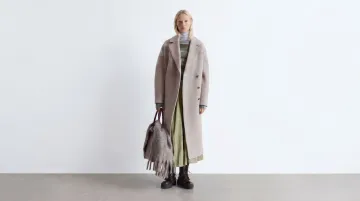
That silhouette advantage extends directly into production efficiency. For lookbook work, one AI model can cycle through six coat-and-knitwear combinations in an hour — work that would typically consume a full studio day of lighting resets, steaming, and model turnaround.
Rich Winter Textures and Elevated Color Palettes
The winter palette dominating luxury fashion discovery includes deep jewel tones—ruby, emerald, burgundy—rich browns like chocolate and mahogany, and elevated neutrals. These hues need accurate rendering on diverse skin tones to convert browsers into buyers.
Winter fabrics each carry distinct rendering requirements under light:
- Velvet and bouclé wool require directional shading to show pile depth and surface texture
- Faux fur needs movement simulation to read as dimensional rather than flat
- Leather and satin depend on specular highlight accuracy to convey sheen
Academic research in garment rendering shows diffusion-based models can capture cloth dynamics and fabric drape in video formats — a meaningful step forward for material accuracy. Platforms like MetaModels.ai pair automated AI processing with human review specifically to catch texture fidelity issues before images reach production, ensuring winter-specific fabrics render with the detail luxury buyers expect.
How AI Virtual Models Enable Winter Fashion Discovery
Visual discovery in fashion is the process of testing how garments look styled and presented before finalizing production, buying, or marketing decisions. AI virtual models serve as a rapid visualization layer at this stage, enabling brands to evaluate pieces in realistic contexts before committing budgets.
The packshot-to-model workflow is especially effective for winter collections. Brands photograph garments flat or on mannequins; AI platforms then convert those shots into styled, on-model images. For winter, this matters most — multiple layered pieces need to be shown together to communicate their combined aesthetic.
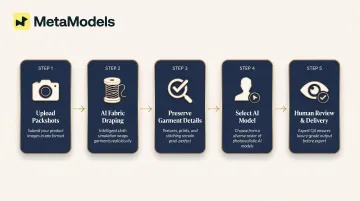
How the process works:
- Upload product packshots (flat-lay or ghost mannequin images)
- AI drapes actual garment fabric onto virtual models in real-time
- Platform preserves color, shape, texture, print, and proportions
- Select from curated model libraries or create custom models matching brand identity
- Human fashion specialists review every image for garment accuracy before delivery
Real-time fabric draping technology simulates how different winter fabrics — wool, knit, leather — behave on a human form, including their response to layering. Platforms like MetaModels.ai reproduce these fabric characteristics on AI-generated models, keeping garment accuracy intact across every output.
Diverse AI model libraries also expand what's testable. Luxury brands can see the same coat on six models — different body types, skin tones, demographics — in the time it would take to book one traditional shoot day.
Content scaling is where AI virtual models deliver the clearest operational impact. A single winter collection might include dozens of SKUs across coats, knitwear, trousers, and accessories — AI virtual models generate styled, consistent imagery for all of them simultaneously. According to BoF and Zalando research, 50% of fashion executives identified product discovery as the key generative AI use case for 2025.
The Business Case: What Luxury Fashion Brands Actually Gain
Reuters reported that Zalando reduced imagery production costs by 90% using generative AI, cutting timelines from 6–8 weeks to 3–4 days. Traditional fashion photography runs $200–$600 per image; AI platforms operate at $5–$50 per image. For a 50-SKU winter campaign requiring 8–12 images per product, the savings compound fast.
Speed is equally critical. Winter fashion has a compressed window between trend identification, collection presentation, and consumer purchase. AI virtual models collapse that production gap from weeks to days. Zalando went from trend spotting to tailored content in under 24 hours, with roughly 70% of editorial campaign assets AI-generated in Q4 2024.
Brand consistency at scale is harder than it sounds. Lighting shifts, rotating photographers, and model availability all introduce variability across a multi-day shoot. AI virtual models remove that friction — delivering the same aesthetic, lighting style, and visual identity across every image, regardless of volume.
These are exactly the pressures MetaModels.ai is built around. For brands running winter campaigns at scale, the platform delivers:
- A curated AI model library with diverse ethnicity, demographics, and body types
- Custom model creation matched to specific brand identity
- Human-reviewed images verifying garment accuracy before delivery
- Ready-to-post content at up to 4K resolution
- No model royalties, no booking limits, no production bottlenecks
What to Look For in an AI Virtual Model Platform for Luxury Winter Collections
Not every AI model platform is built to handle luxury. Winter collections in particular demand a higher bar — heavy fabrics, layered textures, and precise garment construction leave little room for visual shortcuts. When evaluating platforms, look for these qualities:
- Garment accuracy with human review: Fine winter details — stitching, drape, material sheen — must survive the AI rendering process intact. The best platforms pair automated processing with manual quality checks on color, shape, proportions, and fabric texture before any image is delivered.
- Model diversity and customization: A strong library covering diverse ethnicities, body types, and demographics is table stakes. Custom model creation aligned to your brand's visual identity takes it further. McKinsey research shows that more than 35% of fashion executives already use generative AI for image creation.
- Production management at volume: Seasonal campaigns move fast. Look for end-to-end workflow support — not just image generation, but delivery-ready output that doesn't require additional post-production passes.
MetaModels.ai is built around these requirements, offering no model royalties, no booking limits, real-time fabric draping technology, and human-reviewed output up to 4K resolution — making it a practical fit for high-volume winter campaign production.
Frequently Asked Questions
Can I use AI or virtual models for my clothing brand?
Yes, AI virtual model platforms are available for clothing brands of all sizes. These platforms convert product packshots or flat garment images into styled, on-model visuals without requiring physical models or photoshoots.
What types of winter fashion work best with AI virtual models?
Outerwear, knitwear, and layered looks perform especially well, as AI models provide the body context needed to showcase silhouette and drape. Structured pieces like coats and tailored blazers also translate particularly well, given how clearly fit and proportion read on a modeled figure.
How do AI models handle luxury fabrics like cashmere, velvet, and bouclé wool?
Leading platforms use fabric-draping simulation to replicate how materials fall and interact with the body. Human review steps verify that sheen, drape, and construction details are accurately represented in the final image.
How does AI virtual model photography compare in cost to a traditional photoshoot?
AI model imagery eliminates model booking fees, studio rental, photographer day rates, and most post-production costs. Industry data shows traditional photography costs $200–$600 per image versus $5–$50 for AI-generated images, with Zalando reporting 90% cost reductions in real-world campaigns.
Can luxury brands customize AI models to match their brand identity?
Yes, advanced AI platforms allow brands to create custom models with specific aesthetic characteristics—ethnicity, body type, age range, styling—that match their brand aesthetic. This keeps visual identity consistent across seasonal content without repeated casting.
Are AI-generated fashion images accepted on luxury e-commerce platforms and social media?
High-quality, human-reviewed AI model imagery is increasingly used across e-commerce product pages, lookbooks, and social media campaigns. Most platforms evaluate images on quality and garment accuracy, not their AI origin. Meta began labeling AI-generated content in 2024 but does not prohibit its use in commercial contexts.