Introduction
Fashion brands and e-commerce companies are under growing pressure to produce more on-model imagery, faster, and at lower cost. Traditional model photography wasn't built for that reality. Booking fees, scheduling delays, limited size and diversity representation, and rising per-shoot costs make it difficult to scale content without ballooning budgets.
This article breaks down the specific, measurable business benefits of using AI to create fashion models — and what it means for your production costs, timelines, and content reach.
Here's what you'll find inside:
- How AI model generation cuts per-image costs compared to traditional shoots
- Why faster content cycles translate directly to higher revenue capture
- How diverse AI models expand market reach without added production complexity
- What the workflow looks like from packshot to publish-ready image
Key Takeaways
- AI fashion models eliminate physical model bookings, studio rentals, and post-production, cutting per-image costs by 80-99%
- Brands produce on-model imagery for hundreds of SKUs simultaneously, collapsing traditional 3-8 week timelines to hours
- AI model libraries cover diverse body types, ethnicities, and demographics from a single curated source, with no casting required
- Consistent visual style across entire catalogs is achievable without reshoots, strengthening brand coherence
- AI-generated model imagery lifts conversion rates and lowers return rates — with results brands can track directly
What Are AI Fashion Models?
AI fashion models are digitally created, photorealistic avatars generated using machine learning and generative AI, designed to display clothing just as a human model would on a product page or campaign asset. They're used wherever on-model imagery is needed at volume, including:
- E-commerce product detail pages (PDPs)
- Social media content and advertising assets
- Digital lookbooks and campaign visuals
- Marketplace listings
Producing that volume of content is where the traditional packshot-to-model pipeline breaks down. AI fashion models replace it — enabling brands to convert product images into fully styled on-model visuals without physical shoots, models, or studios.
Key Advantages of Using AI for Fashion Models
The advantages below focus on real operational and commercial outcomes that fashion brands and e-commerce teams track directly—not theoretical possibilities. Each advantage maps to a business metric: cost per image, time-to-market, catalog coverage, shopper engagement, or return rates.
Advantage 1: Dramatic Cost Reduction and Faster Content Production
Traditional on-model photography stacks costs at every stage: model agency fees, casting time, stylist and photographer rates, studio rental, and post-production editing. Traditional photoshoots cost $80–$200 per image, with full-day shoots running $5,000–$25,000.
Model day rates alone range from $500–$5,000+. That's before usage rights, which can add another $5,000–$50,000 for unlimited buyouts.
AI fashion models eliminate every one of those cost layers. A packshot converts into a fully styled, on-model visual without a single physical shoot, reducing visual content production costs by 80–99%. AI generation costs $0.05–$5.00 per image.
For brands launching seasonal collections with hundreds of SKUs, the savings compound fast. Traditional photography requires 3 to 8 weeks for logistics, shooting, and post-production. AI-generated imagery compresses that to hours. Zalando reduced campaign cycle times from 6–8 weeks to 3–4 days using AI digital twins.
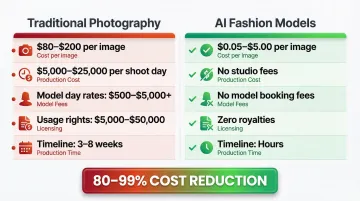
With no usage rights, royalties, or contract renewals, ongoing costs stay flat regardless of volume. MetaModels.ai offers unlimited commercial usage rights with zero royalties and zero licensing fees.
KPIs impacted:
- Cost per image
- Total content production budget
- Time-to-market for new product listings
- Percentage of catalog with on-model imagery
When this advantage matters most:
Most impactful for brands with large catalogs (100+ SKUs per season), fast-fashion retailers with frequent drops, and SME brands that previously couldn't afford on-model photography at all.
Advantage 2: Infinite Scalability with Consistent Brand Visuals
Consistency breaks down fast when brands use multiple models, shoot days, or photographers. Lighting, skin tone rendering, pose energy, and background treatment all vary — producing a fragmented catalog that quietly erodes brand identity.
AI fashion models solve this. A curated library of AI models with defined visual parameters ensures every product image — across every category, every season — maintains a coherent aesthetic that aligns with brand identity.
High-quality, consistent product photography yields 23–33% higher conversion rates compared to inconsistent imagery. Visual drift creates cognitive friction, causing shoppers to doubt product authenticity.
Traditional shoots scale linearly: more products means proportionally more cost and time. AI model imagery doesn't. Producing 1,000 images costs nearly the same as producing 10 — allowing brands to generate content for e-commerce PDPs, social media, lookbooks, and ads from a single workflow, without reshoots.
MetaModels.ai handles quality checks across every image as volume grows, and custom AI model creation keeps visual identity consistent as you expand into new product lines or markets.
KPIs impacted:
- Catalog coverage rate
- Visual consistency score
- Content production throughput
- Channel-ready asset output rate
When this advantage matters most:
Critical for multi-category retailers managing thousands of SKUs, brands expanding into new markets who need localized model representation, and teams where content production has become the bottleneck to product launch speed.
Advantage 3: Inclusive Representation That Drives Shopper Confidence and Reduces Returns
Fit anxiety is one of the most persistent conversion killers in fashion e-commerce — shoppers who can't see how a garment looks on someone their size simply don't buy.
Research confirms that thin models dissuade consumers with larger clothing sizes from purchasing, due to perceived body-size dissimilarity and heightened fit-risk perception.
AI model libraries with diverse ethnicities, body types, ages, and demographics allow brands to show every product on multiple model types without the cost of recasting and reshooting. MetaModels.ai offers a curated library of AI models with diverse ethnicity, demographics, and body types, plus custom model creation to match specific brand identity.
The business case is concrete. Models of consumers' own size mitigate fit-risk, improving purchase decisions and reducing dissimilarity-driven abandonment. Inclusive advertising generates 3.46% higher short-term sales, 16.26% higher long-term sales, and 33% higher strong consideration.
Returns matter too. Apparel return rates run 20–30%, with 45–56% of those driven by size and fit issues. AI-generated imagery with real-time fabric draping shows shoppers how a garment moves and fits — not just how it looks flat on a hanger.
When this advantage matters most:
Highest impact for size-inclusive brands, brands targeting diverse demographics, and any retailer where return rates are driven by fit dissatisfaction.
KPIs impacted:
- Conversion rate
- Return rate
- Average session time on PDPs
- Repeat purchase rate
- Customer satisfaction scores
What Happens When AI Fashion Models Are Avoided
Sticking with traditional photography at scale carries real operational and revenue costs. Here's what brands consistently run into:
Catalog gaps: Lower-margin or high-SKU products go live with flat-lay or packshot-only images, directly cutting into revenue. 76% of shoppers prefer on-model photos over flat lays, and on-model imagery lifts conversion rates by 20-50% compared to flat product images.
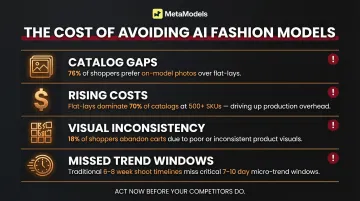
Rising per-image costs: As production demand grows with catalog size, brands must choose between quality, coverage, and budget. At 500+ SKUs, traditional photography budgets force brands to default to flat-lays for 70% of their catalog.
Visual inconsistency: Shoot conditions, model choices, and editing styles vary across seasons and channels, weakening brand identity. 18% of users abandon carts specifically because of poor visual presentation.
Representation gaps and time-to-market pressure compound the problem. Representing diverse customer segments requires additional casting and shoot investment — costs most brands quietly skip, creating gaps that affect both conversion and brand perception.
Slower time-to-market: Traditional 6-to-8-week photography timelines cause brands to miss the 7-to-10-day micro-trend windows that drive social media sales. By the time content is ready, the moment has passed.
How to Get the Most Value from AI Fashion Models
AI fashion models deliver the best results when integrated into your core production workflow rather than applied selectively. Consistency and volume are where the ROI compounds.
Choose a platform with both automation and quality control. Fully automated image processing speeds up output volume, but human review of garment accuracy ensures results are actually suitable for live product pages.
MetaModels.ai combines automated processing with manual editing options and human-reviewed imagery for garment accuracy. Every image is verified by fashion specialists who check color, shape, and proportions before delivery.
Track outcomes over time and refine based on what the data shows. Key metrics to monitor include:
- Conversion rates — are shoppers buying after viewing AI model images?
- Return rates — do customers receive what they expected?
- Catalog coverage — how much of your inventory has live model photography?
- Cost-per-image — how does AI production compare to traditional shoots?
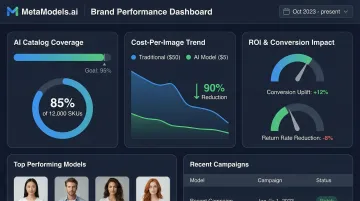
Use these signals to refine model selection, styling choices, and channel application as you scale.
Conclusion
The core value of AI fashion models is operational and commercial: they reduce cost, accelerate production, enable scale, ensure visual consistency, and open the door to inclusive representation. Brands that integrate them early tend to pull ahead on content volume and speed — two factors that increasingly drive conversion in e-commerce.
AI fashion models aren't a replacement for creative vision — they're a production infrastructure upgrade that frees fashion brands to focus on design and storytelling rather than photoshoot logistics. Platforms like MetaModels.ai make that shift practical: packshots become styled model imagery without a single booking call, studio fee, or royalty agreement.
Frequently Asked Questions
What are the benefits of using AI to create fashion models?
AI fashion models reduce per-image costs by 80-99%, eliminate model booking and studio expenses, and collapse production timelines from weeks to hours. They enable scalable catalog coverage, ensure visual consistency across channels, and provide diverse body type representation without additional casting investment.
How can AI be used in fashion design?
AI in fashion covers design concept generation—trend analysis, pattern creation—and production workflows like model imagery and product visualization. Model platforms like MetaModels.ai focus specifically on imagery, converting product packshots into styled on-model photography and video content.
Are AI-generated fashion models as realistic as photos of real models?
High-quality AI platforms produce photorealistic images with accurate garment draping, consistent lighting, and natural poses. Quality varies by platform, and those with human fashion specialist review consistently deliver commercial-grade output.
Can AI fashion models represent diverse body types and ethnicities?
Leading AI model platforms maintain curated libraries of models with varied body types, skin tones, ages, and demographics. Some platforms allow custom model creation, making diverse representation far more accessible than traditional casting while enabling brands to show every product on multiple model types.
Will AI models replace human fashion models entirely?
AI models are most impactful as a scalable production tool for e-commerce catalog imagery, while human models continue to drive editorial, runway, and high-concept campaign work where emotional nuance and brand storytelling are essential.
What types of content can AI fashion models be used for?
AI fashion models work across e-commerce product pages, social media, digital lookbooks, advertising assets, and marketplace listings. MetaModels.ai delivers content up to 4K resolution, formatted for Amazon, Instagram, Facebook, Pinterest, and TikTok.