Introduction
When Anthropologie — a lifestyle brand synonymous with curated aesthetics and independent artisans — landed in the middle of an AI controversy in late 2024, it wasn't just another tech backlash story. It was a wake-up call about how major fashion retailers are actually using AI in their product and marketing imagery, often without disclosure.
The question "Does Anthropologie use AI?" became a flashpoint on Reddit and across social media, sparking heated debates about what consumers expect from brands built on artisanal values — and what happens when those brands quietly cut corners. The backlash reveals something every fashion retailer using AI needs to understand before it happens to them.
TLDR
- Anthropologie faced widespread allegations of using AI-generated artwork on shopping bags in late 2024, with Reddit users calling out "Gaussian blur soullessness" and visual glitches
- Undisclosed AI use carries serious reputational risk, especially for brands whose identity is built on craft and creativity
- Consumers quickly spot and resent AI content, especially from brands marketing themselves on craftsmanship and creativity
- Transparency and quality control separate successful AI adoption from PR disasters
- Fashion AI platforms with human review built in can scale content production without sacrificing brand trust
What We Know: Anthropologie's AI Use in Product and Marketing Imagery
Anthropologie's AI controversy centers on two distinct types of usage: AI-generated decorative artwork for marketing materials like shopping bags, and AI model photography for e-commerce product listings. The confirmed allegations fall into the first category, but the broader industry trend encompasses both.
The brand has not issued any official public statement confirming or denying AI use in product imagery or marketing materials, according to Creative Bloq's December 2024 coverage. For a brand whose identity is built on celebrating independent artists and designers, staying silent on the issue carries its own reputational cost.
Anthropologie built its reputation on styled, editorial photography and carefully curated visual storytelling. The brand's aesthetic relies heavily on craftsmanship, artistry, and authenticity — making any AI shortcut feel jarring and hypocritical to its customer base.
Anthropologie's e-commerce product shots haven't been publicly confirmed as AI-generated, but the shopping bag controversy prompted consumers to scrutinize the brand's broader visual content more closely.
Reddit commenters noted similar AI-style imagery appearing on the brand's app opening page and across multiple marketing touchpoints. These remain unverified allegations based on visual analysis rather than metadata or internal confirmation.
Anthropologie isn't alone in navigating this backlash. Multiple premium retailers faced similar scrutiny between 2023 and 2025:
- J.Crew (August 2025): AI-generated Instagram campaign images with backward-bending feet and distorted props, according to eMarketer
- H&M (March 2025): Announced 30 AI "digital twins" of real models for e-commerce, sparking mixed reactions about consent versus workforce displacement
- Levi's (March 2023): Partnered with LaLaLand.ai for AI-generated diverse models, facing backlash for accusations of "digital blackface"
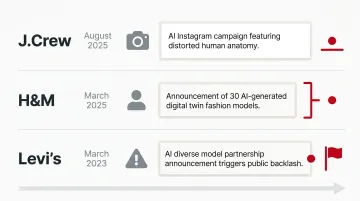
Premium lifestyle retailers consistently draw sharper criticism for AI imagery than utilitarian brands do — largely because their value proposition is rooted in craft and authenticity, making the disconnect more visible to consumers.
The Shopping Bag Controversy: How It Unfolded
The controversy erupted on November 17, 2024, when Reddit user u/PrescribeSomeTea posted to r/ChatGPT asking: "AI generated art on an Anthropologie bag?" The post featured a photo of an Anthropologie shopping bag depicting a winter snow scene with faux pine trees designed to look like balls of yarn.
What Made It Obvious
Reddit commenters immediately identified telltale AI artifacts:
- Inconsistent yarn coloring on the middle tree
- A treetop appearing incorrectly behind the first and second woolen trees
- "Gaussian blur soullessness" — the soft, disjointed quality typical of low-effort AI generation
- Overall compositional incoherence that no human art director would approve
The discussion spread to r/graphic_design, where user u/SecretPancake42 noted the same AI-style imagery appeared across multiple Anthropologie brand touchpoints. A self-identified Anthropologie employee (u/unhappypassion) commented: "it's easily the ugliest bag ive seen since working there... it's so obviously ai and SO lazy."
The Consumer Reaction
The backlash was sharp and personal. Notable comments included:
- "I think they owe us an anthro-apology."
- "It's uncanny valley, it causes a natural visceral revulsion."
- "With something like Anthropologie that prides itself on embracing artists, it's pretty disingenious and goes against their brand."
- "Gross that a company named Anthropologie would use anti-human images."
The criticism wasn't just about quality — it was about perceived deception and betrayal. As one Redditor put it, Anthropologie was "intentionally misleading people by banking on them not knowing it's AI."
Industry-Wide Problem
Anthropologie wasn't alone in facing AI backlash in late 2024:
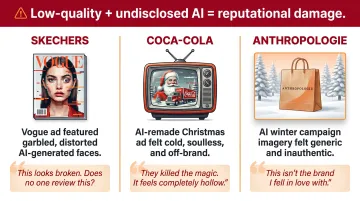
| Brand | Incident | Consumer Response |
|---|---|---|
| Skechers | Full-page AI ad in Vogue with garbled faces, illegible text, missing fabric chunks | "You didn't save money because now I hate you" |
| Coca-Cola | AI-remade Christmas ad with penguins and polar bears together | Called "soulless cash-grabbing husk" |
| Anthropologie | Shopping bag with AI winter scene | Accusations of being "disingenuous" and "anti-human" |
Across all three cases, the backlash wasn't triggered by AI use alone — it was triggered by low-quality output that consumers could see through. Undisclosed, visibly flawed AI signals to customers that a brand cut corners, and that signal is harder to walk back than the original mistake.
Why Fashion Brands Are Turning to AI for Product Imagery
Traditional fashion product photography stacks up costs fast: model bookings, studio time, hair and makeup, stylists, and location fees — before a single image is exported.
AI imagery services like BetterStudio charge €0.75–€1.30 per image, compared to traditional fashion photoshoots that can run €3,000–€15,000 per day. For brands managing thousands of SKUs across multiple channels — e-commerce, social, email, print — the math favors AI at scale.
Content Volume at Scale
Fashion retailers face unique content volume challenges:
- Multiple imagery variants needed per product (different angles, styled looks, model diversity)
- Seasonal refreshes requiring new shoots every 6–12 weeks
- Multi-channel requirements demanding different formats and aspect ratios
- Marketplace compliance needing specific background and layout specifications
Industry Adoption
These pressures explain why AI imagery has moved from experiment to standard practice. The Nuremberg Institute for Market Decisions (NIM) found that 100% of 600 surveyed marketing professionals were using AI in their activities by 2024. IAB reported that nearly 90% of big-budget video advertisers are currently using or planning to use generative AI tools.
That adoption rate also explains why tool quality has become the defining variable — not whether to use AI, but which kind.
Generic Tools vs. Purpose-Built Platforms
The spectrum ranges from:
- Generic AI art generators (Midjourney, DALL-E, Stable Diffusion) that produce the "AI slop" quality seen in Anthropologie's bag imagery
- Purpose-built fashion AI platforms (BetterStudio, LaLaLand.ai, Botika, MetaModels.ai) that incorporate garment accuracy checks, diverse AI models, and brand style consistency
Generic generators optimize for visual impressiveness — they fail on the details that matter most in fashion: fabric drape, fit accuracy, and color fidelity. Purpose-built platforms are trained on garment construction, which is what separates a usable product image from an embarrassing one.
The Transparency Problem: What Consumers Actually Want
Consumer expectations around AI disclosure have crystallized rapidly. Adobe's September 2024 study of 2,002 US consumers found that 93% believe it's important to understand how digital content was created or edited. Getty Images VisualGPS research across 30,000+ adults in 25 countries found that 98% consider authentic imagery essential for earning trust.
The Trust Penalty:
NIM's 2024 research revealed a paradox: only 20% of consumers trust AI itself, and identical content is rated less natural, less useful, and less appealing when labeled "AI-generated." However, not disclosing AI use carries massive reputational risk when discovered.
Brands face a double bind: transparency triggers skepticism, but getting caught using undisclosed AI destroys trust entirely.
Regulatory Pressure Builds:
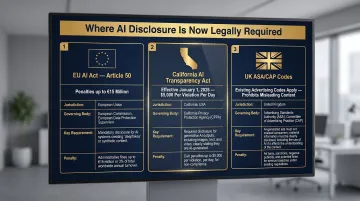
Several jurisdictions now mandate AI disclosure:
- EU AI Act Article 50: Requires disclosure of AI-generated commercial imagery, with penalties up to €15 million
- California AI Transparency Act: Effective January 1, 2026, with penalties of $5,000 per violation per day
- UK ASA/CAP Codes: Existing advertising codes apply to AI imagery, prohibiting misleading content
What Works:
Brands that frame AI adoption as part of a larger efficiency or inclusivity story receive more positive reception than those caught using AI without acknowledgment. H&M's March 2025 announcement of 30 AI "digital twins" — with model consent and compensation — represents the industry's most prominent attempt at transparent AI adoption, though it still sparked controversy.
Conversely, Aerie's public pledge not to use AI-generated bodies became its most-liked Instagram post for an entire year, demonstrating that an anti-AI stance can be a powerful brand differentiator.
Doing AI Product Imagery Right: Lessons from the Anthropologie Backlash
Lesson 1: Quality Over Speed
Using generic AI art generators to cut costs visibly harms brand perception. The standard for AI imagery must match or exceed what consumers expect from traditional photography.
Common AI artifacts identified across 2024 controversies include garbled text, faceless background figures, missing fabric chunks, backward-bending limbs, and the "uncanny valley" effect that triggers visceral revulsion. These patterns suggest general-purpose generators consistently fail on details that art directors and consumers notice immediately.
Lesson 2: Use Purpose-Built Tools
The difference between a generic image generator and a specialized fashion AI platform is fundamental. Purpose-built tools understand garment draping, fabric texture, fit accuracy, and brand consistency — critical factors for e-commerce product images.
While generic generators optimize for overall visual impressiveness, fashion-specific platforms prioritize correct rendering of:
- Fabric drape and movement
- Color accuracy and texture
- Garment fit and proportions
- Embellishment and detail preservation
Lesson 3: Maintain Human Oversight
The criticism of Anthropologie's bag wasn't just about AI use — it was about lack of quality control. AI-generated images that go through human review and brand approval processes are far less likely to produce the uncanny results that triggered the backlash.
The MetaModels.ai Approach
MetaModels.ai is built specifically for fashion e-commerce — the opposite of the low-effort, unreviewed output Anthropologie was accused of publishing. The platform delivers:
- Real-time fabric draping that preserves garment color, shape, texture, print, and proportions
- Human review by fashion specialists on every output before delivery
- A diverse model library with customizable ethnicity, body types, age ranges, and demographics
- Custom model and scene creation matched to brand identity
- Ready-to-publish output up to 4K resolution for e-commerce, social media, ads, and lookbooks
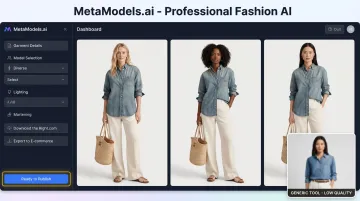
MetaModels manages production end-to-end, delivering consistent quality across products, regions, and seasons — at a fraction of traditional photography costs. See current pricing at MetaModels.ai.
Key differentiators from general-purpose generators:
These capabilities translate into measurable advantages over generic tools:
- Garment accuracy checks covering color, shape, and proportions
- Category-specific rendering for menswear (shoulder fit, lapel detail), sportswear (stretch fabrics, compression fits), and luxury items (embellishment preservation)
- Fashion specialist review before every delivery
- Marketplace compliance for Amazon, Myntra, Flipkart, and other platforms
AI as Competitive Advantage:
Done right, AI imagery lets brands scale content production, represent customers more inclusively, and cut costs — without the reputational exposure that comes from low-effort, undisclosed shortcuts. The brands that come out ahead will be those that treat AI as a production tool that still demands human judgment, not one that replaces it.
Frequently Asked Questions
Does Anthropologie use AI art?
Anthropologie faced credible public allegations of using AI-generated artwork on its shopping bags in late 2024, based on visual analysis by Reddit users who identified typical AI artifacts. The brand has not issued an official statement confirming or denying AI use in product imagery or marketing materials.
How are AI images used and how are they useful?
AI images are used in fashion retail for product backgrounds, marketing visuals, model photography, and decorative assets. They reduce costs (roughly $1–$1.50 per image versus $3,000–$15,000 per traditional shoot day), speed up production timelines, and allow brands to scale content across thousands of products and channels.
What was the Anthropologie AI bag controversy?
In November 2024, a Reddit post questioned whether Anthropologie's shopping bag artwork was AI-generated. The image's blurry, disjointed quality and visual artifacts sparked widespread backlash, with consumers criticizing the brand for being "disingenuous" given its identity as a champion of independent artists and craftsmanship.
Why do consumers react negatively to AI-generated brand imagery?
Consumers react negatively when AI imagery looks visibly off — distorted details, unnatural textures, or blurry edges — or when its use isn't disclosed. The backlash hits hardest for brands built around craftsmanship and authenticity, where undisclosed AI use feels like a direct contradiction of brand identity.
Do brands need to disclose when they use AI in product images?
No universal law exists yet, but the EU AI Act Article 50 (penalties up to €15 million) and California's AI Transparency Act (effective January 1, 2026, with $5,000/day penalties) mandate disclosure in those regions. Beyond legal exposure, undisclosed AI use carries growing reputational risk as consumer expectations shift.
Can AI product images look as good as traditional fashion photography?
Yes, purpose-built AI fashion imagery platforms can produce high-quality, brand-consistent product images with accurate garment rendering. The gap between professional AI tools — those with human review and fashion-specific rendering — and generic AI art generators is wide. Choosing the wrong tool is precisely what turns a brand asset into a public relations problem.