Virtual female models are rewriting the rules. These AI-generated digital humans convert flat-lay packshots into polished, on-model imagery—complete with realistic wool draping, leather texture, and layered silhouettes—without booking a single model or studio hour. This guide covers what virtual female models are, why fall fashion is their highest-ROI application, how AI renders autumn's signature fabrics, and how to build a complete fall campaign workflow using these tools.
Key Takeaways
- Virtual female models convert packshots into on-model imagery — no photoshoots, no scheduling, no delays
- AI fabric draping simulates wool, leather, and suede with realistic physics and visual fidelity
- Fall's texture-heavy fabrics and compressed timelines make it the ideal use case
- Brands cut production timelines from 5-6 weeks to hours while covering every SKU and colorway
- MetaModels.ai delivers human-reviewed 4K imagery with diverse model options and no royalty costs
What Are Virtual Female Models in Fashion Photography?
Virtual female models are photorealistic, AI-generated digital humans designed to display clothing with the same visual fidelity as professional studio photography—but they exist entirely as digital assets. Unlike virtual influencers with social media personas or metaverse avatars for consumers, these are purpose-built B2B content production tools for e-commerce product pages, lookbooks, social media, and digital advertising.
Two primary creation methods exist: traditional CGI (manually sculpted 3D models requiring specialized artists and longer timelines) and generative AI using diffusion models. Generative AI has become the dominant approach for e-commerce and seasonal campaigns because it's faster, more affordable, and produces results indistinguishable from professional photography.
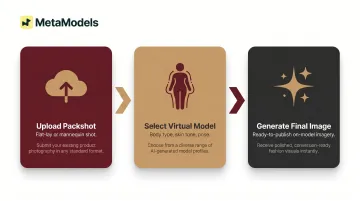
Modern platforms use diffusion models trained on millions of fashion photographs to generate hyper-realistic models. The production workflow runs in three steps:
- Upload flat-lay or mannequin shots of the garment
- Select a virtual model by body type, skin tone, and pose
- The AI generates the final on-model image, ready for use
Earlier GAN-based tools appeared artificial; today's diffusion technology delivers photorealism that fooled 71% of shoppers in blind tests.
Why Fall Fashion Photography Is Uniquely Challenging
Fall is fashion's most content-intensive season. Brands must photograph layered outfits, texture-rich fabrics (wool, cashmere, leather, suede, corduroy), and coordinated colorways across large SKU counts—all before the season opens.
Autumn/Winter collections showcase at Fashion Weeks in February/March, then arrive in-store from July to September. That compressed window makes this the industry's most lucrative period, driven by higher-priced outerwear and holiday gifting.
Timing pressure crushes brands. Traditional production for a 200-piece collection takes 5-6 weeks from planning to final delivery. Brands typically front-load photography budgets in July-September, booking studios 2-3 months in advance for peak September-October windows. Miss that window, and you're launching mid-season when early traffic spikes have passed.
Costs spike dramatically for fall shoots. Standard e-commerce on-model photography runs $130-$830 per outfit, but campaign-level production reaches $500-$1,500+ per image. Day rates range from $2,500-$8,000 for e-commerce or $8,000-$25,000+ for campaigns, covering photographer, model, studio, stylist, and post-production. Fall's layered styling requires more preparation time per look, and each outfit combination multiplies session costs quickly. ASOS spent an estimated £50 million on photography in 2023 alone.
Additional fall-specific cost drivers include:
- Studio rentals: $100-$270/hour
- Model bookings: $200-$530/hour
- Post-production editing: $20-$40/image
- Rush fees: 20-30% premium for compressed timelines
Location shoots for autumn aesthetics add travel expenses, permits, insurance, and weather contingency—with no guarantee you'll get the golden-hour lighting or leaf-covered backdrop you planned for.
The Body Diversity Gap in Seasonal Collections
Shooting a large collection on a single model type fails to show diverse customers how layered pieces fit different body types. Peer-reviewed research confirms that thin-model photography dissuades consumers with larger clothing sizes from purchasing, due to perceived body-size dissimilarity and heightened fit-risk perception. This effect is strongest for items where body size is diagnostic of fit: coats, blazers, and structured knitwear — the core of every fall collection.
Timeline compression, escalating costs, incomplete SKU coverage, and limited representation converge every fall. These aren't isolated friction points — they're compounding failures that AI-powered virtual models are specifically positioned to solve.
How Virtual Female Models Bring Fall Aesthetics to Life
Fall fashion presents a genuine production challenge: heavy textures, layered silhouettes, and moody lighting are hard to capture consistently at scale. Virtual female models solve this through simulation technology that handles the season's complexity from fabric physics to background rendering.
Modern AI rendering replicates how different textiles behave. Real-time fabric physics engines convert physical lab test data — tensile strength, bending stiffness, shear behavior — into digital code that recalculates gravity, internal tension, and collision forces across millions of mesh points per second.
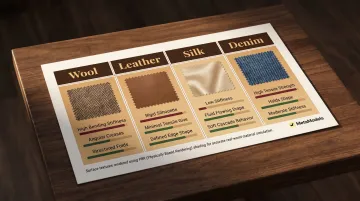
Fabric-specific draping simulation:
- Wool: High bending stiffness creates angular creases and structured folds
- Silk: Low bending stiffness produces flowing, fluid drapes
- Denim: High tensile strength maintains structure and shape
- Leather: Stiff material with minimal give, holding defined silhouettes
Physically Based Rendering (PBR) shaders capture surface textures and micro-details, dictating how light interacts with fabric — the sheen on leather, the matte texture of cashmere, the visible weave in corduroy. Platforms built for real-time fabric draping handle fall's layered textures directly, with some brands reporting 70% cost savings on apparel sampling by replacing physical prototypes with digital ones.
Layering and Color Rendering
Autumn looks typically involve three or more garment layers: base layer, mid-layer, and outerwear. AI models render these stacked combinations coherently, showing realistic volume, silhouette, and proportion — something flat-lay photography can't replicate. The system calculates how a chunky knit sits under a leather jacket, how a scarf drapes over a coat collar, and how layered hems interact at different heights.
Color rendering handles the season's signature palette — burnt sienna, deep burgundy, forest green, camel, charcoal — with accurate representation across different skin tones and lighting scenarios. AI fashion model generators analyze thousands of real photographs to learn how light behaves on human skin and fabric, with recommended color temperatures of 5000–5500K for neutral, professional results.
Representation and Backgrounds
Diverse model representation lets brands show how a camel coat or rust-toned sweater looks across different skin tones and body types. This gives every customer a realistic sense of fit — especially relevant for fall's fuller silhouettes, where sizing variation is more visible than in summer styles.
Virtual backgrounds remove location dependency entirely. Autumnal settings — fallen leaves, brick streets, warm indoor lighting — are generated digitally, with no location scouting or weather risk. Fall campaigns get their seasonal visual identity without the logistics or cost.
The Business Case for AI Models in Fall Campaigns
Traditional fall shoots carry a predictable cost structure: model fees, casting, studio or location rental, stylist, photographer, post-production, and inevitable reshoots. AI-powered virtual model production compresses this dramatically.
Cost efficiency breakdown:
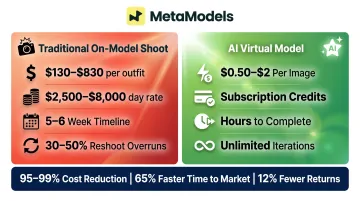
| Traditional On-Model | AI Virtual Model |
|---|---|
| $130-$830 per outfit | $0.50-$2 per image |
| $2,500-$8,000 day rate (e-commerce) | Subscription-based credits |
| $8,000-$25,000+ day rate (campaign) | No model booking fees |
| Reshoots add 30-50% overruns | Unlimited iterations included |
For 60 on-model images, traditional production costs $4,800-$12,000 versus $30-$120 for AI—a 95-99% cost reduction. Real-world case studies show ASOS achieved a 12% reduction in returns within the first quarter of deploying virtual model technology, while luxury retailer Milaner saw a 157% increase in conversion rate after testing AI-powered on-model imagery.
Speed to market protects revenue. AI compresses the content pipeline from weeks to hours. Leading platforms generate professional assets in approximately 30 seconds, with brands reporting 65% time-to-market reduction. This directly protects fall revenue by enabling brands to go live at the start of the season rather than mid-season. Some systems can generate up to 2,000 final images per day.
Full SKU and colorway coverage becomes economically viable. With virtual models, brands can generate on-model imagery for every SKU in the fall collection—including replenishment colorways and late-addition pieces—without incremental shoot costs. This solves the common problem of incomplete product pages at launch, where 56% of shoppers' first action is to explore product images and 77% say high-quality images are important to purchase decisions.
That consumer expectation for complete, high-quality imagery is exactly what MetaModels.ai addresses. The platform converts existing flat-lay packshots into on-model fall imagery using a curated library of diverse female models, real-time fabric draping, and human-reviewed outputs to confirm garment accuracy.
Brands get 4K-resolution, ready-to-post content across their full fall catalog — no model booking, no royalties, no incremental shoot costs per colorway.
Building Your Fall Lookbook with AI: A Practical Workflow
Step 1: Prepare Your Source Images
Upload flat-lay packshots or existing product photos of fall pieces. Source image quality sets the ceiling for what AI can produce, so proper lighting and clear garment detail in the original are non-negotiable. Ensure your packshots capture fabric texture, print details, and accurate color representation before uploading.
Best practices for fall-specific source images:
- Use consistent lighting (5000-5500K color temperature recommended)
- Capture texture detail in wool, leather, and knit fabrics
- Photograph layered pieces separately for maximum flexibility
- Include all colorway variations you plan to offer
Step 2: Select and Customize Your Virtual Model
Choose from a diverse model library reflecting your target customer demographics—skin tone, body type, pose. For fall specifically, consider selecting poses and stances that suit outerwear and layered looks: standing, walking, or slight profile positions work better than poses optimized for minimal clothing.
Model selection considerations:
- Match model demographics to your target audience
- Choose body types that accurately represent how garments fit across sizes
- Select poses that accommodate volume from layered pieces
- Consider multiple model variations for A/B testing
Step 3: Configure Fall-Specific Styling Parameters
Set background scene (autumnal exterior or warm interior), lighting temperature (warm golden tones versus cool overcast), and garment layering order. Human review at this stage ensures fabric draping and garment accuracy before final render.
You can also customize:
- Seasonal background libraries with autumn aesthetics
- Lighting conditions mimicking natural fall environments
- Styling accessories (scarves, hats, bags) to complete looks
- Multiple variations for testing different creative approaches
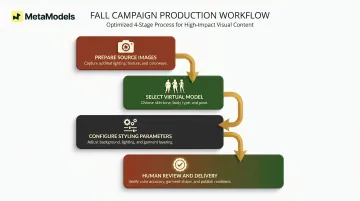
Before delivery, human fashion specialists review every AI image — checking color accuracy, garment shape, proportions, fabric texture, and print preservation. Images that pass this review arrive ready to publish, with no post-production required.
Frequently Asked Questions
Is there an AI that puts outfits together?
Yes, AI tools can generate complete outfit compositions by combining individual garments, including layered fall looks. Some platforms allow brands to mix and match pieces on a virtual model to preview full styling combinations before producing final campaign images.
Are AI fashion models real people?
AI fashion models are not real people—they are photorealistic digital humans generated by AI, built to closely resemble real models in final imagery. 59% of shoppers want clear disclosure when images are AI-generated, and reputable platforms include human review to ensure garment accuracy.
What is an e-commerce photoshoot?
An e-commerce photoshoot is a product photography session that produces on-model or flat-lay images for online listings. AI virtual model platforms now deliver the same output digitally—often under $2 per image versus $130–$830 for traditional on-model photography.
How do AI models handle fall fabrics like wool and leather?
Advanced AI platforms use fabric draping simulation to render how different textiles behave—the stiffness of leather, the texture of wool, the volume of chunky knits—producing fall imagery that accurately represents garment fit and drape.
Can virtual female models replace traditional fall photoshoots entirely?
For e-commerce, lookbooks, and digital ads, virtual models can fully replace traditional shoots for most brands. Many also run hybrid approaches—using AI for catalog and SKU coverage while reserving traditional shoots for hero campaigns where emotional storytelling matters most.