
Introduction
A mid-sized brand launching a Spring collection with just 50 styles — each in 5 colors and 8 sizes — is managing 2,000 individual SKUs. Each one needs its own attributes, imagery, and inventory records. Multiply that across two to four seasonal launches per year, and the scale of the problem is hard to overstate.
Fashion catalog management is more demanding than most retail categories because visual accuracy, variant complexity, and seasonal velocity all hit simultaneously. A missing size chart or mismatched product photo doesn't just frustrate customers — 71% of consumers have returned items due to incorrect product content, and each return costs far more than the original sale.
This guide is built for fashion brand managers, e-commerce teams, merchandisers, and marketing professionals managing that complexity on the ground.
What follows covers the end-to-end process: what a strong fashion catalog must contain, how teams typically structure the workflow, and where the most costly mistakes happen.
Key Takeaways
- Product catalog management means organizing, maintaining, and distributing product data — attributes, imagery, variants, and pricing — across every sales channel
- Fashion amplifies this complexity through high SKU counts, fast seasonal cycles, and heavy visual content demands
- A well-managed catalog acts as a single source of truth, keeping every channel current and consistent
- Core components: standardized attributes, variant matrices, organized digital assets, and automated publishing
- Common failures: channel data mismatches, outdated imagery, unscalable manual updates, and poor seasonal transitions
What Is Product Catalog Management for Fashion Brands?
Product catalog management is the system and set of processes used to collect, organize, maintain, and distribute all product-related information — including descriptions, specifications, pricing, availability, and visual assets — across internal teams and external sales channels.
The goal is a single, always-accurate source of product truth — so your D2C website, Amazon storefront, wholesale buyer portal, and Instagram Shopping feed all show identical product names, prices, imagery, and availability, updated simultaneously whenever anything changes.
Fashion complicates this more than most industries, for three specific reasons:
- Multi-dimensional variant structures: Fashion products carry size, color, fit, fabric, and wash variations — a single style can easily generate 40+ unique SKUs
- Seasonal rotation: Collections rotate on compressed schedules (typically two to four per year, or even 52 micro-seasons for fast fashion brands), requiring complete catalog refreshes multiple times annually
- Visual content dependency: Model imagery, lifestyle shots, and flat lays are the primary purchase drivers in fashion — which means asset management and data management are two sides of the same problem
Why Fashion Brands Struggle Without a Solid Catalog Management Process
The SKU Explosion Problem
Fashion products create exponential SKU complexity. A single style offered in 5 colors and 8 sizes creates 40 individual SKUs, each requiring its own set of attributes, imagery, and inventory records. For a mid-sized brand carrying 200 styles per season, that's 8,000 SKUs to manage. At the extreme end, ultra-fast fashion retailer Shein adds 2,000 to 10,000 new SKUs to its app every single day.
This variant proliferation isn't optional — customers expect complete size runs and multiple color options. Without systematic catalog management, brands lose track of which variants exist, which imagery belongs to which SKU, and which products are actually available to sell.
Multi-Channel Selling Demands Data Consistency
The same product must appear correctly on a D2C website, Amazon, wholesale buyer portals, Instagram Shopping, and printed lookbooks simultaneously — with each channel sometimes requiring different content formats or attribute structures. 20% of US customers have purchased clothing through social channels in the last 12 months, and each platform enforces its own technical requirements.
Research shows that inconsistent data across channels carries severe commercial penalties: 54% of shoppers have abandoned an online sale due to inconsistent product information across different websites, and 53% abandoned due to incomplete or poorly written product titles or descriptions.
The Seasonal Velocity Problem
Fashion brands must retire entire catalogs and launch new collections on compressed timelines. Traditional clothing production runs on 12–18 month planning horizons, but ultra-fast fashion has compressed go-to-market cycles to as little as 15 days. Catalog management isn't a one-time setup — it's a recurring, high-stakes operational event that must be planned and executed without disrupting live sales.
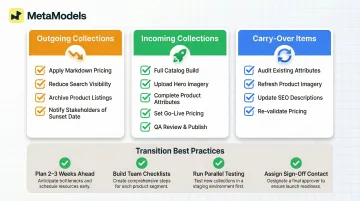
Each seasonal transition requires managing three overlapping workstreams at once:
- Outgoing collections moving to markdown pricing and reduced visibility
- Incoming collections requiring full catalog builds from scratch
- Carry-over items needing attribute updates and refreshed imagery
Without systematic processes, these workstreams collide — delaying launches and creating live-site errors.
Direct Commercial Consequences
Poor catalog management creates measurable financial damage:
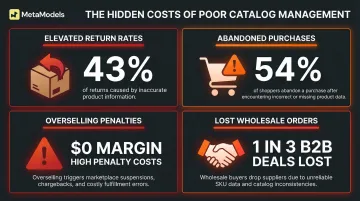
- Elevated return rates: 43% of consumers returned a product in the past year because pre-purchase information was incorrect, and returns cost retailers an average of 17.6% of sales
- Abandoned purchases: Missing size information, inaccurate material descriptions, or unclear imagery drive customers away before they buy
- Overselling penalties: Inventory inaccuracies lead to cancelled orders, which cost an average of £38 each (UK-sourced data) and reduce repeat purchase probability by 67%
- Lost wholesale orders: Buyer-facing catalogs containing outdated or incomplete product data damage professional relationships and cost orders
While catalog management in fashion is operationally preferred rather than regulatory-driven, certain product attributes — fiber content labeling, country of origin, care instructions — do have compliance implications in key markets that require catalog data to be accurate and complete.
How Product Catalog Management Works: An End-to-End Flow
Product catalog management in fashion operates as a continuous cycle rather than a linear project. Data moves from design and sourcing through enrichment, validation, and publishing — then gets monitored and updated throughout the product's active life.
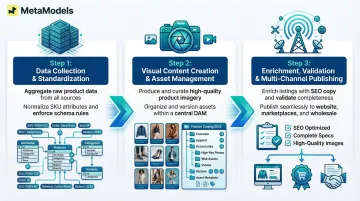
Step 1: Data Collection and Standardization
The process begins by defining a consistent data schema — a master template that specifies every required attribute for a fashion product. This schema includes:
- Style name and SKU/EAN codes
- Color codes and size runs
- Fabric composition and weight
- Care instructions
- Country of origin
- Wholesale and retail pricing
This schema must be enforced across design, merchandising, and production teams so all product records are built to the same standard from the start. Without this foundation, data quality degrades immediately — one team uses "Navy" while another uses "Dark Navy," breaking filters and search functionality across channels.
Step 2: Visual Content Creation and Asset Management
Fashion catalog management is unusually asset-intensive. Each product typically requires multiple image types — front and back shots, detail close-ups, and on-model or lifestyle imagery — and all must be organized, tagged by SKU and variant, and formatted correctly for each channel.
Producing this volume of photography through traditional photoshoots is one of the largest time and cost bottlenecks in fashion catalog production. Brands must book models, secure studio space, shoot hundreds of products, and manage weeks of post-production editing before images are catalog-ready.
AI-powered platforms like MetaModels.ai eliminate this bottleneck by converting flat packshots into professional on-model imagery at scale. Real-time fabric draping technology generates photorealistic images showing how garments fit and move on actual models, no photoshoots required.
Every AI-generated image undergoes human fashion specialist review to verify color accuracy, shape, and proportions before delivery. The result: visual quality that meets brand standards while cutting cost and accelerating time-to-catalog.
Step 3: Enrichment, Validation, and Multi-Channel Publishing
Completed product records (data + assets) are enriched with channel-specific content:
- SEO-optimized descriptions for the website
- Concise bullet points for marketplaces
- Detailed spec sheets for wholesale buyers
- Platform-compliant imagery formatted to each channel's technical requirements
Teams then validate each record against channel requirements before publishing or syndicating. Automation is critical here: manual publishing across channels introduces errors and cannot scale with a growing catalog. Leading brands use Product Information Management (PIM) systems to centralize data and automate syndication, keeping all channels in sync the moment a record changes.
What a Well-Managed Fashion Product Catalog Includes
Product Attribute Standards
Every SKU record should contain a defined and consistently formatted set of attributes:
- Product title and category
- Gender and fit type
- Fabric composition and weight
- Size and color codes
- Care instructions
- Country of origin
Naming conventions for these attributes must be standardized across the entire catalog. "Navy" should never appear alongside "Dark Navy" or "Navy Blue" — inconsistent naming breaks filters, search, and syndication tools. Establish a master attribute glossary and enforce it consistently across every team and tool.
Variant Matrix Structure
Fashion products should be organized as parent-child structures — one parent style record linked to individual variant records for each size and color combination. This structure allows teams to manage product information at the style level while inventory and orders are tracked at the SKU level.
Benefits of parent-child structure:
- Prevents duplicate records and keeps data clean
- Simplifies updating a product attribute across all variants at once
- Enables customers to browse by style and select their preferred size and color
- Supports accurate inventory tracking at the granular SKU level
Digital Asset Library Linked to SKUs
A well-organized digital asset component includes all imagery and video tagged by style and variant, stored in a central location, formatted to each channel's specifications, and updated whenever new photography is produced.
The volume and consistency of imagery directly affects conversion rates. Research shows that on-model photos convert 20-30% higher than flat-lays and reduce returns by 15-25% across most clothing categories.
Major marketplaces enforce strict image requirements as well. Amazon recommends 5-7 images per product with pure white backgrounds and requires all adult apparel to be shown on-model.
Real-Time Inventory and Pricing Data
Catalog data changes constantly. Stock levels, pricing, and availability must flow through to every channel automatically to prevent overselling, customer complaints, and reputational damage.
Automated integrations between inventory systems, ERP platforms, and catalog management tools ensure that when a product sells out in one channel, it's marked unavailable everywhere else within minutes. Brands that skip this automation expose themselves to:
- Orders placed against stock that no longer exists
- Cancelled orders and negative customer reviews
- Platform penalties on marketplaces with strict fulfillment standards
Common Mistakes and Misconceptions in Fashion Catalog Management
Treating Catalog Management as a Launch-Only Task
Many fashion brands invest in catalog setup at the start of a season but don't build systematic processes for ongoing maintenance. Pricing updates, inventory changes, product corrections, and new imagery are handled reactively and manually, leading to compounding inconsistencies across channels.
Catalog management is an ongoing operational function. Assign clear ownership, document workflows, and schedule regular audits to catch errors before they reach customers.
Confusing a Catalog with a Product Database
Teams sometimes treat catalog management as purely a data task — filling spreadsheet fields — while underinvesting in visual content, asset organization, and channel-specific formatting. In fashion, the catalog is as much a visual system as a data system.
Low-quality or incomplete imagery undermines the entire record no matter how accurate the attribute data is. If customers can't see how a garment fits or drapes on a body, they won't buy — or they'll buy and return it.
Underestimating Seasonal Transition Complexity
Brands often overlook the catalog management workload involved in retiring a previous season's products, launching a new collection, and managing carry-over or markdown items simultaneously.
Without documented workflows and clear ownership, seasonal transitions become chaotic and error-prone. To keep transitions on track:
- Plan timelines at least two to three weeks before the cutover date
- Build team-specific checklists covering retiring, launching, and markdown tasks
- Run parallel testing on new collections before going live
- Assign a single point of contact to sign off on channel accuracy at each stage
Frequently Asked Questions
What is product catalog management in fashion?
Product catalog management is the ongoing process of organizing, maintaining, and distributing all product information — data, imagery, and pricing — across internal teams and external sales channels. In fashion, this is uniquely complex due to high variant counts, seasonal cycles, and heavy reliance on visual content.
What should a fashion product catalog include?
A complete fashion catalog covers five core elements:
- Standardized product attributes (name, SKU, size run, color, fabric, care instructions)
- Variant matrix records linking parent styles to individual SKUs
- High-quality imagery for each variant
- Accurate pricing and real-time inventory availability
- Consistent formatting linked to the correct product records
How do fashion brands manage product variants like size and color?
Brands use a parent-child or style-variant structure, where one parent record holds shared attributes (style name, fabric, care instructions) and individual variant records track unique attributes (size, color, SKU code, stock level). This allows teams to manage data at the style level while selling at the variant level.
What is the difference between a PIM and a PLM in fashion?
A PLM manages the full development lifecycle — from design through production — centralizing specs, CAD files, and bills of materials. A PIM handles finished product data, distributing it to sales channels. Most fashion brands run both systems in an integrated workflow.
How often should fashion brands update their product catalogs?
Inventory levels and pricing should update in near-real time via automated integrations between your ERP and catalog systems. Product attributes and imagery are typically reviewed at seasonal launches or when changes occur.
How can AI improve product catalog management for fashion brands?
AI accelerates catalog management across several tasks:
- Automating attribute tagging and category classification
- Generating product descriptions from structured data
- Producing on-model imagery directly from flat packshots
- Scaling visual content without additional photo shoots
Platforms like MetaModels.ai handle that last step specifically — converting packshots into photorealistic on-model images, so products reach sales channels faster without the cost of traditional photography.