Introduction
Most fashion brands know the feeling: weeks of pre-production, a packed call sheet, and a final invoice that reads like a small car payment.
A traditional fashion photoshoot costs between $5,000 and $15,000 per day, according to fashion photography industry data. Studio rental, model fees, photographers, stylists, and post-production retouching can consume weeks of planning to deliver just 25–40 final images. AI tools are now replicating that same output in days, at costs starting below $1 per image.
This guide is for fashion brands, e-commerce managers, photographers, and marketers evaluating which AI tools can replace which photoshoot functions. We'll break down what works, where the technology still falls short, and how to choose the right tool based on your content needs and quality standards.
Key Takeaways
- AI tools replicate core photoshoot functions: model presentation, background staging, outfit variation, and retouching
- Costs drop from $150–$1,500 per image (traditional) to $0.10–$1.20 per image (AI platforms)
- Top tools specialize: model swapping, background replacement, or packshot-to-model conversion
- Real limitations exist: fabric accuracy, multi-angle consistency, and editorial-level creative direction
- Choice depends on use case—e-commerce volume, lookbook quality, or social media speed
Why Traditional Fashion Photoshoots Are Reaching a Breaking Point
The financial burden of traditional photoshoots has become unsustainable for many brands. Visual content production accounts for 15-20% of total marketing budgets in apparel, with small brands allocating 10-15% of revenue to photoshoots alone.
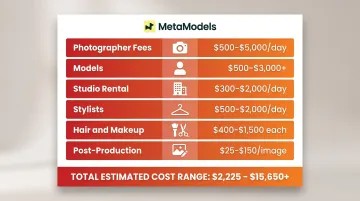
A typical campaign budget includes:
- Photographer fees: $500–$5,000/day
- Models: $500–$3,000+ per model
- Studio rental: $300–$2,000/day
- Stylists: $500–$2,000/day
- Hair and makeup artists: $400–$1,500 each
- Post-production retouching: $25–$150 per image
For small and mid-size brands, these costs stack fast — making professional imagery financially out of reach.
Speed is an equally serious problem. Physical samples must exist before a single image is captured, so content creation routinely lags weeks behind design. A typical production cycle runs 3–6 weeks:
- Pre-production (1–2 weeks): moodboarding, casting, location scouting
- Shoot day (1–2 days): the actual photography
- Post-production (2–4 weeks): culling, approvals, retouching, delivery
For fast-fashion and DTC brands on rapid drop cycles, that timeline is a structural disadvantage.
Then there's scale. A single shoot covers a limited number of looks, body types, and regional variations. Representing diverse demographics or testing colorway options means booking additional shoots — multiplying both cost and time. Payment platform Klarna cut $6 million in image production costs by generating over 1,000 images using AI tools in Q1 2024, cutting their development cycle from 6 weeks to 7 days.
5 Core AI Capabilities Now Replacing Traditional Photoshoot Functions
Capability 1: AI Model Generation and Virtual Try-On
AI model generation tools allow brands to place garments on photorealistic human figures without booking physical models. The best tools go beyond simple compositing—they simulate how fabric actually behaves on different body shapes, including drape lines, stretch, and fit adjustments. MetaModels.ai offers a curated library of AI models with diverse ethnicity, body types, and demographics, plus real-time fabric draping technology that preserves garment-specific details like colour, shape, texture, and proportions.
The royalty and rights advantage is significant. AI-generated models carry no usage rights complications, no re-booking fees, and no contractual limitations on how long or where the image can be used. For brands running content at scale across multiple channels and regions, this eliminates complex licensing negotiations and recurring model fees entirely.
Capability 2: Background Replacement and Scene Generation
AI background tools place models or products in any environment—clean studio white, urban editorial, outdoor lifestyle—without a location shoot. Modern tools handle complex masking challenges automatically, including flyaway hair, sheer fabric, and accessories. Tasks that previously required 30-60 minutes of manual editing per image now process in 3-5 seconds.
Scene libraries allow teams to maintain uniform visual aesthetic across all product images without re-creating setups. Brands can apply the same background treatment to hundreds of products, ensuring catalog consistency that would be cost-prohibitive with traditional photography.
Capability 3: Outfit and Garment Swapping
Say a brand has 200 SKUs across 4 colorways each — that's 800 potential product images from a single model session. Virtual outfit swapping makes this possible by mapping each piece onto a single base model image. Quality tools preserve garment-specific details like collar structure, hem length, and fabric weight, rather than simply texture-mapping clothing onto a body. This distinction matters—poor garment swapping flattens details and destroys product trust.
For e-commerce applications, this capability allows brands to produce full catalog imagery (front, back, detail shots) across multiple colorways without a physical sample for each variation. A single model pose can represent dozens of SKUs.
Capability 4: AI Retouching and Post-Production Automation
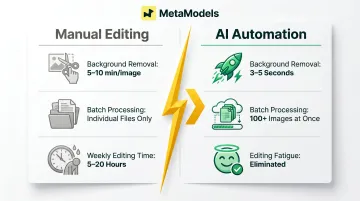
AI retouching tools handle time-intensive post-production tasks that follow every shoot: skin tone consistency, background cleanup, lighting correction, and shadow refinement. According to a study of 423 photographers, 28.6% spend 5-10 hours per week on editing and 22.5% spend 10-20 hours weekly, with over half experiencing mental exhaustion from lengthy editing sessions.
AI background removal processes images in 3-5 seconds versus 5-10 minutes manually, with batch processing handling 100+ images at once. The most practical tools integrate directly into existing workflows as Photoshop plugins or batch processors — no platform migration, no retraining required.
Capability 5: Packshot-to-Model Conversion
Brands often have high-quality flat-lay or ghost mannequin product images (packshots) but need them shown on human figures for e-commerce and marketing. AI tools like MetaModels.ai convert these existing packshots into on-model imagery, eliminating the need for a separate model shoot.
For high-SKU e-commerce brands, the scale impact is concrete: thousands of product images can be upgraded to on-model presentation without a single additional shoot day, reducing per-image production cost while maintaining consistent quality across the entire catalog.
Best AI Tools for Fashion Photography: A Use-Case Breakdown
For E-Commerce Brands Needing Catalog Scale
Platforms that combine AI model libraries with batch processing and packshot conversion are best suited for catalog-scale output. Key evaluation criteria include:
- Consistency across multiple product images
- Garment accuracy and proportional fidelity
- Resolution output (4K-ready exports for print and high-res digital)
- Ability to produce front/back/detail shots in a uniform style
Human review of AI outputs is a differentiating quality indicator for brands where accuracy is non-negotiable. MetaModels.ai employs human fashion specialists to review every generated image for garment accuracy before delivery, catching errors in colour, shape, and proportions that automated systems miss.
For Fashion Marketers Producing Social and Campaign Content
For marketing teams, visual variety and speed matter more than raw feature count. AI background changers, relighting tools, and outfit variation generators are the practical starting points.
Workflow integration is often the deciding factor — tools that connect to existing creative suites save more time than standalone apps requiring constant file exports and re-imports. Platforms that format outputs to Instagram, Facebook, Pinterest, and TikTok specifications automatically take another task off the list.
For Photographers Adding AI to Their Workflow
Photographers are using AI primarily in post-production—retouching automation, background swaps, lighting correction—rather than replacing the shoot entirely. Base image quality still drives AI output quality. Poorly lit or composed source images produce poor AI results regardless of tool capability. Photographers should evaluate AI tools as efficiency accelerators for the tasks they find most tedious, not as wholesale replacements for their creative work.
For Independent Designers and Small Labels
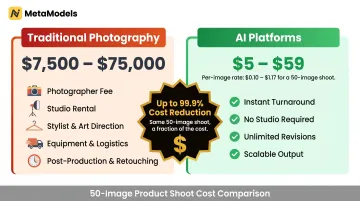
AI tools have lowered the barrier to entry for professional-quality fashion content. Traditional fashion photography costs $150–$1,500 per image; AI platforms range from $0.10–$1.17 per image.
For a small brand producing 50 product images, that's $7,500–$75,000 (traditional) versus $5–$59 (AI) — a cost difference that changes which content projects are financially viable in the first place.
Tools with no-model, no-royalty structures are especially practical for brands that cannot budget for ongoing model usage rights. MetaModels.ai offers unlimited commercial usage rights with zero licensing fees and zero royalty obligations, allowing small brands to deploy images across all commercial channels without recurring costs.
What AI Fashion Photography Tools Still Get Wrong
Current AI tools consistently struggle with a handful of specific limitations:
- Fabric texture fidelity — fine details like linen weave, velvet pile, and sheer layers often flatten or distort
- Garment construction details — topstitching, pleating, and structured tailoring lose definition at output
- Multi-angle consistency — the same outfit can look slightly different front versus back, undermining product trust
Tools with human-review steps in their workflow are specifically designed to catch and correct these errors before delivery. That quality gate separates professional-grade platforms from consumer-level AI image generators.
The consistency challenge at scale is the most significant practical gap. Generating a coherent set of images (front, side, back, close-up) of the same garment on the same model with consistent lighting and pose is harder for AI than producing a single impressive image. Brands evaluating AI tools should test multi-image consistency, not just single-image quality.
These consistency gaps point to a broader truth: AI is not a substitute for high-end editorial photography, campaign work with a distinctive photographic voice, or fine-art fashion imagery. Those applications still require human creative direction.
The e-commerce and catalog tier, however, AI is rapidly automating. A January 2026 survey of 600 UK photographers by the Association of Photographers found 58% had lost work to generative AI, with a total financial loss of £1,012 million (approximately $1.27 billion USD), or £34,900 ($48,000 USD) per photographer. The losses are concentrated in "functional" photography — product shots, catalog work, and commercial imagery — not editorial assignments.
How to Choose the Right AI Tool for Your Fashion Brand
Use a simple decision framework based on two variables: volume of content needed and required level of garment accuracy.
Here's how different brand profiles map to different tool priorities:
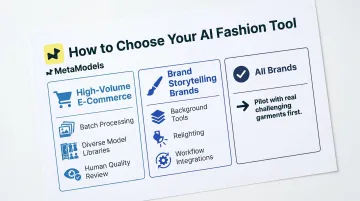
- High-volume e-commerce brands need batch processing, diverse AI model libraries, and human quality review. MetaModels.ai offers subscription tiers from 20 to 300 image credits monthly, with human fashion specialist review included across all plans — practical for brands requiring verified garment accuracy at scale.
- Lower-volume, brand-storytelling brands benefit more from background tools and relighting features that elevate existing photography. Look for tools that integrate with your current creative workflow (Photoshop plugins, Lightroom integrations) to reduce friction.
- All brands should pilot with a real content batch — not ideal test images. Run your most challenging garments through first: sheer fabrics, complex prints, structured tailoring. Limitations surface fast under real conditions.
Workflow fit matters more than feature count. The most effective tool is the one that removes the most friction from your existing process, not the one with the longest list of capabilities.
Frequently Asked Questions
Can AI fashion photography tools fully replace human models and photographers?
AI reliably replaces models and photographers for catalog and e-commerce content, where the primary function is accurate product presentation. Editorial and brand-voice-driven work still benefits from human creative direction. The industry is in a hybrid phase, not a full replacement phase.
How much does AI fashion photography cost compared to a traditional photoshoot?
Traditional campaigns cost $10,000-$30,000 for a one-day professional shoot, while AI platform pricing ranges from $0.10-$1.20 per image. That gap makes professional-quality content production viable for small and mid-size brands for the first time.
What is the best AI tool for fashion e-commerce product photography?
For packshot-to-model conversion and diverse AI model presentation at scale, platforms like MetaModels.ai are purpose-built. For retouching and background work layered onto existing shoots, tools that integrate with Photoshop workflows are practical.
How accurate is AI at rendering fabric textures and garment-specific details?
General AI image tools can struggle with fine fabric detail and construction accuracy. Specialized fashion AI platforms that include human review steps achieve meaningfully higher garment fidelity by catching and correcting errors before delivery.
Do I need technical skills or 3D design experience to use AI fashion photography tools?
Most current platforms are designed for non-technical users—marketers, designers, and brand managers—and do not require photography, 3D modelling, or coding knowledge to produce usable outputs. The workflow is typically as simple as uploading packshots and selecting model and background preferences.
Are AI-generated fashion images legally compliant for commercial advertising use?
AI-generated model images (with no real person's likeness) generally avoid the model release complications of traditional photography. Confirm the platform's terms cover commercial use rights, and note that New York's S8420A law (effective June 9, 2026) requires conspicuous disclosure of "synthetic performers" in ads, with penalties up to $5,000 per violation.