Introduction
Fashion brands targeting the Middle East are under pressure to produce more imagery, faster, for a consumer base with expectations that outpace most traditional production workflows. The region's e-commerce sector reached USD 584.8 billion in 2025 and is expanding at a 15.15% CAGR through 2034 — and AI model photography is transforming how brands keep pace, offering a scalable solution to uniquely regional challenges.
Brands operating across the UAE, Saudi Arabia, and the broader GCC face a distinct set of pressures: cultural representation demands, modest fashion requirements, and compressed seasonal campaign windows. The digital audience is enormous — the UAE counts 11.3 million social media identities (100% of its population), while Saudi Arabia sits at 99% smartphone penetration.
Meeting that audience with culturally resonant, on-model imagery at scale is exactly where AI model photography is proving its value — and why this article examines how the technology is reshaping fashion content across the region.
Key Takeaways
- AI model photography is surging in the GCC, driven by USD 584.8B e-commerce market growth and extreme social media penetration
- Culturally representative AI models with Middle Eastern aesthetics and modest styling are now a competitive necessity
- Modest fashion brands use AI to scale catalog imagery for thousands of SKUs cost-effectively
- Ramadan and Eid drive 136% fashion spend spikes—AI-generated seasonal campaigns let brands capture early-search traffic fast
AI Models That Reflect Middle Eastern Identity
Fashion brands targeting GCC audiences are moving decisively away from generic, Western-default AI model libraries. Instead, they're actively seeking—or custom-building—AI models with Middle Eastern facial features, diverse skin tones, and culturally resonant styling choices.
Why Representation Matters in the Region
Middle Eastern consumers have long noted underrepresentation in global fashion imagery. As social commerce deepens across the region, visual relatability directly influences purchasing decisions.
Research from McKinsey found that 66% of consumers now shape shopping choices based on social values, with 45% believing retailers should actively support diverse brands. When consumers don't find products reflecting their identity, 1 in 5 cite this as their primary barrier to purchase.
The stakes are higher when brands attempt representation through AI without authenticity. A 2026 study from SMU's Temerlin Advertising Institute found that when fashion brands deployed AI-generated models in body-positivity campaigns, consumers perceived the effort as hypocritical, particularly when AI usage was disclosed.
Women reported lower brand attitudes, reduced purchase intentions, and less willingness to recommend the brand — demonstrating that representation without genuine investment triggers backlash.
Current Adoption Patterns
While public documentation of GCC-specific AI model deployments remains limited, global precedents signal the direction of regional adoption:
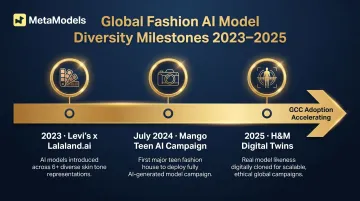
- Levi's partnered with Lalaland.ai in 2023 to increase diversity in body types and skin tones, citing underrepresentation of people of color in online shopping
- H&M created AI "digital twins" of 30 real-life models in 2025, with explicit consent agreements and disclosure protocols
- Mango Teen launched its first fully AI-generated campaign in July 2024, citing faster content creation as a primary driver
For GCC brands, building a library of diverse, culturally authentic AI models covering ethnicity, age, body type, and regional styling has shifted from optional differentiation to competitive necessity. Brands that deploy AI models reflecting genuine Middle Eastern aesthetics gain trust; those that default to Western norms risk the backlash documented in global case studies.
Scaling Modest Fashion Content with AI Photography
The global Islamic clothing market reached USD 128.4 billion in 2025, projected to hit USD 249.7 billion by 2034 at a 7.7% CAGR. The GCC represents the largest and most influential segment within this market, yet modest fashion brands face an acute content production challenge: the sheer volume of SKUs—abayas, kaftans, hijab-coordinated outfits, modest swimwear—demands imagery at a scale traditional photoshoots struggle to deliver affordably.
How AI Addresses the Modest Fashion Challenge
AI model photography enables brands to generate on-model imagery for hundreds of modest fashion SKUs from packshots or flat-lays, ensuring accurate fabric drape representation—critical for flowing abayas and structured kaftans—without booking models or studios. The technology drapes actual garment fabric onto AI-generated models in real-time, preserving garment details including color, shape, texture, and proportions.
This capability is commercially essential. Research consistently shows that on-model imagery outperforms packshots: studies found 94% higher conversion rates for high-quality product photos, with 22% of e-commerce returns attributed to products looking different in person than in photos. For modest fashion retailers managing thousands of SKU variations, converting packshots to on-model imagery directly reduces return rates and lifts purchase confidence at scale.
Quality Considerations for Modest Fashion
Fabric draping accuracy is non-negotiable for abaya and kaftan imagery. Flowing, layered garments present technically demanding rendering challenges for AI systems. Leading platforms address this through structured quality assurance workflows that include:
- Human review of every AI output by fashion specialists
- Verification of color accuracy, garment shape, and fabric proportions
- Checks for drape realism on flowing and layered silhouettes
- Final approval before image delivery
Brands running large SKU catalogs across seasonal collection cycles—especially those distributing through e-commerce—face the steepest content production costs. AI imagery addresses this directly, compressing weeks of photoshoot scheduling into a repeatable, on-demand workflow.
AI-Powered Seasonal Campaign Visuals for Cultural Moments
The Middle Eastern fashion calendar is defined by high-value cultural moments—Ramadan, Eid Al-Fitr, Eid Al-Adha, Saudi National Day, UAE National Day, and Dubai Shopping Festival—each requiring fresh campaign imagery within compressed production windows.
The Commercial Urgency of Ramadan and Eid
Google and Visa's 2024-2025 State of Commerce report for Saudi Arabia reveals the scale of seasonal demand:
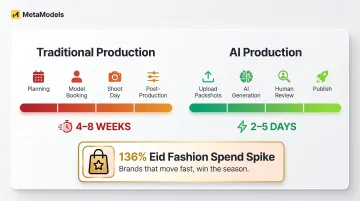
- Fashion spend rose 136% the week before Eid Al-Fitr versus non-peak periods
- Luxury apparel search interest climbed 45% during the final weeks of Ramadan
- Apparel-related search interest surged 23% during weeks three and four of Ramadan
- Saudi Founding Day (February) saw a 44% boost in apparel spend as early Ramadan shopping began
Brands that capture early search intent—weeks before peak Eid spending—lock in an outsized share of purchase decisions before competitors appear. The problem: traditional photoshoots require 4-8 weeks of planning, execution, and post-production. That timeline simply doesn't align with the Ramadan buildup window.
How AI Enables Seasonal Agility
AI model photography collapses production timelines from weeks to days. Brands can produce full seasonal campaign imagery sets—adapting the same garments across multiple backdrops, lighting styles, and model looks—without rescheduling shoots.
The production numbers bear this out:
- Zalando cut production costs by up to 90% using AI tools
- 70% of its 2024 editorial campaigns were AI-generated
- 72% of consumers in the region identify social media as the most effective advertising channel during Ramadan
Brands that reach those feeds first—with culturally resonant imagery—capture purchase intent before competitors have finished their pre-production planning.
Packshot-to-Model Conversion for GCC E-commerce
Across GCC e-commerce platforms, fashion brands are investing in AI tools that convert flat-lay packshots and ghost mannequin images directly into on-model fashion photography—cutting cost and time-to-publish for product listings.
The Business Case for the Region
The Middle East's fashion e-commerce segment is expanding rapidly. Saudi Arabia's fashion apparel market alone is projected to reach USD 44.8 billion by 2032, while MENA's online retail penetration is forecast to grow from 9% in 2024 to 16% by 2030 within a USD 750 billion retail landscape expanding at 6% CAGR—approximately 1.5 times the global average.
On-model imagery consistently outperforms packshot photography for conversion. Research shows:
- 93% of consumers consider visual appearance the most important purchase factor
- High-quality photos yield 94% higher conversion rates than low-quality alternatives
- Multiple photos from different angles produce a 58% sales boost
- Ghost mannequin photography alone lifts conversion by up to 45% and reduces return rates 20-30%
For brands managing hundreds of SKUs across regional platforms and marketplace sellers, AI packshot-to-model conversion is a direct revenue optimization tool.
MetaModels.ai as a Regional Solution
MetaModels.ai handles this workflow end-to-end: brands upload packshots, and the platform generates on-model imagery using real-time fabric draping technology, with every output reviewed by fashion specialists before delivery.
Key platform capabilities for GCC brands include:
- On-model imagery output up to 4K resolution, formatted for product pages, social media, and ad campaigns
- Human review by fashion specialists on every image, catching garment accuracy issues before publish
- AI model library with diverse ethnicities and body types relevant to regional audiences
- Custom model creation to match specific brand identity requirements

This human-in-the-loop quality check is particularly relevant for the region, where fabric accuracy directly affects return rates.
Social Commerce-Ready AI Visuals for TikTok and Instagram
The Middle East has one of the highest social media engagement rates globally, with TikTok playing a dominant role in fashion discovery. In the MENA region, 77% of consumers discover new products on TikTok, with the platform accounting for 15% of all product discoveries across all channels. 69% of MENA consumers report being more receptive to TikTok ads than ads on other platforms.
The Volume Demands of Social Commerce
The Middle East social commerce market reached USD 9.92 billion in 2025, growing at a historical 23% CAGR from 2021-2024. Instagram reaches 89.1% of the UAE's entire population, with users spending an average of 25 hours and 26 minutes per month on TikTok across 258.7 sessions.
That level of engagement creates constant pressure for fresh content. Fashion brands are generating multiple AI model image variations per garment — different backgrounds, poses, and stylings — to maintain always-on social content calendars.
Some platforms now offer AI video generation from static model images, producing Reels and TikTok content at production scales traditional video shoots simply can't match.
Why Content Velocity Is a Competitive Differentiator
Redseer reports that MENA's digital economy has driven 20% of consumption growth over the past five years while accounting for 10% of consumption expenditure. 87% of KSA consumers aged 18-35 made at least one online fashion purchase in the past year. In that context, content volume isn't just a production metric — it's a direct revenue lever.
Brands gaining ground in social commerce share a common trait:
- Generate multiple image variations per SKU for A/B testing across platforms
- Refresh visuals weekly to align with trend cycles, not quarterly shoot schedules
- Repurpose static AI model images into short-form video without additional production costs
- Maintain visual consistency across Instagram, TikTok, and marketplace listings simultaneously
What's Driving AI Model Photography Trends in the Middle East
The Middle East isn't just following global AI model photography trends — it's accelerating them, driven by a mix of market scale, cultural demand, and competitive pressure unique to the region.
Technology Maturation
Generative AI and fabric-draping simulation have reached a quality threshold where AI-generated fashion imagery is increasingly indistinguishable from traditional photography. The AI-generated fashion market reached USD 2.91 billion in 2025, projected to grow at a 38.6% CAGR to USD 75.9 billion by 2035, signaling rapid technology improvement and market confidence.
Market Scale and E-commerce Growth
The GCC e-commerce market's USD 584.8 billion valuation and 15.15% annual growth rate create pressure on brands to produce more product imagery faster and at lower cost-per-image than traditional shoots allow. With 20% of KSA online fashion spending flowing to international e-commerce sites, local brands face real urgency to match global visual output.
Cost and Efficiency Pressures
Traditional fashion photoshoots in the region involve substantial logistical costs — model booking, studio hire, international talent travel, post-production. AI model photography eliminates or reduces most of these. Platforms now offer per-image pricing starting under USD 1, while Zalando reported up to 90% production cost reductions through AI tools.
Cultural Content Demands
The region's cultural calendar and modest fashion requirements mean brands need a constant stream of tailored imagery that generic global content libraries can't supply. Key demand spikes include:
- 136% Eid spending surge requiring rapid seasonal content refresh
- 45% luxury apparel search spike during Ramadan needing culturally aligned visuals
- Year-round modest fashion imagery that standard international model libraries don't cover
Competitive Dynamics from Global Brands
International fashion houses have already moved aggressively — Zalando running 70% AI-generated editorial campaigns by 2024, H&M creating digital twins of 30 models, Mango Teen alternating AI with real shoots. Regional brands that don't keep pace risk falling visibly behind on both image volume and production quality.
How These Trends Are Reshaping Middle Eastern Fashion
Operational Impact
AI model photography is compressing time-to-publish for product listings and campaign imagery. Traditional shoot-to-publish timelines that took weeks are being reduced to days, changing how marketing and merchandising teams plan content calendars. Platforms now offer faster automated processing tiers, with human-reviewed outputs delivered ready-to-post in up to 4K resolution—eliminating the weeks traditionally allocated to post-production retouching and editing.
Business Impact
Brands using AI model photography can expand SKU coverage, test more visual variations for performance optimization, and reallocate photography budgets toward creative strategy. The competitive dynamic shifts toward content velocity and personalization rather than pure production capacity.
Generating multiple model, styling, and background variations per garment for A/B testing social ad creatives delivers measurable performance advantages — particularly on platforms where over 50% of MENA TikTok users report making impulse purchases after seeing videos.
Shifting Roles in Regional Fashion Production
The shift is creating tension in the regional fashion photography ecosystem. Traditional photographers, stylists, and models face reduced commission volumes as brands redirect budgets to AI platforms. Globally, brands like H&M are transitioning to one-time "body scan" payments for models, then using digital twins for future productions without rebooking—a model that may spread regionally.
New roles are emerging in parallel:
- AI prompt engineering — crafting inputs that produce brand-accurate garment styling
- Model curation — selecting and customizing AI models to reflect regional demographics
- Output quality review — human oversight ensuring garment accuracy and brand consistency
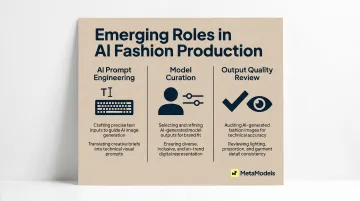
For regional fashion teams, this means the skill premium is shifting from production execution toward creative direction and AI workflow management.
Future Signals for AI Model Photography in Middle Eastern Fashion
While current adoption is accelerating, several emerging signals will define the next 1–3 years:
AI Content Transparency Requirements
Regulators and consumers are pushing AI content transparency onto the global agenda—with real consequences for fashion brands. The EU AI Act Article 50 mandates that AI-generated or substantially manipulated images be "clearly identifiable as artificial," with fines up to EUR 15 million or 3% of global annual turnover.
The UAE's AI regulatory framework is still evolving, and no fashion-specific disclosure requirements have been issued yet. But the August 2025 Guess/Vogue controversy makes the reputational risk concrete.
American Vogue ran Guess advertisements featuring AI-generated models with disclosure only in small print. A TikTok video exposing the campaign received over 2.7 million views, triggering consumer backlash. The incident underscores that brands deploying AI models in trust-sensitive luxury positioning must proactively implement transparency strategies, regardless of current regulatory requirements.
Transparency can also be a brand asset. Aerie pledged not to use AI-generated bodies in marketing, and their October 2025 Instagram post announcing this became their most-liked post in a year.
Virtual Try-On and Personalization
The global virtual try-on market is expected to reach USD 15.18 billion in 2025, growing at 25.95% CAGR to USD 48.10 billion by 2030. For GCC fashion brands, this growth translates into three practical shifts:
- Personalized visualization: Shoppers can try modest fashion and luxury garments on AI models that match their own body type and style preferences
- Social commerce integration: Virtual try-on features embedded in regional platforms move discovery and conversion into a single experience
- Static to interactive: Product imagery evolves from a single catalog shot to an on-demand, personalized fitting room
Normalization and Competitive Differentiation
Within 1–3 years, AI model photography will normalize as a standard production tool for Middle Eastern fashion brands. Competitive differentiation will shift from whether brands use AI to how well they use it—specifically, how authentically their AI models represent regional aesthetics and how naturally AI imagery integrates into localized, culturally resonant campaigns.
Conclusion
AI model photography is not a distant future technology for Middle Eastern fashion—it is an active, accelerating shift reshaping how brands produce campaign imagery, fill e-commerce catalogs, and show up in the social feeds of one of the world's most digitally engaged, fashion-forward consumer bases.
High smartphone adoption, massive seasonal demand cycles, multicultural consumer expectations, rapid e-commerce growth, and the scale requirements of modest fashion make the GCC one of the world's most compelling markets for AI model photography. The brands that invest now in culturally authentic AI model workflows—pairing efficiency with genuine regional representation—will be the ones setting the pace as the technology evolves.
MetaModels.ai is built for exactly this moment: a diverse AI model library with ethnicity customization, human-reviewed outputs that verify garment accuracy, and packshot-to-model conversion that lets brands grow their visual output without increasing production costs.
Frequently Asked Questions
Are AI-generated models being used in Middle Eastern fashion campaigns?
Yes, adoption is growing. Regional and global brands operating in the GCC are increasingly using AI model photography for e-commerce catalogs and social campaigns, with platforms beginning to build culturally specific model libraries to meet demand for Middle Eastern representation.
Can AI models accurately represent modest fashion such as abayas and kaftans?
Modern AI model tools with fabric draping simulation can represent modest garments well, though flowing and layered garments remain technically demanding. Human review of outputs is recommended for brands where garment accuracy is critical to purchase decisions and return rates.
How does AI model photography reduce costs for Middle Eastern fashion brands?
AI model photography eliminates traditional shoot costs: model fees, studio hire, styling, and travel. Platforms now offer pricing from under USD 1 per image, compared to traditional workflows that require weeks of planning and thousands of dollars to produce comparable content.
What ethical and cultural considerations apply to AI model photography in the Middle East?
Two dimensions matter most. First, cultural sensitivity — AI models should reflect genuine regional aesthetics, not default to Western norms. Second, transparency — consumers increasingly expect disclosure when imagery is AI-generated, and brands that obscure this have faced significant backlash.
Which types of Middle Eastern fashion brands benefit most from AI model photography?
The clearest fit is modest fashion retailers managing large SKU catalogs, luxury brands needing fast Ramadan and Eid campaign turnarounds, and GCC e-commerce brands with limited on-model imagery coverage. These use cases benefit most from AI's ability to produce volume quickly without sacrificing visual quality.
How can a fashion brand create AI models that look and feel authentically Middle Eastern?
Use AI platforms offering detailed ethnicity and demographic customization, invest in a curated library of regionally relevant model personas, and include human review to ensure outputs align with local aesthetic and cultural expectations—authenticity requires intentional design, not default settings.