Key Takeaways
- Gymshark partnered with Google Cloud in 2023 to modernize its data infrastructure and deploy generative AI across customer experiences and operations
- Key applications include Vertex AI-powered product selection assistants, personalised recommendations, and smarter training app features
- Machine learning models improve supply chain forecasting accuracy and support faster internal decision-making
- Gymshark's model shows how fashion brands can use AI to personalize at scale without sacrificing operational efficiency
Gymshark's AI Turning Point: The Google Cloud Partnership
Gymshark's rapid expansion to shoppers in 180+ countries had outpaced its legacy data management and analytics tools, creating decision-making blind spots and limiting personalisation at scale. Ben Francis, CEO and founder, described existing infrastructure as a "mish-mash" that was "sticky-taped together". Despite having transactional data on every customer since founding, the data wasn't sophisticated or detailed enough to drive growth.
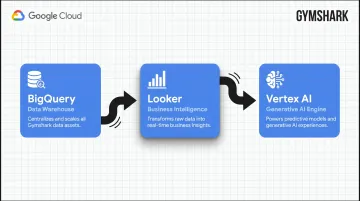
In October 2023 at Google Cloud Next London, Gymshark announced Google Cloud as its strategic technology partner to modernise analytics, enable real-time insights, and power generative AI innovation — with Deloitte as the implementation partner. The core infrastructure shift included three components:
- BigQuery replaced the central data warehouse for faster, scalable querying
- Looker became the unified business intelligence and visualisation platform, giving every team access to the same data
- Vertex AI served as the generative AI engine for experimenting with product assistants, personalisation, and training app enhancements
Francis was direct about the stakes: "Data is at the heart of this evolution, and with the help of Google Cloud's technology and data analytics experts, we are certain that we will be able to reach our goals and remain a leader in this competitive industry."
Helen Kelisky, Managing Director of Google Cloud UKI, framed the shift as Gymshark moving "from digital native to data native".
Why This Partnership Mattered for Growth
Gymshark's growth ambitions — Black Friday traffic spikes, new territory expansion, and supply chain complexity — demanded real-time analytics and AI inference at global scale, not batch reporting run overnight. With revenue reaching £556.2 million in 2023 and over 900 staff across multiple regions, the brand needed infrastructure capable of supporting 17 million+ community members and 10 million+ customers simultaneously.
The Google Cloud partnership provided exactly that: a platform where customer data could inform decisions in real time, from personalised product recommendations to demand forecasting across new markets.
AI for Personalised Shopping and Product Discovery
As Gymshark expanded globally, delivering relevant product experiences to customers with varied fitness goals, body types, and regional preferences became impossible to manage manually. The brand shifted from session-based metrics to user-level data to understand long-term customer value and fragmented purchase journeys.
The Vertex AI-powered expert assistant concept introduced AI-driven guides that help customers navigate product selection — surfacing the right leggings, compression tops, or training gear based on individual needs, rather than relying on generic filters. Black Friday became the first major live use case: Gymshark used its new data infrastructure and AI capabilities to expand the breadth, relevance, and availability of product offerings during peak demand.
Earlier data-driven personalisation efforts already showed results. According to Think with Google's case study, Gymshark achieved:
- 5% improvement in product listing page click-through rate following e-commerce reporting enhancements
- 30% improvement in time spent on user journey analysis compared to previous platforms
- 9% improvement in checkout drop-off rates after rethinking first-time app user experience
Social listening, behavioural analytics, and customer feedback loops connect Gymshark's community data (Instagram, TikTok, Gymshark Insiders) with e-commerce behaviour to shape what content and products each customer sees.
The broader strategic aim is shifting from reactive personalisation — surfacing what's popular — to predictive personalisation that anticipates what an individual customer wants next, based on their fitness journey and purchase history.
From Mass Marketing to 1:1 Relevance
Gymshark's audience of Millennials and Gen Z expects experiences that feel tailored. Generic email blasts and homepage carousels don't hold their attention. Real-time analytics enable Gymshark to serve targeted content, product drops, and recommendations at the individual level. Gymshark made a company-wide commitment to eliminate the phrase "I reckon" from key decision-making, replacing instinct with data-driven insight. App users now visit 5-10 times per week, compared to web users visiting 2-3 times per month. Personalised experiences — including early access to new product releases every Thursday via push notifications — are a core driver of that engagement gap.
How AI Informs Gymshark's Product Design
Gymshark aggregates customer reviews, social media sentiment, engagement patterns, and ambassador feedback through its AI-enabled data stack. The goal: understand what customers actually want before a new product is designed. Ben Francis explained: "We know that a lot of customers will use that app three or five days a week during workouts, and some of them will be into weightlifting, some into CrossFit — different, more contextual data that we can overlay onto the transactional data".
Machine learning takes this further through demand forecasting. By analysing purchase patterns, seasonal trends, and community signals, Gymshark can predict which product categories and colourways are likely to perform. That means fewer costly overproduction runs and design resources concentrated on high-demand lines.
The influencer co-creation feedback loop demonstrates how data feeds back into design. Whitney Simmons, Gymshark's first Creative Director of Adapt, collaborated on multiple collections where customer feedback directly shaped product iterations. The final Whitney Simmons x Gymshark collection notes it was "designed with your feedback in mind," with specific refinements including a waistband 1.5cm shorter than previous versions based on wearer input. Traditional apparel brands rely on gut instinct and slow trend reporting. Gymshark validates design decisions with real-time community signals — before samples are even made.
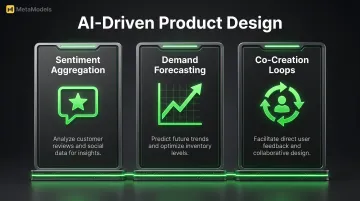
Three capabilities underpin this approach:
- Sentiment aggregation — reviews, social data, and ambassador input processed through a unified AI stack
- Demand forecasting — purchase patterns and community signals used to predict category and colourway performance
- Co-creation loops — customer feedback fed directly into product iterations, with measurable changes (like the 1.5cm waistband adjustment) as proof
AI Across Operations: The Training App and Supply Chain
The Gymshark Training App Gets Smarter
Vertex AI-powered enhancements to the Gymshark training app introduced the ability to log workouts via natural language text input (instead of manual data entry) and receive dynamic, real-time insights tailored to individual fitness goals — turning the app from a logging tool into a personalised coaching companion. One showcased use case involved the fitness app using workout history to recommend specific exercises for the following day.
The app holds a 4.9 out of 5 rating with 15,000 reviews and includes thousands of free workouts, habit tracking, and Apple Health integration.
That engagement data feeds directly back into product decisions. What workouts users complete, what goals they set, and how they participate in the #Gymshark66 challenge — a 66-day global wellness initiative that has helped hundreds of thousands build healthy habits — all shape community strategy and development priorities.
Supply Chain and Forecasting
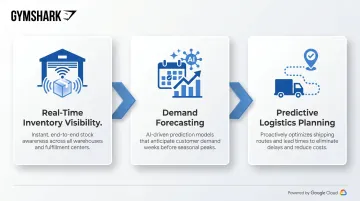
Google Cloud's AI and machine learning tools support supply chain operations across several areas:
- Real-time inventory visibility — teams know stock positions at any moment
- Demand forecasting — reduces stockouts and overproduction, especially during peak events like Black Friday
- Predictive logistics planning — anticipates fulfillment pressure before it hits
The technology stack functions as the "ground truth" for business decision-making. Every team — from design to logistics — works from the same real-time, AI-enriched data layer, enabling faster and more confident calls across the business.
What Fashion Brands Can Learn from Gymshark's AI Strategy
Modernise the data foundation before scaling AI
Gymshark's AI wins were only possible after replacing outdated legacy systems with a scalable, unified data stack. Brands that try to layer AI on top of fragmented data will hit a ceiling quickly. Research from McKinsey shows that companies growing faster derive 40% more revenue from personalisation than slower-growing counterparts, and that data-driven organisations are 23 times more likely to acquire customers.
Let community data drive product decisions
Gymshark's most powerful AI use cases connect customer behaviour, social signals, and ambassador feedback directly to design and marketing choices. Brands with engaged communities hold vast, largely untapped AI training data. McKinsey also reports that 71% of consumers expect personalised interactions, and 76% get frustrated when they don't receive them — making community data not just valuable but expected.
Start where the impact is visible
Gymshark's first high-profile AI deployment was personalisation for Black Friday — a high-stakes, measurable moment. Fashion brands should identify their equivalent: a product launch, a peak sales period, or a creative production bottleneck where AI can deliver fast, demonstrable value.
That last point is where many brands find the clearest starting line. For fashion teams facing content production bottlenecks, MetaModels.ai offers exactly that kind of entry point — converting packshots into on-model imagery using a curated library of diverse AI models, eliminating photoshoot costs and scaling inclusive, personalised visuals without the overhead of traditional production.
Frequently Asked Questions
Does Gymshark use AI models?
Gymshark's marketing primarily features human fitness influencers and ambassadors. Operationally, the brand uses Vertex AI and Google Cloud for personalisation, demand forecasting, and product discovery. Gymshark has not publicly confirmed replacing human models with AI-generated imagery in marketing content.
Who are the models for Gymshark?
Gymshark works with fitness influencers and long-term brand ambassadors including Whitney Simmons (Creative Director of Adapt), David Laid (Creative Director of Lifting), and Chris Bumstead. Each ambassador participates in product co-creation alongside their ambassador role.
What AI tools does Gymshark use?
The core AI stack runs on Google Cloud: Vertex AI for generative AI experimentation and personalisation, BigQuery for data warehousing, and Looker for business intelligence and reporting. Deloitte served as implementation partner, with the build beginning in 2023.
How does Gymshark use AI for personalisation?
Vertex AI powers expert product selection assistants that guide customers through product discovery. Real-time analytics serve personalised recommendations and marketing content based on each customer's behaviour and fitness goals.
How has AI changed Gymshark's approach to supply chain and forecasting?
Google Cloud's AI and machine learning capabilities give Gymshark enhanced demand forecasting, real-time inventory insights, and more accurate planning around peak events — reducing both stockouts and overproduction.