Introduction
A TikTok-viral aesthetic can dominate Instagram feeds for three weeks, then vanish. This is the era of micro-trends — where prevailing fashion categories no longer define decades but rather a singular week on social media. Ultra-fast fashion companies now design and produce items within weeks, not seasons, to keep pace with the relentless churn. In this environment, speed and data have become the new competitive advantage in fast fashion e-commerce.
Boohoo Group — a portfolio of 13 British fashion brands including PrettyLittleThing, Nasty Gal, and Karen Millen — has built its competitive edge on exactly this logic. The company runs a multi-layered AI strategy spanning trend detection, on-site search, merchandising, and customer acquisition. Each layer is designed to catch social media-driven trends before they peak. Here's how it works, and what other brands can take from it.
Key Takeaways
- Boohoo monitors TikTok, Instagram, and Google Trends using AI to identify emerging fashion trends before competitors
- A four-step AI framework — identify, predict, match, contingency plan — guides rapid trend response
- Bloomreach's AI powers personalized on-site search and merchandising using real-time customer data
- Rokt's AI targets post-purchase offers and acquires new customers through partner networks
- Boohoo's response to the viral "Mob Wife" trend in early 2024 shows the full AI system in action
How Boohoo Uses AI to Identify and Predict Fashion Trends
Social media has compressed trend cycles sharply. Global clothing production doubled between 2000 and 2014, and garments purchased per capita increased approximately 60% in the same period. Brands now compete to spot and capitalize on trends in weeks, not months.
Step 1: Identify Emerging Trends
Boohoo monitors trending searches across TikTok, Instagram, Google Trends, and its own platform data to surface emerging trends early. Jonny Longden, Boohoo's Group Digital Director, emphasizes that passive awareness matters as much as active searching. Customers may have seen a trend on social media without consciously searching for it — but if Boohoo presents the right product at the right moment, it can convert latent interest into sales.
Step 2: Predict Traction Using Four Signals
Once a trend surfaces, Boohoo evaluates it across four dimensions:
- Velocity – How fast is the trend rising?
- Quality – What is the depth of social engagement (likes, shares, comments)?
- Diversity – Is the trend spreading across multiple platforms or confined to one?
- Locality – Is it global or region-specific?
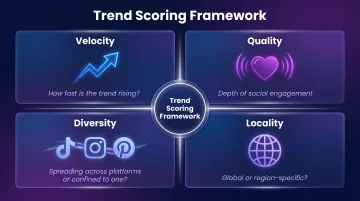
Combining these signals helps Boohoo decide how much to invest in a trend. As Longden notes, not all trends perform as expected, making prediction accuracy critical to avoiding markdowns and overproduction.
AI Automates What Was Manual
Those four signals feed directly into an automated scoring layer. Instead of analysts manually combing through platforms, AI aggregates and ranks trend data across Boohoo's 13 brands simultaneously.
This shift to automation enables faster, lower-risk inventory decisions. The stakes are real: one dump truck of textile waste is landfilled or incinerated every single second due to overproduction, and brands that misjudge a trend pay for it in markdowns and waste.
The "Mob Wife" Case Study: AI Trend-Chasing in Action
Inspired by characters from The Sopranos and Goodfellas, the "Mob Wife" aesthetic — massive faux fur coats, glossy leather, clashing animal prints, gold jewellery — went viral on TikTok at the start of 2024. Within days, it became the first major fashion trend of 2024.
The Trend in Numbers
- TikTok hashtags #MobWives, #MobWife, and #MobWifeAesthetic accumulated over 493 million views combined
- Google searches for "mob wife winter" surged 3,850%, "mob wife trend" 2,800%, and "mob wife aesthetic 2024" 2,500% in the week leading to January 17, 2024
- Depop searches for leopard print jumped 213%; faux fur coats rose 18%
Step 3: Match Products to the Trend
Boohoo used AI to automatically scan and tag thousands of existing products — leopard print dresses, fur coats — as relevant to the "Mob Wife" trend. This enabled customers to discover full outfits matching the trend without Boohoo staff manually reviewing every SKU. Longden highlighted that "some quite interesting AI functions activate" when auto-tagging products at scale.
That auto-tagging fed directly into searchable trend landing pages, connecting both active searchers and latent browsers who hadn't consciously decided they wanted the trend yet. As Longden explained, "If they do happen to be on your platforms, and you present the right product and the right information, you might persuade them."
Step 4: Contingency Planning for Trend Decline
Boohoo planned for the trend's decline in advance. Longden recommends an agile supply chain with small-quantity ordering that can be scaled back quickly. The goal: "avoid making product that won't sell." Just as "Barbiecore" evaporated after summer 2023, the "Mob Wife" moment was always going to be short-lived — and Boohoo's small-batch ordering meant it exited the trend without heavy markdowns.
AI-Powered Search and Merchandising: Personalizing the Shopping Journey
In April 2024, Boohoo Group expanded its partnership with Bloomreach, adding AI-powered search and merchandising across PrettyLittleThing, Boohoo, BoohooMAN, and Karen Millen — extending a relationship that started in 2021 with email, mobile push, and SMS personalization across all 13 brands.
How It Works
Boohoo uses first-party customer and product data to serve personalized on-site and in-app journeys that mirror active marketing campaigns. The platform ranks and boosts products in real time based on each customer's browsing and purchase history.
Why it matters: A customer who clicks a campaign ad no longer lands on a generic homepage. The on-site and in-app experience continues the same narrative they were already engaged with.
As PrettyLittleThing CMO Nicki Capstick stated: "The ability to use first party data to extend personalization from our marketing campaigns to our on-site and in-app search and merchandising experience is a game changer."
Business Outcomes
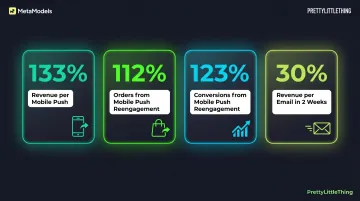
PrettyLittleThing reported significant performance improvements after adopting Bloomreach:
- 133% increase in revenue per mobile push
- 112% increase in orders from mobile push reengagement campaigns
- 123% increase in conversions from mobile push reengagement campaigns
- 30% increase in revenue per email within two weeks
These figures come from vendor reporting, though Bloomreach's broader benchmarks independently point to similar gains: 35.2% higher conversion rates, 39.8% higher revenue per visit, and 28.1% lower exit rates during peak shopping periods.
AI for Targeted Promotions and Customer Acquisition
In September 2023, Boohoo expanded its partnership with Rokt, an AI and machine learning personalization platform, to serve relevant, non-endemic offers on the post-purchase confirmation page. The confirmation page is a high-intent moment — customers have just completed a transaction and are receptive to complementary offers.
Customer Acquisition at Scale
Boohoo uses Rokt Ads to acquire new customers by placing ads within Rokt's partner network, which includes Ticketmaster, Uber, AMC Theatres, Live Nation, PayPal, and Staples. By using first-party data, Boohoo reaches highly relevant audiences beyond its own platforms across boohoo, Nasty Gal, BoohooMAN, and PrettyLittleThing.
Boohoo states this approach drives higher customer engagement, stronger brand loyalty, and increased transaction value. Boohoo-specific metrics aren't publicly available, but the platform-level numbers suggest meaningful impact:
- Rokt's global click-through rate is 4.03% — roughly 10x Google Display (0.4%) and 4x Facebook Ads (1.5%)
- Rokt's global conversion rate sits at 6.32%, well above typical display ad benchmarks
- Post-purchase upsell conversion rates average around 4% industry-wide, with high-performing merchants hitting 10% or more
What Fashion Brands Can Learn from Boohoo's AI Playbook
Boohoo's AI advantage is an integrated system connecting trend intelligence, site experience, and customer acquisition into one continuous loop. Brands of any size can start with one layer (trend monitoring or search personalization) and build from there.
The Visual Content Bottleneck
While Boohoo's AI strategy excels at identifying trends and personalising discovery, producing trend-responsive product imagery at speed remains a bottleneck for many brands. Traditional photoshoots require weeks of planning, model booking, and post-production — time fashion brands don't have when a trend may peak and fade within weeks.
Platforms like MetaModels.ai solve this directly — converting product packshots into styled on-model photography without costly photoshoots every time a trend shifts. For brands operating on Boohoo's playbook, generating on-trend visuals in days rather than weeks compresses the time between spotting a trend and getting product in front of buyers.
Build Agile Supply Chains, Not Just AI Tools
Longden's core insight: the goal isn't to chase every trend recklessly, but to build systems that let brands move fast when it matters and pull back when it doesn't. The stakes are real — for every five garments produced, the equivalent of three end up in a landfill or are incinerated every year.
The data on getting this right is compelling:
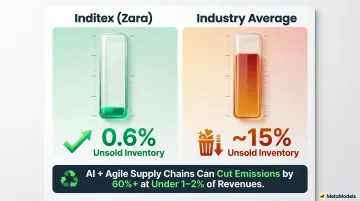
- Inditex (Zara's parent company) holds a 0.6% end-of-season unsold inventory rate, against an industry average of roughly 15%
- Brands that pair agile supply chains with AI trend intelligence can cut emissions by more than 60% at a cost of under 1–2% of revenues
Frequently Asked Questions
Does Boohoo use AI?
Yes. Boohoo uses AI across trend forecasting (monitoring TikTok, Instagram, Google Trends), on-site search and merchandising (via Bloomreach), and targeted customer promotions and acquisition (via Rokt).
What AI tools does Boohoo use for trend forecasting?
Boohoo monitors social media platforms, Google Trends, and internal site data. It then evaluates each trend using AI-driven signals — velocity, quality, diversity, and locality — to predict traction and guide inventory decisions.
How does Boohoo use AI for search and merchandising?
Boohoo uses Bloomreach's AI-powered platform to rank and boost products in real time using first-party customer data. This creates personalized on-site and in-app experiences that stay consistent from ad click to product page.
What was the "Mob Wife" trend and how did Boohoo use AI to respond to it?
The "Mob Wife" aesthetic went viral on TikTok in early 2024, driving demand for faux fur coats and leopard print. Boohoo used AI to auto-tag thousands of relevant products and create searchable trend landing pages, connecting shoppers to trend-aligned items at speed.
How does AI help Boohoo personalize the customer experience?
Boohoo uses Bloomreach for on-site personalization and Rokt's AI for post-purchase targeted offers. Each interaction is shaped by browsing behavior, purchase history, and live engagement data.
Can smaller fashion brands use AI for trend forecasting like Boohoo?
Yes. While Boohoo operates at significant scale, the underlying tools — social listening, Google Trends monitoring, AI-powered tagging, and search personalization — are increasingly accessible to brands of all sizes. Starting with just one of these elements is a practical first step.