Introduction
Alo Yoga operates under a business model that would strain most fashion retailers. Launching new styles every two weeks across 70+ stores in 12 countries means up to one-third of the brand's assortment changes within each cycle — more than traditional inventory planning tools can handle.
To keep pace, Alo Yoga needed AI to solve two distinct problems: managing stock accuracy across regions with shifting demand signals, and producing visual content fast enough to match the product cadence.
This article breaks down how Alo Yoga deployed AI across both inventory planning and marketing, and what it means for other fashion brands trying to scale without sacrificing customer experience.
Key Takeaways
- Alo Yoga partnered with invent.ai to overhaul inventory planning, achieving +6.8% improvement in revenue-weighted availability and 80% reduction in manual planning time
- AI-driven demand forecasting cut abandoned sales by 8.2% year-on-year while reducing weeks' cover by three weeks
- SMS campaigns via Attentive, influencer analytics, and personalized content help Alo Yoga convert its wellness-oriented community into repeat buyers across channels
- Together, these AI applications show how inventory efficiency and targeted marketing can reinforce each other — a replicable playbook for digitally native apparel brands
The Challenge: Why Alo Yoga Needed AI
Alo Yoga's "constant drops of newness" model creates a planning nightmare. New products and colorways launch every two weeks, with approximately one-third of the assortment changing each cycle. Traditional planning tools couldn't keep pace.
Key operational challenges included:
- Managing inventory accuracy across 70 stores in 12 countries
- Forecasting demand for diverse regional preferences and trend cycles
- Balancing stock levels for products with 14-day lifecycles
- Coordinating allocation decisions across store types and geographies
Casey Hahn, VP at Alo Yoga, described the brand as "hungry for results" regarding allocation and replenishment improvements. Gurhan Kok, CEO of invent.ai, called Alo's demand prediction challenge "one of the most challenging use cases we have seen" in retail AI deployment.
Those pressures translated into real operational damage: stock imbalances, delayed replenishment, and misallocated inventory across the global network — all while customer demand remained strong.
How Alo Yoga Uses AI for Inventory Management
The invent.ai Partnership
Alo Yoga selected invent.ai's AI-powered platform to handle assortment, allocation, and replenishment optimization. The platform was customized to fit the brand's rapid product cadence and global store network.
Proof-of-Concept Rollout
The deployment followed a rigorous testing framework:
- Duration: Six weeks
- Scope: 20% of Alo's stores vs. 80% control group
- Methodology: Both groups drew from the same inventory pool for true A/B comparison
- Result: +10% sales uplift in the AI-managed stores
This result established organizational trust in AI-driven decision-making. Full implementation was completed within three months.
Expanded AI Capabilities
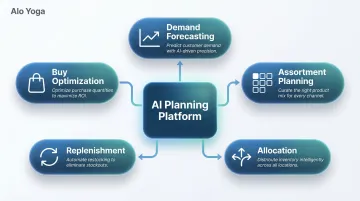
The partnership now covers five critical planning functions:
- Demand Forecasting: SKU-level predictions by store, trend, and region let planners respond to demand signals in real-time.
- Assortment Planning: Recommends optimal product mix per location based on historical performance and trend analysis.
- Allocation: Initial stock distribution matches predicted demand patterns rather than generic formulas.
- Replenishment: Automated reorder triggers prevent stockouts while minimizing excess inventory.
- Buy Optimization: Informs purchasing decisions for future seasons based on trend velocity and regional preferences.
Quantified Operational Gains
Verified results from Alo Yoga's implementation include:
- +6.8% revenue-weighted availability improvement
- 80% reduction in manual planning time
- -8.2% abandoned sales year-on-year (2024 to 2025)
- Three-week reduction in weeks' cover (holding less stock while improving availability)
- +2.9% year-on-year availability improvement
The combined effect: leaner inventory positions without sacrificing shelf availability — a trade-off most retailers struggle to crack.
What Makes This AI Different
Eya Yerkes, EVP of Planning and Allocation at Alo Yoga, emphasized that invent.ai is "one of the few companies delivering true AI solutions" rather than rules-based automation. The distinction matters: the platform processes buying patterns, regional trends, and live store data to present planners with informed recommendations — keeping human judgment in the loop rather than bypassing it.
Gurhan Kok captured the practical upshot: the technology provides "real-time responsiveness to market trends, ensuring the right products are in the right stores at the right time."
How Alo Yoga Uses AI in Marketing
AI-Enhanced SMS Marketing
Alo Yoga uses Attentive for SMS and MMS marketing, which currently accounts for 4% of total business revenue. The platform enables:
- Behavioral segmentation for targeted messaging
- A/B testing for conversion optimization
- Bespoke landing pages (converting significantly higher than generic homepage links)
- Personalized product recommendations and new drop announcements
Cher Fuller, Senior Director of Digital Marketing, noted that SMS has "a ton of growth potential" as an acquisition channel approaching parity with email.
Influencer Strategy and Analytics
Alo Yoga's Fall 2023 influencer campaign delivered 367% ROI and 1,640% year-on-year sales growth during the campaign period (August 10 to September 30, 2023). The campaign featured three content creators across seven content pieces, generating 133,000 total views.
While celebrity relationships with figures like Kendall Jenner and Hailey Bieber are human-curated, the brand increasingly uses data and analytics to identify which influencer content formats, platforms, and audiences drive measurable results. BTS member Jin holds the formal title of Global Ambassador as of October 2024.
Multi-Handle Social Strategy
Alo Yoga operates a sophisticated multi-platform presence with over 4.95 million total followers:
- @alo (Instagram): 2.2M followers — main brand
- @alomoves (Instagram): 1.1M followers — fitness platform
- @alowellness_ (Instagram): 64K followers — wellness content
- Alo Men (Instagram): 76.8K followers — men's line
- @alo (TikTok): 405.1K followers
AI and analytics inform which content types, formats, and timing drive the highest engagement across each platform and audience segment.
AI in Visual Content Creation
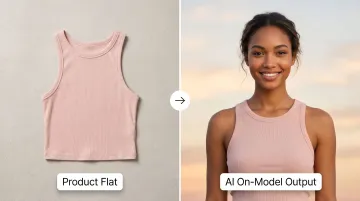
Alo Yoga releases new product drops every two weeks — a pace that makes consistent campaign imagery a genuine production challenge. AI imagery platforms like MetaModels.ai address this by converting product packshots into on-model photography without physical photoshoots, keeping visuals consistent across bi-weekly drops and multiple channels.
The AI-generated fashion photography market reached $1.51 billion in 2024 and is projected to hit $6.12 billion by 2029 (32.1% CAGR) — a trajectory that reflects how central content production speed has become for brands running rapid product cycles.
Key Results: What AI Has Delivered for Alo Yoga
Inventory Outcomes
According to invent.ai partnership data reported at NRF 2026:
- +6.8% improvement in revenue-weighted availability
- -8.2% fewer abandoned sales from 2024 to 2025
- Three-week reduction in weeks' cover
- Improved in-stock performance sustained even after multiple peak trading days
Marketing Outcomes
Campaign-level results demonstrate the commercial impact of data-driven marketing:
- 1,640% sales increase during the Fall 2023 influencer campaign period vs. prior year
- 367% ROI from the Fall 2023 initiative
- SMS contributing 4% of total revenue with growth trajectory approaching email's contribution
Broader Brand Growth
AI has enabled aggressive expansion:
- Now operating across 12 countries
- UK stores in London (Regent Street flagship, King's Road, Westfield London, Battersea Power Station), Manchester, and Leeds
- Surpassed $1 billion in annual sales by 2022
- Maintains 40%+ annual growth rate
- E-commerce represents approximately 65% of total revenue
- Over 300,000 Alo Moves subscribers at $20/month
Those numbers point toward one clear next step: an IPO. Alo Yoga is reportedly moving toward a public offering — a signal that AI-enabled inventory and marketing operations can sustain this kind of growth across hundreds of SKUs and 12 markets without the brand losing control of its margins or its identity.
What Fashion Brands Can Learn from Alo Yoga's AI Strategy
Lead with the "Art and Science" Principle
Casey Hahn framed Alo's approach perfectly: "We have the art of products and trends down, but needed support with our assortment mix and understanding where the demand is coming from."
AI doesn't replace brand instinct — it operationalizes it. Fashion brands excel at creating desirable products. AI handles the science of demand prediction, inventory positioning, and content scaling.
Start Small, Prove Fast
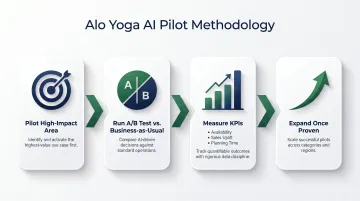
Alo Yoga's six-week proof of concept across 20% of stores is replicable:
- Pilot AI in a high-impact, measurable area (allocation or replenishment)
- Run a controlled A/B test against business-as-usual operations
- Measure specific KPIs (availability, sales uplift, planning time)
- Expand once results are proven
This approach builds organizational confidence and delivers ROI before committing to enterprise-wide transformation.
Solve the Content Production Bottleneck
For brands running rapid product cycles similar to Alo Yoga's bi-weekly drops, keeping up with visual content demand is a parallel challenge. Traditional photoshoots create logistical delays and cost constraints that limit SKU coverage.
Platforms like MetaModels.ai let brands produce on-model visuals for every new SKU without booking models or scheduling shoots. The efficiency gains are real: BCG research on AI in retail documents 30%+ productivity gains and 10% employee cost reductions from AI adoption — benefits that apply to content production workflows just as much as inventory operations.
Understand the Industry Pressure Driving Adoption
Alo Yoga's results align with broader industry trends:
- 35%+ of fashion executives now use generative AI in functional areas
- 45% of executives prioritize margins and stock management
- 20% of all clothes produced annually never reach consumers, generating $140 billion in waste
- Average time to clear stock reached a record 168 days in 2024
Early movers are already seeing results: Zalando cut demand forecasting errors by 20%, and French retailer Etam estimates AI can reduce leftover stock by 10-20%. Brands that delay adoption aren't just missing efficiency gains — they're absorbing costs their competitors are actively cutting.
Frequently Asked Questions
What AI tools does Alo Yoga use for inventory management?
Alo Yoga uses invent.ai's AI-decisioning platform for allocation, replenishment, demand forecasting, assortment planning, and buy optimization across its global store network. The platform delivers real-time responsiveness to market trends and was fully implemented within three months.
How did AI improve Alo Yoga's inventory availability?
The invent.ai partnership delivered a +6.8% improvement in revenue-weighted availability, 80% reduction in manual planning time, and -8.2% fewer abandoned sales year-on-year. The brand also reduced weeks' cover by three weeks, meaning it held less stock overall while improving customer-facing availability.
How does Alo Yoga use AI in its marketing strategy?
Alo Yoga uses Attentive for AI-informed SMS marketing (accounting for 4% of revenue), influencer performance analytics that delivered 367% ROI and 1,640% sales growth in Fall 2023, and data-informed social content across multiple brand handles. Behavioral segmentation and A/B testing further shape its paid campaign strategy.
How is AI being used in photography?
AI generates on-model fashion imagery directly from product packshots, eliminating the need for physical models or photoshoots. Platforms like MetaModels.ai let brands produce accurate, on-model visuals for e-commerce and campaigns at scale, without the cost of traditional photography.
How quickly did Alo Yoga see results from its AI implementation?
The initial proof of concept with invent.ai was deployed in six weeks, with full implementation completed in two to three months. Measurable revenue and availability improvements were recorded within that window, with a +10% sales uplift documented during the initial pilot phase.
Can other fashion brands replicate Alo Yoga's AI approach?
Yes. Alo Yoga's pilot-first approach, starting with allocation and replenishment before expanding, is a practical framework for brands of any size. Most AI retail and marketing tools now offer modular deployment with pricing tiers suited to both emerging brands and high-volume operations.