Introduction
India's online fashion market is growing fast. The e-retail sector reached USD 65–66 billion in 2025 and is projected to hit USD 170–180 billion by 2030, with fashion making up 25% of total online retail spend.
In that environment, product images aren't nice-to-have—they're conversion drivers. 56% of online shoppers go straight to product images when landing on a page, and 77% say high-quality visuals directly influence their purchase decision.
Indian clothing brands face a specific set of pressures. Complex garments—sarees, lehengas, embroidered kurtas—require specialized photography to show correctly. Seasonal spikes around Diwali and wedding season demand hundreds of catalog images in a short window. And traditional photoshoot costs quickly outpace what most growing D2C brands can absorb.
The result: brands need fast, high-volume imagery, and conventional photography can't deliver it at scale.
This article explains how AI fashion photography bridges that gap—specifically for Indian ecommerce clothing brands selling ethnic and fusion wear on Myntra, Amazon India, Meesho, and their own D2C channels.
TLDR:
- AI fashion photography turns flat-lay product photos into photorealistic on-model images—no studio required
- Indian brands use it to scale catalog production at a fraction of traditional shoot costs
- Ethnic wear support includes fabric draping, embroidery preservation, and South Asian model diversity
- MetaModels.ai outputs 4K images compliant with Amazon India, Myntra, and Meesho requirements
Why Traditional Fashion Photography Falls Short for Indian Ecommerce Brands
Traditional photoshoots follow a predictable pattern: book models, rent studio space, hire photographers and stylists, conduct the shoot, wait for editing, and finally receive images weeks later. For Indian clothing brands managing SKU-heavy catalogs, that pipeline creates real bottlenecks—in cost, time, and scale.
Costs Add Up Quickly
Global benchmarks show traditional professional shoots ranging from USD 10,000–30,000 per day, with luxury editorials exceeding USD 50,000. Even mid-tier shoots in Indian metros carry significant line items: model fees, studio rental, photographer day rates, styling, and post-production.
Those costs compound fast when you're photographing 50–150 SKUs per seasonal collection.
Slow Turnaround Kills Launch Momentum
Traditional shoots require:
- Scheduling models, photographers, and studio availability
- Shipping garments to the location
- Conducting the shoot (typically 1–2 days for 30–50 final images)
- Post-production editing and approval cycles
This timeline stretches days or weeks—devastating when you need to launch new inventory quickly or respond to trending styles. For brands selling on marketplaces where speed-to-listing determines visibility, delays translate directly to lost revenue.
Festival Seasons Demand More Than Traditional Shoots Can Deliver
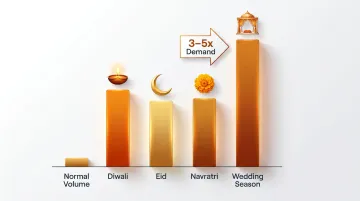
Indian brands face intense seasonal pressure. During Diwali, Eid, Navratri, and wedding seasons, catalog demands spike 3–5x normal volumes. Traditional photoshoot pipelines can't scale fast enough without proportionally higher costs. Brands typically end up paying emergency-rate premiums or missing the seasonal window—neither is a good outcome.
Representation Remains Inconsistent
India's fashion market serves customers across different skin tones, body types, and regional aesthetics. Yet recent coverage documents ongoing bias and representation gaps in the Indian fashion industry. Smaller brands working with limited model agencies often default to narrow visual identities that don't reflect their actual customer base across North, South, East, and West India.
Marketplace Compliance Overhead
Platforms like Myntra, Amazon India, and Meesho each impose specific image requirements. Amazon India requires minimum 500 px on the longest side (1600 px recommended), pure white backgrounds (RGB 255,255,255), and products filling at least 85% of the frame. Traditional shoots generate quality images — but those images still require additional editing rounds to meet each platform's specifications. That's overhead most brands didn't budget for.
What Is AI Fashion Photography and How Does It Work for Clothing Brands
AI fashion photography uses artificial intelligence to generate photorealistic on-model or styled product images from garment inputs such as flat-lay photos, packshots, or ghost mannequin shots—without physical models, studio bookings, or photographers.
The Core Workflow
The process is straightforward:
- Upload product image – Brand uploads a flat-lay or packshot of the garment
- AI draping – The AI places the garment onto a selected model with realistic fabric draping, preserving color, texture, embroidery, and proportions
- Output delivery – Platform generates a ready-to-use catalog image in minutes
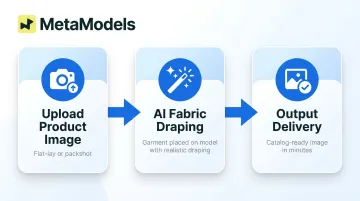
The result: professional on-model catalog shots from the same packshots brands are already taking for inventory.
Types of Outputs AI Fashion Photography Produces
Quality platforms generate the full range of visual content Indian ecommerce brands need:
- On-model product shots for catalog listings
- Marketplace-compliant white-background images meeting Amazon India, Myntra, and Meesho specifications
- Lifestyle scenes with custom backgrounds
- Multi-angle views showing garment details
- Lookbook imagery for social media and campaigns
Why Brands Are Adopting AI Photography Now
This shift is already underway at scale. The AI in fashion market is projected to reach USD 60 billion by 2034, growing nearly 40% annually. H&M, Levi Strauss, and Shein have all integrated AI model generation into their content pipelines — and mid-market and independent brands are following the same path.
Where Generic AI Tools Fall Short on Garment Accuracy
Generic AI tools frequently fail on the details that matter most for Indian ethnic and fusion wear — colors shift, embroidery blurs, and draping looks unnatural on structured silhouettes. MetaModels.ai addresses this directly: fashion specialists review each output for garment fidelity before delivery, catching inaccuracies that would otherwise reach a live listing.
Commercial Rights and Scalability
AI platforms grant full commercial usage rights on all outputs, with no per-model licensing fees or royalty structures. Traditional shoots, by comparison, layer on model contracts, usage restrictions, and exclusivity clauses that can take weeks to negotiate and significantly inflate per-image cost. At scale — hundreds of SKUs per season — that difference becomes substantial.
Key Challenges of Photographing Indian Garments — and How AI Solves Them
Indian ethnic wear presents unique visual complexity that generic AI tools struggle to handle. Here's where specialized AI fashion photography makes the difference.
Fabric Draping Complexity
Sarees involve six yards of fabric with specific pleating patterns. Dupattas drape over shoulders in culturally distinct ways. Anarkalis flare from the waist with volume that must look natural on a model's body.
Generic AI tools trained primarily on Western garments render these incorrectly — pleats appear flat, draping looks stiff, and the garment loses its character.
Platforms with real-time fabric draping technology (like MetaModels.ai) are built to handle how these fabrics fall, layer, and move. The AI doesn't just paste a garment image onto a model; it simulates how that specific fabric would actually drape on that body type.
Embroidery and Embellishment Rendering
Bridal lehengas with heavy zari work, sequined dupattas, mirror-work kurtas, and hand-embroidered sarees contain fine details that blur or distort in low-quality AI outputs. The difference between an entry-level kurta and a premium one often lies in embroidery detail — which must be visible in catalog images.
What to look for:
- High-resolution output (4K minimum)
- Garment accuracy focus in the platform's technology
- Human review steps that catch detail loss before delivery
South Asian Model Representation
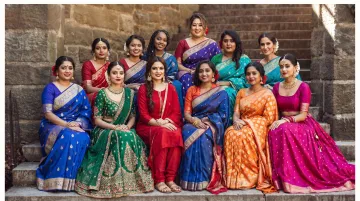
Indian clothing is designed to look its best on South Asian skin tones, body types, and proportions. Western-trained AI models default to Caucasian features and body types — a mismatch that distances the garment from the customer buying it.
Quality platforms maintain diverse libraries of AI models reflecting:
- Range of South Asian skin tones from fair to deep
- Body types common in Indian demographics
- Age ranges and styling appropriate to regional markets
Showing the garment on a model your customer recognizes drives stronger purchase confidence.
Multi-Garment and Coordinated Set Photography
Indian fashion frequently involves coordinating pieces: salwar suits with dupattas, lehengas with blouses and dupattas, kurtas with palazzos. Photographing each piece separately, then hoping customers visualize the complete look, is inefficient.
AI tools that support layered garment generation or outfit pairing let brands show the full coordinated look in one image. Benefits include:
- Fewer separate shoots per collection
- Clearer ensemble presentation for customers
- Faster catalog production for multi-piece SKUs
How Indian Ecommerce Brands Are Using AI Fashion Photography
Indian ecommerce brands are applying AI fashion photography across three distinct use cases — each solving a specific operational challenge.
D2C Catalog Launch
Over 800 homegrown digital-first brands have launched in India since 2019, with several crossing USD 50 million revenue within 2–3 years. These brands use AI fashion photography to produce full product catalogs before launch, enabling them to go live with professional on-model imagery on day one—without the upfront shoot costs of traditional photoshoots.
The workflow: upload packshots of the entire collection, generate on-model images across diverse model types, and publish. This compressed timeline (days instead of weeks) allows brands to test market response faster and iterate based on data.
Marketplace Listing Optimization
Brands selling on Myntra, Meesho, and Amazon India face strict image specifications. Each platform requires specific background colors, resolutions, aspect ratios, and product-to-frame ratios. Manually editing traditional shoot outputs to meet these requirements across hundreds of SKUs is time-intensive.
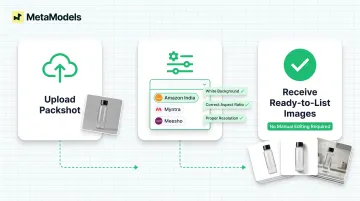
AI platforms that generate marketplace-compliant images from the start eliminate this bottleneck. The process takes three steps:
- Upload a packshot
- Select the marketplace preset (white background, correct aspect ratio, proper resolution)
- Receive ready-to-list images — no manual editing required
Seasonal and Campaign Content
During peak seasons, brands need festive-themed lookbook imagery and social media ad creatives that match the occasion's aesthetic. Booking emergency photoshoots for Diwali campaigns or wedding season promotions is expensive and often impossible on short notice.
AI fashion photography lets brands generate seasonal content in hours, not weeks:
- Select festive or occasion-specific backgrounds
- Style AI models in traditional jewelry and accessories
- Export campaign-ready visuals for social ads, lookbooks, and banners
Brands that move quickly on Diwali or wedding season windows often see stronger conversion than those who miss the moment with delayed creative.
What to Look for When Choosing an AI Fashion Photography Tool for Indian Clothing
Not all AI fashion photography platforms handle Indian ethnic wear equally well. Prioritize these features when evaluating tools.
Indian Garment Support and Fabric Accuracy
Verify the platform supports ethnic wear draping and has been tested on sarees, salwar suits, lehengas, kurtas, and anarkalis. Look for:
- Real-time fabric draping capability (not just garment overlay)
- Human-reviewed output quality to catch garment inaccuracies
- Portfolio examples showing Indian ethnic wear
MetaModels.ai combines real-time fabric draping with human-verified garment accuracy — a practical requirement for ethnic wear brands where detail fidelity directly affects purchase decisions.
Model Diversity and South Asian Representation
Verify the platform offers a curated library with diverse South Asian skin tones, body types, and demographics. The ability to create custom AI models matching your target customer is valuable for brands selling to specific regional markets.
Before committing, confirm:
- How many South Asian models are in the library?
- Can I customize ethnicity, body type, and age range?
- Can I create brand-specific models that represent my actual customers?
Output Resolution and Marketplace Compliance
Ensure the tool produces images at resolutions compatible with Indian marketplace requirements. Amazon India requires minimum 500 px on the longest side, with 1600 px+ recommended for zoom functionality, and a maximum of 10,000 px. Check whether the platform provides ready-to-post files at 4K or equivalent quality without additional post-production.
Additionally, verify that the platform can generate:
- White background images (RGB 255,255,255) for Amazon India main images
- Correct aspect ratios for each marketplace
- Product-to-frame ratios meeting platform specifications
Platforms that deliver marketplace-compliant outputs by default save hours of manual editing per SKU — which adds up fast when you're processing hundreds of listings.
Frequently Asked Questions
How much does traditional fashion photography cost compared to AI for Indian brands?
Professional photoshoots globally run USD 10,000–30,000 per day — a significant expense when accounting for international shoots, logistics, and editing. AI fashion photography platforms offer affordable per-image pricing on volume plans, with monthly subscriptions starting at an entry-level tier for 20 images. Most brands achieve 85–95% cost savings versus traditional shoots.
Can AI fashion photography handle complex Indian garments like sarees and lehengas?
Platforms with real-time fabric draping technology are specifically designed to handle draping-intensive garments by simulating how fabric naturally falls and layers on a model's body. For embellished or heavily draped pieces, tools that include a human review step — like MetaModels.ai's verified output workflow — deliver noticeably better accuracy than fully automated processing alone.
Do AI fashion photography tools offer South Asian model options?
Leading platforms maintain diverse model libraries including South Asian ethnicities, skin tones, and body types. Before committing to a tool, verify the available model range includes representation that matches your target customer demographic and allows customization for regional markets.
Are AI-generated fashion images accepted on Indian ecommerce marketplaces like Myntra and Amazon India?
Platforms review images for quality and compliance rather than specifically checking for AI origin. As long as images meet technical specifications (resolution, background, aspect ratio) and accurately represent the product, they are generally accepted. Brands should confirm current guidelines directly with each marketplace.
How many product images can an Indian brand generate per day using AI fashion photography?
AI tools can process hundreds of images per day depending on batch capabilities and subscription tier. A 300-credit monthly plan allows roughly 10 images daily, while enterprise tiers support higher volumes through API access — far beyond the 30–50 images a traditional shoot day delivers.
What type of input image works best for AI fashion photography of Indian clothing?
Clean, well-lit flat-lay or packshot images on plain backgrounds produce the most reliable results. Higher-quality inputs with clear garment details, accurate colors, and minimal shadows lead to more accurate fabric rendering and draping in the final AI output.