
Introduction
Traditional swimwear catalog shoots are expensive and complex. Model fees alone range from $1,500 to $3,000 per day for agency talent, studio rentals add another $300 to $800, photographers charge $2,000–$4,000 daily, and post-production retouching runs $25–$50 per image at minimum. For a mid-sized catalog of 30–50 SKUs, you're looking at total production costs between $5,000 and $15,000 per shoot—and that doesn't include reshoot contingencies when samples arrive late or colors don't match.
Swimwear compounds these challenges more than most apparel categories. Brands must navigate:
- Fabric behavior under tension and wet conditions
- Fit representation across diverse body types and sizes
- Inclusive model casting that reflects the actual customer base
- Seasonal compression forcing winter-collection shoots months ahead of launch
E-commerce, social media, and paid ads then demand that same content delivered faster and at greater volume.
AI swimwear photography solves all of it. Brands can now convert a flat-lay packshot into a catalog-ready, on-model image in minutes—no studio, no talent booking, no retouching delays. What follows covers exactly how it works, what output quality looks like, and how to get started.
Key Takeaways
- AI converts flat-lay or packshot images into professional on-model catalog photos without physical shoots
- Cuts model booking, studio, and retouching costs — and scales to hundreds of SKUs at once
- Renders real fabric draping and supports diverse body types tailored to swimwear fits
- Output works across e-commerce, lookbooks, social media, and paid ads
- Automated generation paired with human review ensures garment accuracy in every image
Why Traditional Swimwear Catalog Shoots Are Holding Brands Back
A mid-sized swimwear catalog shoot costs more than most brands budget for. Here's what the numbers actually look like:
| Cost Component | Range |
|---|---|
| Photographer day rate | $2,000–$4,000 |
| Model day rate (agency) | $1,500–$3,000 per model |
| Studio rental (basic cyclorama) | $300–$800 |
| Hair and makeup artist | $400–$1,500 |
| Wardrobe stylist | $500–$2,000 |
| Post-production retouching | $25–$50 per image (basic) |
| Per final image (all-in) | $150–$1,500 |
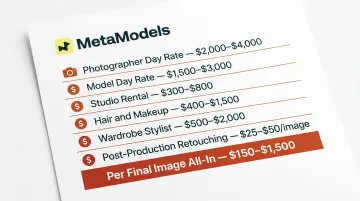
Add agency markups of 20–30% on talent fees, pre-production planning ($500–$1,000), sample shipping costs, and a 15–20% reshoot contingency buffer. One European sportswear brand reported spending approximately €5,000 per shoot — and could only afford one per month given the cost and coordination involved.
The Seasonal Timing Bottleneck
Swimwear operates on one of the tightest seasonal timelines in fashion. Collections must be shot two to three months before launch, with final samples ready four months before the season starts. This means spring/summer swimwear content gets produced during winter months—when beach location shoots require expensive travel to warm climates or awkward studio setups with artificial lighting and props.
When anything shifts after the shoot, the entire timeline unravels:
- Product changes require full reshoots, not quick fixes
- Sample delays push launch dates back across the board
- The production calendar becomes a single point of failure with no flexibility
The Representation Problem Costs Conversions
Traditional shoots default to narrow body type representation due to budget constraints. The impact on buyer confidence is measurable:
- 57% of consumers feel fashion brands don't adequately represent diverse body shapes and sizes
- 67% are more likely to buy from labels featuring varied body sizes in marketing (rising to 78% for plus-size consumers)
- 60% feel more connected to brands featuring models resembling their body type
- 38% often return clothes due to poor fit
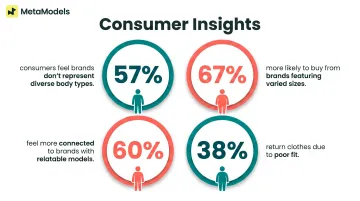
Swimwear is the category where this gap hurts most. Fit is everything — and when shoppers can't see how a piece looks on a body like theirs, they don't buy. Or they buy and return.
What AI Swimwear Photography Actually Does
AI swimwear photography takes a product image (flat lay, packshot, or mannequin shot) and generates a photorealistic image of an AI model wearing that exact garment. The technology preserves color, texture, pattern, cut, strap details, hardware, and garment-specific elements like ruching or mesh panels.
How Model Selection Works
Brands choose from a curated library of AI models representing diverse body types, ethnicities, skin tones, and demographics—or create custom AI models built to match specific brand identity and target customer profiles. This eliminates the logistical constraint of booking multiple models to represent different body types or demographics within a single shoot budget.
What the Output Looks Like
Professional-grade imagery at up to 4K resolution, suitable for product pages, lookbooks, social ads, and email campaigns. Unlike real model contracts, there are no royalties, usage restrictions, or reuse fees. Images are delivered ready to publish across any channel.
Vertical Fashion AI vs. General Image Tools
Generic AI image generators require manual prompting to approximate professional photography standards. Vertical fashion AI platforms are trained specifically on professional swimwear and fashion imagery — understanding composition ratios, light angles, pose standards, and fabric behavior without requiring brands to engineer complex text prompts.
That specialization matters at the output level. Platforms purpose-built for fashion use specialized loss functions that penalize failures general-purpose tools simply don't account for:
- Fabric stiffness errors that make garments look rigid or unnatural
- Color leakage between clothing and skin at garment edges
- Incorrect garment boundaries where fabric blends into the body
- Depth layering mistakes that flatten three-dimensional fit details
Quality Assurance Through Human Review
The highest-quality platforms include a human review step where trained fashion editors verify garment accuracy before images are released. This ensures fabric drape, color fidelity, strap tension, and fit details match the original product — critical for swimwear where material behavior and body fit are highly visible and consequential to buyer trust.
MetaModels.ai pairs real-time fabric draping technology with human-reviewed outputs. For technically demanding styles such as underwire bikini tops, textured one-pieces, and compression cuts, editors confirm fit accuracy before any image goes live.
How AI Handles Swimwear's Unique Visual Challenges
Fabric Physics and Draping
Swimwear fabrics—Lycra, neoprene, mesh, ruching—behave differently on a body than structured garments. Modern AI uses physics-based fabric simulation trained on thousands of textile datasets to model how fibers react to gravity, tension, and movement. The technology simulates:
- Fabric tension and stretch around curves
- Compression marks at straps and elastic bands
- Natural wrinkle lines and fold patterns
- Surface realism down to thread-level detail
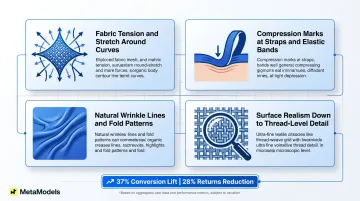
A luxury retailer reported a 37% lift in conversion rates after integrating AI fabric physics, and a sportswear brand saw a 28% decrease in returns due to improved size confidence.
Body Type Accuracy
Swimwear is the category where fit representation matters most to purchase confidence. AI can render the same garment across multiple body types—including plus-size, petite, and athletic builds—with accurate fabric behavior for each.
Traditional shoots make this cost-prohibitive: each additional body type means separate model booking, wardrobe prep, and dedicated shoot time.
Background and Scene Flexibility
Brands can generate images against studio-white backgrounds for e-commerce product pages and simultaneously generate lifestyle scenes (poolside, beach, resort) for lookbooks and social content—from the same packshot. There's no location scouting, no travel budget, and no weather dependencies to manage.
Consistency Across a Full Catalog
Visual consistency drives catalog credibility. AI makes this achievable at scale across 50 or 500 SKUs, eliminating the day-to-day variation that comes with traditional shoots. Key consistency factors it controls:
- Lighting logic and shadow direction
- Model presentation style and posture
- Cropping ratios across all product types
- Color grading and background treatment
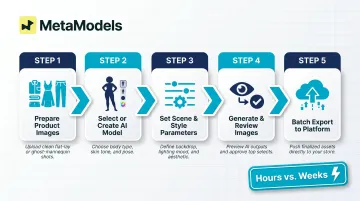
Step-by-Step: Building Your Swimwear Catalog with AI
Preparing Your Product Images
A good input image is a clean flat lay or packshot on a neutral background, with the full garment visible—including all edges, straps, ties, and hardware—shot in consistent lighting. Professional studio prep isn't required, but clarity and completeness matter more than polish. The AI needs every garment detail visible to preserve them accurately in the final output — missing a strap or tie in the source image means it may not appear correctly on the model.
Selecting or Creating Your AI Model
Browse a diverse model library or create a custom model based on your campaign needs:
- Library models cover broad catalog requirements across body types, ages, and skin tones
- Custom models match a specific brand identity or maintain a consistent look across multiple collections
- Diversity selection matters especially for swimwear — models that reflect your actual customer base directly improve purchase confidence
For most brands, starting with library models for seasonal coverage and reserving custom builds for hero campaigns is the most efficient approach.
Setting Scene and Style Parameters
Define three inputs for each image: background type (studio, lifestyle, or a specific environment), pose direction (front, back, side, or close-up detail), and garment-specific instructions.
The more precise the instruction, the more accurate the output. Prompts like "show the tie-side detail at the hip" or "highlight the underwire structure" consistently outperform generic pose requests — especially for technical swimwear features like underwire, removable cups, or adjustable straps.
Generating and Reviewing Your Images
Images generate within minutes of submission. The review process covers three core checks:
- Garment accuracy — straps, seams, and hardware appear as in the source image
- Fabric behavior — drape and texture render naturally for the material type
- Brand consistency — lighting, styling, and framing align across the full collection
MetaModels.ai includes human editorial review at this stage, catching garment errors before delivery rather than leaving quality control to the brand team. Regenerate any images that don't pass before downloading the final set.
Scaling to Full Catalog Production
Upload multiple SKUs at once, set consistent parameters across a collection, and organize outputs by product for direct integration into a PIM, DAM, or e-commerce platform. Batch processing compresses weeks of traditional shoot coordination into hours or days — without rescheduling models, rebooking studios, or waiting on retouching queues.
What to Look for in an AI Swimwear Photography Platform
Not every AI image platform handles swimwear well. Before committing to one, verify it covers these three areas:
- Model library and custom options: The platform should offer AI models across a range of body types, ethnicities, and demographics — plus the ability to create custom models for consistent brand identity across campaigns. Swimwear demands this flexibility more than most apparel categories.
- Swimwear-specific image quality: Generic platforms that work fine for T-shirts often fall short on swimwear, where fabric fit and drape are directly visible to buyers and harder to fake. Look specifically for real fabric draping simulation and human-reviewed quality assurance — not just automated output.
- Scale, resolution, and usage rights: Confirm the platform supports batch production for full-catalog workflows, delivers output at 4K minimum for print and large-format digital, and provides royalty-free usage rights with no per-image restrictions on where content is published.
MetaModels.ai is built around all three: a curated, diverse model library with custom model creation, real-time fabric draping technology, and human editorial review at scale.
How Swimwear Brands Are Using AI Photography Today
Small Brands and Independent Designers
Emerging swimwear labels use AI photography to compete visually with established brands—producing professional catalog imagery for launch without the minimum-order economics that make traditional shoots inaccessible at startup scale. Over 19,000 fashion brands are currently using AI-generated models for lookbooks and product pages.
Scaling Seasonal Collections
Mid-size and growing brands use batch AI generation to produce full seasonal catalogs (50–200 SKUs) in days rather than weeks, enabling earlier launch timelines and more agile response to trend shifts. One beachwear brand produced 30 photorealistic campaign images in less than two weeks with zero studio time, and audience feedback included inquiries asking "Who are these models?" due to the realism of the output.
What the Conversion Numbers Show
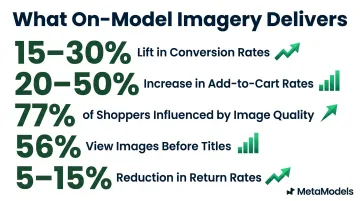
The commercial case for on-model imagery is well-documented across e-commerce:
- 15–30% lift in conversion rates compared to flat-lay product images
- 20–50% increase in add-to-cart rates when shoppers can see garments on a body
- 77% of shoppers say high-quality images and videos directly influence purchase decisions
- 56% of shoppers look at product images before reading titles or descriptions
- 5–15% reduction in return rates when fit and drape are shown clearly on a model
That last point matters most in swimwear. 71% of consumers have returned a product because it didn't match the online image—and fit ambiguity is a primary driver in apparel categories where sizing and drape vary significantly between bodies.
Frequently Asked Questions
How does AI swimwear photography handle fabric draping and fit accuracy?
Modern AI platforms use physics-based fabric simulation to model how swimwear stretches, compresses, and drapes on a body—including tension lines, strap indentations, and natural wrinkle patterns. Human editorial review before delivery catches fit discrepancies, ensuring the output meets commercial accuracy standards.
What do I need to provide to get started with AI swimwear catalog photography?
A clean flat lay or packshot of the garment on a neutral background is the primary input. No studio equipment, models, or professional photography setup required—image clarity and completeness (showing all straps, edges, and details) matter more than production value.
Can AI-generated swimwear images be used on major e-commerce platforms?
Yes—major platforms including Shopify and Amazon accept AI-generated on-model images when they accurately represent the product. Amazon requires on-model imagery for adult swimwear and prohibits mannequins in main images, so AI-generated models are a compliant option. Always verify current platform-specific guidelines before publishing.
How does AI swimwear photography compare to traditional photoshoots in cost?
Traditional shoots cost $150–$1,500 per final image when accounting for model fees, studio rental, photographer day rates, and retouching. AI generation costs range from $0.50–$3.00 per image, cutting per-image spend significantly when producing catalogs at scale.
Is AI swimwear photography inclusive of different body types and sizes?
Leading AI platforms offer diverse model libraries covering a wide range of body types, sizes, ethnicities, and ages. Brands can represent every fit without separate model bookings—shoppers browsing swimwear are more likely to convert when they see themselves reflected in product imagery.
How long does it take to produce a full swimwear catalog using AI photography?
Individual images generate in minutes. Full catalog batches of dozens to hundreds of SKUs can be completed in hours or overnight, compared to weeks of planning, shooting, and post-production for a traditional shoot. Brands using AI-generated lookbooks go to market 70% faster than those relying on traditional workflows.