Introduction
Chicago fashion brands are burning budget on traditional photoshoots while trying to keep pace with seasonal content demands. Model bookings, studio rentals, and multi-day production schedules don't scale—and for brands competing on tight margins, the math rarely works out.
AI model photography is changing this equation. The technology uses generative AI to place garments from flat-lay or packshot images onto virtual models, producing professional on-model imagery without physical shoots. For Chicago's growing fashion sector—home to major retailers like Ulta Beauty, AKIRA, and a thriving DTC community—this means dramatically lower per-image costs and faster time-to-publish across seasonal catalogs.
Chicago ranked as the top U.S. metro area for corporate relocations for 13 consecutive years, with a 5.5 million-person workforce and over $1.7 billion in annual retail earnings. The first Chicago Fashion Summit in 2025 positioned the city as "a growing hub for innovation in fashion and retail." This article breaks down the AI model photography trends shaping how Chicago brands produce, scale, and diversify their visual content.
Key Takeaways
- AI model photography eliminates physical model bookings, cutting per-image costs from $175 to under $2
- Diverse AI model libraries cover body types and demographics that would require multiple casting calls to replicate
- On-demand production lets brands publish hundreds of SKUs with consistent model identity in hours, not weeks
- Human-verified workflows ensure garment accuracy at AI speed — without sacrificing editorial quality
- Chicago brands moving early are already outpacing competitors on content volume, cost efficiency, and time-to-publish
AI Models Are Replacing Traditional Photoshoots for Fashion Brands
Fashion brands are converting flat-lay and ghost mannequin packshots directly into on-model imagery using AI, bypassing model booking, studio hire, and shoot scheduling entirely. This packshot-to-model workflow has moved from experimental to operational—especially for brands managing large catalogs.
Chicago's emerging DTC labels and mid-size e-commerce retailers are adopting this approach to launch collections faster without traditional production overhead. Instead of scheduling seasonal batch shoots, brands upload product images, select virtual model attributes, and receive ready-to-publish imagery within days.
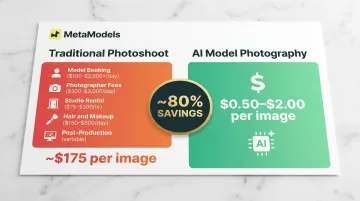
The cost difference is substantial. Traditional fashion photoshoots stack multiple expense layers:
- Model booking: $100–$2,000+ per day
- Photographer fees: $500–$3,000 per day
- Studio rental: $75–$500 per hour
- Hair and makeup: $150–$800 per day
- Post-production and retouching: variable, typically bundled
Per-image costs vary, but one D2C brand case study reported traditional photography averaging $175 per image compared to $0.50–$2.00 per image using AI tools—an approximately 80% reduction.
Those savings are accelerating adoption, but cost is only part of the story. Several structural pressures are pushing brands toward AI-generated imagery:
- Faster seasonal cycles demand more content, more frequently, across more channels
- Tighter marketing budgets make scalable alternatives to traditional shoots a necessity
- Chicago DTC brands compete nationally while operating leaner than coastal counterparts, so efficiency gains matter more
- E-commerce catalogs with hundreds of SKUs make traditional shoots logistically unworkable at scale
73% of fashion executives prioritized generative AI for their businesses in 2024, according to McKinsey's State of Fashion report. For Chicago brands, that shift is already visible in how emerging DTC labels and mid-size retailers are building their production workflows.
AI Is Making Diversity and Inclusion Scalable for Fashion Imagery
AI model platforms now offer curated libraries spanning different ethnicities, body types, ages, and demographics. Brands can represent their full customer base in product imagery without organizing separate shoots for each demographic group.
The most visible example of this trend, and its complications, came from Levi Strauss & Co. On March 22, 2023, Levi's announced a partnership with Lalaland.ai to create AI-generated models intended to "increase the number and diversity" of models and represent customers "of every size and skin tone."
The backlash was immediate. Models of color and industry voices criticized the move as tokenism and cost-cutting disguised as diversity. Shawn Grain Carter, professor at the Fashion Institute of Technology, stated bluntly: "Let's make no mistake about it, Levi's is doing this because this saves them money."
Within six days, Levi's added an editor's note to their press release: "We do not see this pilot as a means to advance diversity or as a substitute for the real action that must be taken to deliver on our diversity, equity and inclusion goals."
Why this matters for Chicago brands:
The Levi's episode is a blueprint in what not to do — but the underlying capability remains valuable when applied honestly. Chicago's diverse urban consumer base expects to see themselves reflected in brand imagery. 63% of U.S. adults believe diversity in fashion remains a priority, while 48% felt excluded from fashion ads in the prior year, according to Mintel's 2024 Fashion Inclusivity report.
AI model libraries remove the cost barrier that previously limited how many demographic "versions" of on-model content smaller brands could produce. A Chicago brand can showcase the same garment across multiple body types, skin tones, and age ranges without booking separate models or scheduling additional shoots.
Critical ethical considerations:
- Disclose AI-generated imagery clearly — don't present it as traditional photography
- Back diverse AI model use with genuine DEI commitments, or risk the same backlash Levi's faced
- Avoid displacing models of color, who already face higher industry barriers, without consent-based frameworks in place
- Pair the technology with authentic workforce inclusion; representation at scale only holds up when the broader practices do too
On-Demand, Catalog-Scale Content Production Is Becoming the New Standard
Fashion brands are moving from seasonal batch shoots to continuous, on-demand content production. New garments can be photographed and published within hours using AI model tools, with consistent model identity maintained across hundreds or thousands of SKUs.
Brands generate multiple variations simultaneously—different backgrounds, poses, model presentations—to populate e-commerce product pages, social media, ads, and lookbooks without additional per-variation costs.
Why Catalog-Scale On-Model Content Matters Commercially
Consumer preference for on-model imagery is clear. 76% of shoppers identified on-model photos as the most useful format for purchase decisions, according to a Stylitics survey of 411 shoppers. On-model images answer two critical questions: "Will this work on my body?" (fit and proportion) and "How will this fit into my life?" (styling and inspiration).
Format alone isn't enough, though. BigCommerce reports that professional photography drives 75% higher conversions compared to low-quality imagery, with 22% of returns occurring because products looked different in person than in photos.
MetaModels.ai for Catalog-Scale Production
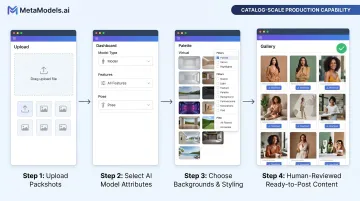
MetaModels.ai enables Chicago fashion brands to convert packshots into AI model content at catalog scale, with human-reviewed outputs and real-time fabric draping technology. The workflow replaces time-consuming scheduling, studio booking, and post-production delays:
- Upload product packshots (flat-lay or ghost mannequin images)
- Select from curated AI model libraries or create custom models matching brand identity
- Choose backgrounds, styling items, and model presentations
- Receive ready-to-post content up to 4K resolution with human review for garment accuracy
The platform's human-verified process addresses quality concerns that affected earlier AI fashion tools—ensuring color accuracy, shape preservation, and correct fabric drape before delivery. That makes outputs viable for professional e-commerce, lookbooks, and advertising campaigns.
Chicago brands managing large catalogs benefit from consistent model identity across hundreds of SKUs, A/B testing with different model presentations, and the ability to launch new products with complete on-model imagery in hours rather than weeks.
AI-Generated Backgrounds, Virtual Styling, and Motion Content Are Expanding Creative Possibilities
AI enables fashion brands to pair model imagery with dynamically generated backgrounds—from clean studio environments to outdoor lifestyle scenes—and produce short-form motion content from the same garment assets. That means fewer production days, lower costs, and faster turnaround without sacrificing visual quality.
Industry adoption examples:
Mango launched its first entirely AI-generated campaign in July 2024 for the limited-edition "Sunset Dream" collection of its Mango Teen youth line. Multiple internal teams collaborated, including teen design, art and styling, dataset and AI model training, and photography studio teams. The campaign demonstrated that cross-functional AI workflows can deliver polished editorial imagery at scale without traditional shoots.
H&M announced plans in March 2025 to create AI-generated "digital twins" of 30 models, developed with Swedish tech firm Uncut. Models retain ownership rights over their digital replicas and are compensated at agreed usage rates. Images featuring digital twins include watermarks to clearly signpost AI use.
Both cases show a broader shift: brands are moving background generation, video, and styling into the same AI-driven workflow as model imagery — treating packshots as the single source asset for entire campaigns.
Why this matters for Chicago brands competing with coastal fashion companies:
AI-generated backgrounds and motion content allow smaller brands to produce editorial-quality campaign imagery and social-ready video without budgets for location shoots or film crews. A Chicago DTC brand can generate:
- Multiple lifestyle backgrounds from a single packshot
- Social media video content showcasing garments in motion
- Seasonal campaign imagery with custom environments
- A/B testing variations across different visual contexts
For brands in Chicago without dedicated creative production teams, that flexibility translates directly into faster campaign cycles and lower cost-per-asset.
Human-Verified AI Imagery Is Emerging as the Quality and Trust Standard
As AI-generated fashion imagery becomes widespread, a key differentiator is emerging: human review to verify garment accuracy. This ensures cut, color, pattern, fabric drape, and logo representation in AI outputs match actual products before images go live.
Why Human Verification Matters
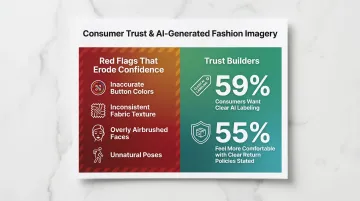
Early AI fashion tools frequently produced garment distortions, inaccurate color rendering, and fabric misrepresentation—issues that undermine consumer trust and increase returns. A Stylitics survey found that while 71% of shoppers couldn't distinguish between real and AI-generated images, confidence dropped sharply with poor technical execution.
Shoppers identified specific red flags that eroded confidence:
- Inaccurate button colors and inconsistent fabric texture
- Overly airbrushed model faces and unnatural poses
- 59% wanted clear labeling of AI imagery, treating disclosure as a trust signal
- 55% felt more comfortable buying from AI-generated images when return policies were clearly stated
When AI quality falls short, the cost shows up in returns and lost repeat customers. Human-verified workflows address this directly—combining AI production speed with editorial-level accuracy checks.
MetaModels.ai employs human fashion specialists to review every AI-generated image and video for garment accuracy before delivery. Reviewers check color accuracy, shape preservation, and proportional correctness—ensuring outputs meet professional standards for e-commerce, lookbooks, and advertising.
This review-first process closes the gap that purely automated tools leave open, giving fashion brands confidence that what shoppers see matches what they'll receive.
What's Driving These AI Model Photography Trends in Chicago
Several industry-specific forces are accelerating Chicago fashion brands' shift toward AI model photography:
Technology Advancement
Generative AI, real-time fabric draping simulation, and 4K output have matured fast — what was experimental in 2022 is now production-ready. One global e-commerce media producer now creates AI-generated and AI-assisted content for over 900 global brands, according to Business of Fashion's State of Fashion 2026 report.
Today's platforms deliver photorealistic outputs that pass consumer scrutiny — when properly executed.
Cost and Efficiency Pressure
Chicago-based DTC and e-commerce brands face rising production costs while managing tighter margins. A single traditional shoot draws from multiple budget lines:
- Studio rental: $175–$500/hour
- Model booking: $100–$2,000+/day
- Photographer fees: $500–$3,000/day
That adds up to $175+ per finished image. AI-generated alternatives run $0.50–$2.00 per image. For brands managing catalogs of hundreds or thousands of SKUs, that gap determines whether scaling content is feasible at all.
Market Demand and Competitive Dynamics
National and global e-commerce competition means Chicago brands need more content, faster, and across more channels than traditional shoots allow. The U.S. online fashion market reached $161.4 billion in revenue in 2024, creating pressure to maintain competitive content velocity.
Coastal brands' early AI adoption creates competitive pressure on Midwest fashion companies to follow suit or risk content production disadvantages in speed, volume, and cost efficiency.
Operational and Workforce Impact on Chicago Fashion Brands
AI model photography is changing workflows beyond just imagery production. Teams can shift from shoot scheduling and production management to creative direction and brand strategy, with AI handling volume production layers.
Workflow transformation:
Instead of coordinating model bookings, studio availability, photographer schedules, and post-production timelines, teams focus on:
- Selecting model attributes and styling that align with brand identity
- Curating backgrounds and creative direction
- Testing multiple visual approaches through A/B variations
- Optimizing imagery performance across channels
This operational shift moves creative teams upstream toward strategy and downstream toward performance optimization, with AI managing the production middle layer. That efficiency gain, however, comes at a direct cost to the people who previously filled that middle layer.
Workforce considerations:
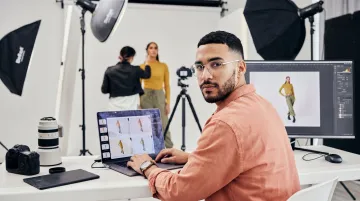
The technology raises real questions for Chicago-based photographers, models, and production crews. One study found that 30% of photographers had lost assignments to generative AI as of September 2024; by February 2025, that figure increased to 58%, according to the Association of Photographers (AOP). The average financial loss was calculated at approximately $18,000+ per photographer.
Emerging responses:
New roles are developing as the industry adapts:
- AI content directors who curate and guide AI-generated visual strategies
- Prompt-based creative leads skilled at optimizing outputs through precise input parameters
- AI retouchers who refine and verify generated imagery against brand standards
- Hybrid photographers who fold AI tools into traditional on-set workflows
The 2025 SAG-AFTRA Commercials Contract established detailed provisions for securing performer consent when using digital replicas. It requires reasonably specific descriptions of intended use and documented informed consent from performers — a formal acknowledgment that creative workers need defined protections as AI adoption accelerates.
For Chicago fashion brands, that distinction matters. Local creative ecosystems — photographers, stylists, production crews — are tightly networked. How brands manage this transition shapes both their reputation and their access to the city's creative talent pool going forward.
Future Signals to Watch
AI model photography is evolving quickly. Chicago fashion brands should monitor these near-term developments:
AI Video and Motion Content
Advances in AI video generation will soon let brands generate entire social campaigns from packshots alone. Short-form video for TikTok, Instagram Reels, and YouTube Shorts — currently expensive and time-consuming to produce — will become as straightforward to generate as static imagery.
Tightening Regulations
Regulations around AI-generated imagery are emerging rapidly:
- EU AI Act (Article 50) requires providers to ensure synthetic media is "clearly identifiable as artificial," with fines up to €15 million or 3% of global annual turnover
- New York State (S. 8420) requires "conspicuous disclosure" of synthetic performers in advertising, with fines from $1,000–$5,000 per violation
- FTC guidance considers undisclosed AI-generated "influencers" or testimonials that appear to be real humans as potentially deceptive under Section 5 of the FTC Act
Brands should build disclosure practices now rather than scrambling to comply when enforcement begins.
Platform Integration
AI model tools are moving deeper into e-commerce platforms (Shopify, BigCommerce, WooCommerce) and PLM systems. Within 1–3 years, on-demand image generation will be built directly into product publishing workflows — triggered when a SKU goes live, not managed as a separate creative project.
Conclusion
AI model photography has moved from experimental to operational for Chicago fashion brands. Platforms now deliver human-verified outputs that meet professional e-commerce standards, and adoption is accelerating fast.
Brands adopting AI model photography workflows early are securing real advantages in content volume, cost efficiency, and representation. A Chicago DTC brand can now launch a 100-SKU collection with complete on-model imagery across diverse demographics in days, not weeks, at a fraction of traditional costs.
Getting the tooling right now matters. Brands that establish AI model workflows before this becomes standard practice will carry lower content costs, faster launch cycles, and broader demographic coverage into a more competitive market.
Frequently Asked Questions
Which fashion brands use AI?
Levi Strauss & Co. piloted AI models via Lalaland.ai, though faced backlash over diversity framing. Mango produced AI-generated campaigns for its teen lines, and H&M announced plans to create digital twins of 30 models. Emerging DTC and e-commerce brands are rapidly adopting the technology for catalog imagery.
What is AI model photography and how does it work for fashion brands?
AI model photography uses generative AI to place garments from flat-lay or packshot images onto virtual models, producing on-model imagery without physical shoots. Brands upload product images, select model attributes and styling, and receive ready-to-use content at scale — typically up to 4K resolution, with human review for garment accuracy.
How much can Chicago fashion brands save by switching to AI model photography?
Traditional fashion photoshoots cost approximately $175–$500 per studio hour, with model bookings ranging from $100–$2,000+ per day. One D2C case study reported AI-generated imagery at $0.50–$2.00 per image versus $175 per image for traditional photography—representing potential savings of 80% or more for catalog-scale production.
Can AI models accurately represent different body types and skin tones?
Modern AI model platforms offer curated libraries spanning diverse ethnicities, body types, and demographics. Human-verified workflows help ensure garment fit and drape are rendered accurately across different model presentations. Evaluate platforms by the depth of their diverse model libraries and whether human review is built into their quality process.
Are AI-generated fashion images good enough for professional e-commerce and lookbook content?
Leading platforms produce imagery at up to 4K resolution suitable for product pages, lookbooks, social media, and ad campaigns. Output quality varies by platform — look for human review steps that verify color accuracy, shape preservation, and fabric drape before delivery.
What are the ethical considerations of using AI models in fashion?
The core concerns center on four areas:
- Disclosure: Be transparent with consumers about AI-generated imagery
- Representation: Avoid displacing human models of color, who face higher industry barriers
- Consent: Don't use models' likenesses to train AI without permission or compensation
- Authenticity: Pair AI model use with genuine DEI commitments — not as a substitute for real workforce inclusion