Introduction
AI model photography is no longer experimental. Fashion brands are actively adopting it, but outcomes vary widely based on when and how they make the shift. Adopt too early without quality controls in place, and you risk undermining brand trust and wasting resources. Wait too long, and competitors are already scaling content faster and cheaper while you're still coordinating traditional shoot schedules.
This guide maps out the exact scenarios and readiness signals that determine when adoption makes sense — covering the business triggers that justify the shift, the warning signs that suggest waiting, and a phased approach that minimises risk while building internal confidence.
Key Takeaways
- Time adoption to real business triggers—catalog volume, content velocity, or cost pressure—not industry trends
- E-commerce brands with high SKU counts, frequent drops, or multi-channel content needs see the clearest early gains
- Watch for content bottlenecks, rising per-image costs, and diversity gaps that traditional shoots can't fix efficiently
- Hold off if your brand relies on tactile storytelling, serves ultra-luxury segments, or lacks quality-review processes
- Start with secondary content like colorway variants before moving to hero imagery
Why Timing Matters When Adopting AI Model Photography
AI model photography adoption isn't a single on/off decision. Brands that adopt during the wrong growth phase or for the wrong content tier often get low-quality outputs that damage product perception and erode shopper trust. The consequences play out in measurable ways: higher return rates, abandoned carts, and negative brand sentiment.
When AI-generated garment imagery misrenders draping, shows wrong button colors, or creates unnatural fabric textures, shoppers notice—and return the product. Online apparel already sees return rates of 24.4% in the U.S., 7.9 percentage points higher than general online retail. Processing a single return costs retailers approximately 66% of the product's price, so inaccurate imagery has a direct dollar impact.
That cost compounds when imagery is the root cause: 43% of UK consumers returned a product specifically because pre-purchase product information was incorrect, including poor imagery and misleading descriptions.
The efficiency equation matters too. Brands that adopt AI model photography at the right moment — typically when per-shoot costs consistently exceed what AI tooling would cost at the same volume — unlock real savings over time. Those who adopt before reaching that threshold may see marginal gains that don't justify the operational change, workflow disruption, and team training required.
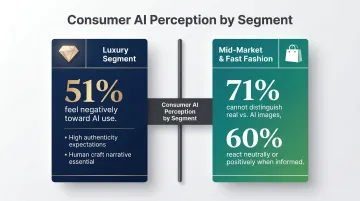
Consumer response to AI imagery also isn't uniform across segments. A Vogue Business survey found that 51% of respondents would feel more negatively toward brands using AI in luxury fashion products, reflecting heightened authenticity expectations in premium tiers. In mid-market and fast-fashion contexts, reception is far more forgiving. A study by Stylitics found that 71% of shoppers could not distinguish between real and AI-generated apparel images, and 60% reacted neutrally or positively when informed the images were AI-generated.
When AI Model Photography Makes the Most Sense
The "right time" is always contextual — driven by catalog scale, content velocity, budget reality, and brand positioning. Each of the three scenarios below signals a distinct tipping point.
Catalog Size and Content Volume
The strongest indicator for readiness is when your SKU count outpaces the speed of traditional shoots. Brands with seasonal collections of hundreds of SKUs, or those adding new colorways weekly, face the clearest efficiency case.
The volume leaders illustrate the pressure point clearly:
- Shein produces 300,000+ new items annually — 75x to 150x more SKUs than traditional retailers — in micro-batches of 100-200 units per SKU
- Zara releases over 10,000 distinct SKUs per year
- H&M drops approximately 500 new designs every week
At this scale, traditional shoots simply can't keep pace.
AI model photography can generate multi-model, multi-angle variants from a single packshot — something impossible at scale with traditional shoots. Brands converting flat lays or packshots to on-model imagery face the lowest adoption friction, particularly when using platforms with real-time fabric draping technology like MetaModels.ai.
Content Frequency and Channel Demands
Brands running frequent drops, flash sales, or multi-platform campaigns face a content multiplication problem. E-commerce PDPs, social ads, email, and lookbooks all have different format and styling needs.
The gap between what shoppers expect and what most brands deliver is significant:
- Optimal product pages require 8 image types per SKU — front on-model, back, 45-degree angle, detail close-up, ghost/flat lay, lifestyle, alternate colorway, and 360-degree spin
- 76% of shoppers say on-model photos are the most useful format for purchase decisions
- Yet only 40% of products on retailer sites have more than two images
AI tools allow the same garment to appear in multiple settings, on diverse model types, without reshooting. For brands with weekly drops or seasonal refreshes, this removes the scheduling constraint that slows publishing.
Budget and Shoot Economics
When traditional shoot costs outpace what AI production would deliver for the same output, the financial case becomes straightforward.
Traditional fashion photography costs:
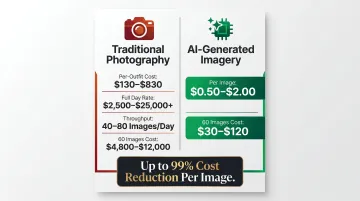
- Per-outfit cost (on-model e-commerce): $130-$830
- Full day rate: $2,500-$8,000 (e-commerce); $8,000-$25,000+ (campaign/editorial)
- Typical throughput: 40-80 on-model images per day (e-commerce pace)
AI-generated imagery costs:
- AI-generated on-model images: $0.50-$2.00 per image
- Example comparison: 60 AI images cost $30-$120 vs. traditional 60 images at $4,800-$12,000
For mid-market brands and startups that previously couldn't afford diverse, multi-model catalog imagery, AI removes the access barrier entirely. That makes it a growth-stage decision as much as a budget one — the economics shift before most brands expect them to.
Signs Your Brand Is Ready to Make the Switch
Not every brand that could adopt AI model photography is actually ready to do so. These four signals are reliable indicators that the timing is right:
Content production bottlenecks. If your creative team regularly misses launch deadlines because photography scheduling, editing, and approvals are the constraint—not design or inventory—that's a strong signal. AI model photography removes the scheduling, casting, and post-production lag that slows traditional pipelines. Brands coordinating multiple seasonal drops or managing weekly SKU releases benefit most.
Diversity and representation gaps. If your catalogue shows limited model diversity due to casting costs and logistics, AI model photography can close this gap directly. Platforms like MetaModels.ai offer curated libraries of AI models across ethnicities, body types, and demographics, plus custom model creation — so brands can build inclusivity into every SKU without additional per-shoot cost.
Research confirms shoppers notice and value representation. Nielsen Norman Group research found that shoppers feel "more confident in their purchasing decisions" when seeing products on people who look like them and are "more likely to purchase and later return to the site."
Existing packshot or flat lay inventory. Brands with a library of product-only images are in the strongest position to adopt. AI model photography workflows that convert packshots to on-model visuals require no reshooting — the transition is incremental, not a ground-up rebuild.
A quality review process. Readiness also means having — or being willing to build — a lightweight QA step to catch garment inaccuracies before outputs reach product pages. MetaModels.ai's human-reviewed AI images offer a built-in safeguard for brands that want to scale without sacrificing garment accuracy.
When You Should Hold Off on AI Model Photography
Brands whose core identity depends on artisanal, handcrafted, or luxury authenticity narratives face real brand risk if AI imagery is adopted prematurely. Shopper expectations in ultra-premium segments are calibrated around human craft, editorial photography, and tactile storytelling that AI currently struggles to replicate convincingly.
Academic research published in the Journal of Advertising Research found that disclosing AI use in luxury advertising leads to significantly lower brand favourability due to perceived loss of human effort and authenticity. When Valentino posted an AI-generated video in December 2025, the brand faced widespread consumer backlash, with hundreds of comments calling the imagery "cheap" and "lazy."
Reputational risk isn't the only concern — operational readiness matters just as much. If a brand lacks the internal process to review AI outputs for garment accuracy, publishing flawed images creates a different problem entirely. Product categories with complex textures, structured tailoring, or intricate details — hand embroidery, fine knitwear, sheer fabrics — may not yet meet the fidelity threshold that AI draping technology can reliably deliver. Inaccurate product imagery drives returns and erodes customer trust.
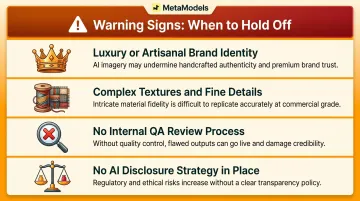
Disclosure requirements are also tightening — and brands without a labelling strategy in place before adopting AI imagery at scale face compliance exposure. Two significant regulations are coming into force:
- New York's Synthetic Performers in Advertising Disclosure Act (effective June 9, 2026) requires conspicuous disclosure when an advertisement features an AI-generated synthetic performer
- EU AI Act Article 50 (effective August 2, 2026) requires deployers to disclose artificially generated content to audiences
Getting the disclosure framework right before you scale is far easier than retrofitting it after the fact.
Best Practices for Timing Your Adoption
Phase the rollout by content tier. Start AI model photography on secondary content—colourway variants, supplemental PDP images, category page thumbnails—before deploying it on hero campaign imagery or homepage visuals. This reduces risk, builds internal confidence, and allows quality benchmarking against existing traditional photography.
Set clear quality benchmarks before scaling. Define what "acceptable" looks like for AI outputs in your specific product category:
- Drape accuracy and fabric realism
- Colour fidelity against packshots
- Model proportionality and fit representation
- Detail preservation (buttons, seams, embellishments)
Build a human review checkpoint into your process before scaling. Brands that scale AI imagery without QA checkpoints are most likely to publish inaccurate product representations. MetaModels.ai addresses this directly — fashion specialists review every image for colour, shape, and proportions before delivery, so the safeguard is built into the workflow rather than bolted on after the fact.
Align adoption timing with a product launch or catalogue refresh cycle. The natural pause point between seasons is the lowest-friction moment to restructure your photography workflow. Use this window to:
- Pilot AI model photography on a defined SKU set
- Measure output quality and operational impact
- Build a repeatable process before applying it to the full catalogue
- Train your team on the review and approval workflow
Frequently Asked Questions
Frequently Asked Questions
Will AI replace fashion photography?
AI model photography is replacing specific, high-volume use cases like e-commerce PDP imagery and catalogue variants. However, editorial, campaign, and luxury fashion photography—where human craft and emotional storytelling are central—remains largely the domain of traditional photography. A hybrid model—AI for volume, humans for craft—is the most likely long-term outcome.
Is AI replacing fashion models?
AI is displacing human models in e-commerce and catalogue contexts, particularly for repetitive, high-volume imagery. Human models remain essential for brand campaigns, editorial, runway, and any content where authentic human presence drives engagement. Disclosure requirements, model compensation, and ethical use are active industry concerns brands should factor into any adoption decision.
Can I use AI models for my clothing brand?
Yes, AI model photography is accessible to brands of all sizes, from startups to major retailers. Platforms convert existing packshots or flat lays into on-model imagery without requiring new photoshoots, making it practical even for lean teams.
What is the best way to start using AI model photography for my brand?
Begin with a small, defined SKU set—ideally products with existing packshot imagery. Run a pilot to assess quality and operational fit, then use the results to build a phased rollout plan before applying AI model photography across the full catalogue.
Should luxury fashion brands use AI model photography?
Luxury brands face a higher bar for adoption because their audience equates premium pricing with authentic, human-crafted imagery. While AI can support secondary content like size-variant imagery or lookbook fills, luxury brands should approach primary campaign visuals with caution until AI quality reliably meets their editorial standard.
Do I need to disclose AI-generated model images to my customers?
Requirements vary by region and are evolving fast—New York's disclosure law takes effect June 2026, the EU's in August 2026. Beyond legal compliance, 59% of shoppers want clear labelling on AI-generated content, and labels like "Virtual Model" consistently build rather than erode trust.