Farfetch, the technology-first fashion marketplace connecting consumers with over 1,400 boutiques and brands worldwide, consistently pushes the boundaries of AI adoption. Most recently, the platform transformed how product photography is created and deployed in advertising—turning standard white-background catalog images into immersive, lifestyle-inspired visual content at scale.
This article covers Farfetch's AI visual content strategy, its breakthrough partnership with Smartly's AI Studio, the step-by-step process behind AI-generated fashion visuals, measurable results, and what it signals for the broader fashion industry.
Key Takeaways
- Farfetch converts white-background product images into lifestyle-inspired ad creatives using AI-powered scene generation
- Its partnership with Smartly's AI Studio achieved +64% ROAS, +65% GTV, and +70% orders from AI-generated creative templates
- Farfetch built a multi-layered AI ecosystem spanning visual search, personalization, and creative production long before this campaign
- The approach signals a broader industry shift: AI-generated imagery is replacing traditional photoshoots across fashion at every scale
- MetaModels.ai brings the same capability to smaller brands — no enterprise budget or photoshoot required
Farfetch's AI Journey: From Visual Search to Smart Photography
Farfetch's AI strategy didn't begin with generative creative production—it started years earlier with foundational investments in search and personalization.
Three milestones mark that early progression:
- August 2017 — Farfetch partnered with Certona to deploy AI-driven personalization on its Black & White white-label platform, achieving a verified 10% rise in click-through rates in personalized email marketing. Clients included Manolo Blahnik, Christopher Kane, and Thom Browne.
- December 2018 — Farfetch launched "See It, Snap It, Shop It," a visual search feature powered by Syte's deep-learning AI, integrated into the iOS app. Shoppers could upload any fashion image and find matching luxury products instantly.
- Mid-2018 — Farfetch employed 631 engineers and data scientists (roughly 35% of total headcount) and was processing approximately $1B in GMV across 900+ boutiques and 3,200+ brands.

These early AI investments laid the groundwork for something bigger: using AI to reimagine the creative production pipeline itself.
That progression — from recommendation engines to visual search to generative creative — reflects a deliberate pattern: prove AI value in low-risk functions first, then extend it into content production.
The Smartly AI Studio Partnership: Farfetch's AI Photography Breakthrough
Farfetch identified a core problem in its Dynamic Product Ads (DPAs): product images on white backgrounds lacked the visual variety and emotional pull needed to drive strong ad performance on social media. Consumers scroll past sterile product shots—they engage with lifestyle imagery that tells a story.
To solve this, Farfetch partnered with Smartly and integrated Smartly's AI Studio into its creative workflow. The goal: produce editorial-quality visuals without booking a single photoshoot.
Three Core Capabilities Smartly's AI Studio Provided
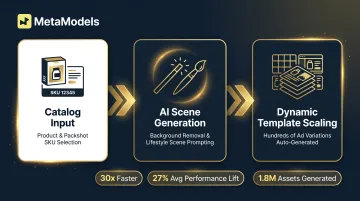
- Removes backgrounds from catalog images automatically
- Generates lifestyle backgrounds using natural-language prompts and style-matching
- Transforms static product shots into contextual, story-driven scenes
Farfetch tested the approach with a vacation-themed product campaign—curating a seasonal assortment of swimwear, sandals, and resortwear, then applying AI-generated scenes to create cohesive, aspirational ad creatives.
That campaign test validated a broader template overhaul. Dynamic image templates were rebuilt: instead of a single white-background layout, each was enriched with AI-generated backgrounds and style variations matching Farfetch's brand aesthetic. The team could now produce hundreds of ad variations from a single catalog feed with no manual design work.
Results That Proved the Model
According to the official Smartly case study published in February 2026, Farfetch achieved:
- +64% ROAS (Return on Ad Spend)
- +65% GTV (Gross Transaction Value)
- +70% increase in total orders
None of this required additional design headcount or larger production budgets. AI-generated creative templates, deployed at scale, drove all three gains.
Inside the Process: How Farfetch Creates AI-Generated Fashion Visuals
Selecting the Right Product Catalog Inputs
The process begins with selecting product catalog assets—typically existing packshots or white-background product images—and identifying which categories or seasonal themes are best suited for lifestyle AI treatment.
Not every product is equally suited for AI scene generation. Best practices include:
- Choosing seasonal collections (swimwear for summer, outerwear for fall) that naturally fit lifestyle contexts
- Selecting hero SKUs with strong visual appeal
- Ensuring thematic coherence across the product set for brand consistency
Generating Backgrounds and Scenes with AI
Natural-language prompts are used in tools like Smartly's AI Studio to generate contextually relevant backgrounds. For example, prompting a sun-drenched beach setting for a swimwear campaign or urban street scenes for streetwear.
Background generation works best when prompts match the brand's existing aesthetic — so the final output feels like editorial content, not a stock image. Adobe Firefly recommends structuring prompts around:
- Positional descriptions — "on top of," "overhead view"
- Material/texture cues — "marble," "knotty pine"
- Synonym testing when initial prompts miss the mark
To extend consistency across a full product line, platforms offer Image Style Transfer — applying the look and feel of one approved image to all new generations automatically.
Scaling Through Dynamic Templates
The edited product images (with AI-generated backgrounds) are loaded into dynamic templates that automatically apply style variations across hundreds of product SKUs, enabling mass production without a design team bottleneck.
The output is ready-to-run in advertising platforms, serving as a direct replacement for the traditional creative production pipeline—eliminating the need for physical models, studio booking, and post-production editing for ad-specific assets.
Smartly's platform reports a 30x faster creative process, a 27% average performance lift, and 1.8 million assets generated to date — figures that reflect what this pipeline looks like at enterprise scale.
The Business Case: Results Farfetch Achieved with AI Photography
Farfetch's verified results speak to the business impact of AI-generated creative templates:
| Metric | Uplift |
|---|---|
| Return on Ad Spend (ROAS) | +64% |
| Gross Transaction Value (GTV) | +65% |
| Total Orders | +70% |
Why These Results Happened
More creative variety = better algorithm performance. Ad-serving algorithms test multiple creative variations to match shopper intent. AI-generated scenes provide the volume and diversity needed for optimization.
Lifestyle imagery outperforms white-background imagery. Consumers respond to emotional context—seeing a product in a sun-drenched vacation setting creates desire and purchase motivation, not just passive awareness.
Cost efficiency at scale. Farfetch achieved these results without increasing design headcount or ad production budgets. According to McKinsey's June 2023 report, generative AI could increase marketing function productivity by 5% to 15% of total marketing spending.
For fashion brands weighing the investment, these numbers make the case: better imagery, produced faster and cheaper, directly moves revenue metrics.
What Farfetch's AI Photography Model Means for Fashion Brands
Farfetch's approach signals a fundamental shift in fashion content production: the move from expensive, time-consuming physical photoshoots to AI-powered visual ecosystems that can generate thousands of brand-consistent images on demand.
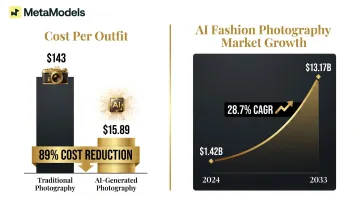
Traditional fashion photography costs $143 per outfit (stills + video) versus $15.89 for generative AI, according to Orbitvu's independent testing—approximately 89% cost reduction per outfit.
The AI-generated fashion photography market reached an estimated $1.42B in 2024 and is projected to grow at 28.7% CAGR to $13.17B by 2033. This is a structural shift, not a trend.
Accessibility for Smaller Brands
That market growth is being driven by brands at every scale, not just enterprise players like Farfetch. MetaModels.ai lets fashion brands convert packshots into AI model content—diverse, human-reviewed visuals with real-time fabric draping and no model booking costs.
MetaModels offers:
- Create custom AI models matched to your brand identity
- Choose from a curated library spanning diverse ethnicities, demographics, and body types
- Get human-reviewed output that verifies garment color, shape, and proportions
- Export ready-to-publish content at up to 4K resolution
- Start with affordable per-image pricing and flexible subscription plans
Brands that hold off on AI-generated visuals are already seeing the gap widen in ad performance and content output. The cost and speed advantages compound quickly — and competitors are moving.
Frequently Asked Questions
Does Farfetch use AI?
Yes, Farfetch uses AI extensively across its platform—including for personalized product recommendations, visual search (via Syte), and AI-generated creative content for its Dynamic Product Ads (via Smartly AI Studio).
What AI technology does Farfetch use for product photography?
Farfetch partnered with Smartly's AI Studio to use AI-powered background removal and scene generation, turning standard product catalog images into lifestyle-inspired visuals for advertising campaigns without physical photoshoots.
How does AI model photography reduce costs for fashion brands?
AI model photography eliminates physical studio rentals, model booking fees, and lengthy post-production cycles by generating brand-consistent visuals directly from existing product images. Costs drop by approximately 89% per outfit compared to traditional photography.
Can smaller fashion brands use AI model photography like Farfetch?
Yes, platforms like MetaModels.ai make the same concept accessible to brands of any size by offering a curated library of diverse AI models, custom model creation, and packshot-to-lifestyle conversion without enterprise-level budgets.
What is the difference between AI background generation and AI model photography?
AI background generation places existing product images into new scene settings, while AI model photography uses AI-generated human figures to show how garments look when worn. MetaModels.ai focuses on the latter, with human reviewers checking every image for garment accuracy.
How does Farfetch's AI photography strategy improve ad performance?
Farfetch generates visual variety by producing lifestyle scenes instead of plain product shots. This gives ad-serving algorithms more creative options to match shopper intent, driving higher click-through rates and improving ROAS and conversion rates.