](https://file-host.link/website/metamodels-jdwky2/assets/blog-images/6e280ea4-80bd-415d-9e4a-a3e68c6e9f48/1777633565358113_8f6bf1ad41564069b5ecb14f4f0e0f97/360.webp)
Introduction
AI is replacing studio shoots faster than most brands anticipated. Fashion teams are now generating on-model imagery at scale—faster, cheaper, and with more creative control than traditional photoshoots allow. According to the Association of Photographers, 30% of photographers lost assignments to generative AI by September 2024, surging to 58% by February 2025, signaling rapid substitution of traditional shoots in commercial contexts.
Looklet is an established enterprise virtual styling platform that converts existing product photography into on-model imagery. For many brands, though, it creates as many constraints as it solves:
- Garments must be photographed in a Looklet studio first or supplied as ghost mannequin images
- The system is built for large retail merchandising teams, not agile DTC operators
- Its enterprise-only pricing and steep learning curve exclude growth-stage brands
This article explores the best Looklet alternatives for AI fashion catalog photography—tools that offer more creative flexibility, simpler onboarding, and scalable on-model image generation from packshots.
Key Takeaways
- Looklet depends on studio-captured or ghost mannequin inputs, making it a poor fit for brands needing flexible, AI-native catalog photography
- The strongest alternatives generate on-model catalog images directly from packshots — no physical models or studios required
- Evaluate tools on garment fidelity, model diversity, ease of use, scalability, and commercial rights
- Top alternatives: MetaModels.ai, Rawshot AI, BetterStudio, Lalaland.ai, and Botika
- MetaModels.ai leads on garment fidelity, model diversity, and human-verified output
What Is Looklet and Why Brands Are Looking for Alternatives
Looklet is a digital fashion content platform that converts existing product photography or studio-captured garments into on-model imagery using a mix of digitized real models and AI-generated models. It is primarily designed for high-volume enterprise retail merchandising workflows, where brands need to produce consistent catalog imagery across thousands of SKUs.
Several limitations push brands toward alternatives:
- Looklet's Enterprise tier requires garments photographed in a Looklet studio or partner facility, with annual throughput guidance of 15,000–25,000 items per studio. Even the Virtual Studio tier requires ghost mannequin inputs with strict formatting guidelines.
- Pricing is contact-driven with no public list rates beyond a 10-image free allocation for the Virtual Studio product.
- The platform is optimized for catalog efficiency, not campaign or editorial content — bespoke creative direction is limited.
- Complex workflows and planning requirements make it inaccessible for lean teams.
The alternatives below are AI-native platforms that generate catalog-ready on-model imagery directly from flat-lay or packshot inputs — no prior studio step required — at price points and complexity levels that work for brands of any size.
Best Looklet Alternatives for AI Fashion Catalog Photography
These tools were selected based on their ability to generate high-quality, catalog-ready on-model imagery from product photos without the studio-dependent workflow that limits Looklet's flexibility.
MetaModels.ai
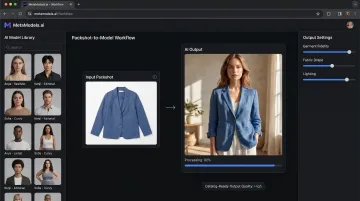
MetaModels.ai is an AI-powered fashion imagery platform that converts packshots directly into on-model catalog content—no physical models, no photoshoots, and no royalties—while delivering human-verified images for garment accuracy at up to 4K resolution.
What sets it apart:
- Real-time fabric draping renders garments realistically, preserving color, shape, texture, print, and proportions
- Curated AI model library spans diverse ethnicities, demographics, and body types
- Custom model creation lets brands build models that match their visual identity
- Every image is human-reviewed by fashion specialists before delivery, ensuring garment accuracy at scale
| Feature | Details |
|---|---|
| Key Features | Real-time fabric draping, human-reviewed AI images, diverse AI model library, custom brand model creation, packshot-to-model conversion, ready-to-post content up to 4K resolution |
| Best For | Fashion brands, e-commerce companies, and marketing teams wanting scalable, brand-consistent catalog imagery without physical photoshoots or model booking costs |
| Pricing | Starter: 20 credits; Growth: 100 credits; Pro: 300 credits; Pay-per-image option also available; Enterprise: Custom pricing |
Rawshot AI
Rawshot AI is an EU-built AI fashion photography platform that replaces text prompting with a click-driven graphical interface—giving fashion teams direct control over camera, pose, lighting, background, and composition to generate original on-model imagery and short video.
Highlights:
- No-prompt interface makes it accessible for non-technical teams
- Preserves garment attributes including cut, color, pattern, logo, fabric, and drape
- Supports consistent synthetic models across catalogs of 1,000+ SKUs
- Every output includes C2PA-signed provenance metadata and full commercial rights, making it strong for compliance-sensitive workflows
| Feature | Details |
|---|---|
| Key Features | Click-driven interface (no prompting), garment fidelity controls, 150+ visual style presets, video generation, C2PA compliance metadata, REST API for catalog automation |
| Best For | DTC operators, enterprise retailers, and creative teams needing original AI fashion photography with full directorial control and audit-ready compliance outputs |
| Pricing | Starter: $9/month (80 tokens, 16 images); Growth: $39/month (400 tokens, 80 images); Pro: $89/month (960 tokens, 192 images); Business: $179/month (2,000 tokens, 400 images); 7-day free trial with 30 tokens |
BetterStudio
BetterStudio is a modern AI fashion imagery platform that turns simple product shots into photorealistic on-model images using digital twins of real models created with explicit real-world consent, with EU AI Act compliance built in.
Highlights:
- Bulk upload and product feed integration accelerate high-volume catalog workflows
- Creative control over poses, styles, and backgrounds
- Cross-market ready with authentic global imagery — one of the more ethically transparent platforms in this category
- Enterprise tier includes compliance exports and full audit trail for regulatory readiness
| Feature | Details |
|---|---|
| Key Features | Consent-based digital model twins, bulk upload, product feed integration, pose and background customization, EU AI Act compliance |
| Best For | Brands prioritizing ethical AI image production, global market content, and transparent compliance documentation alongside catalog-scale output |
| Pricing | Boutique: €135/month annual (2,000 credits, ~133 images); Retail: €425/month annual (7,000 credits, ~467 images); Maison: €850/month annual (16,000 credits, ~1,067 images); Enterprise: Custom; Pay-as-you-go: €150/1,000 credits |
Lalaland.ai
Lalaland.ai is an AI fashion model platform focused on inclusive, diverse visual representation—offering a broad library of AI-generated models across body types, skin tones, and sizes to help brands create representative catalog imagery at scale. The technology is now part of Browzwear's digital product creation (DPC) suite.
Highlights:
- Purpose-built for diversity and inclusivity in fashion visuals
- Parametric model customization across body size, skin tone, dynamic poses, and styling
- Integrates with Browzwear's 3D design tools, enabling visualization before samples exist
Used by brands wanting to reflect broader customer demographics, though pricing sits on the higher end and the workflow now centers on 3D-integrated digital pipelines rather than packshot-to-model conversion.
| Feature | Details |
|---|---|
| Key Features | Diverse AI model library (body types, skin tones, sizes), parametric model customization, integration with Browzwear 3D DPC tools, dynamic poses and styling |
| Best For | Fashion brands prioritizing inclusive representation across their catalog imagery and those using 3D design workflows, particularly those selling to diverse global audiences |
| Pricing | Contact for custom quote (now part of Browzwear enterprise solutions) |
Botika
Botika is an AI photography automation platform that converts flat-lay or plain product photos into studio-grade on-model imagery, supporting both photo and short video output with a flexible credit-based model suited to DTC and mid-size brands.
Highlights:
- Covers both photo and video content generation in one platform
- Wide AI model selection with background customization and touch-up tools
- Free trial available with no upfront commitment
Output quality can be inconsistent, and delivery times vary by tier (for example, a 3-day turnaround for photo fixes on the Pro plan) — better suited to teams with moderate quality tolerances than high-end fashion houses.
| Feature | Details |
|---|---|
| Key Features | Photo and video output, AI model variety, background customization, credit-based flexible pricing, free trial available |
| Best For | Small to mid-size fashion e-commerce teams and DTC brands looking for a cost-efficient, multi-format alternative to traditional photoshoots |
| Pricing | Lite: $33/month (annual); Pro: $35/month (annual, 2K, video/editorials, 2 retouch requests); Advanced: $40/month (annual, 4K, 3 retouch requests, faster delivery); Enterprise: Custom; Free trial available |
How We Chose These Looklet Alternatives
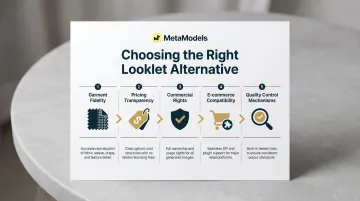
We assessed each tool on its ability to generate catalog-ready on-model imagery from product inputs without studio dependency. Evaluation criteria included output realism, garment fidelity, model diversity, ease of use for non-technical teams, and scalability across SKU volumes.
Beyond image quality, we weighted business outcome factors that affect real production decisions:
- Pricing transparency — accessibility for brands at different budget levels
- Commercial rights clarity — licensing terms and compliance assurances
- E-commerce compatibility — how well each tool connects to your existing stack
- Quality control mechanisms — human review, AI labeling, and error-checking that protect brand safety
A common mistake brands make when evaluating these tools: choosing based on image samples alone rather than testing workflow fit. A tool that produces stunning demos but requires complex setup, studio input, or manual intervention for every image will underperform at catalog scale. Test with your actual packshots, evaluate turnaround times, and verify integration capabilities before committing.
Conclusion
Looklet's studio-dependent workflow and enterprise-only orientation make it a poor fit for brands needing flexible, AI-native catalog photography. The alternatives in this list demonstrate that high-quality on-model imagery is now accessible without a dedicated virtual studio setup.
When evaluating alternatives, match the tool to your actual operating context. Key factors to weigh:
- Catalog scale: a 50-SKU DTC brand has different throughput needs than a 5,000-SKU retailer
- Team size: some platforms assume in-house creative teams; others handle production end-to-end
- Compliance needs: model consent, likeness rights, and regional regulations vary by platform
- Creative control: degree of customization over model, styling, and background
If your goal is to convert packshots into brand-consistent, human-verified catalog imagery at scale — with no model bookings, no royalties, and real-time fabric draping — MetaModels.ai is built precisely for that workflow and serves as a direct Looklet alternative.
Frequently Asked Questions
What is Looklet used for in fashion catalog photography?
Looklet is an enterprise virtual styling platform that generates on-model apparel images from existing product photos or garments captured in a Looklet studio. It is used mainly by large retail merchandising teams for high-volume catalog production and model variation workflows.
Why do fashion brands look for alternatives to Looklet?
Looklet is built for enterprise-scale operations, which means it requires studio-captured garment inputs or strict ghost mannequin formatting and carries a steep learning curve. Smaller and mid-size brands often find AI-native platforms more flexible, more accessible to price, and faster to adopt.
Can AI fashion catalog tools replace traditional photoshoots entirely?
AI tools can replace a significant portion of catalog photography, especially for on-model e-commerce imagery. Traditional shoots still hold value for hero campaign content, initial garment reference captures, and high-end editorial work where bespoke creative direction is required.
What features should I prioritize when choosing a Looklet alternative?
Focus on these criteria when evaluating options:
- Garment fidelity and fabric rendering accuracy
- Model diversity (ethnicity, body type, demographics)
- Ease of use for non-technical teams
- Scalability for large SKU catalogs
- Output resolution and commercial rights clarity
- Whether the tool works from packshots or requires prior studio photography
Are AI-generated fashion catalog images safe to use commercially?
Most AI fashion photography platforms grant commercial usage rights, but always verify this in the tool's terms of service. For regulatory compliance, look for platforms that support C2PA provenance metadata or AI content labeling, as required under EU AI Act Article 50.
How much do Looklet alternatives typically cost compared to traditional photoshoots?
AI catalog tools cost significantly less than traditional photoshoots. Entry-level plans typically start at $9–$33 per month, with per-image costs often under $0.50. By comparison, professional fashion photoshoots run $900–$2,500+ per day before factoring in models, stylists, and post-production.