Getting ownership wrong carries real consequences: brands lose the ability to protect visuals from competitors, or worse, face legal exposure for using content they don't actually have rights to. The problem intensifies for fashion imagery, where right-of-publicity laws, advertising standards, and ethical representation concerns layer additional risk beyond copyright.
This guide covers copyright law basics, who can realistically claim ownership, what platform terms actually say, and what makes AI-generated fashion model imagery a distinct legal category requiring specialized consideration.
TLDR: Key Takeaways
- Purely AI-generated images default to public domain in the US — competitors can use them freely
- Human creative input strengthens copyright claims — document your prompts, edits, and creative decisions
- Platform terms of service determine your commercial rights, not copyright law alone
- Using AI-generated model imagery triggers right-of-publicity concerns beyond standard copyright
- Platforms with explicit commercial licenses and human-reviewed outputs carry the lowest legal risk
The Legal Baseline: What Copyright Law Says About AI Images
US Copyright Office Position: Human Authorship Required
The US Copyright Office's March 16, 2023 guidance established the core rule: copyright protection requires human authorship. Works produced entirely by AI — with minimal human creative input — are considered public domain. The guidance sets out three requirements:
- Human authorship as a prerequisite for registration
- Mandatory disclosure of AI-generated content
- Exclusion of AI-generated portions from copyright claims, with brief explanation of human contribution
The Office launched a broader AI Initiative in 2023, receiving over 10,000 public comments. It has since issued a multi-part report: Part 1 on digital replicas (July 31, 2024), Part 2 on copyrightability of AI outputs (January 29, 2025), and Part 3 on generative AI training (May 9, 2025).
The "Sufficient Human Creativity" Threshold
The Copyright Office evaluates cases individually, weighing whether the human shaped the creative outcome or merely issued instructions the AI carried out autonomously. This line is still being drawn.
Zarya of the Dawn case (February 21, 2023): The Office registered copyright in the human-authored text and selection/arrangement of images in Kristina Kashtanova's graphic novel but denied protection for individual AI-generated images created using Midjourney. Because users cannot predict or control the specific visual expression Midjourney generates, those images lacked sufficient human authorship.
The Office applied a "distance test" — examining the gap between user prompt and AI output. The greater the distance, the weaker the copyright claim.
Thaler v. Perlmutter: AI-Only Authorship Definitively Rejected
Dr. Stephen Thaler sought to register an artwork crediting his AI system as sole author. The case moved through multiple courts:
| Date | Court | Outcome |
|---|---|---|
| 2022 | US Copyright Office | Denied registration; only human-authored works eligible |
| August 18, 2023 | US District Court, D.C. | Affirmed; human authorship is a "bedrock requirement" |
| March 18, 2025 | D.C. Circuit Court of Appeals | Affirmed; Copyright Act requires works authored by "a human being" |
| March 2, 2026 | US Supreme Court | Denied certiorari; declined to hear case |
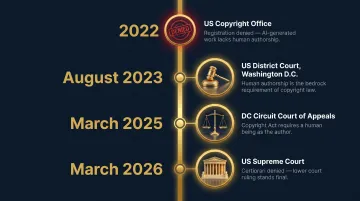
The Supreme Court's refusal to hear the case leaves the D.C. Circuit's ruling as controlling precedent: works generated autonomously by AI cannot receive US copyright protection.
UK Framework: "Arrangements Necessary" Standard
The UK takes a materially different approach. Section 9(3) of the Copyright, Designs and Patents Act 1988 assigns authorship of "computer-generated" works to the person who made the arrangements necessary for creation, granting 50 years of protection.
Key differences from US law:
- Protection lasts 50 years from creation (not life plus 70 years)
- No moral rights attach
- Focus is on who made the "arrangements," not who performed creative expression
- Courts have not yet tested this provision against generative AI cases
EU Position: No Specific Rules Yet
The EU currently lacks specific rules on copyrightability of AI-generated works. A European Parliament Research Service briefing (December 19, 2025) confirms that while CJEU case law demonstrates a "strong need for human creativity," no EU-wide framework exists. The Parliament supports a human-centric approach but has not yet proposed legislation.
The EU AI Act (Regulation 2024/1689) entered force August 1, 2024, but addresses transparency and labeling — not copyright ownership.
Who Could Own an AI-Generated Image?
The User/Prompter Claim
Many assume the person writing the prompt owns the output. Platform terms of service often reinforce this belief. However, legally, if the AI made most creative decisions, the user's copyright claim may not hold up.
Critical distinction: Owning the right to use an image (via license) is not the same as owning the copyright to it.
The AI Platform/Developer Claim
Platforms can and do retain rights over outputs through their terms. They may:
- Claim broad licenses to reproduce or use content
- Grant users only limited licenses rather than full ownership
- Reserve rights to train on outputs or use them for marketing
Miss this distinction and you could be building a campaign on content you don't actually own — with no legal recourse if the platform revokes access or repurposes your visuals.
The Training Data Complication
Images AI models generate are shaped by copyrighted works in training data. Three active lawsuits show how rights holders are pushing back — with mixed results:
| Case | Court / Date | Outcome |
|---|---|---|
| Getty Images v. Stability AI | UK High Court, Nov 4, 2025 | Secondary copyright claim rejected — model weights ruled not "infringing copies" |
| NYT v. OpenAI | US District Court, Apr 4, 2025 | Infringement claims allowed to proceed; OpenAI ordered to hand over 20M chat logs |
| Andersen v. Stability AI | US District Court, trial Sep 8, 2026 | Motion to dismiss denied — court found it plausible AI output "embodies the transformations" of plaintiffs' works |
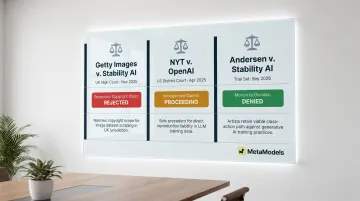
These cases add a layer of legal uncertainty to the provenance of any AI output.
The Public Domain Default
If no human authorship is found and the platform doesn't assert rights, the image belongs to no one — it enters the public domain. For businesses, this means competitors can freely use the same or similar AI-generated visuals, offering zero exclusivity protection.
The Ownership Spectrum
Ownership of an AI image exists on a sliding scale determined by:
- How much human creativity is involved
- What the platform's terms say
- What jurisdiction applies
For fashion brands and e-commerce teams using AI imagery commercially, that uncertainty isn't abstract — it directly affects whether your visual assets can be protected, licensed, or enforced against copying.
Platform Terms of Service: The Fine Print
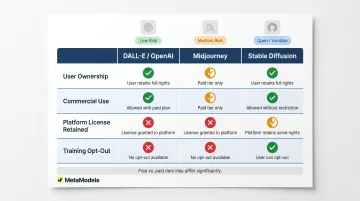
Different platforms have distinct stances. Here's how major tools compare:
| Feature | OpenAI / DALL-E | Midjourney | Stable Diffusion |
|---|---|---|---|
| User owns output? | Yes. "You own the Output." | Paid tiers: Yes. Free tier: CC-BY-NC 4.0 only. | "Claims no rights in the Output." |
| Commercial use permitted? | Yes, subject to compliance | Paid tiers: Yes. Companies with >$1M revenue must buy Pro/Mega. Free tier: Non-commercial only. | Yes, no explicit prohibition |
| Platform retains rights? | License to "use Content to provide, maintain, develop, and improve our Services" | "Perpetual, worldwide, non-exclusive, sublicensable, no-charge, royalty-free, irrevocable copyright license" to reproduce, display, distribute | Use-based restrictions (no false info to harm others, no PII to harm individuals) |
| Training opt-out available? | Yes | Not explicitly stated | N/A (open-source) |
OpenAI provides the clearest ownership assignment with training opt-out. Midjourney's perpetual license is the broadest retention clause — every image you generate is subject to that irrevocable license. Stable Diffusion offers the most permissive framework but provides no legal warranty or indemnity.
Licensing vs. Ownership in Practical Terms
A platform saying "you own your images" and a platform granting "a perpetual, royalty-free license to use your images" are not the same thing legally. The fine print may allow the platform to reproduce, share, or train on your outputs regardless. That distinction directly affects which platform you should choose for commercial work.
Practical Advice for Platform Selection
Always review terms of service before using AI images for commercial campaigns, product listings, or advertising. Look specifically for:
- Confirm commercial use rights are explicitly granted, not just implied
- Check sublicensing permissions before sharing outputs with clients or agencies
- Verify whether the platform retains rights to distribute your outputs
- Compare free-tier and paid-tier licensing — they often differ significantly
AI-Generated Fashion Model Imagery: A Specific Legal Category
Why Fashion Model Imagery Is Distinct
Beyond standard copyright concerns, generating images of human figures introduces questions about personality rights and right-of-publicity laws — these are separate from copyright and concern a person's control over commercial use of their likeness.
The AI Lookalike Risk
If an AI-generated model bears a close resemblance to a real person — whether a public figure, celebrity, or professional model — the brand publishing that image may face right-of-publicity claims even if the image is technically in the public domain.
US State Laws Addressing AI-Generated Likenesses:
| Law | Jurisdiction | Effective Date | Key Provisions | Applies to Fictional AI Figures? |
|---|---|---|---|---|
| ELVIS Act | Tennessee | July 1, 2024 | Prohibits unauthorized voice replicas; creates liability for technology providers | No — requires figure "readily identifiable and attributable to a particular individual" |
| AB 2602 | California | January 1, 2025 | Requires contracts authorizing digital replicas to include "reasonably specific description" of use | No — protects living individuals' likeness |
| AB 1836 | California | 2024 | Prohibits unauthorized posthumous digital replicas; 70-year post-mortem protection; $10,000 statutory minimum damages | No — requires likeness "readily identifiable" as specific deceased person |
| NO FAKES Act | Federal (proposed) | Introduced April 9, 2025; pending | Would prohibit nonconsensual digital replicas; $5,000 statutory damages per violation | No — defines "digital replica" as "nearly indistinguishable from actual voice or visual likeness" |
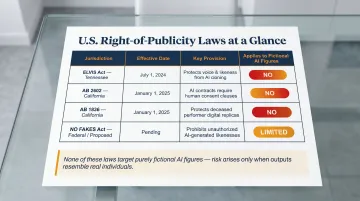
Critical finding: None of these laws apply to purely fictional AI-generated fashion models not based on any specific real person. However, risk arises when an AI tool generates a figure that unintentionally resembles a real person — particularly celebrities or models whose likenesses may be present in training data.
EU AI Act Article 50: Transparency and Labeling Obligations
Article 50 of the EU AI Act imposes two tiers of obligation for AI-generated fashion imagery:
Provider obligations (effective August 2, 2025): Providers of AI systems generating synthetic images must ensure outputs are "marked in a machine-readable format and detectable as artificially generated or manipulated."
Deployer obligations: Deployers using AI to generate content must "disclose that the content has been artificially generated" in "an appropriate, timely and clear manner." An exception exists for "evidently artistic, creative, satirical, fictional or analogous work," where disclosure is limited to acknowledging the existence of generated content without hampering display or enjoyment.
Brands selling into EU markets must implement content labeling infrastructure.
Ethical Representation and Legal Risk
How brands portray AI-generated models — including diversity, body types, and demographics depicted — is increasingly subject to ethical scrutiny and advertising standards. Brands relying on a narrow or unrealistic AI model library may face reputational and regulatory challenges.
Human Oversight Mitigates Both Legal and Ethical Risk
Platforms that involve human review of AI-generated model images create a verifiable layer of human creative contribution, which strengthens copyright claims and reduces the chance of harmful outputs reaching publication.
MetaModels.ai builds this oversight into its core workflow: every AI image and video passes through human fashion specialists who verify color accuracy, shape, and proportions before delivery.
The platform's model library covers varied ethnicities, body types, and demographics — a practical response to both advertising standards pressure and the reputational risks of narrow representation. For fashion brands generating content at scale, that combination of human review and inclusive defaults reduces exposure on both fronts.
Practical Steps for Fashion Brands and E-Commerce Businesses
Document Human Creative Contributions
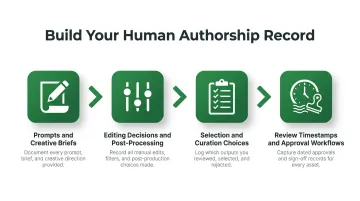
Maintain records of:
- Prompts and creative briefs
- Editing decisions and post-processing work
- Selection and curation choices
- Review timestamps and approval workflows
This documentation builds the case for human authorship and supports stronger IP claims if ownership is challenged.
Once your documentation practices are in place, the next step is ensuring the platforms you use actually back you up commercially.
Choose Platforms with Explicit Commercial Licensing
Look beyond vague "you own it" language. Seek platforms that clearly state images can be used in:
- Advertising campaigns
- Product listings
- Paid media
Favor platforms that specify what rights are transferred and what (if anything) the platform retains. Verify that your use case — including sublicensing to agencies or retailers — is permitted.
Platform terms are only part of the equation. The legal rules governing AI-generated content are still being written, so staying informed is as important as your contracts.
Monitor the Legal Landscape Continuously
Follow:
- US Copyright Office updates and reports
- EU AI Act developments
- Key court decisions (particularly Andersen v. Stability AI trial in September 2026)
Periodically re-check the terms of service of any AI tools you use — platform terms can change without notice, with significant implications for commercial content already published.
Frequently Asked Questions
Who legally owns AI-generated fashion model images?
Under current US law, purely AI-generated images are not protected by copyright and default to the public domain. Practical usage rights are governed by the platform's terms of service. Human creative input — prompts, editing, curation — can strengthen ownership claims, so document your creative process.
Can I use AI-generated images for commercial purposes like ads or product listings?
Commercial use depends entirely on the platform's terms of service. Many platforms allow commercial use on paid tiers but restrict it on free plans. Verify rights explicitly before using AI images in any paid context, such as ads or product listings.
Do AI platforms retain rights over the images I generate?
Most platforms grant a usage license rather than full copyright ownership, and may retain rights to reproduce outputs for their own purposes — such as model training or marketing. Read the terms carefully before assuming you hold exclusive rights.
Can I copyright an image I created using an AI image generator?
The US Copyright Office may grant partial copyright for AI-assisted works where significant human creativity is documented, but will not register predominantly AI-generated works. Human editing, creative direction, and post-processing all strengthen your claim.
What happens if an AI-generated model image resembles a real person?
Even if the image is not copyrighted, a close likeness to a real person can trigger right-of-publicity or personality rights claims — these are separate from copyright and vary significantly by jurisdiction. Use platforms with human review processes and reverse-image comparison checks to reduce this risk.
Is it ethical for fashion brands to use AI-generated models?
Ethical use depends on how AI models are deployed. Diversity, representation, and transparency with consumers are key considerations. Brands that use platforms with human-reviewed, inclusive model libraries reduce reputational risk and stay aligned with advertising standards in both US and EU markets.