Introduction
When fashion brands discuss sustainability, the conversation typically centers on organic cotton, recycled polyester, and factory audits. Yet one of the industry's most carbon-intensive activities rarely makes headlines: the photoshoot. Every campaign image you scroll past required flights, physical samples, energy-hungry studios, and logistics chains that together emit carbon at a scale most consumers never see.
Research from the Carbon Trust and Ordre.com shows that travel alone for fashion weeks generates approximately 241,000 tonnes of CO₂ annually. That figure covers only wholesale buying trips — not the hundreds of individual campaigns brands shoot each season.
Traditional fashion photoshoots involve international crew travel, manufacturing samples solely for content creation, running studio lighting rigs for days, and generating material waste from props and sets. Most brand sustainability reports don't account for any of it.
This article examines the specific emissions drivers in traditional fashion photography, how AI-powered imagery eliminates them through cloud-based workflows, what peer-reviewed research says about the environmental difference, and practical steps brands can take to reduce content production emissions today.
Key Takeaways
- Traditional shoots emit carbon through crew travel, sample manufacturing, multi-day studio energy use, and physical waste
- AI photography replaces the entire production chain with cloud rendering — no flights, samples, or studios required
- Peer-reviewed research confirms AI image generation uses a fraction of the energy of traditional production
- Case studies document emissions reductions approaching 98% compared to physical campaign equivalents
- Brands can pilot AI imagery for a single product category to build an internal sustainability and cost case
The Hidden Carbon Cost of Traditional Fashion Photoshoots
Travel Dominates the Emissions Ledger
International flights are the single largest carbon driver in fashion content production. Models, photographers, stylists, creative directors, and production crews routinely fly across continents for campaigns and seasonal shoots. The Carbon Trust's analysis of fashion week travel quantified the scale: 241,000 tonnes of CO₂ annually from wholesale buying trips alone, with retailers contributing 135,000 tonnes and designers 106,000 tonnes. This figure covers air travel, accommodation, intercity transfers, and collection shipping for the major fashion weeks over a 12-month cycle.
For individual campaigns, the numbers compound quickly. A single international shoot requiring long-haul flights for a crew of 8–12 people, plus accommodation and local logistics, can generate between 5 and 15 tonnes of CO₂ — the equivalent of multiple households' annual emissions for one campaign.
Physical Samples: Manufactured to Be Discarded
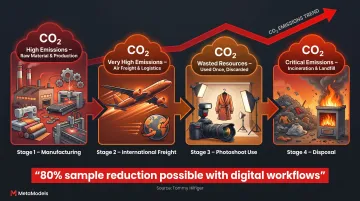
Brands manufacture garment samples specifically for photoshoots — pieces that are rarely sold and often destroyed after the shoot wraps. Industry case studies reveal the scale of the problem: Tommy Hilfiger reported reducing physical samples by up to 80% through 3D design workflows, while Adidas documented saving over one million material samples by shifting to digital prototyping.
These samples drive emissions twice: once through manufacturing (fabric sourcing, cutting, sewing, finishing) and again through international freight to shoot locations. The samples themselves often end up landfilled or incinerated, creating both material waste and wasted embedded carbon.
Studio Energy Consumption
Professional photo studios run lighting rigs, climate control systems, and production equipment continuously for multi-day shoots. The Sustainable Production Alliance's study of film and TV production found that utilities contributed 22% of emissions for tentpole films and were the largest source — 49% — for half-hour multi-camera TV shows due to stage-based production.
Fashion shoots run shorter than film productions, but the energy demands are still substantial:
- High-intensity lighting arrays drawing continuous power for 8–12 hour shooting days
- HVAC systems maintaining climate-controlled environments for garment and model comfort
- Diesel generators where grid connections are impractical, adding to the total emissions per shoot
Material Waste on Set
Energy use is just one layer. Beyond samples, every shoot generates prop waste, set construction materials, single-use backdrops, packaging, and styling consumables. Industry estimates place per-campaign material waste in the hundreds of kilograms, though no independently audited figures for fashion shoots exist in public literature. The waste extends beyond visible props — it includes packaging for shipped garments, expendable styling materials, and construction debris from temporary sets.
The Cumulative Impact
Add crew flights, sample production, freight logistics, studio energy, and on-set waste, and a single international campaign can rival the annual carbon output of several households. This is a structural emissions source — one built into how fashion content is made. It compounds with every new collection, every seasonal refresh, and every product launch.
How AI Photography Eliminates Photoshoot Emissions
AI photography doesn't optimize the traditional workflow — it replaces it entirely with a virtual, cloud-based process. There is no shoot location, no traveling crew, and no physical infrastructure.
Zero Sample Production
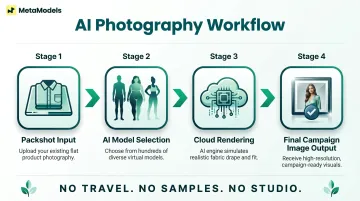
Rather than manufacturing garments solely for photography, AI platforms take existing product images — packshots or flat-lay shots — and render them onto photorealistic AI models using real-time fabric draping technology. The garment's color, texture, print, and proportions are preserved digitally, eliminating the need to produce, ship, and later discard shoot-specific samples.
MetaModels.ai converts packshots directly into on-model catalog and campaign imagery — no garment shipping required. Brands select from a diverse library of AI models customizable by ethnicity, body type, age, and styling, or request custom models aligned with their brand identity.
Every image is reviewed by human fashion specialists for garment accuracy before delivery. Final content is ready to publish in up to 4K resolution, formatted for e-commerce product pages, social media, advertising, and lookbooks.
Cloud Rendering Replaces Studio Energy
Traditional studios consume electricity for high-powered lighting arrays, climate control, and on-site production equipment running for extended periods. Cloud-based AI rendering operates on distributed processing infrastructure, which, while not emission-free, functions at significantly higher energy efficiency than dedicated studio setups. Modern cloud providers are also shifting to renewable energy sources — Google has matched 100% of its annual electricity consumption with renewable energy since 2017 and targets 24/7 carbon-free energy by 2030, while AWS matched 100% of data center electricity with renewables in 2024.
The shift from physical studios to cloud infrastructure removes the need for:
- Diesel generators and high-intensity lighting rigs
- Climate control systems running throughout shoot days
- On-location power infrastructure and ancillary equipment
Digital Assets Are Infinitely Reusable
Once a garment is digitized, it can be re-rendered in new backgrounds, on different models, or across seasonal campaigns without any incremental carbon cost. Content volume scales independently of physical production. A brand can generate hundreds of campaign variations for A/B testing or regional customization without producing additional samples or scheduling additional shoots.
This reusability also accelerates time-to-market. Earlier access to campaign imagery helps brands make better pre-season inventory decisions, reducing overproduction — a sustainability gain that compounds well beyond the shoot itself.
Quantifying AI's Environmental Impact
Peer-Reviewed Evidence
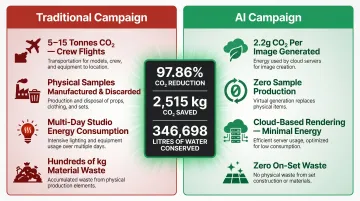
A 2024 study published in Nature Scientific Reports compared the carbon emissions of AI-generated imagery to human-produced content. Researchers found that AI illustration systems like DALL-E 2 and Midjourney emitted approximately 2.2 g and 1.9 g of CO₂ per image, respectively — between 310 and 2,900 times less than human illustrators, depending on geography and hardware.
The study focuses on general illustration rather than fashion-specific content and has faced methodological critiques from the International Society for Industrial Ecology regarding scope boundaries. Even so, the directional finding holds: AI generation consumes dramatically less energy per image than traditional production methods.
Additional research quantifies AI's energy footprint in practical terms. A 2023 study by Luccioni, Jernite, and Strubell found that generating a single image on a powerful model uses roughly the energy of one full smartphone charge, and producing 1,000 images on Stable Diffusion XL yields emissions comparable to driving approximately 4.1 miles in a gasoline car. These figures vary with data center efficiency and grid carbon intensity, but they establish a baseline: AI image generation is energy-efficient relative to the alternative.
Campaign-Level Reductions
Vendor case studies report even more dramatic shifts. DRESSX documented a campaign that replaced physical production with digital outputs entirely. The results, while from a single non-peer-reviewed case, show what's possible when travel, sample manufacturing, and studio energy are eliminated at once:
- 97.86% reduction in CO₂ — 2,515 kg saved across the campaign
- 346,698 litres of water conserved — equivalent to roughly 1,400 bathtubs
DRESSX also projects that replacing just 1% of physical clothing with digital alternatives could save 5 trillion litres of water and 35 million tonnes of CO₂ annually. These are projections, not verified outcomes, but the scale points to a meaningful lever for brands managing emissions targets and water-use commitments.
Per-Image Metrics in Context
For a brand producing 500 catalog images per season, the shift from traditional shoots to AI generation could represent the difference between multi-tonne CO₂ campaigns (driven by flights and studios) and gram-scale digital rendering. The exact savings depend on shoot location, crew size, and cloud infrastructure, but the structural difference between flying a crew to a location shoot and rendering images on a data center is measurable — and it shows up directly in a brand's annual emissions report.
Beyond Carbon: How AI Imagery Helps Tackle Fashion's Waste Problem
Decoupling Content from Overproduction
Physical samples created for shoots are rarely resold. Many are destroyed or landfilled after the campaign wraps, contributing to the 92 million tonnes of textile waste generated globally each year. AI imagery decouples content production from sample manufacturing, eliminating an entire category of production waste at the source.
Earlier Imagery, Better Inventory Decisions
Digital content production is faster than physical shoots. Earlier availability of campaign visuals allows brands to test creative concepts, gather market feedback, and adjust pre-season stocking decisions before committing to large production runs. This reduces the overproduction that drives both waste and end-of-season markdowns.
Reducing Returns Through Accurate Representation
High-quality, accurate product imagery reduces uncertainty in online purchases. MIT Sloan research found that incorporating product images into predictive models improved return-rate prediction by more than 13%. Lower return rates mean fewer reverse logistics shipments — adding another layer of emissions savings on top of eliminating the shoot itself.
E-commerce returns generate an estimated 24 million metric tonnes of CO₂ annually, and apparel return rates often exceed 30%. Better imagery directly reduces that burden.
Is AI Photography Truly Green? Addressing the Counterargument
AI Isn't Zero-Emission
AI systems require energy for computation, training, and cloud rendering. Ignoring this would miss the full picture. The real question isn't whether AI uses energy — it does — but whether its net environmental impact is lower than the alternative.
The Net Benefit Equation
Even accounting for computational energy use, AI consumes dramatically less electricity than traditional studio setups — and it eliminates transportation fuel, sample manufacturing, and material waste entirely. One study found that generating 1,000 AI images uses energy equivalent to driving roughly 4 miles in a car. That's a fraction of the emissions from a single long-haul flight for one crew member, let alone an entire production team.
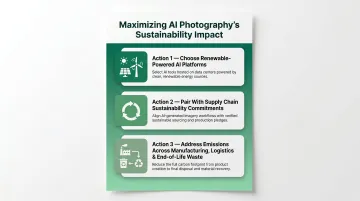
The sustainability profile of AI photography will only improve as cloud providers shift further toward renewable energy. Brands can amplify that impact by:
- Choosing AI platforms hosted on renewable-powered infrastructure
- Pairing AI photography with supply chain sustainability commitments
- Addressing emissions across manufacturing, logistics, and end-of-life waste — not just content production
Transparency Matters
The environmental case for AI photography is strongest when claims are specific and verifiable. Brands should ask vendors direct questions before accepting any sustainability claim:
- Where are your data centers located, and what energy sources power them?
- How is renewable energy procurement documented or certified?
- What scope boundaries define your sustainability metrics?
Generic claims should be treated skeptically. Concrete figures backed by third-party audits or peer-reviewed research are what matter.
How Fashion Brands Can Start Reducing Their Carbon Footprint Today
Step One: Audit Your Baseline
Before you can measure improvement, establish a benchmark. Document the emissions from a recent campaign:
- Crew travel (use flight calculators to estimate CO₂ per route and passenger)
- Sample production volumes and freight (request data from suppliers)
- Studio usage (lighting, HVAC, equipment runtime)
- Post-production energy and logistics
This baseline provides a concrete reference point for comparing traditional versus AI workflows and gives you the numbers to justify switching internally.
Step Two: Run a Pilot
Choose a single product category — basics, accessories, or a specific seasonal line — and produce the content using AI photography. Compare both environmental metrics and production costs against the traditional equivalent. Track:
- Total CO₂ emissions (or energy consumption if direct emissions data is unavailable)
- Production time from briefing to delivery
- Cost per final image
- Quality and conversion performance
A small, controlled pilot generates the data you need to make the business and sustainability case internally without disrupting your entire content pipeline.
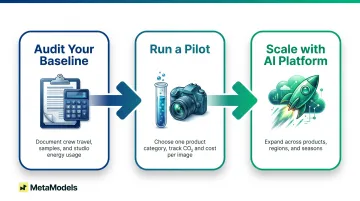
Step Three: Scale with a Platform Built for Production
Once the pilot validates the approach, scale across your content workflow using a platform designed for volume and consistency. MetaModels.ai converts existing packshot images into full on-model catalog content, managing every production stage — from briefing to final delivery — to ensure consistent quality as you expand across products, regions, and seasons.
With affordable per-image pricing and subscription plans starting at 20 credits, brands can phase the transition incrementally without large upfront commitments.
Enterprise customers gain API access, dedicated account management, and advanced analytics. These connect directly with existing e-commerce platforms, DAM systems, and marketing tools — making it straightforward to fold AI-generated content into your current workflow.
Frequently Asked Questions
Frequently Asked Questions
How to reduce carbon footprint in fashion?
Sustainable materials and ethical manufacturing get the most attention, but content production offers faster, more measurable impact. Replacing physical photoshoots with AI-generated imagery eliminates crew travel, sample manufacturing, and studio energy — making it one of the most actionable emissions reductions available to fashion brands right now.
How much CO₂ does a traditional fashion photoshoot produce?
Estimates for international campaigns range from 5 to 15 tonnes of CO₂ per shoot, depending on crew size, travel distance, shoot duration, and sample production volume. A single long-haul flight for a creative team can generate multiple tonnes alone, and studio energy, logistics, and sample freight compound the total.
Is AI-generated imagery truly sustainable?
AI systems do use energy, but research consistently shows net emissions per image are dramatically lower than traditional production — especially when eliminating travel, sample manufacturing, and studio infrastructure. The sustainability profile improves further as cloud providers transition to renewable energy grids.
Can AI photography replace physical samples entirely?
For content production, yes. Platforms with real-time fabric draping and packshot-to-model rendering produce accurate on-model imagery without shoot-specific samples. Physical samples may still be needed for wholesale presentations or fit reviews, depending on your workflow.
What are the biggest sources of carbon emissions in fashion marketing?
The primary drivers are crew and model flights, physical sample production and shipping, and studio energy consumption. AI photography eliminates or dramatically reduces each of these by replacing physical production with cloud-based rendering.
How does AI fashion photography help reduce sample waste?
AI platforms render garments digitally from packshot images, removing the need to manufacture and ship duplicate samples for content shoots. This cuts physical waste and logistics emissions from sample overproduction — while letting brands create diverse campaign variations without additional material cost.
AI photography offers a proven way to eliminate one of fashion's most carbon-intensive activities without sacrificing visual quality, brand consistency, or creative control. The technology works, the evidence is building, and the business case holds up. What's left is deciding whether to use it.