Introduction
Fashion brands produce approximately 30% more clothing than they can sell, contributing to the roughly 92 million tonnes of textile waste generated globally each year. Traditional fashion photography doesn't just document this overproduction crisis — it actively drives it.
Every photoshoot demands physical samples that frequently get discarded, locks brands into large inventory orders before imagery is complete, and forces merchandising teams into speculative buying decisions months before consumer demand materializes.
AI fashion photography breaks this cycle at the content production stage. Platforms like MetaModels.ai convert packshots into photorealistic on-model imagery using real-time fabric draping technology, enabling brands to validate demand digitally before manufacturing begins. The result: reduced carbon emissions, eliminated sample waste, and production volumes aligned to actual consumer demand.
Key Takeaways
- Fashion generates 92 million tonnes of textile waste annually—traditional photography drives this by requiring physical samples for every SKU
- AI fashion photography eliminates sample production waste and dramatically cuts photoshoot carbon footprints
- Brands can validate demand before committing to manufacturing runs, cutting the gap between production volumes and actual sales
- Human-verified AI imagery delivers e-commerce-ready content at scale—no studio bookings, no model fees, no physical resources
- Start with a single product category and see sustainability and profitability gains fast
Fashion's Overproduction Crisis: A Problem Built Into the System
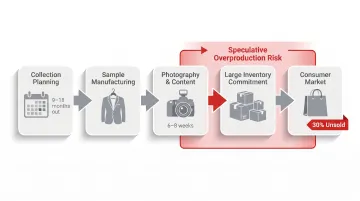
Fashion production operates on a fundamental mismatch: brands plan collections 9-18 months in advance based on trend forecasts, while consumer preferences shift within weeks. This disconnect generates enormous waste. The Ellen MacArthur Foundation estimates over $500 billion in value is lost annually due to clothing underutilisation and lack of recycling, with 73% of textiles ending up landfilled or incinerated rather than recycled.
The root cause is structural, not a forecasting failure. Every pre-retail step — sampling, photography, catalogue creation, inventory planning — builds momentum toward overproduction before a single item reaches consumers.
That momentum has real consequences downstream. McKinsey research shows demand signals often fail to reach tier-two and tier-three suppliers for months, resulting in factory utilisation dropping from 100% in 2021 to 60–70% in 2023 as brands couldn't cancel orders fast enough when demand shifted.
Photography sits at the centre of this pipeline problem. When content production requires 6–8 weeks from planning to final deliverables, brands must commit to large manufacturing orders before imagery can validate market interest. That speculative timing directly contributes to the 30% unsold rate plaguing the industry.
The Hidden Environmental Cost of Traditional Fashion Photography
Traditional photoshoots carry a substantial but rarely measured environmental burden. While no canonical industry figure exists for carbon per shoot day—most brands don't track it—the directional data is stark. A single transatlantic flight for one crew member produces 1-2 tonnes of CO2e; international campaigns involving multiple crew flights can reach multi-tonne ranges. Air freight for samples is 50-100 times more carbon-intensive per tonne-kilometre than sea freight.
For every SKU photographed, brands manufacture one or more physical samples—often in multiple colourways and sizes. Mid-size retailers can ship hundreds of garment samples between continents for a seasonal shoot. These samples are rarely sold once photography wraps. Many are destroyed, representing waste generated solely to produce marketing imagery.
Additional environmental costs include:
- Studio energy consumption for lighting and climate control
- Single-use props and set materials discarded after shoots
- Water usage for garment steaming and preparation
- Printed lookbooks and physical catalogues
- Sample packaging and shipping materials
These physical costs connect directly to a deeper problem: inventory lock-in. The cost and lead time of traditional shoots compel brands to commit to large production orders before imagery is complete and demand is tested. Content production, in other words, actively drives the manufacture of clothing that may never sell.
Fashion Industry Charter data confirms that Scope 3 emissions—which include content production travel and freight—represent 96-99% of a fashion brand's total emissions footprint.
How AI Fashion Photography Cuts Waste Before It Starts
AI fashion photography eliminates sample waste through a fundamental shift: generating high-quality garment imagery from packshots or digital files without manufacturing physical samples. Platforms use real-time fabric rendering to drape digital garment textures onto AI-generated models, preserving colour, shape, texture, print, and proportions while producing photorealistic on-model content.
Pre-production demand validation is now practical. Brands can create and publish product visuals before committing to manufacturing runs, then collect pre-orders or measure engagement before deciding what—and how much—to produce. That alignment closes the gap between what brands make and what customers actually buy, targeting the production-demand mismatch at its source.
That shift is already happening in practice. MetaModels.ai converts packshots into on-model imagery using fabric draping technology and a curated library of diverse AI models. Brands generate e-commerce, social media, and lookbook content at scale without physical shoots, model bookings, or the sample waste those shoots require. Key capabilities include:
- Fabric draping technology that preserves colour fidelity, texture, and proportions
- Diverse AI model library covering varied ethnicity, demographics, and body types
- Human review by fashion specialists before every image is delivered
- Ready-to-post output up to 4K resolution for e-commerce and marketing channels
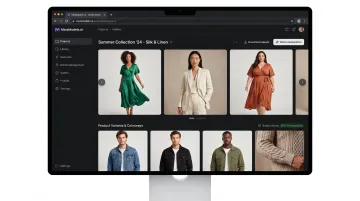
Scalability changes the overproduction calculus directly. Because AI imagery carries near-zero marginal cost per additional variant, brands can photograph every colourway, size representation, and market-specific version digitally. Brands no longer need to consolidate into fewer, larger runs to justify shoot costs—which is typically where oversupply originates.
The cost difference is substantial:
| Traditional Shoot | AI Platform | |
|---|---|---|
| Daily image output | 50–100 images | Hundreds of variants |
| Cost per final image | £150–£500 | Single-digit pounds |
| Campaign timeline | 6–8 weeks | 3–4 days |
Zalando's implementation illustrates the scale impact: 70% of their editorial images are now AI-generated, with production timelines reduced from 6-8 weeks to 3-4 days and campaign costs dropping 90%.
The Sustainability and Business Case: Why This Makes Financial Sense
The Sustainability and Business Case
Switching to AI-generated fashion imagery delivers quantifiable environmental and financial benefits. While formal life cycle assessments comparing AI workflows to traditional photoshoots remain limited, available research shows generating 1,000 AI images (using Stable Diffusion XL) emits approximately 1.6kg of CO2e—roughly 1.6 grams per image. Traditional photography produces kilograms of CO2e per SKU when travel and freight are amortised, putting AI-generated content roughly 1,000x lower in emissions per image.
The financial benefits are just as compelling:
- Traditional full-day shoots cost £15,000-25,000 for 50-100 images with crews of 10-15 people — AI-generated content requires 2-3 specialists and costs single-digit pounds per image
- Zalando cut production timelines from 6-8 weeks to 3-4 days, enabling campaign launches in under 24 hours
- Earlier imagery availability lets merchandising teams order closer to actual demand, reducing speculative overstock
- Multiple variations — different models, styling, backgrounds — can be generated to validate creative before committing budget
Consumer expectations support sustainability investments: McKinsey research found 25% of UK fashion consumers are "sustainability seekers" willing to pay 15% more for sustainable options. Separately, Bain & Company data shows 15% of global consumers are "sustainability champions" who consistently factor environmental impact into purchasing decisions.
That consumer demand makes the commercial case clear. Fashion content aligned with current social trends—made possible by AI's production speed—converts 3.2 times better than generic photography. Sustainability and commercial performance aren't in tension here; they reinforce each other.
Getting Started: How Brands Can Shift to AI Fashion Imagery
Start with a phased approach: test AI-generated imagery on a single product category or secondary channel before scaling. Social media content, regional market adaptations, or seasonal collections provide lower-risk testing grounds where you can compare AI output against traditional photoshoot results on quality, engagement, and environmental metrics.
Key evaluation criteria for platform selection:
- Fabric rendering accuracy: Real-time draping that preserves garment colour, texture, and proportions
- Model diversity: Library covering varied ethnicities, body types, ages, and demographics
- Human review processes: Fashion specialists verifying garment accuracy before delivery
- Output specifications: Resolution suitable for e-commerce and print (up to 4K)
- Brand customisation: Ability to create custom AI models matching your brand identity
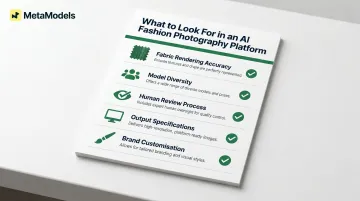
MetaModels.ai meets all five criteria — garment specialists review every image for accuracy, and the platform's custom model creation lets brands build AI models that reflect their specific identity rather than defaulting to generic library options.
Regulatory pressure adds urgency to this shift. The EU Corporate Sustainability Reporting Directive (CSRD) requires Scope 3 emissions reporting for companies over 1,000 employees and €450M turnover. The EU ban on destroying unsold textiles takes effect July 2026 for large enterprises.
Switching to AI-generated imagery provides measurable, reportable reductions in both Scope 3 emissions and material waste — the kind of documented impact that belongs in sustainability disclosures.
Those disclosures have a specific home under the GHG Protocol: photoshoot-related emissions fall under Scope 3 Category 1 (purchased goods and services, covering sample production) and Category 6 (business travel for crew and models). Eliminating physical samples and studio shoots reduces both categories with quantifiable, auditable impact.
Frequently Asked Questions
How does AI fashion photography help reduce overproduction?
AI imagery eliminates physical sample production required for traditional shoots, allowing brands to publish visuals and gauge demand before manufacturing commits. This removes the inventory lock-in that traditional photoshoot timelines create, helping brands produce closer to actual demand rather than forecasted estimates.
What is the environmental impact of a traditional fashion photoshoot?
Traditional shoots generate kilograms of CO2e per SKU through crew travel, studio energy, water use, and physical waste from props and discarded samples. Mid-size seasonal shoots often ship hundreds of samples internationally — air freight alone produces 50–100 times more emissions than sea transport.
Can AI-generated model images replace traditional photoshoots for e-commerce?
Yes. AI platforms produce high-resolution, photorealistic on-model content suitable for e-commerce product pages, social media, and lookbooks. Human review processes verify garment accuracy—checking colour, fit, drape, and detail precision—ensuring digital outputs serve as reliable production-ready assets.
Do brands need to produce physical samples to use AI fashion photography?
No. Many AI fashion photography platforms generate on-model imagery directly from packshots or digital files, completely eliminating the need to manufacture physical samples for photography purposes. This represents the core waste reduction mechanism of the technology.
How much can brands save by switching to AI fashion photography?
Zalando reported a 90% campaign production cost reduction — traditional shoots run £15,000–25,000 per day, while AI-generated images cost single-digit pounds each. Savings come from eliminating travel, studio fees, and model bookings, with further gains from reduced overstock through better demand visibility.
What role does digital sampling play in reducing fashion waste?
Digital samples serve as production proxies, allowing design review and stakeholder approval before manufacturing begins. This reduces defective batch waste and helps brands avoid over-ordering on styles that haven't been validated, cutting waste at the earliest stage of the production cycle.