The Photography Problem That's Unique to Upcycled Brands
Upcycled clothing brands are built on sustainability and creativity — yet traditional model photography works against both. Studio shoots burn through budgets that could fund garment sourcing. They generate measurable carbon emissions. And they assume an inventory model that upcycled brands simply don't have.
The math simply doesn't work. Traditional fashion photography assumes brands produce dozens or hundreds of units per style, allowing shoot costs to spread across large inventory runs. Professional photoshoots cost $5,000 to $25,000 per day, with per-image costs ranging from $80 to $200. But upcycled brands typically work with quantities of one to five units per garment—making this cost structure completely unviable.
The Cost Breakdown That Doesn't Scale
Traditional photoshoot expenses stack quickly:
- Photographer day rates: $1,000–$3,500
- Studio rental: $300–$1,500
- Model booking fees: $200–$4,000
- Hair and makeup: $400–$1,200
- Wardrobe styling: $400–$1,000
- Post-production retouching: $15–$75 per image
When you're photographing a jacket that exists in a single unit, spending $5,000 on a shoot day is economically absurd. That garment might sell for $200. The photography alone costs 25x the retail price.
Listing Delays Cost Real Revenue
Traditional production timelines run 10 to 21 days from concept to published images—potentially extending to four to eight weeks for complex productions. Upcycled items must go live immediately. Delay means the piece sells before it's even photographed, or worse, sits unphotographed while customer interest fades.
The Consistency Problem
Brands that manage to photograph items often rely on ad-hoc solutions: different models, inconsistent lighting, varying styling approaches. This creates catalog inconsistency that hurts brand credibility and conversion rates. 77% of shoppers say high-quality images directly influence purchase decisions, yet maintaining that standard across hundreds of unique pieces is logistically impossible.
The Sustainability Contradiction
Flying models and crew generates 1 to 2 tonnes of CO2e per round-trip transatlantic flight. Air freight for garment samples is 50 to 100 times more carbon-intensive than sea freight. Studio HVAC, lighting, and post-production energy use add further environmental costs—all contradicting the core messaging of a brand built on reduced waste and conscious production.
How AI Model Photography Works for Upcycled Garments
AI model photography allows brands to upload a flat-lay, ghost mannequin, or packshot image and receive professional on-model imagery—without booking a single model or studio. The platform places garments onto lifelike AI-generated models in various poses, lighting conditions, and settings.
Real-Time Fabric Draping vs. Generic Overlays
Upcycled garments feature unusual textures, irregular silhouettes, and unique construction from reclaimed materials. Advanced platforms don't simply apply texture overlays. Instead, they simulate how fabric actually behaves on a body.
MetaModels.ai's real-time fabric draping technology renders how materials drape, fold, and shift under real-body tension. Every generated image undergoes human review by fashion specialists who verify color accuracy, shape, proportions, and garment details before delivery. This quality control is essential for one-of-a-kind pieces where inaccurate rendering could misrepresent the product entirely.
Model Diversity That Matches Your Values
AI model libraries span diverse options across ethnicity, body type, age, and size. This matters particularly for upcycled brands whose audiences skew toward values-driven consumers who notice and care about representation.
MetaModels.ai addresses this with:
- Customizable ethnicity, body type, and age range
- Custom model creation matching specific brand identity
- Consistent look across hundreds of different pieces
- No model booking limitations or availability constraints
61% of Americans find diversity in advertising important, with 38% more likely to trust brands showing diverse representation.
Professional-Grade Outputs Ready for Every Channel
Platforms deliver outputs in up to 4K resolution, ready for immediate use across e-commerce product pages, social media, paid ads, and lookbooks. No additional editing required. Images already meet marketplace-specific requirements for platforms like Amazon, Myntra, and Shopify, with appropriate aspect ratios and background standards already applied.
Scaling Content Without Scaling Costs
Traditional photography costs scale linearly—or worse—as catalog size grows. Photographing 50 unique items costs roughly the same per-item as photographing 500. AI model photography breaks this model entirely.
The Cost Comparison
| Metric | Traditional Photography | AI Model Photography |
|---|---|---|
| Cost per image | $80–$200 | $0.10–$5 |
| 100 SKUs (3 images each) | $24,000–$45,000 | $300–$1,500 |
| Turnaround time | 10–21 days | Same day (under 1 hour) |
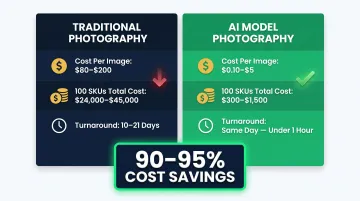
MetaModels.ai sits at the lower end of that AI range — starting at approximately $0.24 per image, with the Pro Plan bringing that down to around $0.22 per image across 300 monthly credits. Volume subscription pricing makes the per-image cost even more predictable.
Eliminated Recurring Costs
AI model photography removes entire budget line items:
- No model booking fees or talent agency commissions
- No studio rental or location fees
- No stylist, makeup artist, or hair professional costs
- No retouching outsourcing or post-production labor
- No model royalties or usage licensing fees
MetaModels.ai operates on a no-models, no-royalties model with unlimited commercial usage rights. Brands own output images outright with zero ongoing licensing obligations.
Catalog Depth Drives Conversion
With per-image costs reduced by 90-95%, brands can photograph every piece rather than choosing only "hero" items. This drives measurable results:
- On-model photos convert 20-30% higher than flat-lay images
- Listings with on-model photos see 40-60% increased time on page
- 76% of shoppers say on-model photos are most useful for buying decisions
For upcycled brands with 200+ one-of-a-kind pieces, that conversion advantage applies to every listing — not just the handful of items that made it onto a traditional shoot schedule.
Staying True to Your Brand's Sustainable Values
For sustainable fashion founders, the concern about AI imagery often comes down to authenticity. But cutting unnecessary travel, studio energy consumption, and physical sample production is itself a sustainability decision — one that aligns with the values already driving the brand.
The Environmental Case for AI Photography
Generating 1,000 AI images produces approximately 1.6 kg of CO2e—roughly 1.6 grams per image. This is measured in grams, while traditional photoshoots measure in tonnes per shoot day. The energy to generate one AI image equals charging a smartphone.
The largest carbon savings come from eliminating:
- International crew and model travel
- Intercontinental sample freight
- Studio heating, cooling, and lighting for full-day shoots
- Physical sample production for fitting sessions
Scope 3 emissions account for approximately 99% of fashion brands' full carbon footprint, and photoshoot logistics fall squarely into this category.
Representation Alignment
Sustainable and upcycled fashion communities advocate vocally for body diversity and inclusive sizing. AI model libraries spanning diverse body types and demographics allow brands to show garments on the range of bodies their customers actually have—something traditional agencies often fail to deliver affordably.
The purchase impact of that representation is measurable:
- 41% of Gen Z consumers favor brands that reflect their identity
- Purchase intent among Black customers rose from 17% to 40% as perceptions of brand inclusiveness improved
- 96% of consumers actively seek photos from other shoppers when buying clothing online
Transparency as a Positioning Opportunity
Brands can openly communicate their use of AI model photography as a deliberate sustainability choice. Rather than obscuring the technology, treat it as a brand signal. A few ways to do this in practice:
- Add a short note on product pages explaining that AI imagery reduces sample waste and shoot emissions
- Include it in your sustainability page alongside material sourcing and packaging commitments
- Reference it in social captions when launching new seasonal imagery
Real-World Workflow: From Packshot to Published
The full process runs in five steps — most teams complete it in under an hour per batch:
Step 1: Shoot or Source Your Garment Image Capture a flat-lay or ghost mannequin image of your upcycled garment using standard product photography. Standard JPEG or PNG files are all you need — no specialized equipment required.
Step 2: Upload and Select Parameters Upload the image to your AI model photography platform. Select model characteristics (body type, ethnicity, age), pose, styling elements, and background that align with your brand aesthetic.
Step 3: Automated Generation The platform's AI drapes the actual garment fabric onto the selected model in real-time, preserving texture, color, print, and proportions.
Step 4: Human Quality Review Fashion specialists review the generated image, checking for garment accuracy including color fidelity, shape correctness, and detail preservation. MetaModels.ai includes this human review step before delivery to catch any rendering inaccuracies—critical for unusual construction common in upcycled pieces.
Step 5: Download Ready-to-Publish Images Receive final images in up to 4K resolution, formatted for your intended channel—e-commerce listings, social media, paid ads, or lookbooks. No additional editing required.
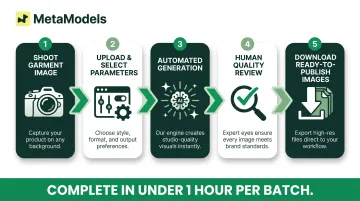
Because the workflow is fully batch-compatible, a small team can process dozens of new listings in a single session — without touching a camera or booking a single model.
Frequently Asked Questions
Frequently Asked Questions
How does AI model photography handle garments that are truly one-of-a-kind?
AI model photography works from a single image of the garment—no physical fitting or multiple units required. This makes it inherently suited to one-of-a-kind pieces. Human review catches any garment rendering inaccuracies before publication.
Is using AI model photography consistent with a sustainable brand's values?
Yes. Eliminating studio shoots, model travel, and physical sample production significantly reduces environmental impact. Many sustainable brands frame it as an intentional sustainability choice—one that visibly reinforces their mission to cut waste and emissions.
How much does AI model photography cost compared to hiring a model and photographer?
Traditional on-model photography costs $80–$200 per image, with full shoot days ranging from $5,000–$25,000. AI model photography typically costs $0.10–$5 per image—MetaModels.ai starts at approximately $0.22 USD per image—representing 90–95% savings for brands with large catalogs of unique pieces.
Can AI models accurately show fabric texture and drape in upcycled garments made from unusual materials?
Advanced platforms use fabric draping simulation technology that renders how materials actually behave on a body, capturing accurate movement and weight for each specific fabric. Human review ensures garment accuracy before images are published, verifying that unusual textures, irregular silhouettes, and unique construction are represented correctly.
Do customers trust AI-generated model images when shopping for upcycled clothing?
71% of shoppers cannot tell the difference between AI-generated and traditional photography, and 60% react neutrally or positively when informed images are AI-generated. When images are high-resolution, accurately show the garment, and feature diverse realistic-looking models, customer trust and conversion rates are comparable to traditional photography.
What image format do I need to start using AI model photography for my upcycled brand?
Most platforms accept standard flat-lay or ghost mannequin packshots in common formats like JPEG or PNG. No specialized photography equipment is required beyond basic product shots you're already taking for inventory.