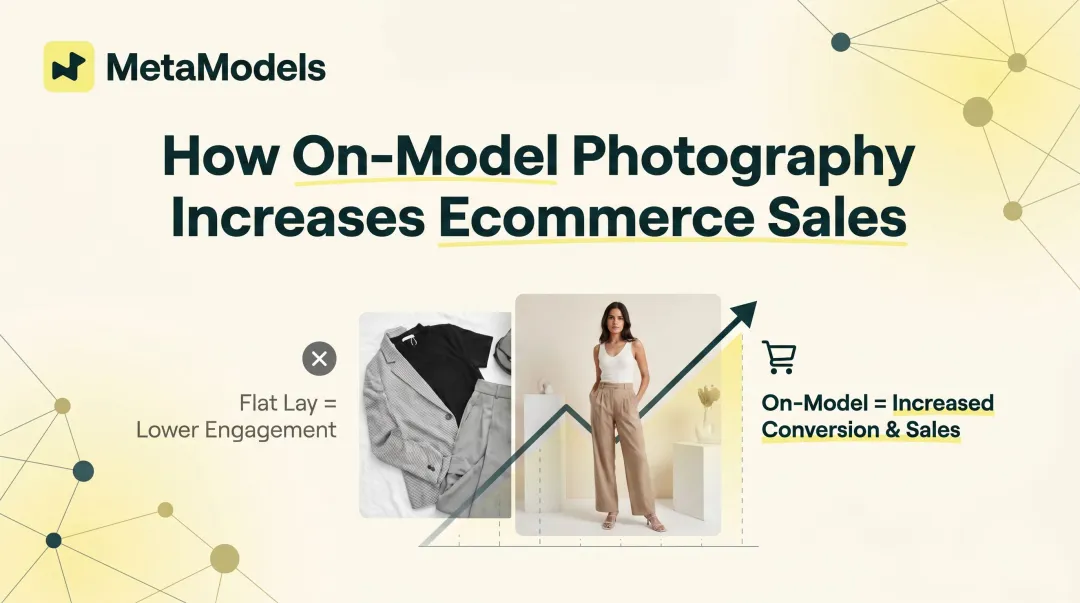
This matters because fashion conversion rates are notoriously thin. The category benchmarks sit at 1.8%–3% according to industry data, and strong visuals are one of the fastest levers to reach the upper end. When shoppers cannot touch or try on clothing online, imagery becomes the only sensory substitute. The gap between what they expect on screen and what arrives at their door drives a 26% average return rate in apparel, eating directly into margin with every box that comes back.
This article explains why PDP image quality in fashion has measurable, trackable consequences for business outcomes — not just aesthetic appeal — and what fashion retailers can do to close the expectation gap before it costs them a conversion or triggers a return.
Key Takeaways
- Fashion e-commerce conversion benchmarks sit at 1.8%–3%, and high-quality on-model PDP imagery is one of the fastest levers to reach the upper end
- Shoppers can't touch or try on clothing online, and poor imagery drives returns that cost $10–$30 per item to process
- On-model imagery, multiple angles, and lifestyle context all increase purchase confidence and add-to-cart rates
- Inconsistent or low-quality images suppress conversion catalog-wide, erode trust, and drive higher return rates
- AI-powered platforms now allow fashion brands to produce on-model, catalog-scale PDP visuals without traditional photoshoot costs or timelines
What Are Fashion PDP Images?
Fashion PDP images are all visual content displayed on a product detail page: flat-lay shots, on-model photography, close-up detail images, and lifestyle visuals. Their primary job is to replace the in-store experience of seeing, touching, and trying on a garment.
They appear across direct-to-consumer storefronts, marketplace listings (Amazon, Zalando, Flipkart), and are repurposed for social commerce and ad creatives.
PDP imagery functions as a conversion tool first — answering the questions a shopper would ask in a fitting room:
- How does it fit?
- What does the fabric look like up close?
- Will it work on someone with my body type?
- How does it move when worn?
The difference between a converting PDP and a bounce is often whether the imagery answers these questions convincingly enough to justify the purchase.
Key Advantages of High-Quality Fashion PDP Images
The three advantages below are tied to specific, trackable business outcomes. Each has direct implications for revenue, cost, and operational efficiency in fashion e-commerce.
On-Model Imagery Directly Lifts Conversion Rates
On-model images give shoppers the spatial and proportional context that flat-lay or ghost mannequin shots cannot provide. They answer the most critical purchase question in fashion: "How will this look on a real person?"
When a garment is shown worn and styled, shoppers can assess drape, silhouette, and scale. This reduces hesitation at the point of decision.
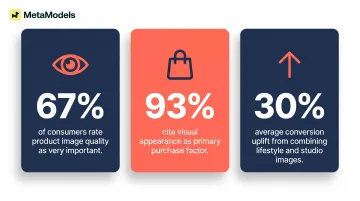
- 67% of consumers say product image quality is "very important" in choosing and purchasing a product, and 93% consider visual appearance the primary factor in purchase decisions
- Combining lifestyle and studio images yields an average 30% conversion uplift, per eMarketer data
- Shoppers convert at higher rates when they see models who reflect their own body type or identity; diverse representation signals authenticity and reduces bounce
KPIs impacted: Add-to-cart rate, PDP conversion rate, time on page, bounce rate
When this advantage matters most: High-competition categories, mid-to-premium price points, and new customer acquisition — where shoppers have no prior experience with the brand and rely entirely on what they see on the page.
Accurate Visual Representation Reduces Return Rates
Fashion has the highest return rate of any retail category. Apparel averages ~26% online return rate, versus ~10% across other retail. In the UK, 30% of online fashion items are returned annually, with poor fit as the top reason. Most returns are triggered by a product looking different in person than expected.
Precise PDP imagery that shows true color rendering, fabric texture, fit on body, and garment movement closes the expectation gap before purchase, not after delivery.
- Every return costs a fashion retailer $10 to $30 per item in return shipping, restocking, and resale value loss
- "Not what I expected" accounts for 22% of returns, while size and fit issues drive 67% of fashion returns
- Close-up texture shots, on-model images at different angles, and real-time fabric draping visuals reduce the "looked different in person" return trigger
- Nordstrom achieved an 18% reduction in returns within two quarters after implementing high-resolution 360-degree product views
KPIs impacted: Return rate, customer lifetime value, net revenue (gross revenue minus returns), review sentiment
When this advantage matters most: Brands with large catalogs where individual product shoots are hard to control for consistency; high-SKU fashion retailers where image quality is uneven across the range.
Multi-Format & Lifestyle Imagery Increases Engagement and Dwell Time
A single hero shot is no longer sufficient. Fashion shoppers expect a visual journey: multiple angles, close-up details, at least one lifestyle or styled context image, and short-form video and 360° formats.
Multi-format image sets extend time on page, give shoppers more sensory context, and create natural scroll behavior that delays the decision to exit.
- Longer engagement signals higher buying intent and feeds positive SEO signals; a 1-second delay in load time can cut conversions by up to 7%, so image richness must be balanced with page speed
- Lifestyle imagery answers the use-case question that helps shoppers justify the purchase — showing the garment in a real-world context (vacation, office, evening out) increases purchase intent
- Listings with more than five images convert 50% higher than single-image listings in large-scale marketplace studies
KPIs impacted: Time on page (dwell time), scroll depth, bounce rate, SEO ranking signals, return visit rate
When this advantage matters most: Seasonal collections and new arrivals where the use-case context isn't obvious; brands targeting aspirational lifestyle segments where the visual story is as important as the product itself.
What Happens When Fashion PDP Imagery Falls Short
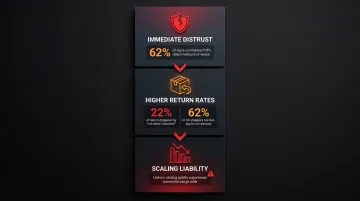
For fashion e-commerce brands, weak PDP imagery isn't just an aesthetic problem — it shows up directly in bounce rates, returns, and catalog performance. The consequences fall into three clear patterns:
- Immediate distrust: Shoppers can't touch the product, so any visual flaw signals broader brand unreliability. Only 18% of 141 top-grossing e-commerce sites had "good" or "acceptable" PDP UX, with up to 62% rated mediocre or worse — meaning most shoppers are already being let down before they add to cart.
- Higher return rates: When the product doesn't match what shoppers saw on screen, returns spike. "Not what I expected" triggers 22% of returns, hitting margin and logistics costs directly. In the UK, 62% of online fashion shoppers admit to ordering multiple sizes or colors with the intention to return most — a bracketing habit that weak imagery actively encourages.
- A scaling liability: Brands with hundreds of SKUs relying on inconsistent shoot-by-shoot production end up with uneven catalog quality. That unevenness suppresses conversion across the range — not just on individual products — pulling down catalog-wide revenue as the assortment grows.
How to Get the Most Value from Fashion PDP Images
Strong PDP imagery requires a consistent production standard applied across the full catalog — not just hero products — and reviewed regularly against performance data. Four practices drive the most impact:
Default to on-model imagery for all apparel categories. Include at least 3–5 images per product: front, back, close-up detail, and lifestyle context. Shopify recommends 4–7 core images for mobile speed and up to 12 purposeful images total for full PDP coverage. More images reliably correlate with higher add-to-cart rates.
Track performance at the product level. Monitor dwell time, add-to-cart rate, and return rate by SKU. A high PDP visit rate paired with low add-to-cart usually means the imagery isn't answering fit or quality questions.
Scale image quality across the full catalog. Brands that optimize hero products while leaving long-tail SKUs under-imaged lose conversions across the majority of their range. Platforms like MetaModels.ai convert packshots into styled, model-worn visuals for entire catalogs — every image human-reviewed by fashion specialists to verify color accuracy, garment shape, and proportions before delivery.
Optimize for mobile load speed. High-resolution, multi-angle imagery must load fast. Each 1-second delay can cost up to 7% in conversions, so compress files and optimize image delivery without sacrificing visual quality.
Conclusion
In fashion e-commerce, PDP imagery is not a creative asset — it is a conversion instrument. The data shows that on-model, multi-angle, lifestyle-contextual images outperform minimal or low-quality alternatives on every metric that matters: add-to-cart rate, dwell time, and return rate.
The advantage of strong PDP imagery compounds over time. Higher-converting pages build review volume, which feeds trust and conversion in a self-reinforcing cycle that under-investing brands cannot easily replicate.
With AI imaging tools now making catalog-scale on-model photography accessible without traditional photoshoot costs, the structural barrier is gone. For fashion brands still relying on flat packshots, the case for upgrading PDP imagery has never been clearer — or more actionable.
Frequently Asked Questions
Frequently Asked Questions
What is the conversion rate for fashion?
Fashion e-commerce PDP conversion rates typically range from 1.8%–3%, though this varies by traffic source, price point, and page quality. Active apparel sits at 1.8% in Q4 2025, while Shopify cites 1.9%–3.3% as a "good" range. Imagery is one of the most direct levers for reaching the upper end.
Is a 3% conversion rate good for fashion e-commerce?
Yes, 3% sits at the upper end of the fashion e-commerce benchmark and is considered strong performance. Well-optimized PDPs — particularly those with high-quality on-model imagery, social proof, and fast load times — can get you there.
Do 75% of online shoppers rely on product photos when deciding on a potential purchase?
67% of consumers say product image quality is "very important", and 93% cite visual appearance as the primary purchase factor — making visuals the dominant decision driver in fashion e-commerce. On-model imagery has an outsized effect compared to flat-lay or packshot alternatives.
What types of PDP images convert best for fashion products?
On-model photography — especially with multiple angles and lifestyle context — consistently converts best for apparel, followed by close-up detail shots for fabric and texture. Image variety matters as much as individual image quality; listings with more than five images convert 50% higher than single-image listings.
How does on-model imagery compare to flat-lay photography for fashion PDPs?
On-model images consistently outperform flat-lay for conversion in apparel because they answer fit, proportion, and styling questions that flat-lay cannot. Flat-lay remains useful as a secondary image for detail and colour accuracy, but should not be the primary PDP image for clothing.
How many product images should a fashion PDP have?
Aim for 3–5 images minimum, covering front, back, close-up detail, and at least one lifestyle or styled shot. Add-to-cart rates improve with image count up to a practical ceiling of 8–12 images per listing.